







![Alternative Trench Crusade Miniatures? Trench Missionaries Review | Wargames Atlantic [7 Days Early Access]](https://images.beastsofwar.com/2026/03/unboxing-wargames-atlantic-trench-missionaries-coverimage-225-127.jpg)

The Desert War: Bolt Action Boot Camp Preparation // Part Five: Endgame
September 17, 2018 by oriskany
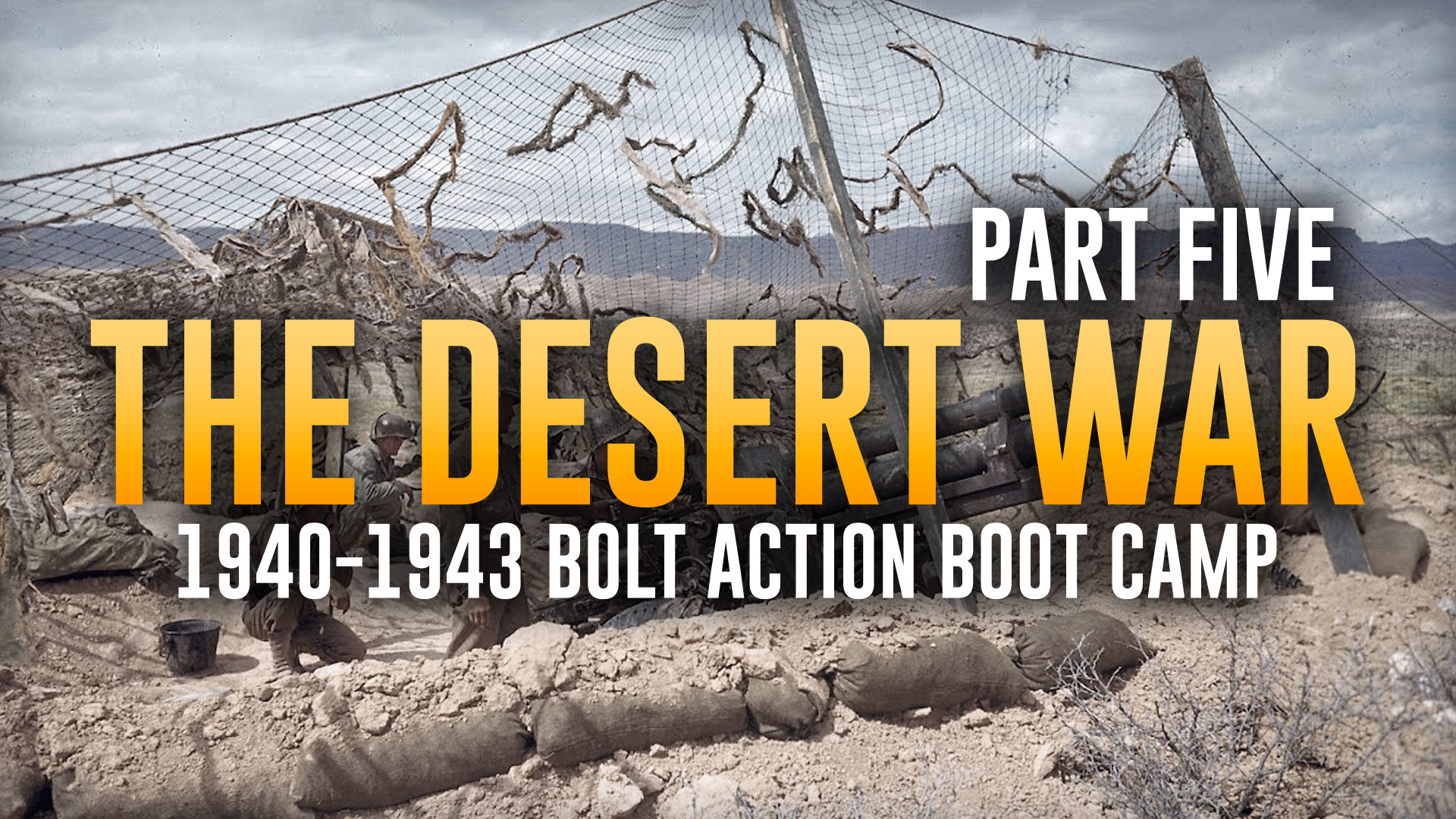
As we enter the final countdown for the upcoming Bolt Action “Western Desert” boot camp, we come at last to the end of our preparatory Desert War article series. For those just joining us, check out our progress so far in Parts One, Two, Three, and Four, where we reviewed how the Desert War opened and developed, introduced new commanders and armies, and swayed back and forth before finally reaching a critical turning point.
Read The Original Article Series Here
But for now let’s see how this epic campaign finally drew to a close, and how some of these final engagements can be brought to the tabletop.

After the Allied victory at El Alamein (Oct-Nov 1942), the shattered remnants of Rommel’s “Panzerarmee Afrika” rapidly fell back out of Egypt, through Libya, and all the way to the Vichy French colony of Tunisia. Part of the reason for such a long retreat was “Operation Torch,” where a whole new Anglo-American army had simultaneously landed a thousand miles behind the Germans and Italians on November 8th, 1942.
Operation Torch
The idea was not only to squeeze the Axis off of the continent of Africa for good but to partly assuage Stalin’s protests for a “Second Front” and to finally get American ground forces in action as soon as possible. But there would also other political ramifications, especially with the French forces that still administered these colonies under the pro-Axis Vichy government.
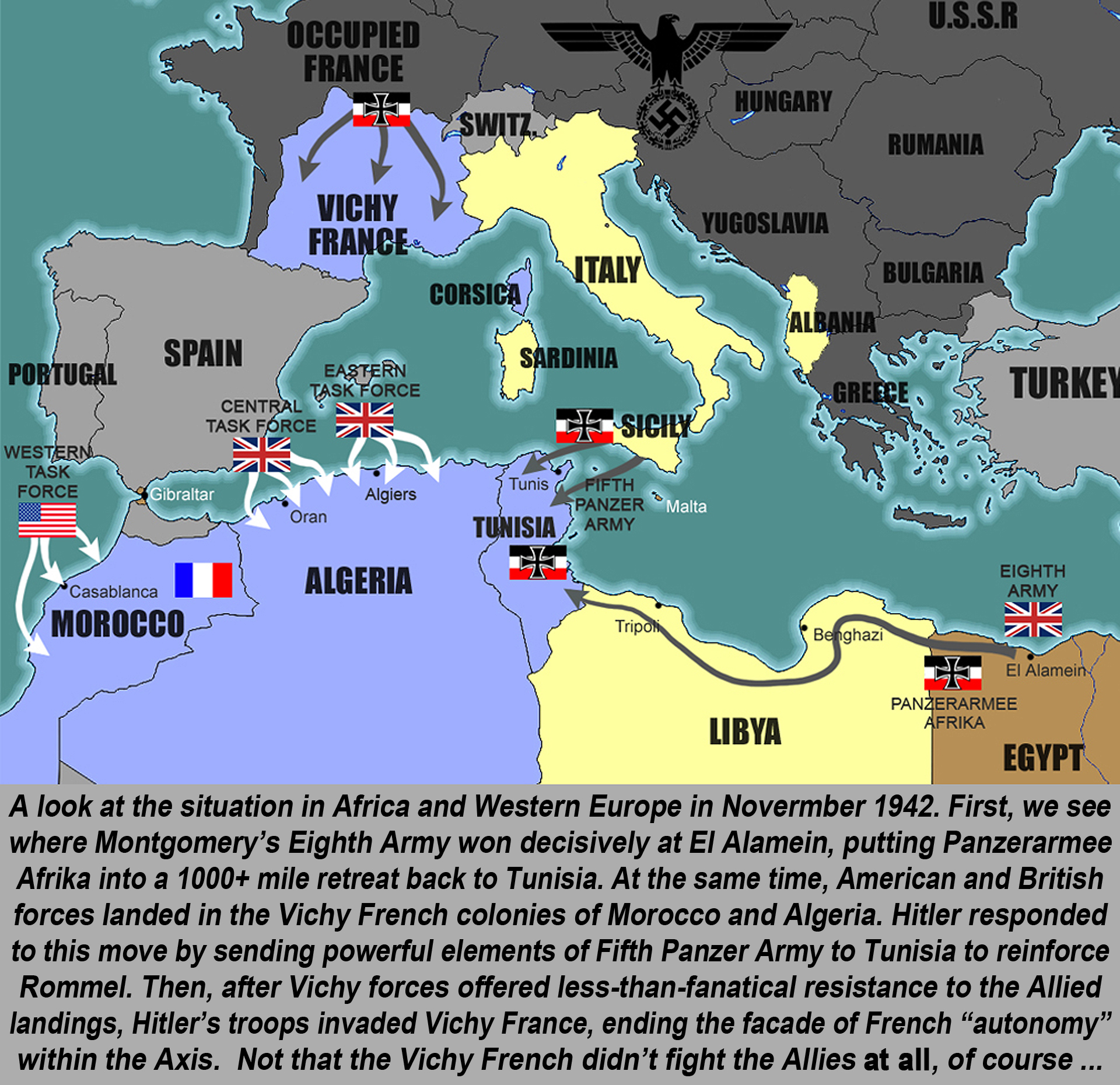
It was these initial American landings in Morocco which provided the setting for the 15mm wargames photographed first in this article, featuring combat not between Americans and Germans, but Americans and French. For those interested in looking at the more famous American battles in North Africa (Sidi Bou Zid, Kasserine Pass, El Guettar), we have another article series taking a look solely at them.
For now, however, we’re looking at Port Lyautey, where the northern wing of General Patton’s “Western Task Force” had come ashore. Regrettably, despite earnest efforts by Allied agents and diplomats before the invasion, Vichy French forces actually fought hard against the invading Americans. The idea of two Allied nations in pitched (and bloody) battle for several days may sound strange. But sadly, it happened.
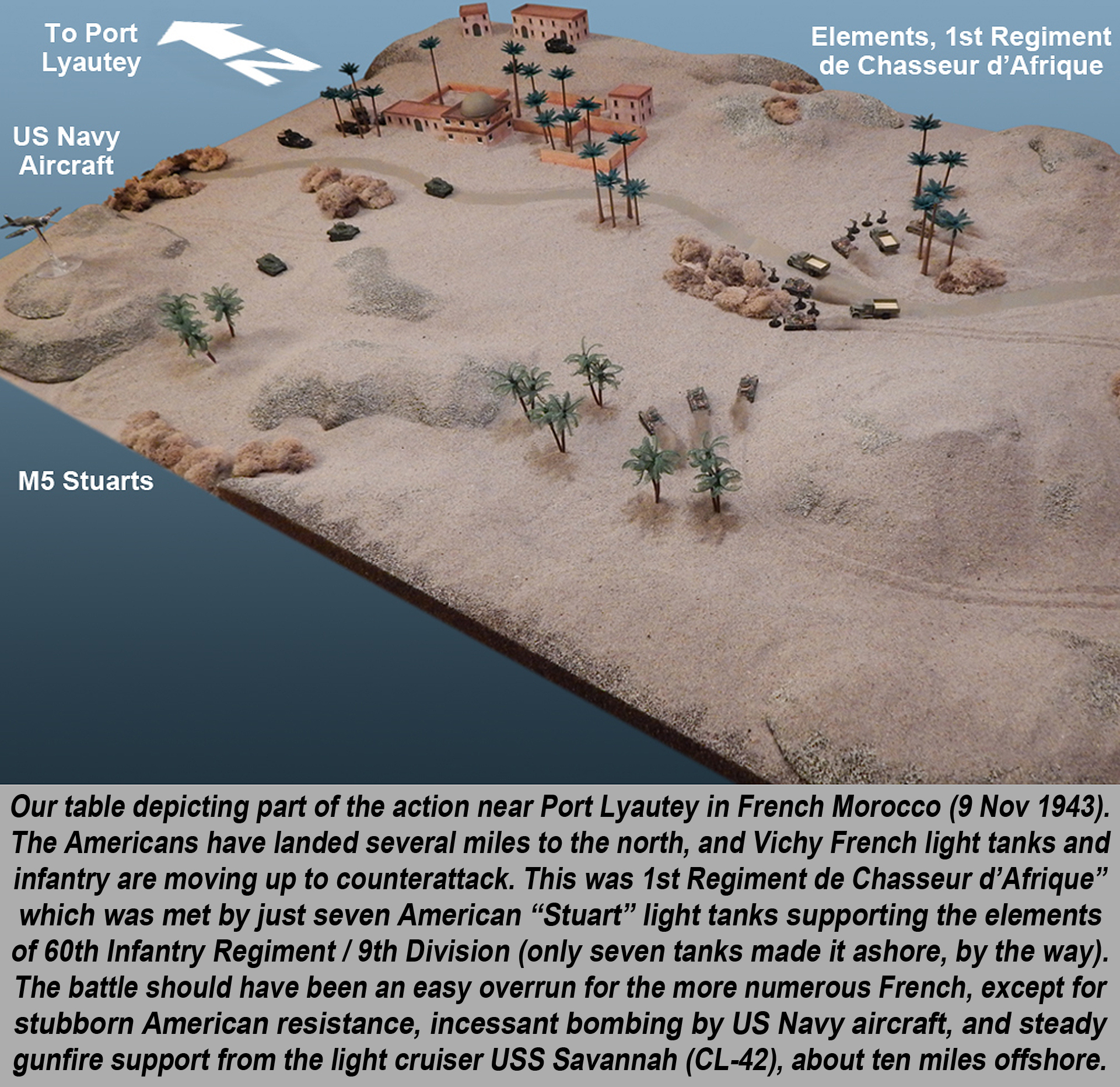
From a wargaming perspective, this also shows that despite what we might get in a starter kit, by no means is North Africa / Desert War table top gaming limited to the classic “British vs. German” model. For those less familiar with the history of the desert campaign, the possibilities are much, much broader than one many may realize.
The politics here are complex. When France had to surrender to Germany in June 1940, a puppet government in the French city of Vichy was allowed to remain “autonomous,” which technically made this “Vichy government” (and its French colonies) an Axis power. By and large, French soldiers in these colonies never voluntarily took part in Germany’s battles, despite the status of their “official” government from which any army takes it orders.

However, whenever Great Britain invaded a Vichy colony like Lebanon or Madagascar, fighting was always fierce. Vichy French troops even fought against Free French troops in Syria. Such fighting didn’t come about through any sense of “Axis loyalty.” This was simply a case of troops obeying official orders, combined with a simple case of “get your tanks off my lawn.”
When the Americans came ashore in Morocco, they too would learn this…the hard way.
Raw, inexperienced, and perhaps a little overanxious to “show the Europeans how to fight,” the Americans struggled with the complexities and dangers of an amphibious invasion. Then they struggled with the Vichy garrison, which did not give up or immediately re-join the Allied cause, despite earnest diplomatic efforts beforehand.
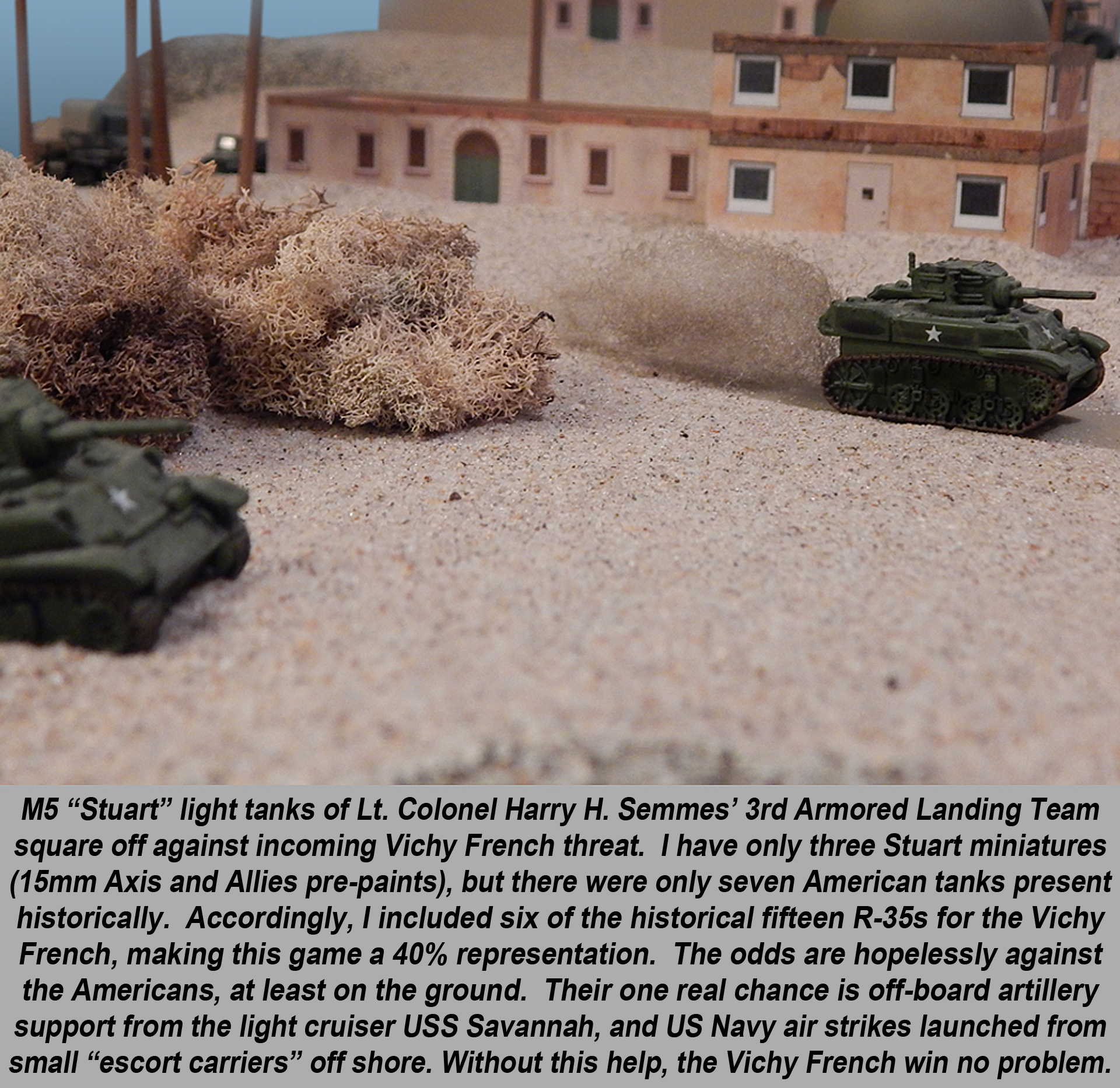
Casualties were heavy, especially in the northernmost American landings at Port Lyautey, where we decided to stage the Desert War game pictured in this article. Here, a force of French armour drove north to counterattack the flank of the Port Lyautey landing zone, and American tanks had to hold them back.
Desperately outnumbered, the American tanks fought furiously. But they probably survived thanks only to the 6-inch guns of light cruiser USS Savannah, and US Navy torpedo bombers dropping antisubmarine depth charges (of all things) on French tanks and artillery positions.
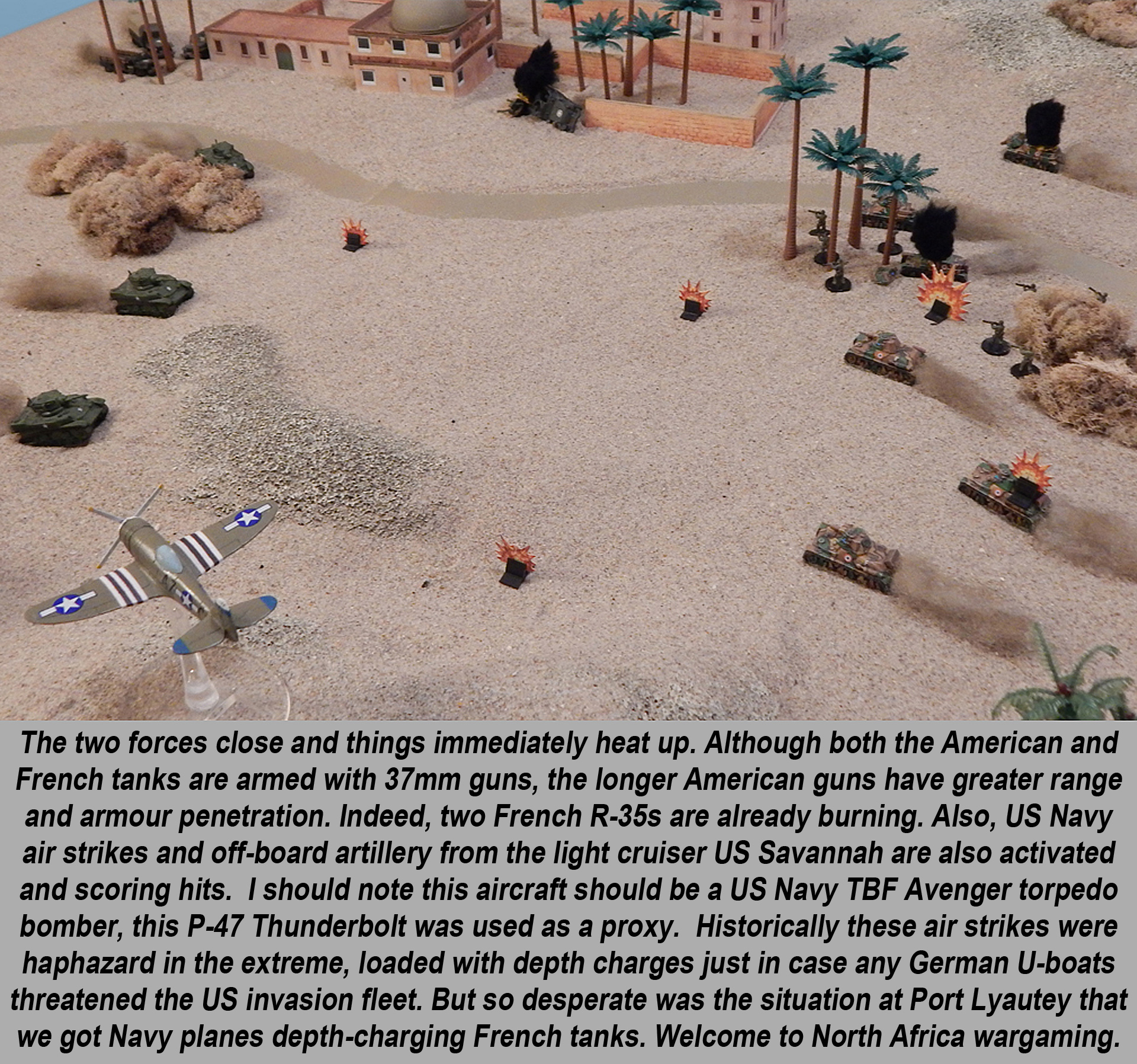
After three or four days, frantic diplomatic efforts finally paid off and the French were convinced to re-join the Allied cause. Fighting sputtered out and together the British and Americans (along with plenty of Free and formerly-Vichy French) pushed hard to the east, out of Morocco and Algeria, and to the final Axis hold out in Africa...Tunisia.
But this last enclave wouldn’t fall for six months, after some of the worst fighting in the North African war.
Tunisia
The battlefields of Tunisia presented a very different type of desert from the classic “sand seas” of Libya and Egypt. Here there was thicker vegetation, more towns, and considerable rain in the winter. In fact, this December quagmire of mud is one reason the Allies couldn’t swoop in and claim Tunisia right after Torch and El Alamein.
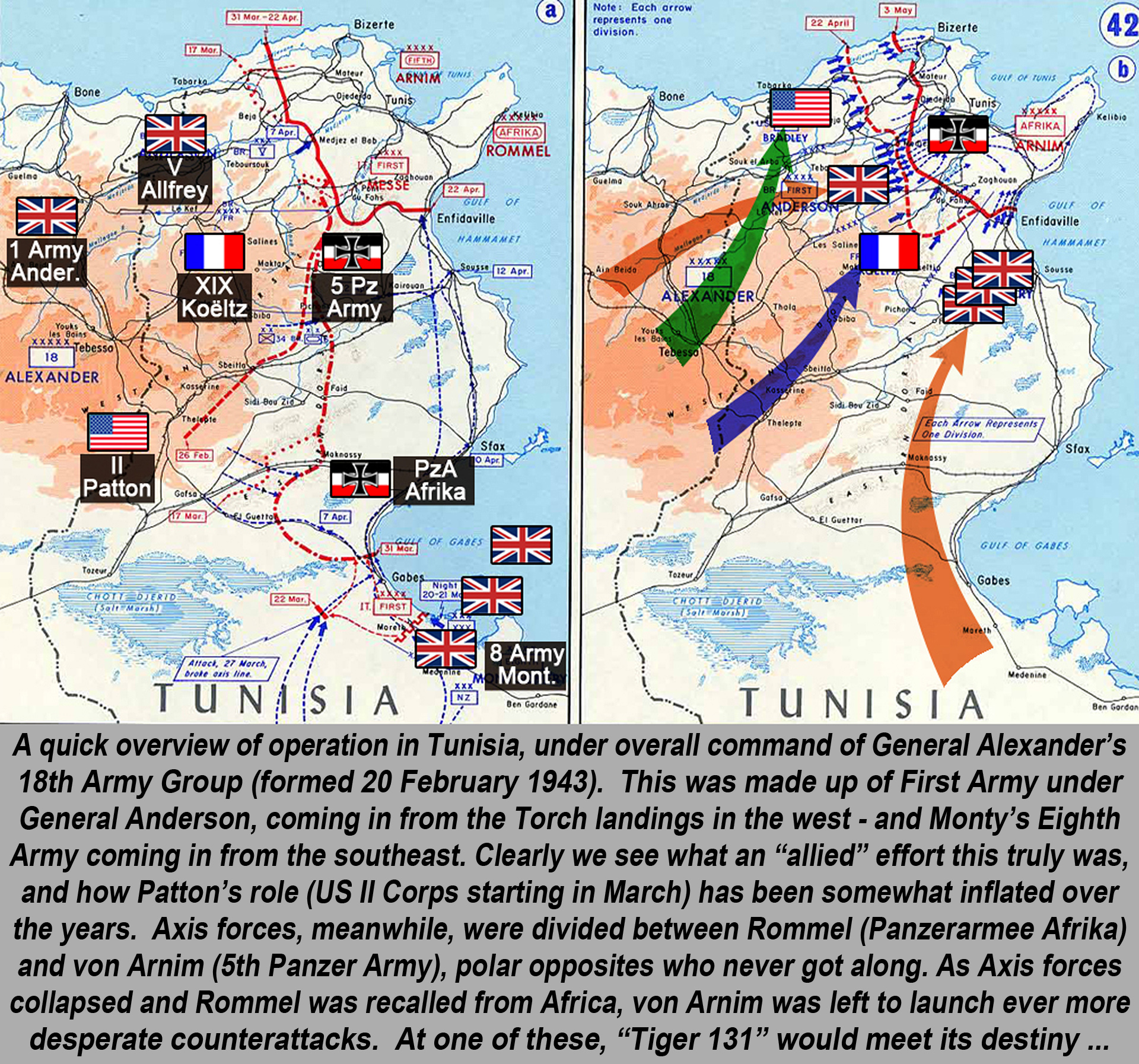
This desert was also much rockier and more mountainous, resulting in deadly battles over narrow defiles and passes. Such was the case at Sidi Bou Zid and Kasserine Pass, where raw American troops ran head-long into battle-hardened German panzers for the first time. Both these February 1943 encounters were unmitigated disasters for the Americans, and for a while, it seemed as if the Germans might stage yet another comeback.
Montgomery’s Eight Army, meanwhile, was pushing against Rommel’s defences in southeast Tunisia, roughly near the Tunisian-Libyan border. This was the so-called “Mareth Line,” a system of old French fortifications built in the 1930s. But our friends the Long Range Desert Group (LRDG) found a way through the mountains (the Tebaga Gap) that allowed Monty to partially outflank this line, which quickly crumbled.
Meanwhile, the famous General George S. Patton had taken over the US II Corps, which had just been handed such ignominious defeat at Faid Pass, Sidi Bou Zid, Sbleita, and Kasserine Pass. With a mix of reorganization, motivation, and hard discipline, he was able to put these divisions back together, which eventually met and wrecked a German attack at El Guettar in March.
Yet the battle didn’t go perfectly, and despite what we see in the movies, Patton wasn’t present until after the issue had been decided. Even so, it can’t be denied that the vast improvement in American performance and confidence is a testament to Patton’s leadership, training, and inspiration of II Corps.
The British, meanwhile, had also broken through in the south. Pushing up through Tunisian towns like Enfidaville and Gabes, they soon linked arms with the British, French, and Americans closing from the west. The remnants of Heersgruppe Afrika collapsed around the so-called “Bizerte Bridgehead,” repeatedly denied permission to make any kind of withdrawal from what was clearly a hopeless position.
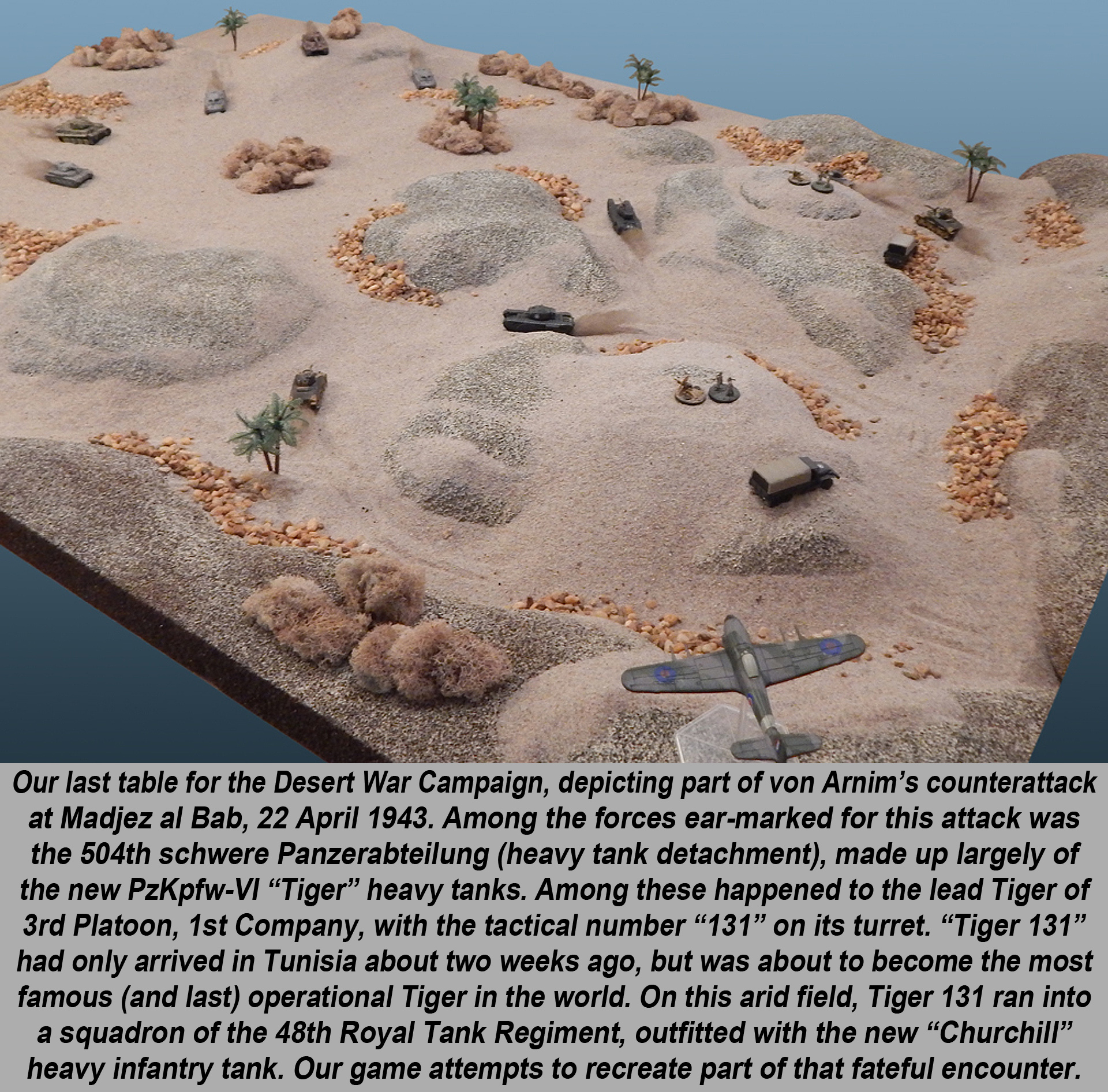
One of the last engagements along this shrinking perimeter, however, has held special meaning to historians, armour enthusiasts, and wargamers. On April 21, 1943, the Germans scraped together some armour from the “Hermann Göring” and 10th Panzer Divisions to make a last-ditch spoiling attack near Madjez el Bab.
This is the battle we tried to recreate in our last Desert War game.
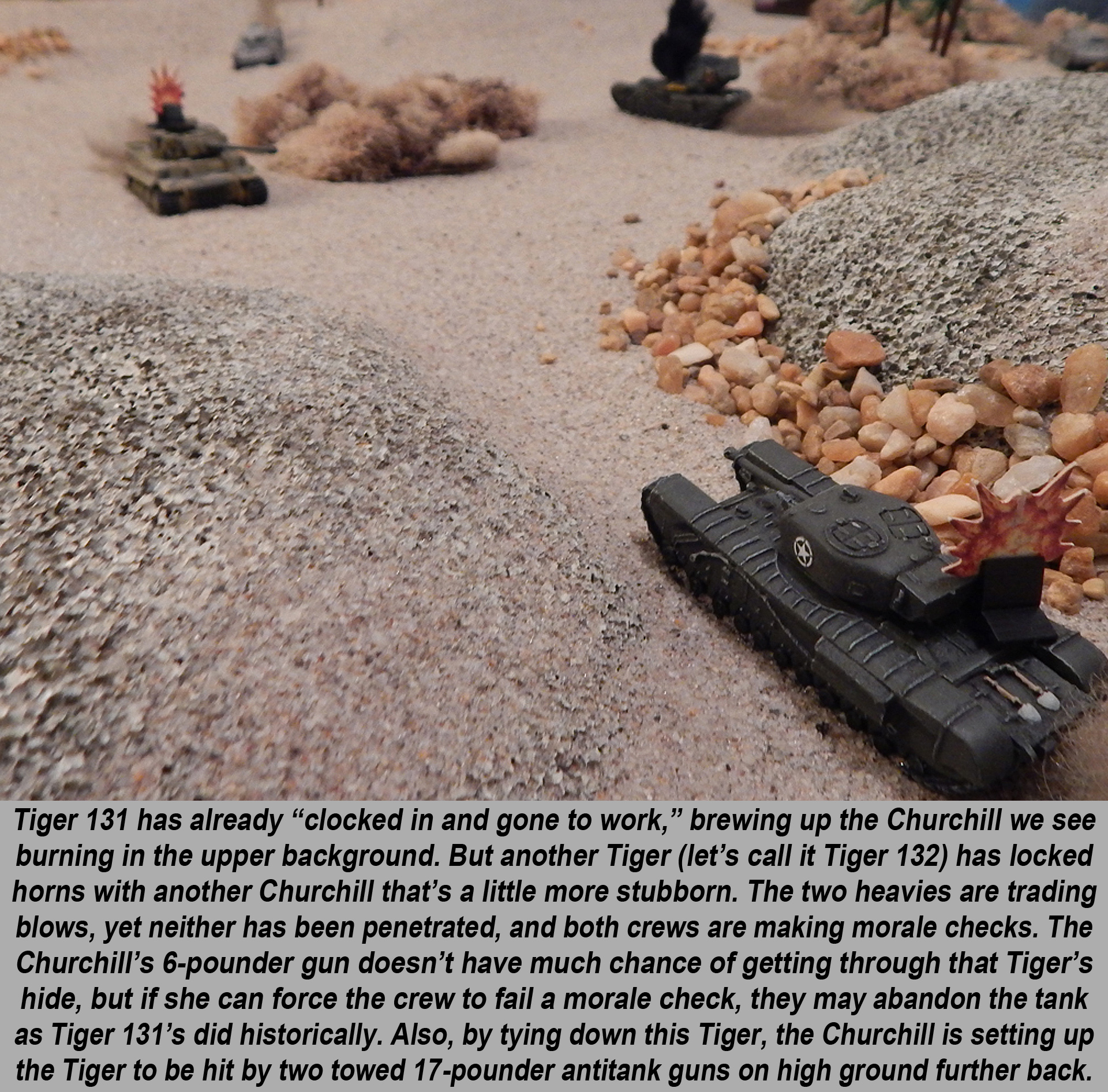
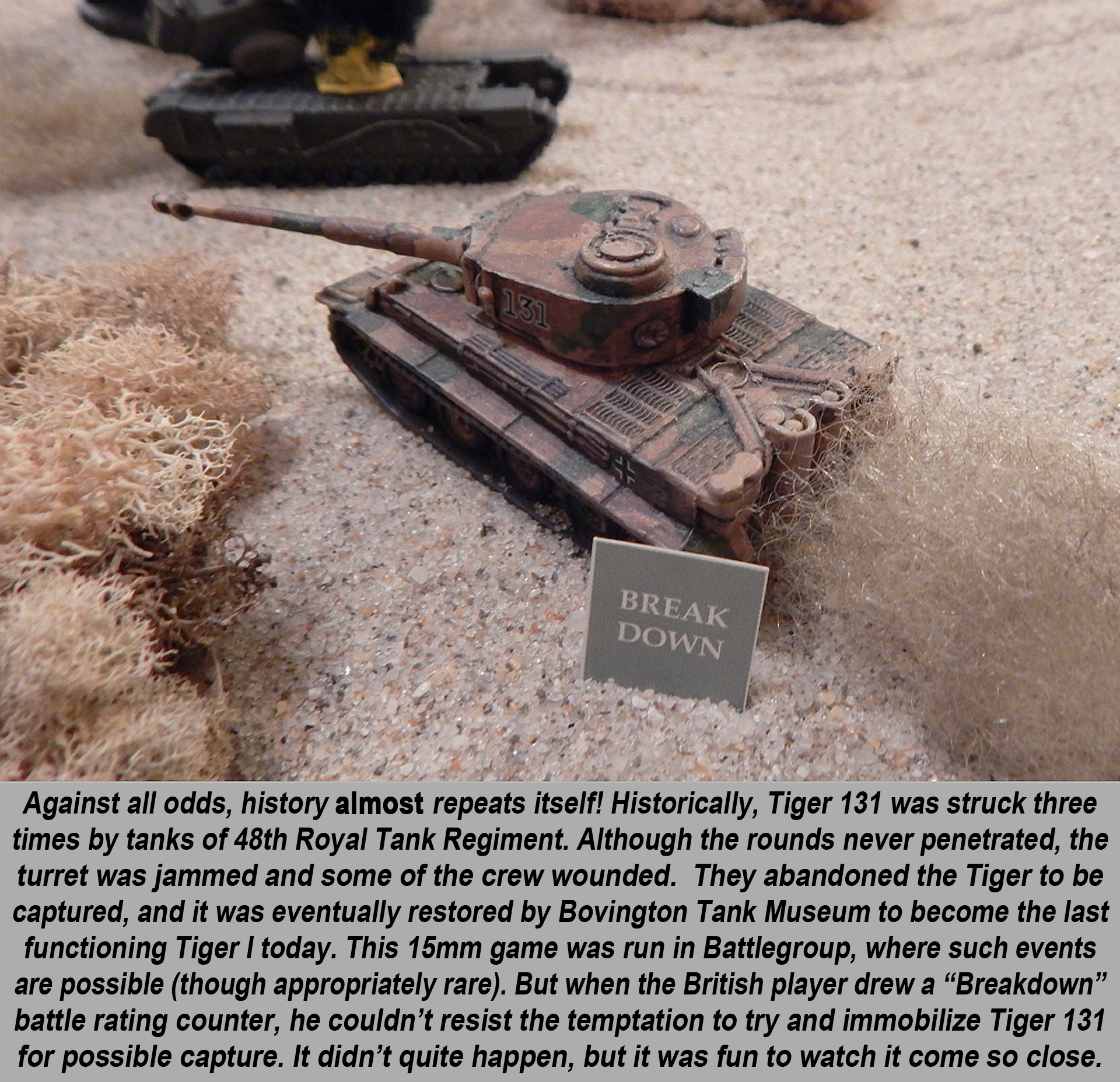
Of course, the counterattack was beaten back. Among the losses was the soon-to-be famous Tiger 131, the first intact Tiger captured by the British. The Tiger was inspected by Churchill and King George VI, before being stripped apart for study by British technicians.
It would be almost 70 years before the tank was put back together again by the Bovington Tank Museum. As of this writing, Tiger 131 remains the world’s one and only operational PzKpfw-VI “Tiger 1” tank.
By the end of April 1943, the rest of Axis forces bottled up in Tunisia were faring little better than Tiger 131. By the middle of May, it was all over. Only about 600 Germans or Italians ever escaped Tunisia. Some 250,000 others (two complete armies) had either been killed or taken prisoner in the final collapse, a defeat equal to Stalingrad just three months before.
The war in Africa was, at last, over.
The Allies, meanwhile, had forged an alliance ready to undertake the invasion of Fortress Europe. The British had won a great victory and at last had a hero. The Americans had been blooded and learned the practicalities of mobile warfare with startling speed. And the French had been brought back into the fold, no longer side-lined by the enforced neutrality of the Vichy Regime.
And so at last, our “Desert War: Gaming WW2 in North Africa” article series comes to a close. Once again I’d really like to thank Beasts of War team for the opportunity to publish on their site, especially @brennon and @lancorz who help with getting these articles ready to publish.
Most of all, I’d like to thank the readers who’ve slogged through my walls of text and kept the conversations going with such positive, constructive, and insightful comments.
For now, however, its time to get ready for the boot camp! Like the final orders be issued, let the last preparations be made! For those of you attending, I look forward to seeing you there! For those participating in the live blog, please enjoy, participate in the comments, and know you are with us in spirit!
Keep a full canteen and watch out for those sandstorms!
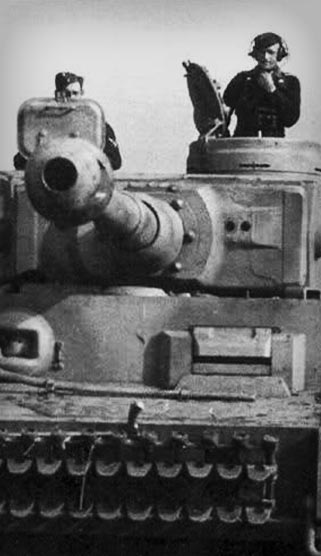
"Part of the reason for such a long retreat was “Operation Torch,” where a whole new Anglo-American army had simultaneously landed a thousand miles behind the Germans and Italians on November 8th, 1942..."
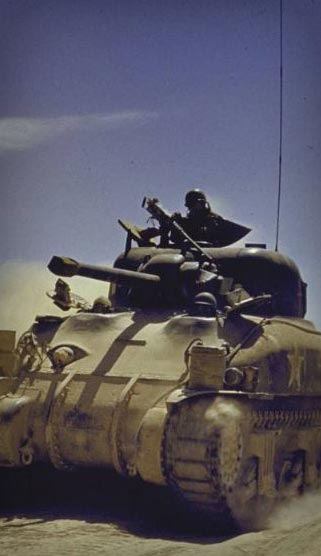
"The British had won a great victory and at last had a hero..."
![StarCraft Tabletop Miniatures Game Pre-Orders Live Now [Updated]](https://images.beastsofwar.com/2026/03/starcraft-tmg-news-cover-600-338.jpg)


![Mounted US Cavalry On Kickstarter For Dead Man’s Hand! [Updated]](https://images.beastsofwar.com/2026/03/us-cavalry-main-600-338.jpg)
![Play WW2 Commando Operations With Butcher & Bolt [Updated]](https://images.beastsofwar.com/2026/03/relaunch-600-338.jpg)
Excellent as ever @oriskany. Have seen 131 but unfortunately it wasn’t running when I went round Bovingdon. I can clearly hear desert war mini’s crying to be bought and my wallet is shaking with fear.
Thanks very much for getting us started, @gremlin! 😀 I’ve seen a running Panther once at Falaise / Argentan, France. I can only imagine the world’s last running Tiger I would be like. 😀
another excellent article, it’s always nice to get the cliff notes when moving into a new period or theatre. This series has been a terrific balance of information without being too overwhelmingly detailed.
Thanks very much, @avernos – No, we covered three years of the Desert War on two continents in just five articles (about 7800 words total), no way we could possibly get “too detailed” on this one! 😀
He also told stories of running gun battles in the free port of Tangier’s when the authorities let ships from both sides in accidentally
Indeed, @torros – those initial Torch landings were chaotic. Neither the Americans or British really knew what they were doing vis-a-vis amphibious landings, some Vichy units were resisting, some were not, no one knew which was which, or if they were agreeing to a cease-fire, which particular units had demobilized and where. The Allies were also in a rush to race eastward into Tunisia as fast as they could, as it turns out they just missed taking most of those key passes before the weather and German reinforcements prevented an immediate collapse.
Thus we see the Tunisian campaign drag deep into 1943.
Excellent series (as always) @oriskany. I can only imagine the amount of effort that goes in to producing these – so thanks for all your hard work.
Thanks very much for the kind words, @tobymagill 😀 And thanks for the comment!
Thank you for a nice article series, many information and inspiration for not only the African, but also any other theatre.
Awesome story with Tiger I 131. And even more awesome to be replaying it and coming so close to what really happened.
Did those Free French and Vichy French wear the same uniforms with the same colour like the Continental French (or did they call them Metropolitain, like in WW I?)?
One could even do battles between Free French and Vichy French, for instance in Algeria (did that happen there?) or Syria. That´d be a completely new sub-theatre for WW II wargaming. Vichy French in Indochina would be interesting, too.
All that remains to say is enjoy the boot camp, good luck with assembling the new shinies and may be even the painting. I imagine the participants outside the building, armed with minis, boxes and spraycans applying base coats to their armies, and passers-by watching wondering, what “dose dudes” are doing. And not only beware of the sandstorms, but also scorpions, snakes and the terrible absence of water.
Thanks very much as always, @jemmy . 😀
Great question on the French uniforms. I honestly don’t know about the Vichy French, many of these units were colonial, so were drawn / recruited from local manpower sources. Others were actual French troops from France (especially artillery and mechanized and armored units).
Pretty sure the Free French were outfitted first with British, then with American Lend Lease equipment
No Free French vs. Vichy combat in Algeria that I know of. The Free French units here were actually Vichy units that were “repatriated” back into the Allies once the cease-fire was organized between Vichy French units initially resisting.
Syria is a different story. Free French and Vichy French forces totally engaged here, and quite bloodily too. I’ve actually run this scenario a few times, as originally published in Brian Train’s “Desert Leader” supplement to Panzer Leader.
Your image of the boot camp is just about perfect, with guys piled up outside the studio with strap cans and cardboard boxes. Other people in the area seem pretty much used to the BoW activities, though.
Thanks as always for the great questions and comment!
French infantry in Tunisia, fighting as Vichy forces generally looked the same as those of 1940, even wearing the ubiquitous greatcoat much of the time. In warmer weather, shirtsleeve order was adopted and some colonial raised units wore just the tunics, but for wargaming you can certainly get away with 1940 French figures to represent Vichy troops in Tunisia.
Awesome, thanks. My 15mm infantry for those tables was small enough to be more or less generic, but the French tanks are obviously in 1940 schemes. Just what I had on hand (and again, these photos are almost 3 years old).
More good stuff. Really looking forward to the Boot Camp now.
Epic, @damon . Look forward to seeing you there! Starting those Panzer Leader maps and counters today.
Well that’s it, the final part of an excellent series and like a kid going to bed on Christmas Eve, I cannot wait to get to the boot camp and get cracking!
Cheers for all your hard work Jim, it’s very much appreciated by us all. Looking forward to some had and counter goodness as well ???
Awesome. Thanks as always, @brucelea! The boot camp is indeed going to be awesome. We have one more bit or pre-boot camp content, a Weekender segment we hope to show soon where we talk about “Armies in the Desert” – the different nations that made up the Axis and Allies in North Africa. Also dispelling a few myths, or at least clearing a few things up (Italian units were always terrible, Rommel actually commanded the DAK through most of the time he was in North Africa, etc).
And yep, the new desert hex boards and counters are started for the free gaming Panzer Leader / Desert Leader. The campaign map is designed and printed and shipped ahead of me (along with my small LRDG force and other materials I’ll be needing, including some paints and brushes). That package really should have arrived last week, I’m tracking it now I hope it will reach BoW tomorrow or Wednesday at the latest.
Nice one @oriskany I think the Mer-el-kebir attack won’t have helped the British landing in Morocco for the last attacks on the Africacorps.
The French navy was certainly the most “anti-Allied” faction of the North Africa Vichy colonial forces – largely because of the events like the Mers-el-Kébir attack you mention.
Probably the biggest example of this is the French battleship Jean Bart opening fire on the American invasion fleet, even though she was still under construction in port! She wasn’t silenced until hit by shells from the American battleship USS Massachusetts.
their are probably many situation like that during the war its just the big ones you hear about look at WWI people were shot after the armistice because they got hit by soldiers that were never told about the ceasefire till later. @oriskany
A friend’s dad who was a chief engineer in the Royal Navy told a variety of stories.One of which was that when taking prisoners from the Western Desert a few if the more fervent nazi officers who they captured accidentally fell overboard on the way to prison camps
Well, @zorg – there are always criminals who execute prisoners or commit other atrocities, or even mistakes of friendly fire. The situation somehow seems so much worse, however, when it is institutionalized by “legitimate” orders. If for no other reason than such events typically take place on a much larger scale.
Very true.
Interesting story, @torros . I keep saying how the Desert War wasn’t quite as “clean” or chivalrous as many like to remember.
I am not sure if I am mixing my theatres here but it was either towards the end of the desert war or early in the Italian campaign, some SAS were captured after Hitler had given the order that all SAS troops were to be executed. However the German officer that captured the SAS was not a Nazi and let the SAS troops go because he respected them as soldiers and did not want them to be shot.
That could be either theater, @commodorerob . I believe this falls under what we commonly call the “Commando Order” passed down from Hitler, where any Allied special forces were to be shot as spies.
We see it ignored after the Ste. Nazaire raid in March of 42, for example.
SAS and LRDG personnel captured in North Africa would fall under this category, and I know for a fact prisoner execution orders were often ignored by DAK / Panzergruppe Afrika / Panzerarmee Afrika.
My “favorite” is Bir el Harmat, where 400 or so Zionist Palestinian volunteers under Major Leibmann helped hold the southern wing of Eighth Army’s desert flank (this is just a few miles away from the more famous, larger episode of the Free French at Bir Hacheim). They were finally overwhelmed and captured, and because they were Jewish, the order came down from Berlin to execute them all as “political refugees.”
I don’t know who ignored the order, or binned it, or made the decision (Rommel is usually attributed) – but in any event the prisoners weren’t executed.
I was at Les Invalides museum in Paris last year, one of the exhibits has quite a bit to say about the British attack on the French navy at Mers el Kebir, some of it not very complimentary, understandable really.
Yeah, @damon – the British Pearl Harbor, and even that analogy falls a little short. After all, the US and Japan weren’t allies at the time. 🙁
Standing up for the Royal Navy here, the French at Mers el Kabir, were given plenty of time to surrender, but refused to do so. It was vital that the ships did not fall into the hands of the Germans so there was little other choice. The British sailors did not enjoy the task, and they only continued to fire until it was clear that the French fleet were out of action.
I don’t think anyone’s “attacking” the Royal Navy, if it sounds like it I certainly apologize. In the end they had orders. Enough said. Churchill made this call as much to protect maritime interests in the Med as well as to impress the Americans with the depth of British resolve (and thus encourage support in the pre Lend-Lease era).
You’re right though, Mers-el-Kébir wasn’t quite a “surprise” attack. That said, the terms given to the French fleet commanders were not really acceptable to my knowledge (scuttle your fleet yourselves or sail to British ports to be demobilized and interred, I BELIEVE was the gist of it).
No military commander would agree to that from a foreign power (even an ally) especially after the new French government assured them that the terms of surrender to Germany promised the French fleet would not be used by the Kriegsmarine.
Please don’t misunderstand, I’m not saying German foreign policy was trustworthy at this point, or that the British weren’t doing the right thing. Just saying why the French naval commanders at the scene didn’t acquiesce to British terms when the fleet showed up outside Mers-el-Kébir.
Oh I was just giving the view of the RN,was not having a go at any of you guys 🙂
I’ve also seen this in interviews of RN veterans who participated in Mers-el-Kébir and later the hunt for the Bismarck.
The only bad thing about these article series is that they end! I’m not even playing at this boot camp and I’m excited to see how some of these come on the table top. Looking forward to watching people put all this info into play.
The only think left to say is…”Tigers? Nobody said nothin about lockin horns with no tigers.”
Tigers are easy to manage, you just have to set a Pheasant on them…
Or a Hurricane IID
@damon – 40mm autocannon baby! 😀
Yep, flying can openers are good fun, but I really like the Pheasant for dishing out the ‘good news’ in 17 pound packages…
Tactical air power versus tanks is always a difficult one to judge, though in the desert the arrival of the Hurricane IID was a bit of a game changer and certainly helped especially with the general lack of mobile flak assets, the open terrain in many areas and lack of enemy air interdiction, it could certainly scatter formations of tanks with a strafe such as at Mereth, and it played havoc among softskin supply vehicles. However perhaps the Desert Air Force could also be remembered by the first use of the cab-rank system which came about due to advances in command and control methods allowing fast and efficient use of force against targets of opportunity.
But also the Allies better use of military intelligence played a huge role in giving the information to the CAS as to where and when to strike targets, especially those vital enemy supply lines. Also the air superiority of the DAF contributed greatly to the success of ground operations.
@piers – You make some great points re: the support, command, and coordination aspects of air power, particularly in the desert (sorry, just catching up on comments here).
I always thought the cab-rank system was more of an Italy-France thing, 43-44. But of course I could be wrong. Did they first use this in Africa, and then implement as more standard practice in Italy (where it became more famous)?
In any event, I totally agree that when it comes to CAS, the gathering, sorting, and dissemination of actionable, timely battlefield intelligence data is AT LEAST half the equation, more so than bombs, cannon, and rockets. Targets of opportunity, avoiding re-hitting the same target with costly and scarce air assets, tracking FRIENDLY forces in a fast-moving battlefield environment so avoid blue-on-blue incidents, coordinating longer-planned air sorties to cover / support planned ground operations, recovery and turnaround of air assets between sorties, all of this has to be coordinated with incredible speed.
And all of this is just tactical. When you start working with operational airpower (against enemy lines of supply and communication), it adds a whole new level of simultaneous complexity (to say nothing of air defense).
@oriskany
The first major innovation by the DAF was the Forward Air Support Link system (FASL) which reduced response time to calls for support.
Next came the Army Air Support Control (AASC) team which further reduced response times. By Crusader they had reduced response times from two hours to under thirty minutes.
El Hamma was the first use of the Cab-rank system which was an improvement of the AASC with the FASL given direction to pilots on station.
The Desert Air Force really did define the standard for close air support in North Africa.
Awesome, @piers , thanks! Sources tend to say Italy (admittedly generic, “high-level” summary sources), but I’m sure that before it was implemented on such a wide scale, this doctrine was rolled out and tested before that. North Africa would be the place.
El Hamma is also pretty late in the North African war, so expansion of the doctrine innovated here would probably be followed up in Sicily and Italy.
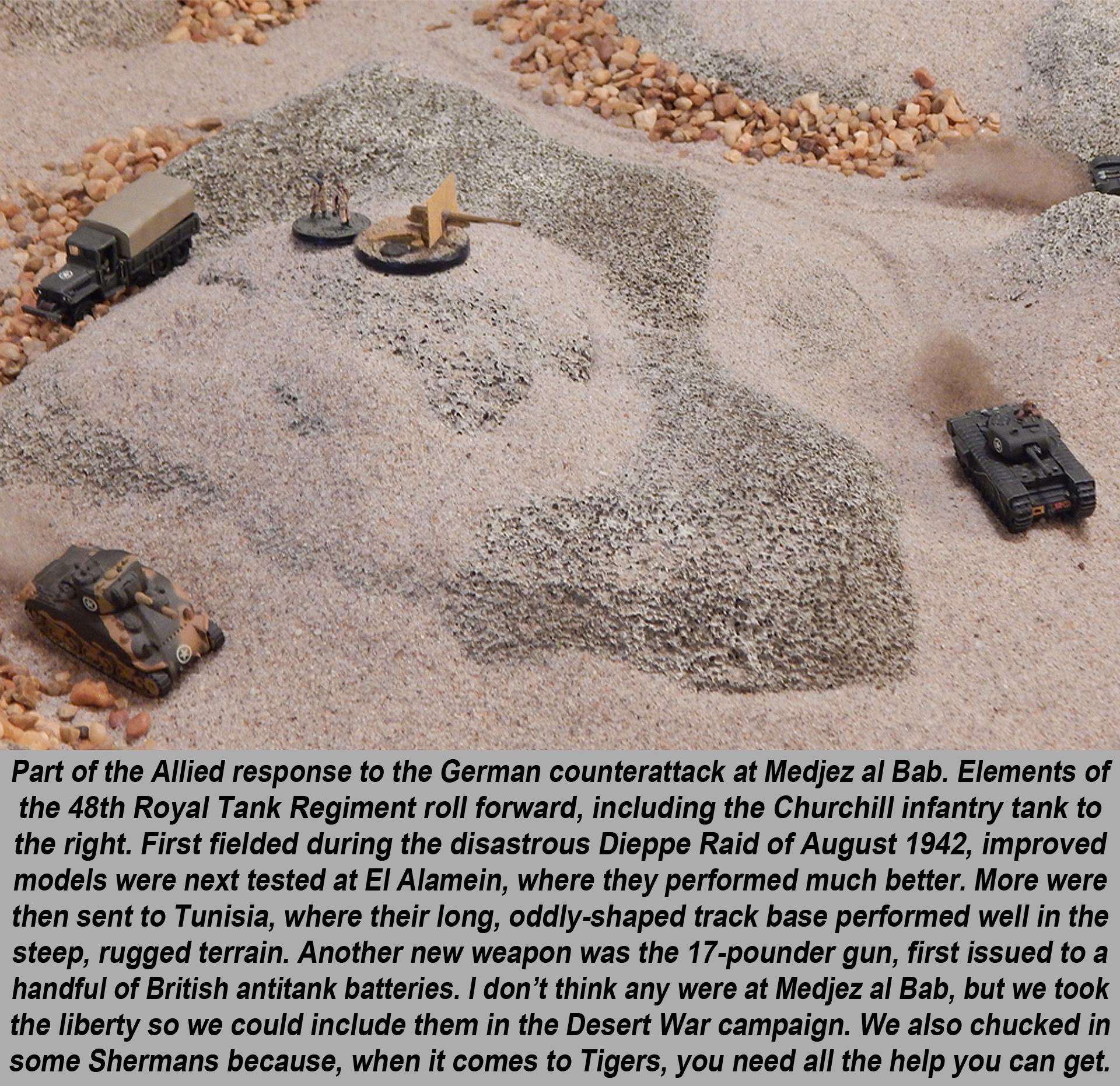
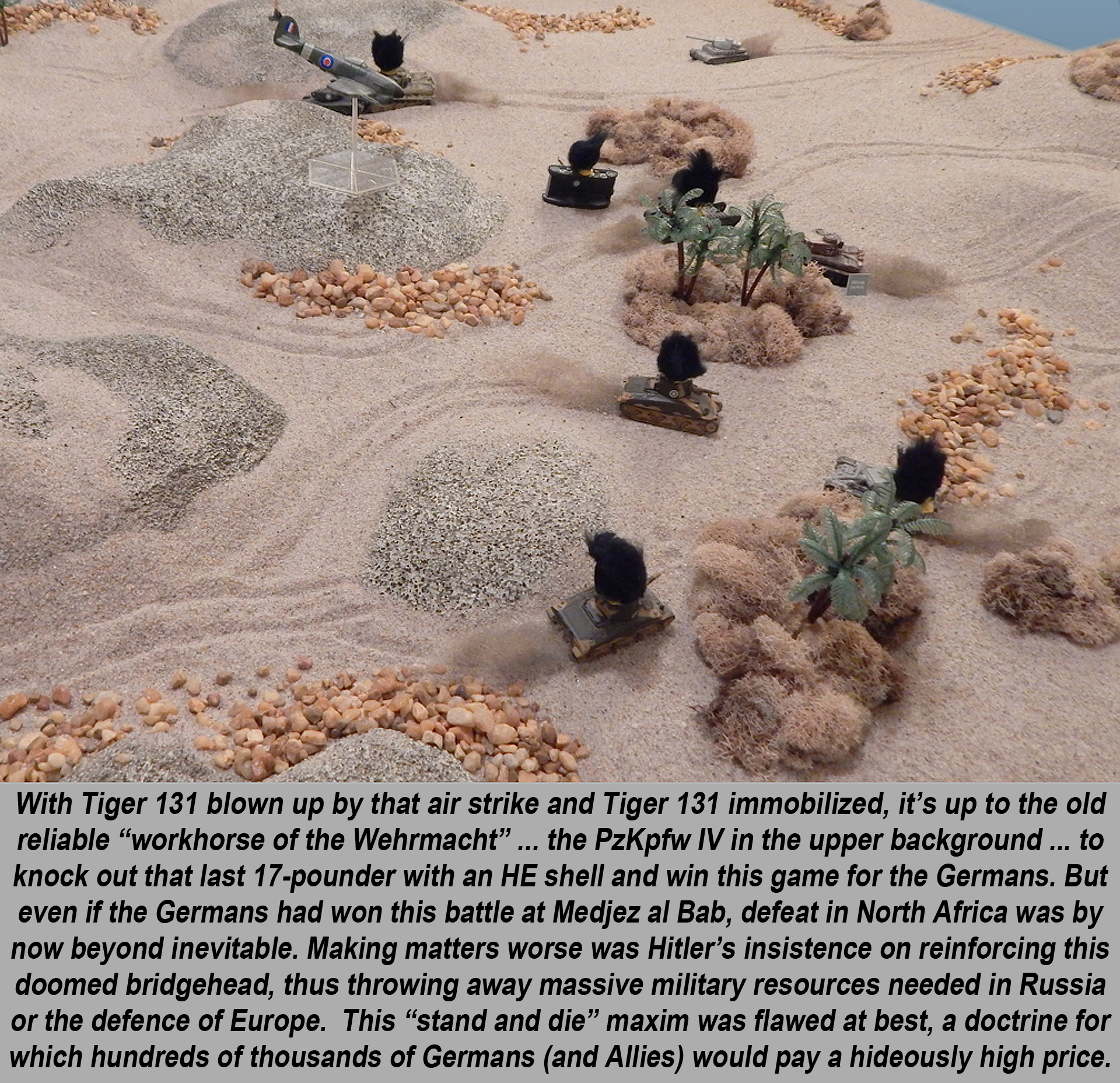
@damon – 17-pounder ATGs are indeed epic, we had a few proxied into our Battlegroup game above (with a little historic license, I don’t think 48th RTR had any 17lbrs on the scene at Medjez al Bab).
From what I understand in North Africa they were just quite rare, with only a few select batteries equipped with the new weapon (and only in Tunisia at the very end of the North African campaign).
@oriskany, yeah, 100 17 pounder guns were bodged onto 25 pounder carriages to create the 17/25lber Pheasant and rushed to Tunisia because of the Tiger problem, first action was in February ’43 I believe.
Awesome, @damon . I didn’t know about the 25-pounder carriage. 😀
Sorry I’ve been out of it, comment-wise, busy day here. 😀
tigers what tigers just elephants in this room ?
Tigers and Elephants?
Like the old joke about a woman’s favorite animal:
Actually, most women have four favorite animals.
A Jaguar in the garage.
A Mink in the closet.
A Tiger in the bedroom.
and a Jackass to pay for it all.
😐 😐 😐
@gladesrunner –
Tigers? Where the hell did the Tigers come from?
Well, that’s why we have Oddball and his Shermans.
Does he know about the Tigers?
… Not yet.
You bet your sweet ass he doesn’t! Or he’d still be back on that funny farm o’ his! He may be nuts, but he’s not crazy enough to put Shermans up against Tigers! You know once those things get rollin’, they’re gonna blow that whole town to pieces, including us, Kelly!
Now it just remains to be seen whether @bugger off will make good his threat in the Live Stream chat to bring a Tiger …
… or two. 😮
Tigers as @johnlyons pointed out in his blog are just not fun to play with or against in this period. Only someone who likes winding people up would be thinking about bringing Tigers to the desert isn’t that right @buggeroff lol
Just wait for them to breakdown.
The most operational Tigers in theatre was 14 out of 22 on 26th February 1943. 501 ran a 62% operational rate for most of their campaign and 504 dropped to 50%, both plagued by lack of spares, lack of their maintenance company for a while and early design issues.
The main disadvantage was how thinly spread the operational tanks were and how they were deployed piecemeal to plug gaps. This limited their effectiveness and also added another problem to good maintenance.
However, the kill rate for 501 gives an indication of the tanks fighting potential with the rate of 13.6 enemy vehicles knocked out for each lost Tiger and 504 has a slightly higher rate. Overall, taking all the Tigers lost to kills gives an overall ration for the tank in North Africa of around 6.8 enemy tanks lost for each Tiger lost.
A further indicator of its effectiveness is the lack of Tigers knocked out by direct enemy fire – 501 lost three to direct fire and one to artillery hits causing a fuel fire while 504 lost only two to Tigers to enemy fire, one to AT fire and one to artillery. Immobilisation and then blowing up with HE was the general means of disposal. Pulling back to ridgelines and laying minefields covered by AT Guns and artillery was the best option against Tigers with one particular minefield causing the loss of seven Tigers during Operation Ox-head.
While tough and a tank killer, Tunisia especially highlighted the intensive maintenance and repair needed for a Tiger battalion in the field.
The breakdown rules are just another feature of what I love about Battlegroup. For those who don’t know, when you lose a unit or something else “bad” happens to you, you draw a battle rating counter from a blind bag or tray. Usually this counter shows how many “battle rating” points your force just lost, but sometimes you draw a special counter like “Breakdown” You lose no battle rating points, and instead get to play the breakdown on an enemy unit.
Well, gee … what unit will I chose? That Opel Blitz truck? That halftrack? the armoured car? OR THAT FREAKIN’ TIGER staring down at me?
In this way, Battlegroup naturally and elegantly ensures that the biggest, heaviest, meanest tanks (like Tigers, IS2s, Sherman Jumbos, Char Bs, Churchills) tend to break down first, WITHOUT all kinds of extra tables, charts, special rules, etc.
Now granted, some scenarios also have the “unreliable” special rule for when a certain type of tank is REALLY trash. But usually it’s just a natural element of the core rules that flows easily on the table top.
Lol.
😀
Just back from Tiger Day X at the Tank Museum, Bovington. They had to throw us out 2 days in a row so they could lock the place up at night. It was an incredible experience standing on the engine deck of the most famous tank on the planet – Tiger 131. I highly recommend a trip there, not just for the tanks but for the experience, history, practical knowledge and the sheer overwhelming presence of armoured vehicles. Lots of items from the Western Desert/North Africa.
That must have been awesome, @dorthonion – thanks for sharing! 😀
Thanks again for another great article !
Cya next week.
@leifer1971 – Definitely look forward to it! 😀
After this you could look at some off the French special forces as they used vehicles that were similar to the LRDG.
@timp764 was surprised a few weeks ago when he looked at some of my terrain plans and sketches. He was taken back by swamps (salt marshes) in the desert. He remarked that he never would have expected swamps on a desert table.
When you mention the Western Desert a lot of people think sand. Yet the theatre its huge from Tunisia to Egypt, there is a huge variety of terrain. Most of the coastal plans are much greener with olive groves, cork trees and vineyards. In other places wheat fields. Going into Tunisia it gets even greener and wetter. From memory some of the Pz-4s were shipped in standard dark yellow as it was considered to blend better in northern Tunisia than the desert colors.
I remember seeing a US army color photo of its units moving into a valley in Tunisia after the rains and the valley was very bright green and shade of bright yellow greens. Even when it is sandy desserts they are grayish sands in Tunisia, yellowish in Libya and quite pink in Egypt with enough exceptions to make what I just said a big dangerous. I have been amazed with the huge variety of terrain types to be found in North Africa and the amount of European terrain I can use on my “Desert” table.
Indeed, @jamesevans140 – once you get into Tunisia you see much rockier ground, higher elevations, and more vegetation. One of the primary reasons the whole country wasn’t carried by 1st Allied Army in December 1942 was the MUD from torrential rains in this desert. 😐
Technically the Qattara Depression is a salt marsh, half the size of Switzerland, that had such a massive impact on shaping the decisive battles of Alamein and Alam Halfa.
For Desert Leader (WW2 desert expansions for Panzer Leader, using boards from Arab-Israeli Wars), Brian Train tended to use “Sinai” AIW boards for the Western Desert, and “Golan / West Bank” boards for Tunisia, Sudan, Syria, and specific rocky parts of the Western Desert (Halfaya Pass, for example).
Thanks for the great comment! 😀
Thanks for the reply @oriskany.
When you look at the more detailed maps there are a lot of small swamps, salt marshes, between the mountains and the coast in southern Tunisia. In the early retreat into Tunisia the Italians made great use of them to shoulder a flank on.
As @timp764 questioned “swamps in a desert??!”. There is a lot of seasonal rain in Tunisia that hands the control of just about everything to General Mud. They also keep many depressions topped up as well.
I would expect these salt marshes would be like flat moors our Australian swamps. Out here the look like unusually very flat valleys between steep hills. The grasses are taller towards the centre but not necessarily greener. You know if you try to drive on it you will quickly be bogged past the axles.
I agree you could easily use the Middle East maps, just add a little more agriculture to them. The mountains in the Middle East are a lot more decomposed and dryer than the mountains of Tunisia. On the tabletop you could easily use scenery from either for occasional gaming. If you are going to do a lot of gaming in one or the other I would build dedicated models. Just for the psychological trick of taking the gamer to the real battlefield. Just like you use signage on your buildings in city battles to take the gamer to the historic city.
It looks like you will be building more scenery for 28mm scale. I game at 15mm and 20mm scales that are close and I can get away with trees, bushes and large hills from 15mm for 20mm. Ok they are a bit smaller and the large hill becomes a small one. Things like buildings, walls, hedges and most man made things for 15mm are just to small for 20mm. But jumping up to 28mm a 15mm hedge becomes a garden edging at this scale.
Do you have a build plan in mind or are you going to do it as needed.
Apologies for the belated reply, @jamesevans140 – We’re flying out to the boot camp tomorrow and things here have been in full-gear for quite some time. Articles, interviews, videos, getting ready to run Bolt Action and Panzer Leader and an “Operation Crusader” campaign game, PLUS everything that will be going on AFTER the boot camp …
… plus End of Quarter at work … 🙁
“In the early retreat into Tunisia the Italians made great use of them to shoulder a flank on.”
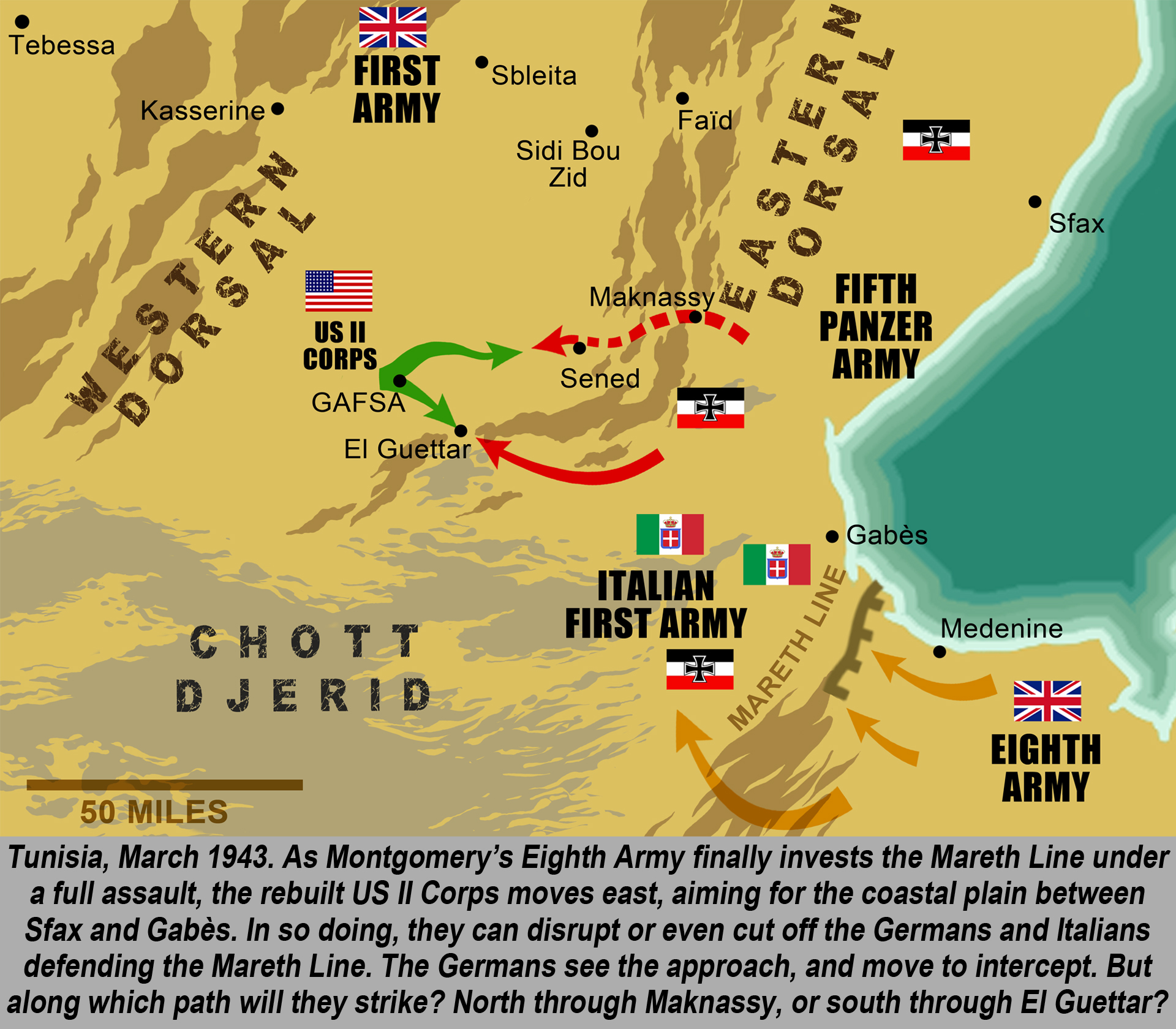
Oh, absolutely. We touched on this briefly, either in this series or the Tunisia series, where the LRDG had to find a way around the Mareth Line, around that shoulder you mention, through the Chatt Djerid salt marshes (Tebaga Gap – assaulted by 28th Maori New Zealand)
Well, the guys at the studio are building a lot of 28mm scenery. I have a very small 28mm LRDG force I built for the boot camp. I don’t know if I’ll ever actually use them in a game, that might be more of a display thing. I guess I’ll have some German 28mm from the Boot Camp so I can set up small skirmishes occasionally. To be honest I hadn’t thought of building any terrain on this scale yet. I’m much more a 15mm or smaller gamer – both for historical realism and ease of storage! 😀
Have a great time at boot camp.
Your right about display models. 28mm/ 1/56 scale are a great size for display. I have been tempted to buy some just for display.
On your map where the German unit is; to the south there are many smaller salt marshes that the Italians used to effect during their retreat through this area. Maybe a day here and a few days there. It forced the 8th Army to make many frontal assaults. This forced them to build up and waste resources.
I check back in about a week to catch up and I will follow you through boot camp. If it is anything like the FoW4 boot camp it should be great. It is times like this I wish that I lived a little closer to England.