







![1918 Spring Offensive Wargame | Full Rules Overview with John & Gerry (WW1 Tabletop Game) [7 Days Early Access]](https://images.beastsofwar.com/2026/03/unboxing-warfulcrum-games-1918-spring-offensive-review-coverimage1-225-127.jpeg)
Spring Clean Challenge 2025- Twenty-Year-Old Space Marines Find New Life as Deathwatch Army


Recommendations: 49
About the Project
I dig out my old, unused Firstborn Space Marines from the 2004 Battle for Macragge and elsewhere, and convert them into a Deathwatch Army for One Page Rules Grimdark Future.
Related Game: Warhammer 40,000
Related Company: Games Workshop
Related Genre: Science Fiction
Related Contest: Spring Clean Hobby Challenge 2025
This Project is Active
Phase 4- The Perfect Crime
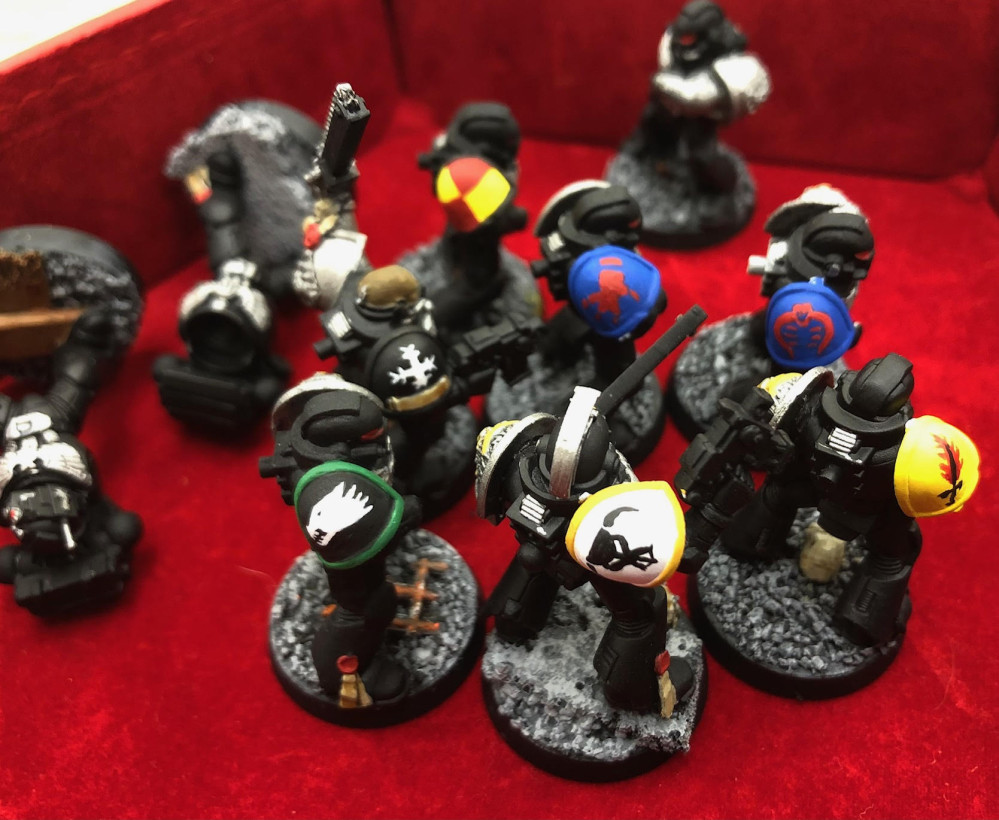
For those who may not know much about the Deathwatch, they are the fighting force of the Ordo Xenos, the part of the Imperium that is charged with studying and neutralizing alien threats. The Deathwatch itself is an elite, ad hoc group of marines taken from all the various loyalist chapters. Marines from these chapters are chosen to go and spend a period of time with the Deathwatch, bringing their own unique skills and outlooks to the group, and bringing back knowledge to share with their home chapter when their tour is completed. While serving with the Deathwatch, marines eschew their usual chapter markings and livery, switching to an all black color scheme, with only their right pauldron painted to indicate their home chapter. All of this makes for an easy paint scheme, with plenty of opportunity to paint fun chapter markings, which is part of why I chose this army.
The right arm and shoulder are painted silver, with a matching pauldron unique to the Deathwatch, and it is this feature that is the most iconic element of the army. They are intricately sculpted with ecclesiastical script behind the Deathwatch icon, and look really impressive on a model. You basically can’t get away with not having this bit, and so this would be the first big hurdle I’d have to overcome if I wanted to really tie this army together.
Of course, Games Workshop sells a sprue of ten plastic shoulder pads (at an exorbitant price, naturally,) that you can use to customize your generic marines into Deathwatch fellas. I picked up one package of these, the first outlay of money in the present day for this project (although unsurprisingly, it would turn out not to be the last.) However, there were only ten of them in the package, not nearly enough for the roughly two dozen troops in my list.
More concerningly, while the pads would work for those newer, multipart plastic models that I had in my army, slotting in easily over the shoulder of the left arm as designed, the majority of my army were those old Battle for Macragge marines which were constructed as one hunk of plastic, from feet to helmet, with arms and shoulders molded right on. The fancy pauldrons could not slip over top of them, and trying to whittle down the Macragge pauldrons to make the new ones fit was going to be time consuming and awkward (and still expensive.) Luckily, I had studied the blade.
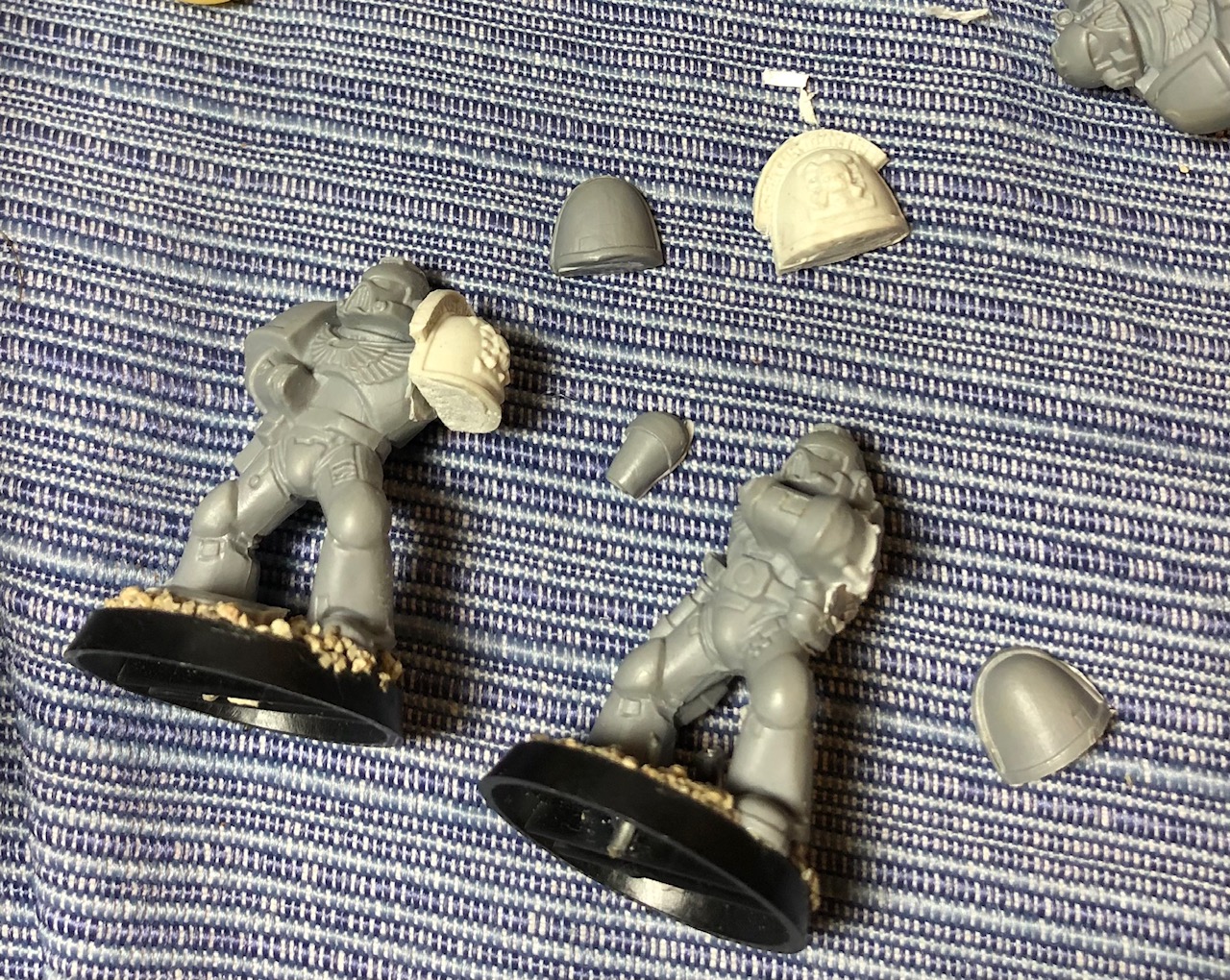
I decided to replace the entire shoulder of the old marines. Using a craft saw and hobby knife, I carved off the entire shoulder. On some models, this left the nub of the left arm that stuck out underneath attached by a smidge of plastic to the torso, and on others, this was completely detached, which would not be a problem. I could have sculpted a blob of cheap putty to replace the bit and then stuck one of those fancy GW pads atop it, and Bob would have indeed been my uncle. But that brings me back to the expense issue, a perennial concern when dealing with the lads from Nottingham. I did not want to have to go out and buy at least one more conversion sprue to finish the project, so naturally I instead turned to crime.
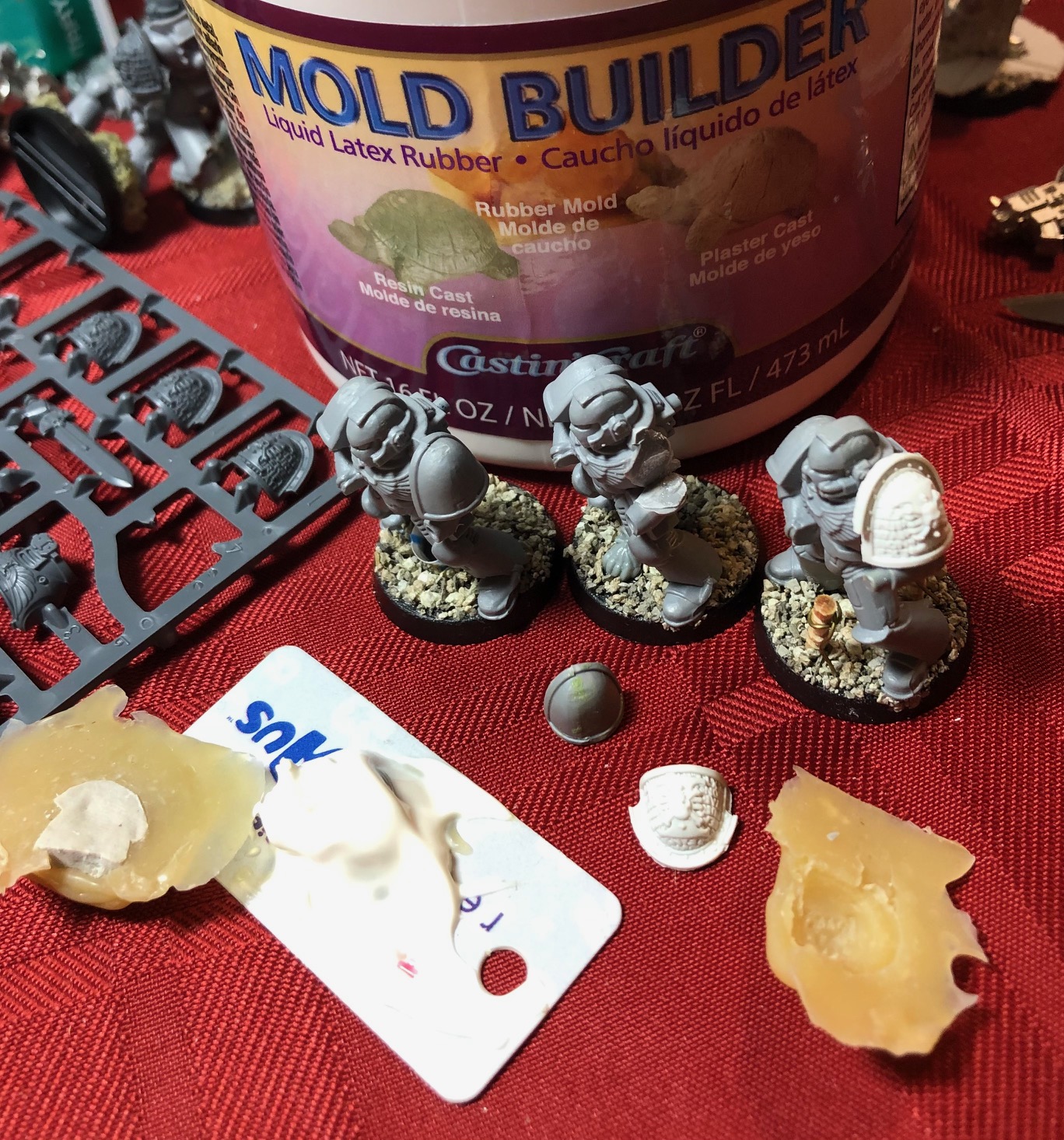
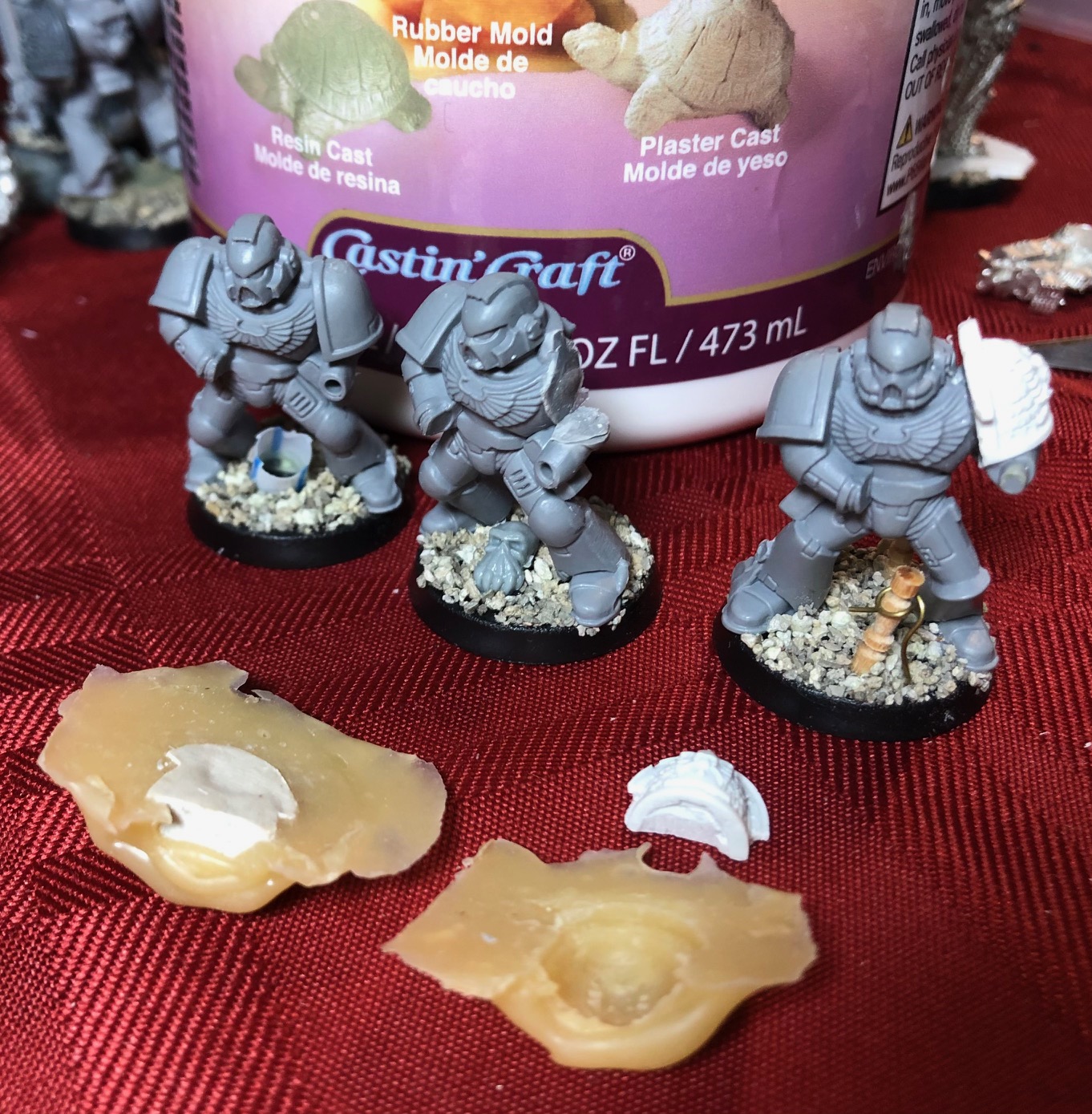 Pictured: Crime
Though definitely a dilettante at the craft, I am a big fan of making molds and recasting parts. Normally I would not bother trying to cast copies of such a thin part as a shoulder pad, but since I was replacing the entire shoulder, I could cast it as a solid structure, allowing for a very simple, single-sided ‘push mold’ that would be practical and robust. To effect the mold, I first carefully cleaned a pad and glued it down to a piece of plasticard. I next used some poster putty to fill in the underside of the pad to make it a solid shape, making it as smooth and flat as possible, since this is where the arm would be reattached.
To create the actual mold itself, I used some mold-making paste. This is a thick latex concoction that one slathers over the surface one wishes to reproduce, applying multiple layers over time to make a flexible rubber mold. The first layer I applied with a Testors brush with stiff plastic bristles, making sure to push the latex into every nook and cranny to ensure good detail of the castings. Once that first layer was dry, I slathered more and more on in thicker and thicker coats. If you are thinking of doing this, use a brush you don’t need for painting later, and be sure to clean the bristles well after each use. After the first couple of layers, you can just slap it on using a popsicle stick, as I did.
Once it was all dried, I had a nice, crisp mold of the original pauldron, ready for casting. Naturally, there are lots of options for casting materials. Because I had used the mold building putty instead of pouring liquid latex into a mold box, the mold did not have a flat back. This means that liquid casting mediums, such as epoxy resin or Mix2Mold would not work. But I had already planned on this being a push mold, using a two-part epoxy putty. There are of course several options for this as well, such as Milliput, green stuff, or a mixture of the two. But I am here for frugality, so I went for the cheapest option: industrial plumber’s putty.
The brand I use is called “Fix-It Stick” by Oatey, which I can usually find at the plumbing supplies section of the hardware store. It is rough and grainy, and no good for sculpting fine details, but if you’re pushing it into a mold it works a treat. I mixed up batches of the putty and mashed them into the mold, being sure to fill the whole mold for maximum detail. The putty dries pretty quickly, and becomes rock hard. There were a few miscasts here and there, but not many, and even most of those were easily patched and usable. In the end, I had a nearly limitless supply of solid shoulder bits for pennies apiece. In addition, I could also use the molds to make hollow pads too, with some careful application in the push mold.
So now I just glued the solid shoulders where I cut away the originals and you couldn’t tell the difference once it was all primed. Painting could not be easier, since the whole arm is silver. Now I had some Firstborn Deathwatch marines, which were not otherwise available elsewhere.
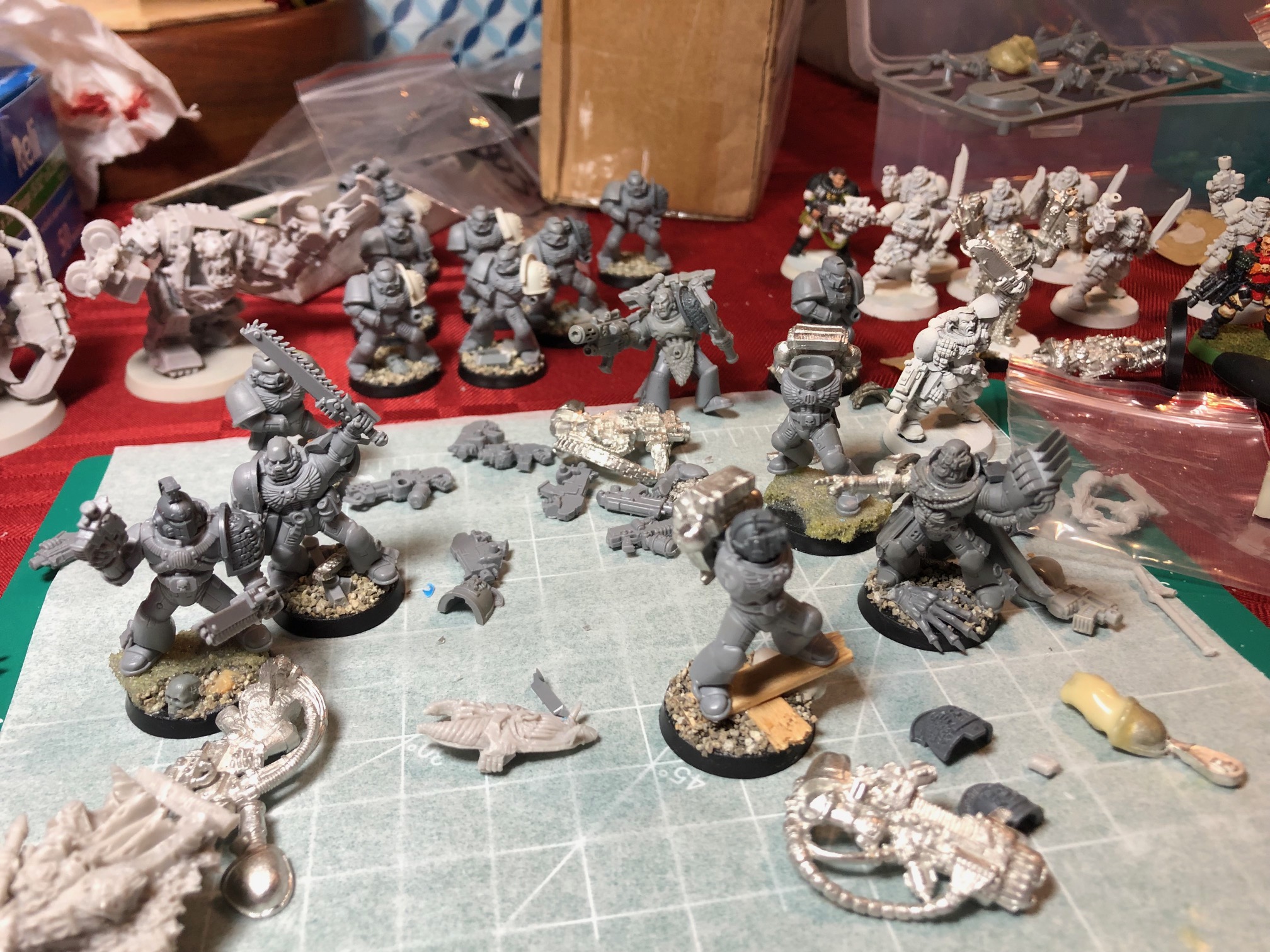
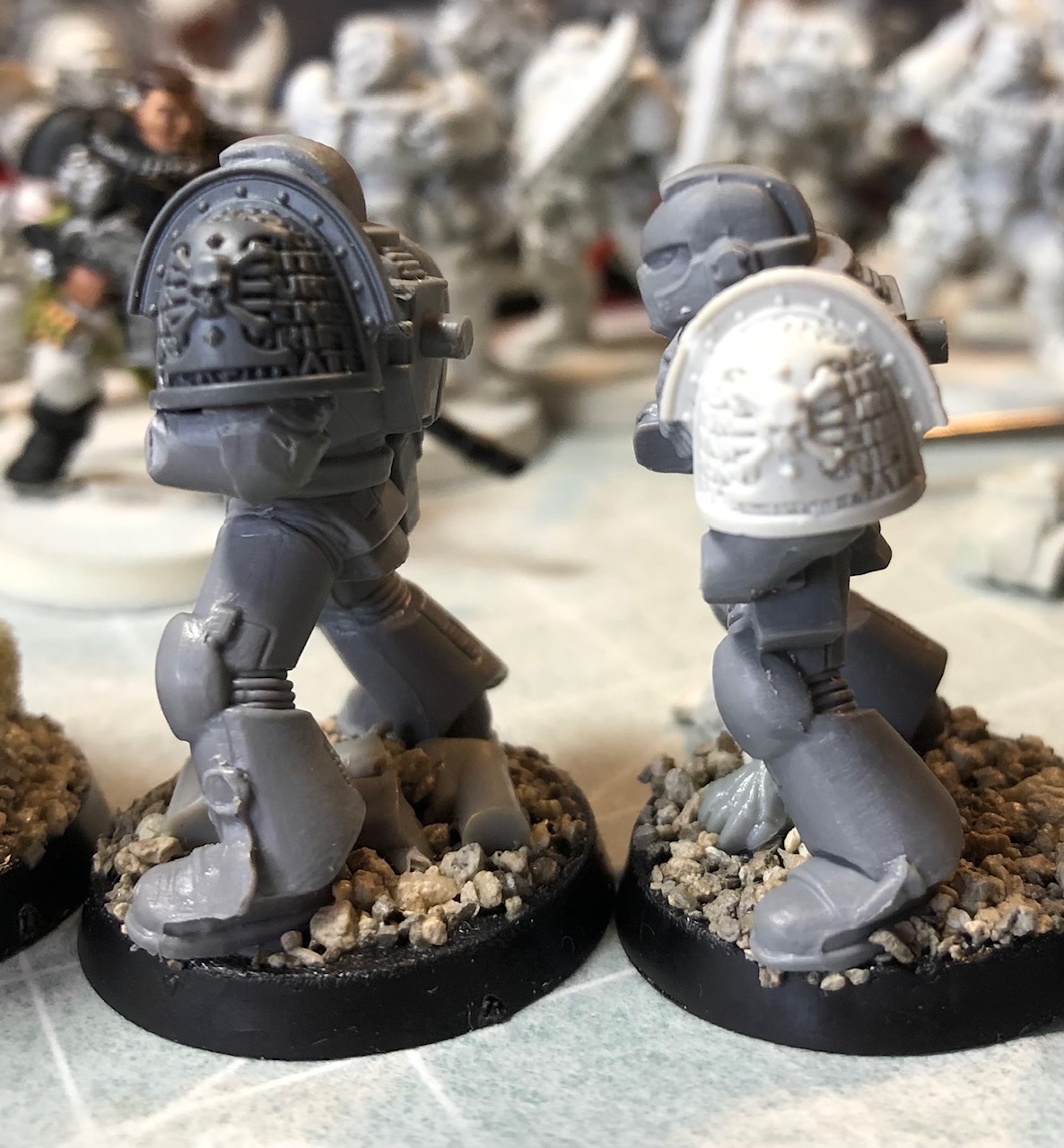
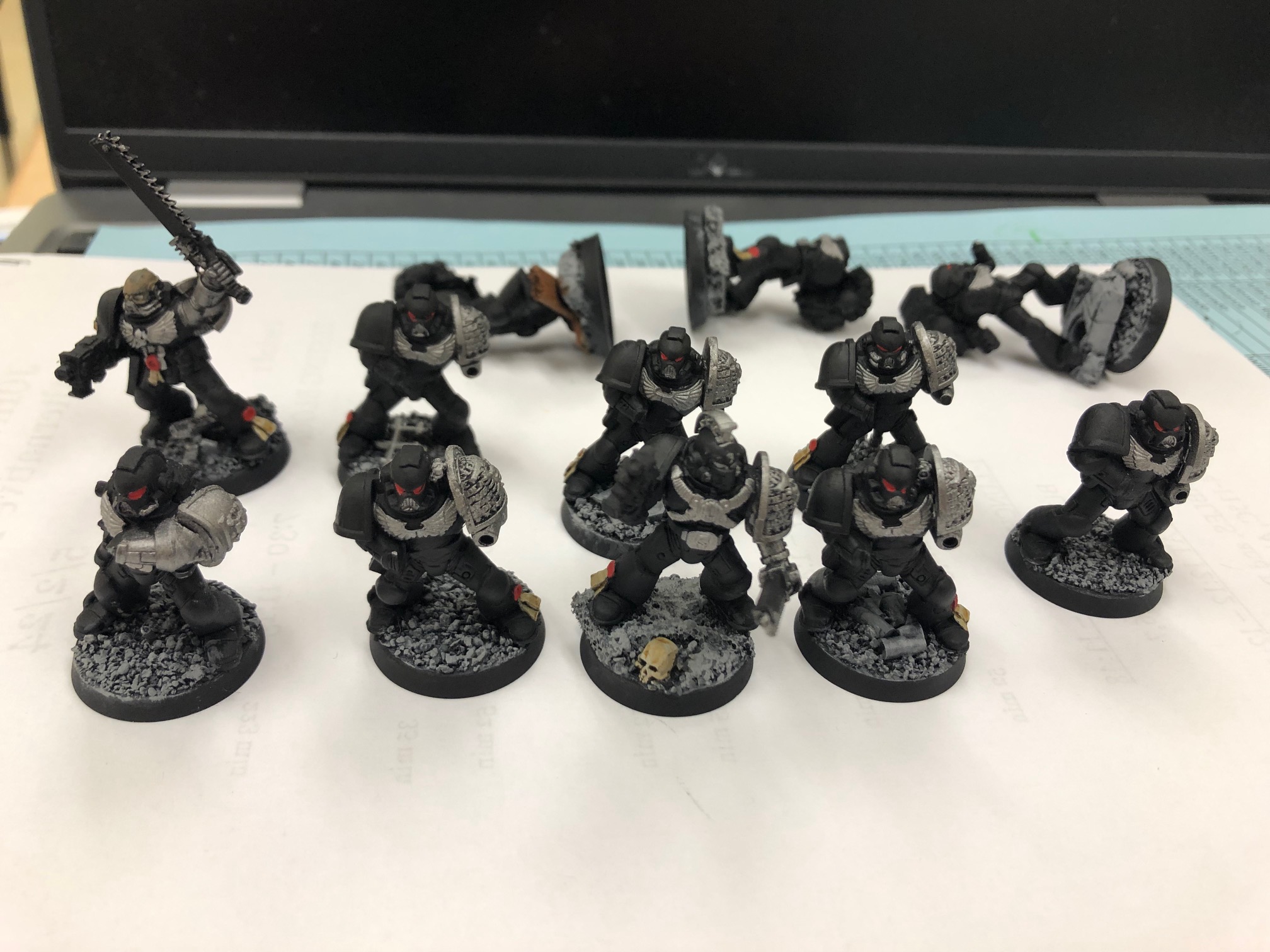
As for the other shoulders, each marine bears the colors and icon of their parent chapter. This allows for a lot of fun opportunities for personalization and improvisation. I didn’t have any of those fancy molded ones with the embossed icons of popular chapters that make it so much easier to paint. Nor did I have any waterslide decals lying around with the icons of the popular chapters, either. So that meant I’d have to freehand the icons, which I took as a blessing, since that meant I could include some original or less-popular chapters.
It’s always bugged me that the concept of the Deathwatch is meant to draw from ALL of the chapters, but we usually only see a handful of A-listers, and always in the most stereotypical positions: the leader of a kill team will be an Ultramarine, the Salamander will be the one with a flamer, the White Scar will be on a bike, and the Fisty Boy will have a massive gun. Yawn. Other chapters know how to use flamers too, and lots of marines can ride bikes. So I made sure to have a wide diversity of chapters, well-known and otherwise (ideally on more than one of each chapter for variety,) and to mix up their ‘positions on the field’ if you will.
I am still working on the painting, but I want to include some old favorites from the old days, such as the Rainbow Warriors, Mantis Warriors, Mentor Legion and the like, as well as some new, original chapters (especially if the icon is easy to paint freehand…)
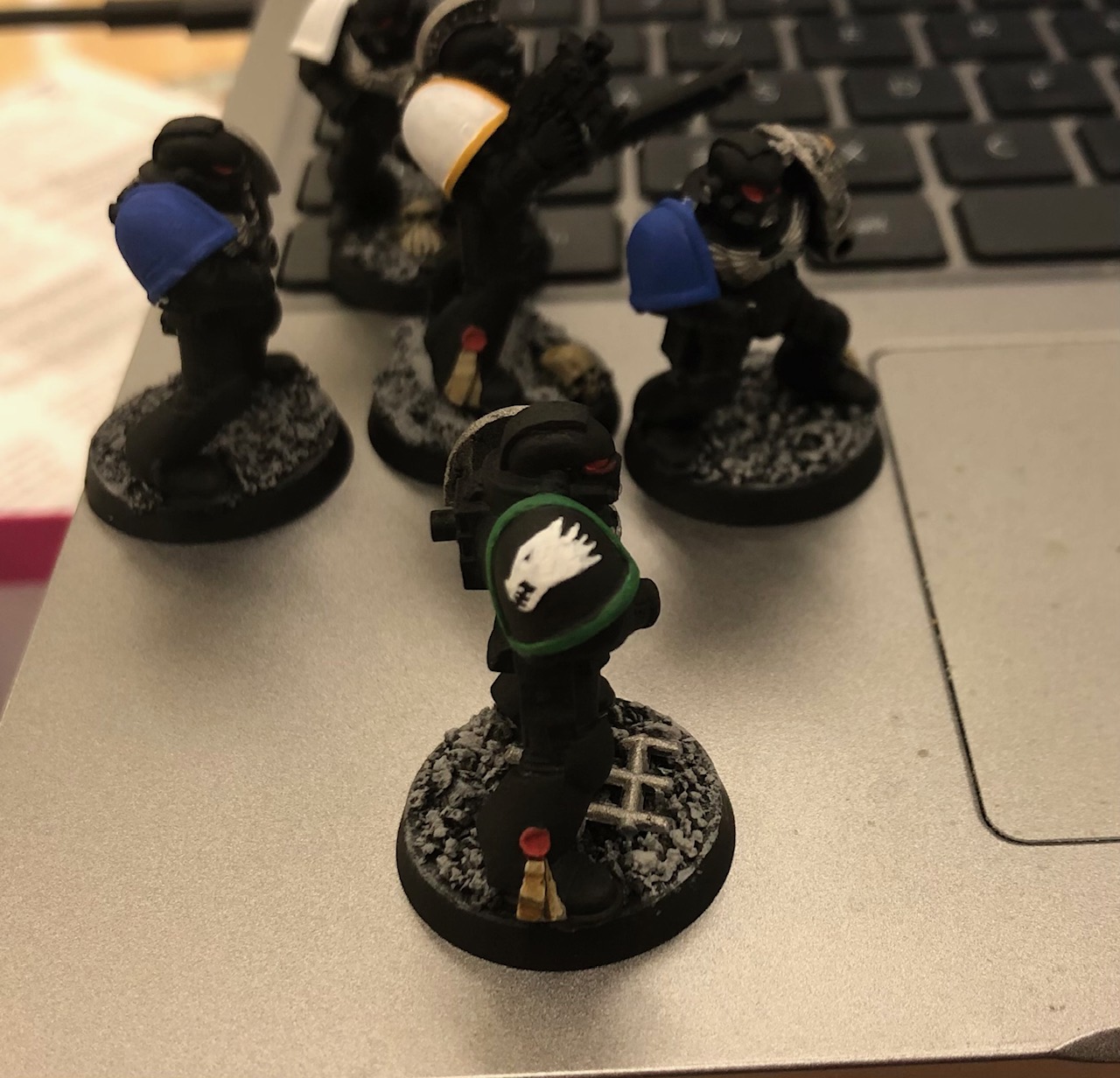
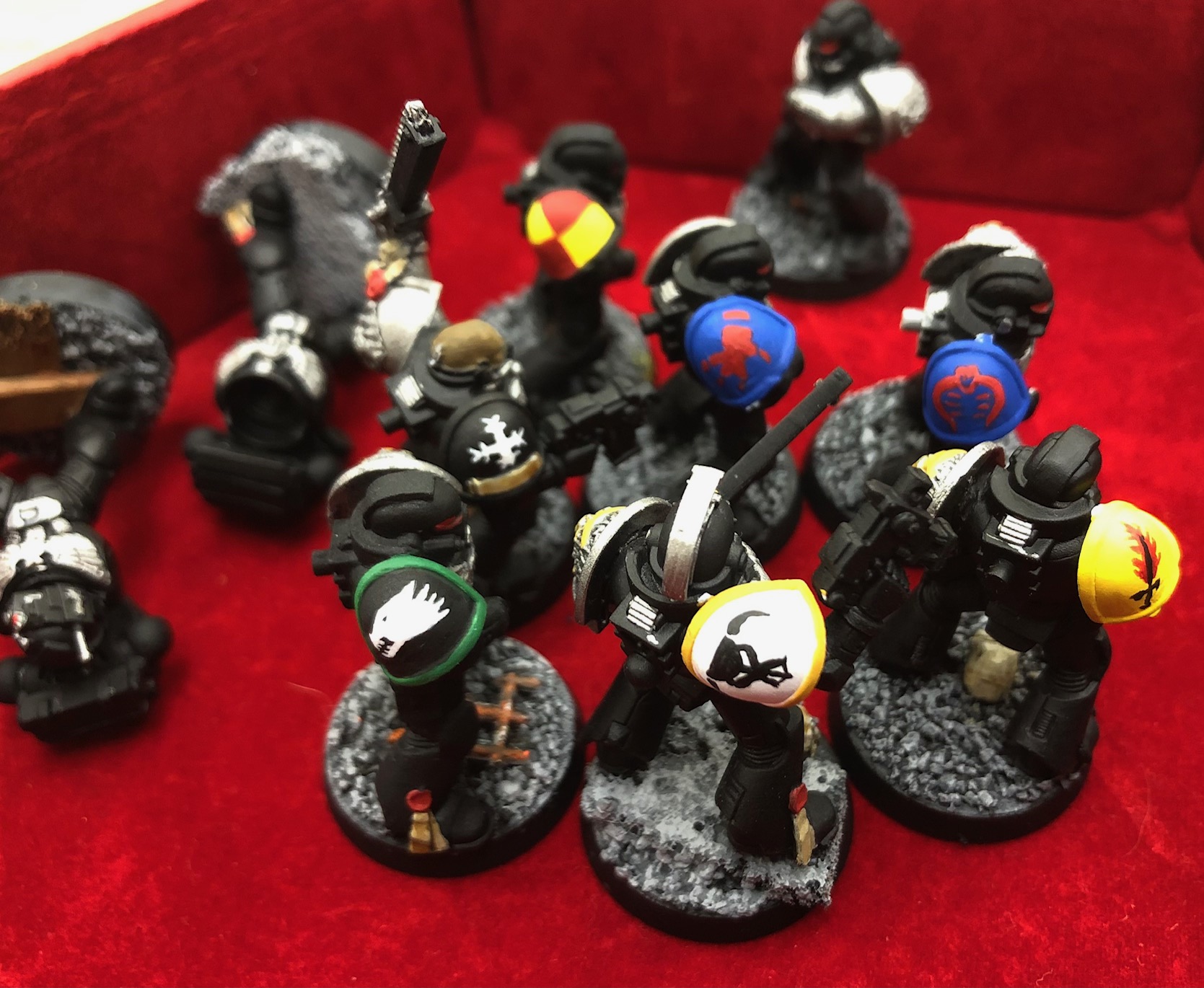
Now I had a couple of infantry squads in progress. It was time to bring in some support for my foot troops.
Phase 3- Plundering some boardgames for minis

Board games!
GW has always branched out to multiple markets, and often produces more ‘casual’ games in order to draw new players into the crack den that is the hobby. Usually, this means a board game of often questionable playability, but using some preexisting minis from 40K or other games. Since these products are not sold under the rigid pricing auspices of GW’s normal business practices, you can often use sales, gift certificates and coupons to get these for less than the minis themselves would cost.
One such game is “Space Marine Adventures: Labyrinth of the Necrons.” A fairly straightforward board game, it has pretty middling reviews on its own, but it does come with five easy-build Space Marines™ (although sadly no Necrons.) These minis are taken from the “Space Marine Heroes” line, which were designed in Japan, and are therefore some of the best designed minis in the catalogue for easy assembly and clean lines. The Heroes line were blind box collectible minis, featuring a dozen or so marines of different varieties and loadout. This game gathered five such marines and put them together as a mixed bag of chapters working together to battle the xenos threat, which sure sounds a lot like the Deathwatch. The game can be picked up for about 25 bucks, which is a little more per model than I usually prefer to pay ($2 a mini, if I can manage it,) but they were of a quality that made it worth the splurge. I in part got them to use with my students at the games club I run at the school where I work. They were sturdy and color coded, which made them good for running skirmish games with teenagers. But they were always bound for a greater destiny.
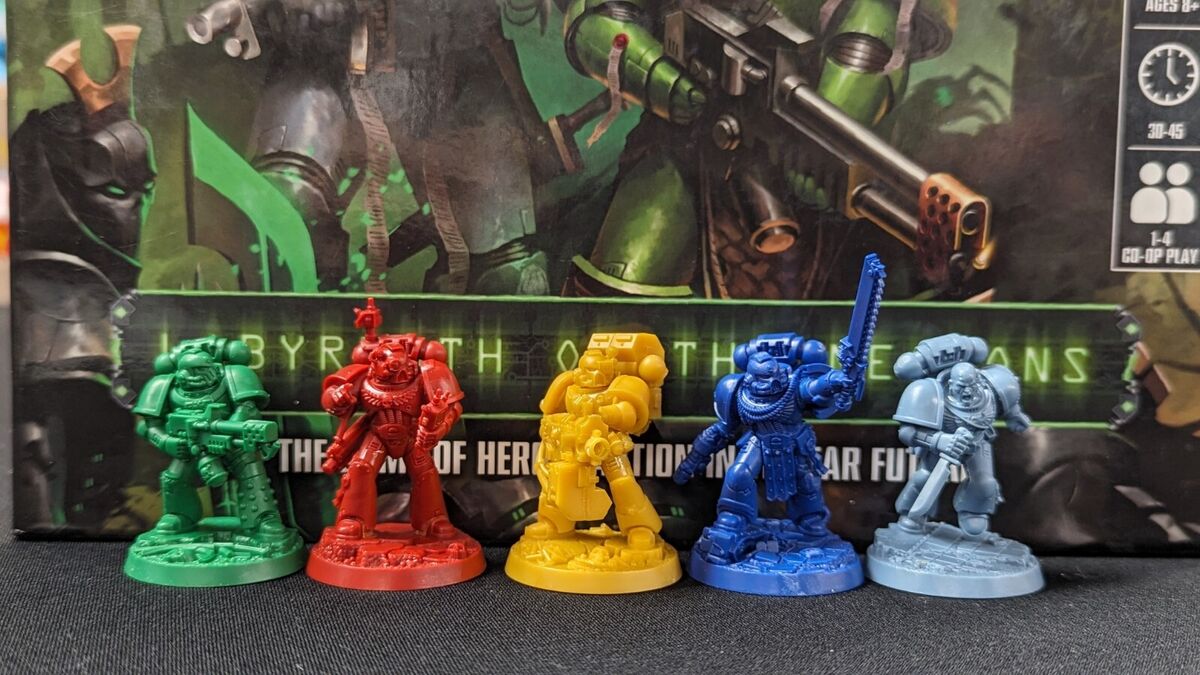
The minis were: a standard sergeant type (who we will see again in this article,) with the traditional chainsword and pistol (a grav pistol in this case,) a marine with flamer who is also sporting the nostalgic studs on his armored bell bottoms, one lugging a heavy bolter and its attendant ammo backpack, one with his bolter slung and running forward with combat knife drawn and ready, and my favorite, who has his bolter hanging loose and is checking an auspex. All were excellently sculpted and packed with detail, including sculpted bases, conveniently also of an urban ruins theme like the rest of my army.
But those bases represented a problem. My old minis, both the Macragge boys and the others, were mounted on the old standard of 25m round bases (as was the style at the time,) into which I had already poured a good bit of love and attention. These new fellas were on 32s, the new standard footprint. Now, this is not an issue for me in general, since OPR is much less rigid in its adherence to such trivial measurements. However, I am a big fan of using movement trays, (especially good when playing with grubby-fingered teenagers,) and putting these dudes next to a bunch of 25mm diameter bases would complicate that. But their bases were A: really well sculpted and would be a shame to waste, and B: had their feet molded right onto them!
My solution was to simply use these guys separate from their smaller-based comrades and make them my command squad. They would get their own movement tray, separate from their lessers. There were five of them, though, and I would need 7 for my purposes. But Providence provides…
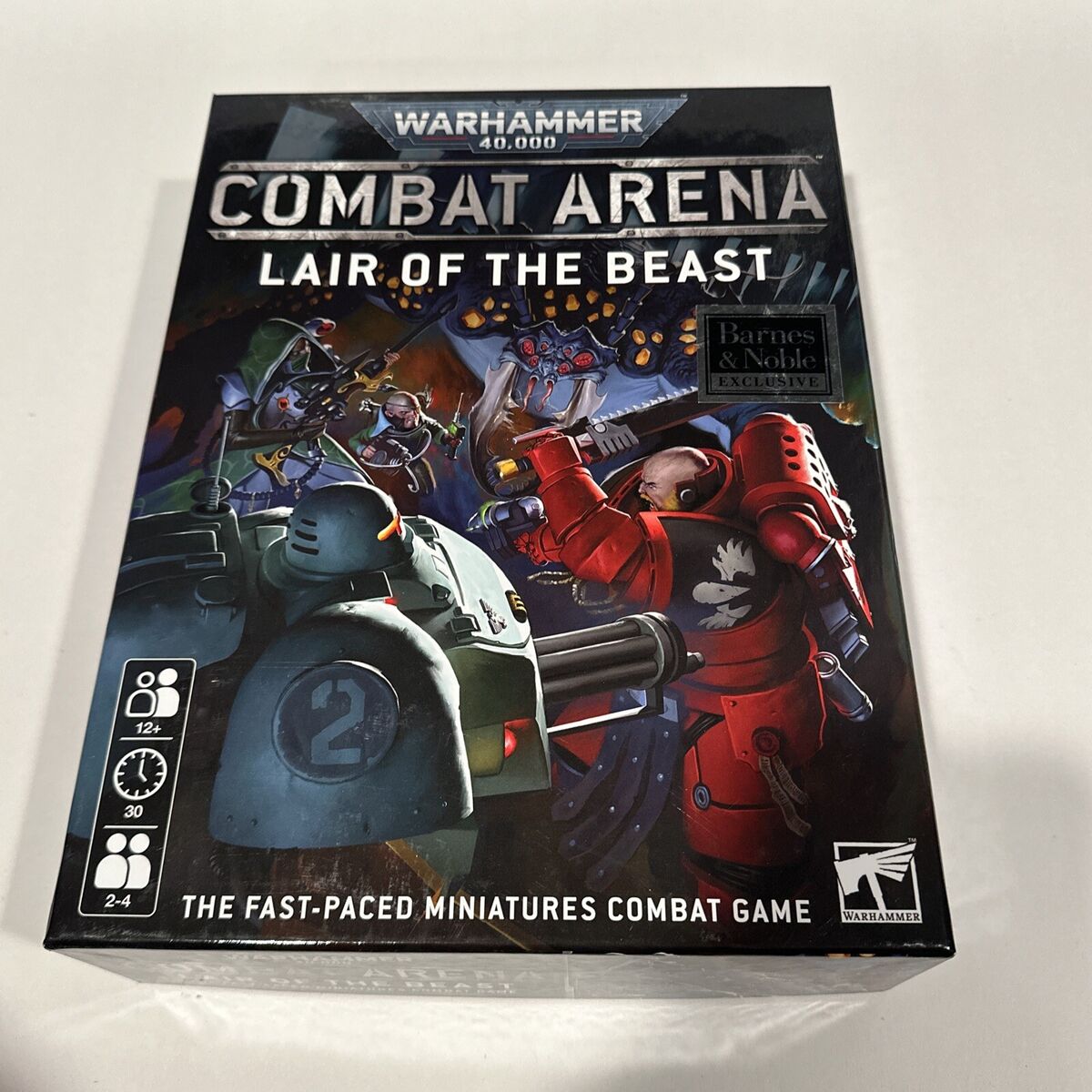
This is an excellent game, available at Barnes & Nobles for about $35, and it contains a shockingly good assortment of minis from the Blackstone Fortress game, which deserve their own description elsewhere. But in addition, they also throw in a space marine (because you cannot legally produce a GW product without at least one.) In this case, they tossed in another copy of the sergeant I mentioned earlier from the Labyrinth of the Necrons game. I acquired two copies of this game (I kind of want to pick up a third, if I’m being honest,) and that meant two of these sergeants, for a total of three including the blue one from the earlier game.
I certainly did not want three identical models in the command squad, especially armed with chainsword and grav pistol. One could remain as it was, but what to do about the other two copies? Here’s where things get interesting…
First off, I wanted another standard marine armed with a bolter. This was an easy conversion; I just removed the standard arms and replaced them with an appropriate pair. I also mounted him backwards on the sculpted base and slightly modified it. This made it look like a completely different base, to avoid ‘sameyness.’ Thus the first conversion was done and dusted.
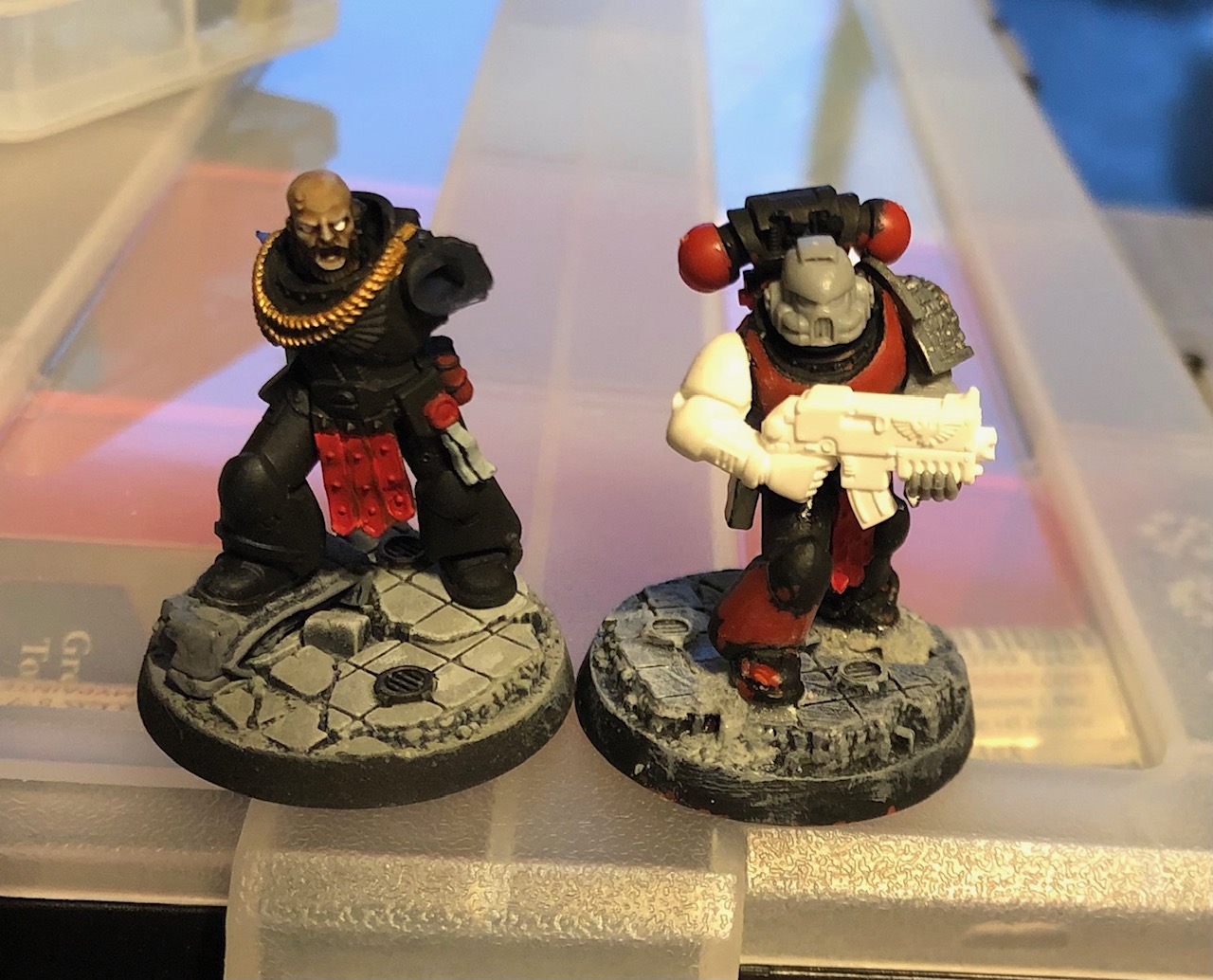 On the left is the armless original. The modded version is on the right, with braid scraped off the breastplate and new arms. Those arms are recast, by the way, and if that offends you, you DEFINITELY won't like my next post...
The second one required much more extensive modification, but would solve another issue that I had. As I mentioned in our last thrilling episode, I had a mini I had made at the Games Day build and take event, which was conspicuously captain-like, with its cape, excessive braid, and the eagle-headed exhausts on its backpack. I gave his combiweapon arm to the ‘bits box Space Wolf’ and swapped it for a metal pointing arm from the Devastators kit. But he had stubby little legs like all of his generation, and in addition to their 32mm bases, the Space Marine Heroes models were noticeably taller. Not quite Primaris in scale, but scale creep had certainly made them tall enough for a captain especially to look odd standing next to his command squad, like a college basketball coach standing around towered over by his student athletes.
So I had one mini with a very captainly torso and stubby legs on a 25mm base, and another with long legs on a 32mm base and a nondescript upper half who needed a new home. It didn’t take King Solomon to point out the obvious solution: Cut them both in half.
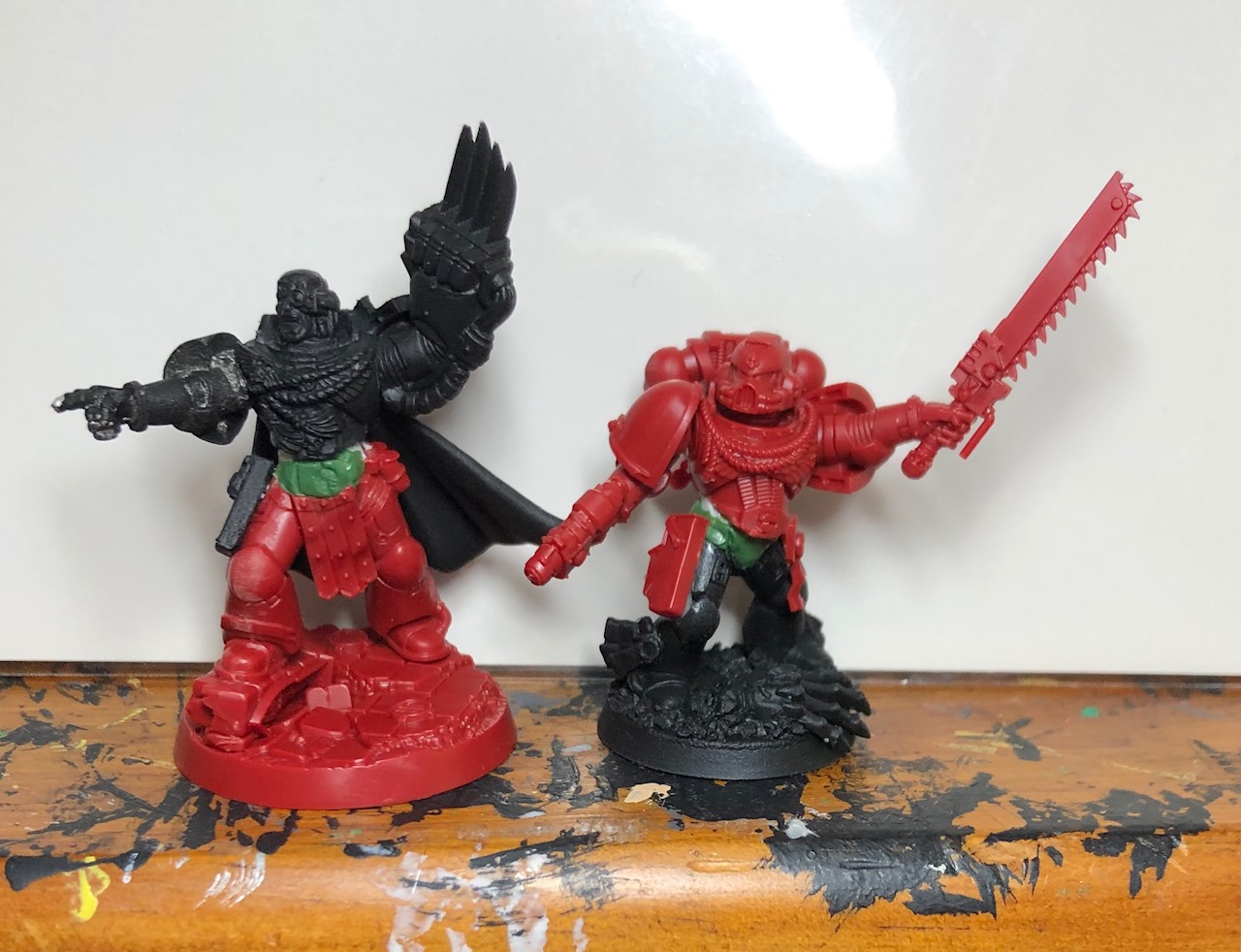 A little green stuff and sculpting to cover the joins, and voila!
With that grisly transformation completed, I now had a proper captain with all the regalia, standing tall upon a 32mm base, and another standard sized sergeant type to rejoin the 25mm base folks.
Now my command squad consisted of the blinged-out captain, a Sgt with pistol and chainsword, three bolters, a flamer, and a heavy bolter. All were on matching 32mm bases and of a similar size and scale.
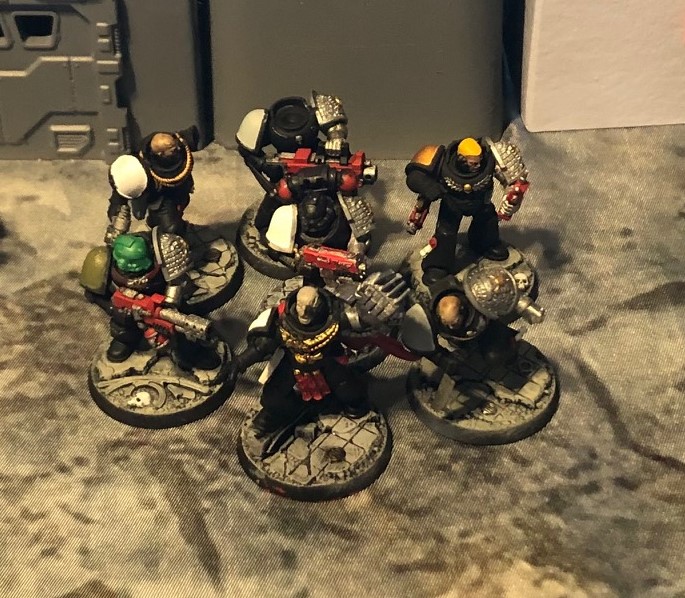 Still a WIP obviously.
This squad would bring my new total to at least three squads, with some heavy weapon options. This gave me flexibility on how I wanted to run them. I could forgo a hero for one squad, and have four standard squads with heavy weapons embedded, go for three squads and a support squad of three models armed with heavy weapons, or mix them up and use all the sergeants and melee-armed guys (and the flamer for good measure,) to make an assault squad. But no matter how I was going to run them, if I wanted to make them into a Deathwatch force, there was one design element I would need to incorporate: those sculpted shoulder pads…
Phase 1- The Idea and Planning (a long-winded introduction)

I’ve been a gamer since I was a kid in the 8o’s- from D&D and every RPG I could get my hands on, and later moving into wargames through collecting minis for RPGs (playing the wrong way, as Gerry would say.)
Back in the late 90’s, my wife and I got into Warhammer Fantasy. We built a few armies, painted fewer, and even played the actual game once or twice. When Mordheim came along, that was our main game, so the large armies fell by the wayside.
Fantasy was our genre, but you couldn’t read White Dwarf or go into a shop selling Warhammer without being blasted with the bombasticity of 40K. I had purchased the 40K 2nd edition box as a Christmas gift for my brother years previously, but the game at that time just didn’t grab us. The more I learned about the lore of the grim dark future, in which I was assured there was only war, the more tempted I was to invest in the game again. But I had all those fantasy armies, and I couldn’t justify spending too much building an army from scratch.
But then, in 2004, GW released the Battle for Macragge boxed starter set. For Sixty US Dollarbucks, you got the new edition of the game, with all the dice, templates and whippy-sticks you needed to play. It also included the best terrain GW has ever produced, pound for pound, so to speak. More importantly, you got a nice chunk of minis.
I’ve always loved the Tyranids/Genestealers, so having a bunch of these creepy little freaks was a welcome addition to my ever-growing collection. And of course, as is required by Royal Decree, it had some Space Marines. Can’t have a starter set without those fashionable fascists that define the setting and upon whose ludicrously massive shoulders rests the success of the entire company.
Meh.
I was in it for the bugs, and the Emperor’s finest were just there to be the OpFor/between meals snack for my insectile horde. Don’t get me wrong, I don’t have anything against the poster boys, but they weren’t what called out to my spirit with a clarion call of creativity. I didn’t have any specific plans for them, so I just based them and gave them a spray of black primer, along with the Tyranids.
But I just kept getting more of them.
When we would attend Games Day in Baltimore, the free mini was often a member of the Astartes. When I searched eBay for cheap Tyranids, I would instead find people begging me to take their sad squads of unloved blue boys, paint caked a millimeter thick, off their hands for a pittance. And when engaging in barter for gaming materia, your plastic power-armored pals were like wampum; a common currency accepted by all, and often just thrown into a trade as an afterthought, so that without ever really intending, I ended up gathering a fair number of the plastic and metal homunculi.
And then promptly forgot about them. Other projects arose and demanded attention, there were new responsibilities at work, and worst of all, my wife and I were stricken with that most destructive and resource-draining of all maladies to infect the gamer: Children.
The Horror.
Fast forward to the modern day, more or less, and a new day has dawned. My children are teenagers now, sullen and self-reliant, freeing up more time for projects. I now have friends who are interested in tabletop wargaming, a house big enough to both store my collection and a table big enough to play with them, and best of all, the breath of fresh air that is One Page Rules.
The thing that always prevented me from getting more into playing Warhammer was actually playing Warhammer. As much as I loved the lore of both the Old World and the far future, the rules themselves were just a slog. Many love the complexity of the game, and they are welcome to that expectation, but I don’t want my play time to feel like work (that’s what hobby time is for.)
A few years ago, I was looking to get back into tabletop gaming, I explored alternate rulesets (I had been working on some Bolt Action/Konflikt ’47 armies, but that is a story for another day.) I found Space Weirdos through Uncle Atom, and had a blast using some old 40K and Star Wars minis for skirmishes. My appetite for 28mm destruction sufficiently whetted, I craved larger battles, and found Xenos Rampant, which finally allowed my to create full armies using the modest collections I had amassed.
Xenos Rampant was great and super flexible, but I craved the list-building that was always one of the more interesting parts of Warhammer games for me. After ignoring it (foolishly) for longer than prudent, I finally dipped a toe into OPR and I was home. Finally I could play with my the rich lore and exquisite sculpting of GW with rules that moved, breathed, and encouraged, rather than punishing, fun.
I began gathering unto my flock all the Tau, Necrons, Orks, Kroot, and so many more that I could source cheaply. I pride myself on frugality, and you’d be amazed at what a little green stuff and a good bits box can create. The flexibillity and soup-friendly nature of the rules let me put together fun lists from whatever I had to hand. And thus, I remembered those old marines of yesteryear that languished in the garage.
There’s nothing cheaper than something you already own, so why not finally make an army of Space Marines to put on the table? The question then became what chapter would I choose? Being neither a furry, a vampire fan, a Mongol fetishist, or any of the other rude stereotypes, I never really had a favorite chapter. Back in the day, I always planned to make my marines into Iron Hands, but even that left me decidedly ungripped.
But I had gotten out of the hobby so long ago, that the game had moved on without me, inventing new armies, fashioned from background lore., and brought into the light of play. The Genestealer Cults were expanded from their place as fluff text in the Tyranid codices, and the Adeptus Mechanicus were elevated from the role of glorified tech support to a wholly original army of their own. Even the Imperial Knights from the old Epic line stomped their way out of the 10mm limbo in which they had dwelt to emerge as not one but TWO armies.
And of course, there was the Deathwatch. I loved the idea of the Deathwatch when I read about them in White Dwarf, but they were always just a fun concept, never something you’d run on the tabletop in a large force. But while I was away, GW did exactly that; giving them their own codex and minis. This inspired me to make my own Deathwatch force using only the old firstborn minis I had already acquired. There would be none of this new-fangled, high-falutin’ Primaris mumbo jumbo in my army; no siree, these would be honest minis from an honest time.
I mean, seriously, the prices these days are criminal, so I had to work with what I had.
So this project will document what I have done so far to bring these venerable veterans of Xenos extermination to the tabletop, involving some sculpting, kit-bashing, corner-cutting, creative penny-pinching, even the occasional, shameful act of actually purchasing new products.
Join me ,won’t you?
Phase 2- A slightly less long-winded cataloguing of resources.
So to begin the project, it was time to take stock of the various Space Marine™ resources I had at my disposal. I had vowed to not make any further purchases for this project, but we’ll see how that goes as we progress.
The core of my squatty force was the ten-man tactical squad that came with the Battle For Macragge starter box all those many years ago. There was a sergeant, with the traditional bolt pistol and chainsword, a marine with missile launcher, one with a flamer, and seven armed with the classic bolter. In the longago, I had cleaned them up and stuck to some 25mm bases decorated in an ‘urban ruins’ theme, since I had planned to play Cityfight with them.
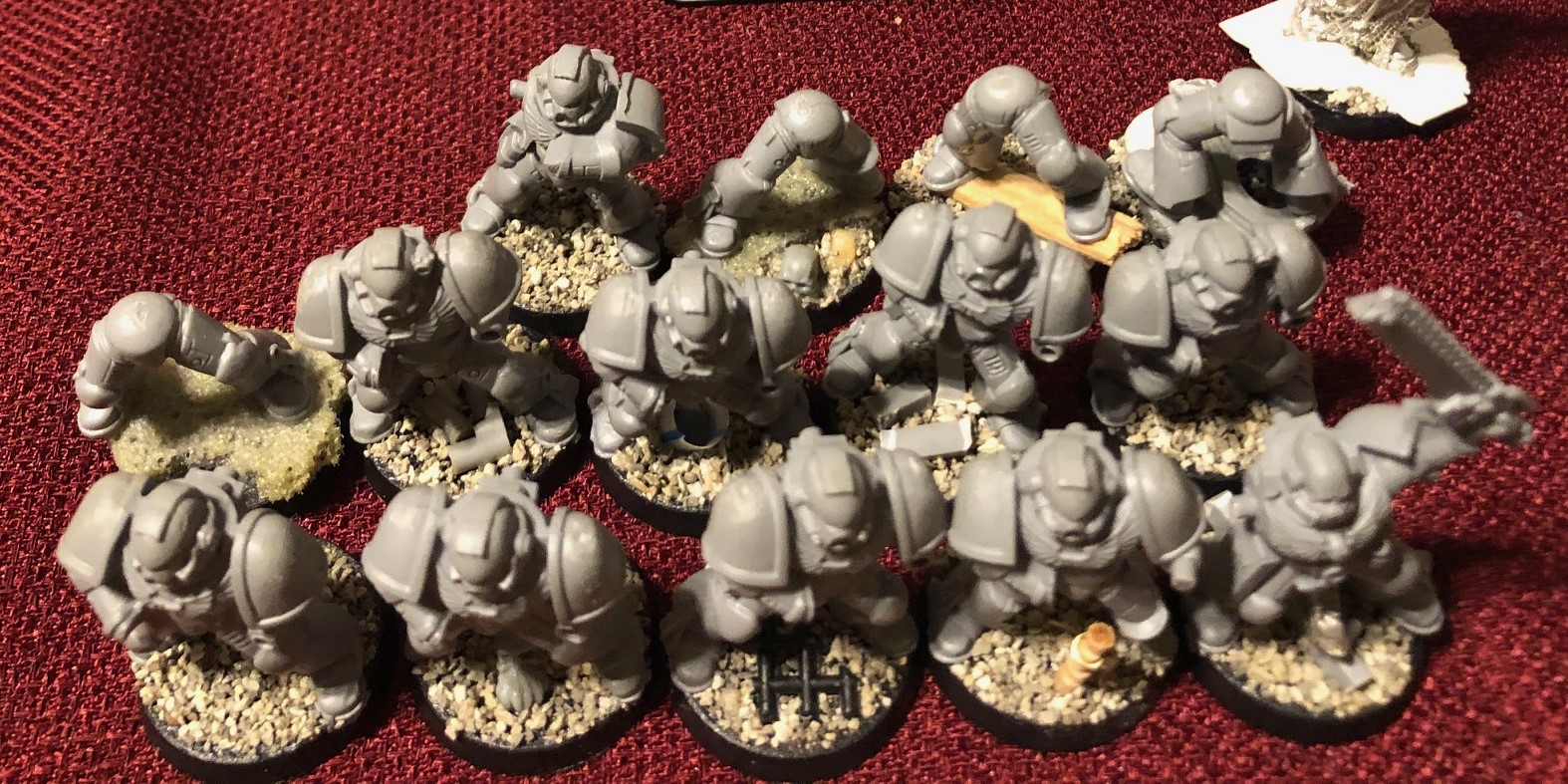 Here they are as they looked coming out of storage. The torso-less legs are from the box mentioned below.
This was a good starting point, and since in One Page Rules (which I would be using them for exclusively,) the Deathwatch analogues (the “Watch Brothers”) were an elite army, I would be able to make much of them. Watch Brothers squads are in groups of three, but can be doubled to six, and with a hero attached, that made squads of seven as the standard. What else could I add to this?
I don’t remember where or why, but at some point in the past I picked up a boxed Devastator Squad, presumably off of a clearance rack somewhere. This was the older set, with five generic multipart plastic marines, and a pack of metal heavy weapons to add on. There was another Sgt, a plastic missile launcher, and metal heavy bolter, plasma cannon, and lascannon. I had already decided that I did not want a second missile launcher, so that marine could be built as something else, like another sergeant or a standard rifleman.
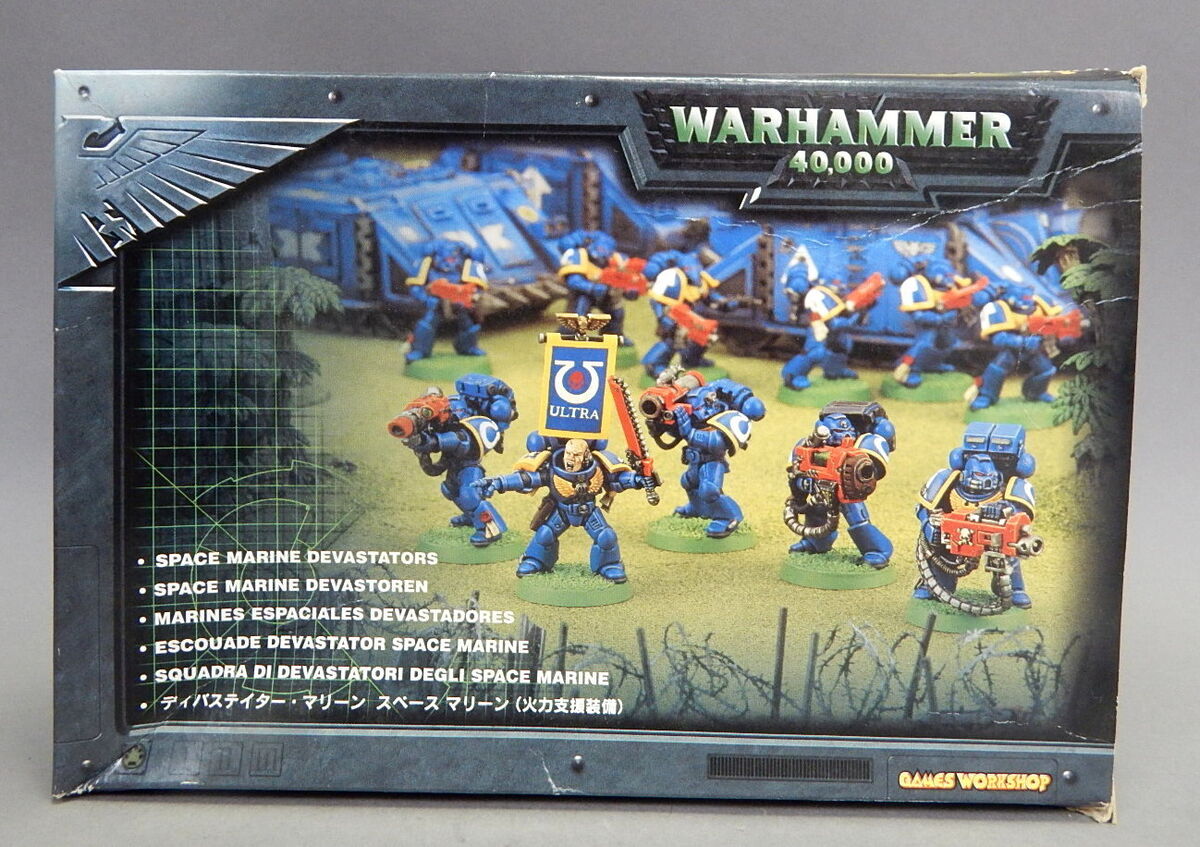 This box. As I said, the OLD one.
Now I had fifteen marines, the equivalent of two seven-man squads, but I was not done, thanks to the joy of Games Day US!
Although it is sadly defunct now, for many years my wife and I would venture forth from the squalid swamps of South Florida to the distant skies of Baltimore, MD to participate in three days of GW-sponsored goodness and joy. We would play in games, win free minis in the trivia contest, attend panel discussions, and just really have a great time. I truly miss it.
One of the neat things was that you would get a free T shirt and unique mini with the price of admission. We still wear the shirts some twenty years later, and of course, I still have the minis. Two of the years we went featured Space Marines™, and since my wife and I went together, that meant two copies of each mini.
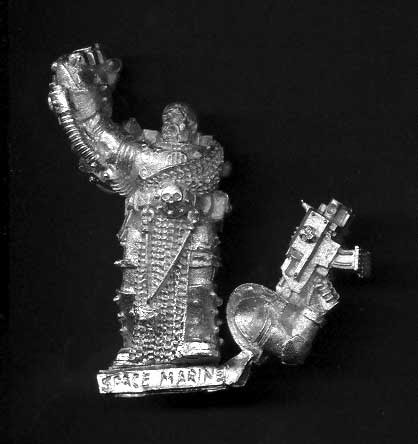
The first of these is a “Space Marine Veteran,” from 2005; a big, beefy boy wearing a chainmail toga over one shoulder, and rocking the Crux Terminatus on his power fist and storm bolter straight off a Terminator. It’s plenty intimidating, but also extremely unique, and it would look extra weird to have two of this guy in an army. I would normally modify one of them, but this is a metal mini, which is harder to carve away or sand down, and the details are too central to the mini itself, so I settled on only using one of him. He would be a hero for one of my units, and my headcanon had him as a Blackshield of unknown chapter origin, and who never cycled out of the Deathwatch.

But the second Games Day marine was more versatile; ostensibly a Space Marine Captain from 2008. Even though he is called a captain, other than some fancy pauldrons, he’s just a standard-sized marine, running forward with a thunder hammer raised in both hands. One copy would work fine in an assault squad, while the other copy (with a helmet swapped for his crew cut,) could instead be given a pair of bolter arms to make him another stock rifleman, or similar conversion.
Another fun activity we participated in at Games Day one year was the Build & Take Conversion contest. It was a cool event where you sit at a table covered in sprues, clippers, and glue and build your own mini, which would then be judged, and at the end of the event, you could take home your plastic creation. The year we did this, it was right after they had released the plastic multipart Space Marine Captain kit, so there were a bunch of those sprues in the mix.
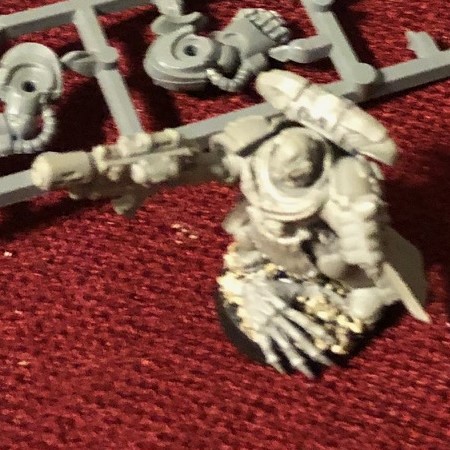 Sorry for the blurry image.
So I decided to make a marine of my own, and though I’m not entirely proud to admit this, I kind of used it as an excuse to load as many bits onto the model that I could, with the idea of scavenging him for parts in the future. He got the upper torso with cloak, the funky eagle-headed exhausts backpack, an iron halo, a combiweapon with extra scope, a single lightning claw, and a holstered pistol. I have no idea if such a mini has ever been legal to run in 40K, but I was going for broke. I even snipped a hand off of a demon mini in the sprue pile so I could plop it on the base at his feet as if he had just cut it off. Here was another min to add to the roster, although I suspected his many features might end up scattered across several models by the end.
I also, and I have no idea from where, had a spare set of legs. This was handy, because I had picked up the old Space Wolf sprue, replete with space viking themed arms, heads, and torsos, to use for a fantasy project, and still had some spare bits, sans legs. This could all be combined for one more guy.
So where does that leave us? 10 marines from the Macragge box, 5 Devastators, 3 metal Games Day freebies, the plastic Captain from the Build & Take, and my bits box Space Wolf gives us a grand total of 20 models. That’s one shy of three squads of seven, but it’s a solid core for an army.
Now, in addition to the infantry, I had picked up (sooo long ago,) an ebay rescue lot of three bikes (one of which had the metal sidecar to be an attack trike,) and a landspeeder, all caked in a protective layer of Ultramarines blue. These would help fill out my ranks, but more on them later. My first focus was on having plenty of infantry to seize and hold objectives, and look cool on the table with their pretty shoulder pads.
So I needed more infantry, but luckily I had a cunning plan on where to find some more non-Primaris Space Marines(TM)…



![StarCraft Tabletop Miniatures Game Pre-Orders Live Now [Updated]](https://images.beastsofwar.com/2026/03/starcraft-tmg-news-cover-600-338.jpg)