































The Battle Of Midway 75th Anniversary: Turning Point In The Pacific [Part One]
May 22, 2017 by oriskany

Military history is littered with turning points. I use the term “littered” intentionally since most battles we think of as “turning points” are nothing of the sort. Wars are huge, complex “engines of causality” that turn on long, curving trends - involving dozens of battles, months or years of time, and millions of people.
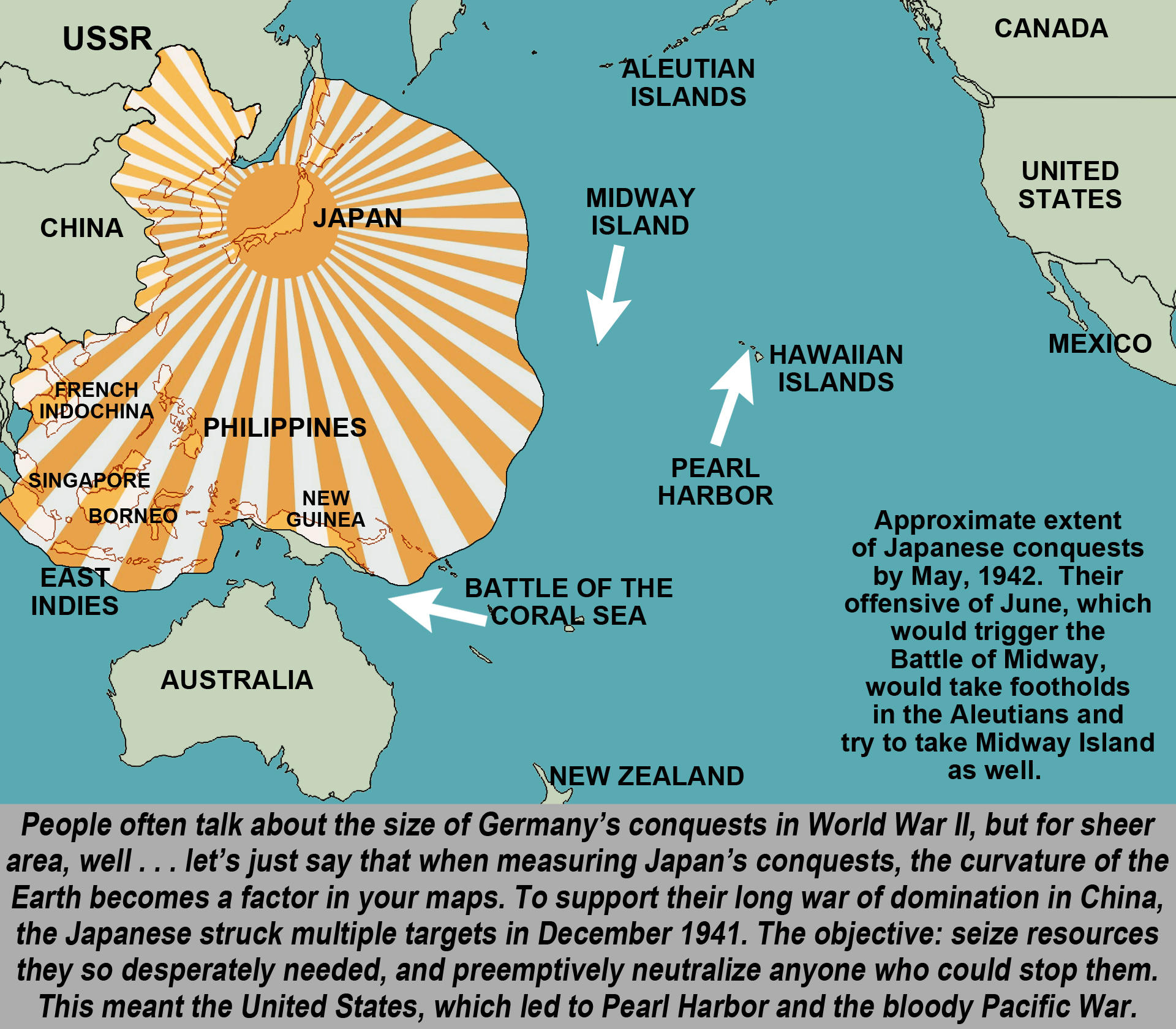
The true “turning point” is a rare beast. The Battle of Midway is one of these.
Welcome to our Commemorative 75th Anniversary article series on the Battle of Midway, fought between the United States and Imperial Japan on the high seas of the Pacific in June 1942. The series will encompass five articles, presented by myself (@oriskany) and Beasts of War member @ecclesiastes (Hendrik Jan Seijmonsbergen).
A New Kind of Battle
The Battle of Midway, at its most fundamental level, was a naval battle fought between Japanese and American aircraft carriers. This was a new type of naval battle, largely putting to rest the plodding gunnery duels fought between battleships that had dominated naval warfare since the Spanish Armada almost 400 years before.
Now, of course, people will mention the Battle of the Coral Sea, also fought between Japanese and American carriers, fought the previous month (May 1942). And others will bring up strikes like Taranto, Pearl Harbor, and the sinking of HMS Repulse and Prince of Wales, all of which featured aircraft carriers and took place before Midway.
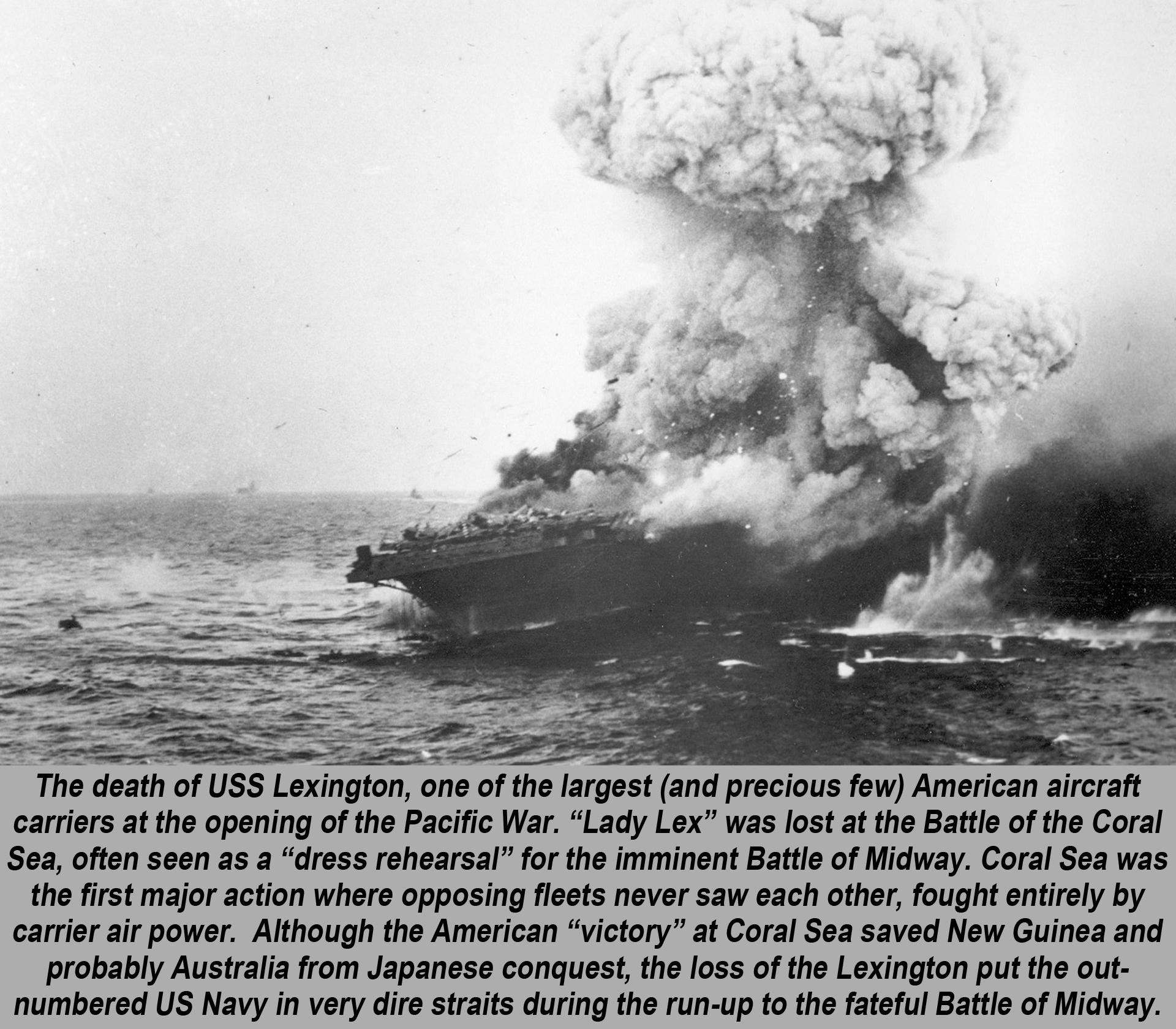
While certainly revolutionary, Coral Sea was much smaller and at the time almost considered a fluke. Midway would “confirm” what the Coral Sea had “proposed.” And actions like Taranto and Pearl Harbor were strikes, Midway would show that aircraft carriers would form the cornerstone of set-piece naval engagements from here on out.
A Wargamer’s View
Wargaming the Battle of Midway poses a number of challenges for the intrepid hobbyist. Fortunately, BoW community member @ecclesiastes has put together “Naval War” - a great system which can be used to recreate the most pivotal parts of this pivotal battle.
Naval War is a freely available, print-and-play naval miniatures game, designed expressly for World War II naval engagements, available here: https://www.naval-war.com/. For anyone with even a passing interest in WWII naval combat, I cannot urge you strongly enough to check out this innovative and evolving system.

I’ve seen a lot of WWII naval wargames, but this one really seems to nail the “sweet spot” between playability and “nutz-n-boltz” historical realism. This, combined with Hendrik Jan’s absolutely epic miniature warships as seen on Beasts of War, convinced me to reach out to him for collaboration on this Midway project.
Even with the best miniatures and rules in the world, however, the Battle of Midway presents some tall obstacles. First up is the scale. Because these battles were fought almost exclusively by aircraft launched from carriers, there were always hundreds of miles between opposing task forces that never actually saw each other.
For this reason, it’s probably a good idea to also have a larger “area” map, where the positions, headings, and speeds of both sides’ naval task forces are tracked. This way the battle could encompass the vast emptiness of the Pacific, zeroing in on the table when the aircraft, submarines, or even surface warships come to grips with the foe.

Another factor that should be taken into account for a Midway wargame is scouting. In these Pacific carrier battles, the first task for both sides was simply to find the enemy. In a day before recon satellites or even reliable long-range radar, fixing a moving enemy fleet’s location amidst a quarter million square miles of ocean was never easy.
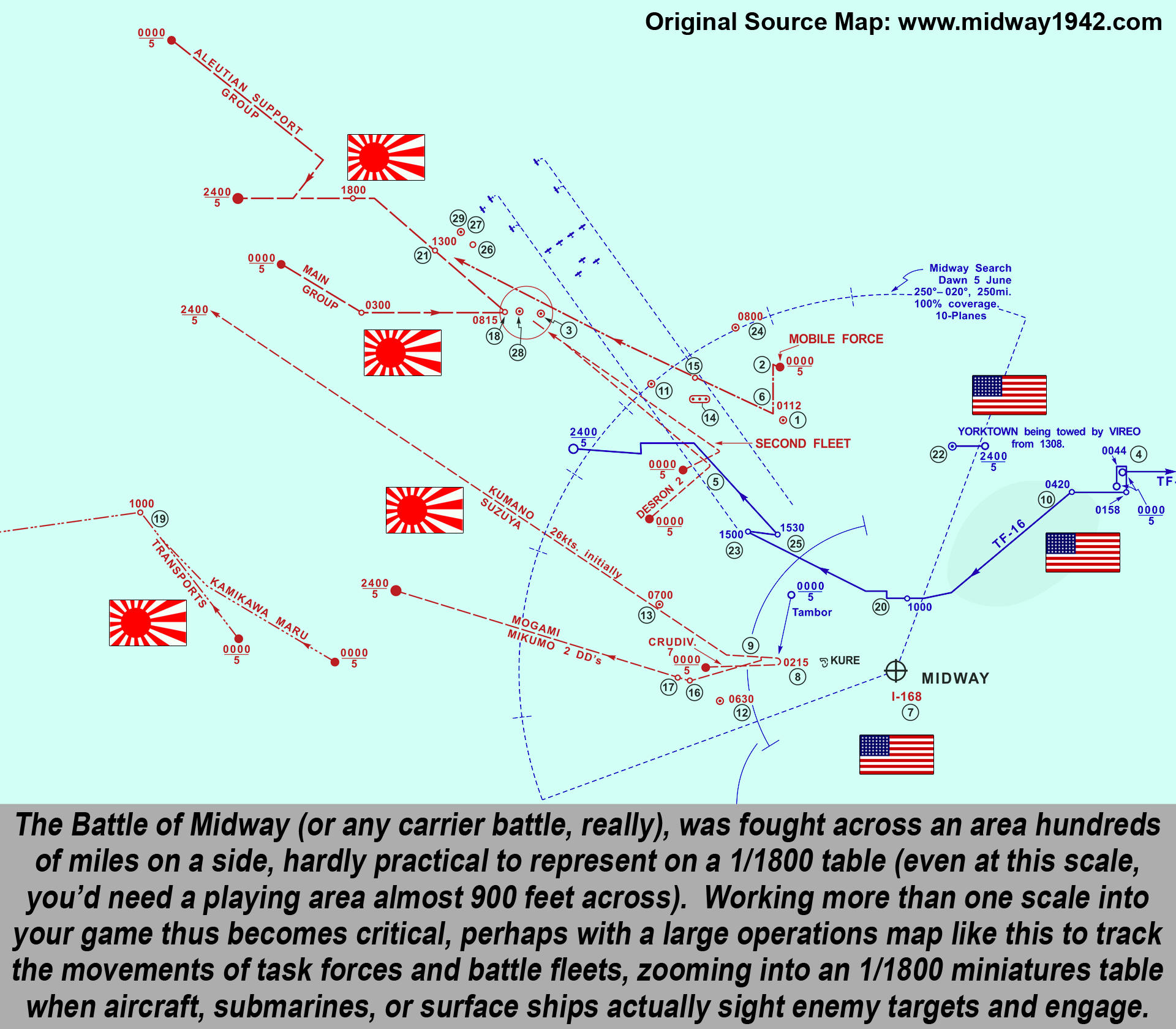
Yet finding and tracking an enemy task force was as vital as it was difficult. Whether through search plane, surface picket ship, or submarine, finding the enemy meant your side could launch that all-important first strike. Meanwhile, you had to naturally do whatever you could to keep the enemy from finding you.
Pacific War Background
Before “cutting into the meat” of Midway, perhaps we should review just the briefest summaries of the Pacific War and discuss the background of how Midway fits into the larger context.
Since at least 1937, Japan had been engaged in a war of conquest in China. Japan, however, is not an island blessed with an abundance of natural resources, and soon Japan’s ability to sustain the war came into doubt. The situation only worsened when the United States placed trade embargoes on Japan in protest of their invasion of China.
Yet many of these resources could be taken from places like the French and Dutch colonies in south-east Asia and the East Indies, especially once France and Holland fell to German occupation in 1940. Any move against these territories, however, would be countered by the Americans in the Philippines and British in Singapore.
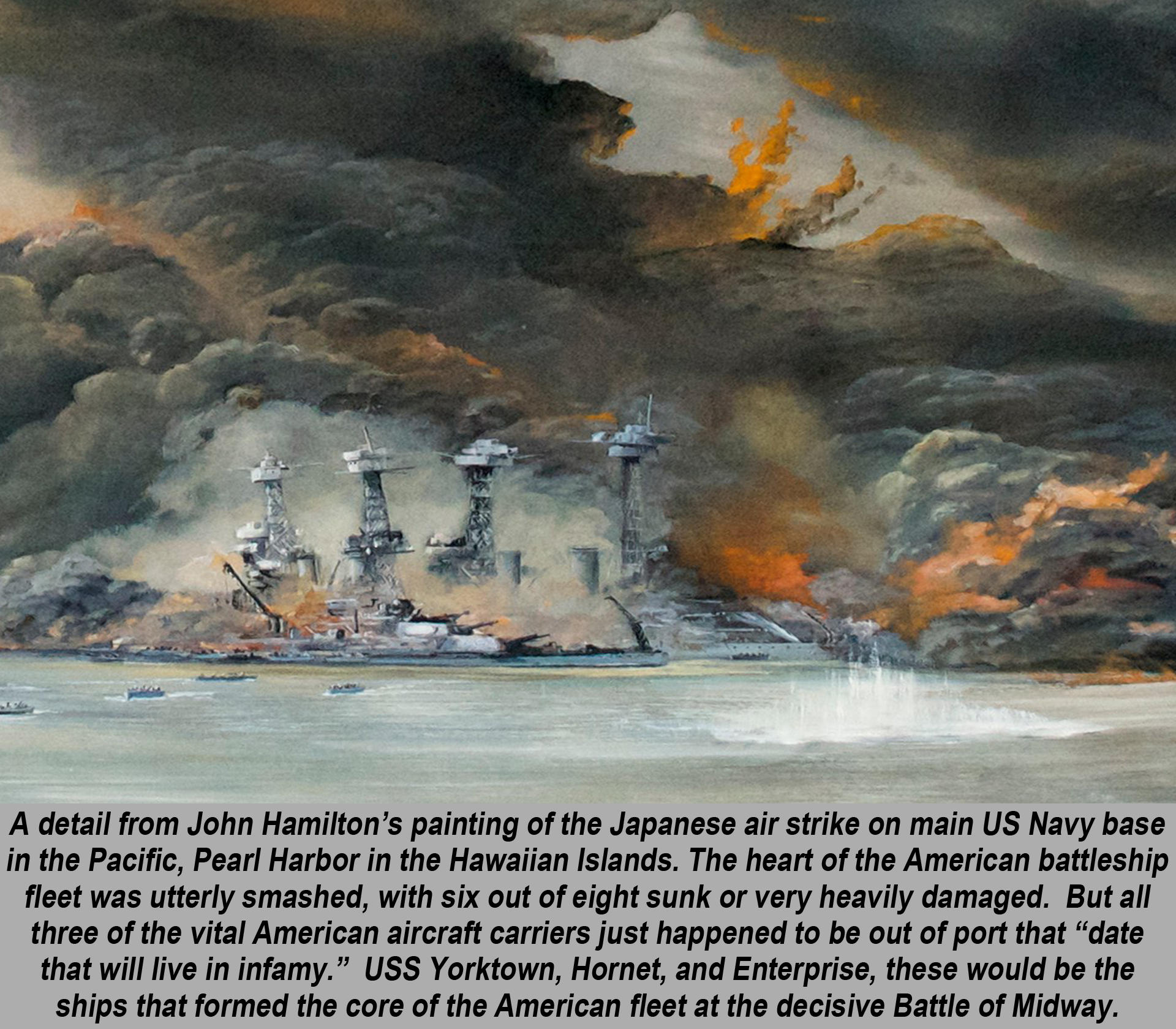
For the Japanese, the solution was simple. Hit the Americans and British first. Thus, in December 1941 we have the infamous surprise attack on Pearl Harbor, the invasion of the Philippines, and the invasion of Malaya, which culminated in the fall of Singapore (by some measures the worst military disaster in the history of the UK).
For at least six months, the Japanese seemed unstoppable. They invaded the Dutch East Indies and crushed a combined US/UK/Dutch naval task force at the Battle of the Java Sea. They invaded Burma and penetrated as far as modern-day Bangladesh. The overran tens of thousands of individual islands, defeating the Americans everywhere.
Soon, Japanese troops were in New Guinea and Australia was being bombed. American and Australian resistance on New Guinea was about to be outflanked as the Japanese swung an invasion fleet around the island’s east tip, hoping to land at Port Moresby on New Guinea’s south shore.
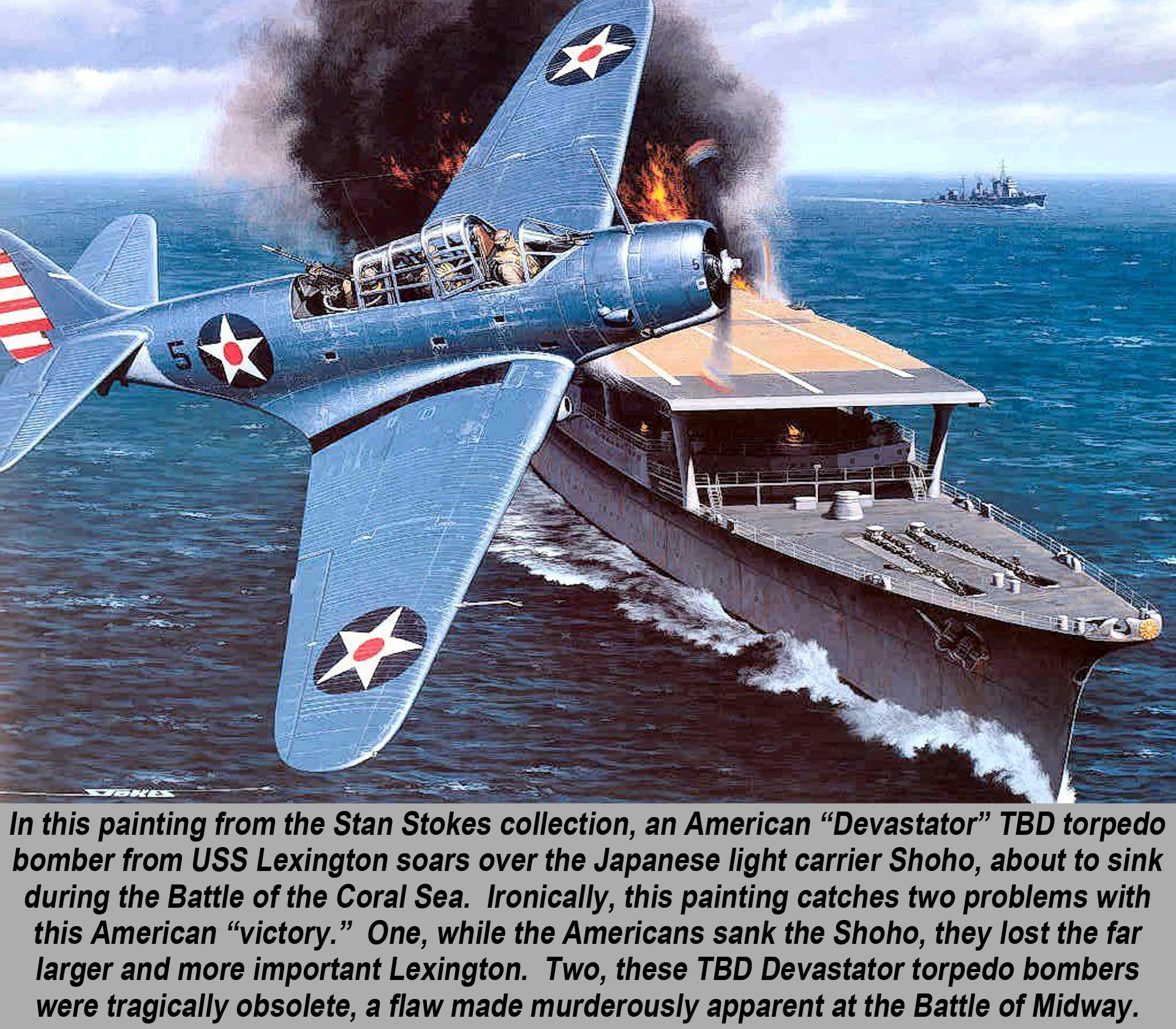
Such an invasion would have spelt disaster for the Allies, potentially opening Australia to a full Japanese invasion. But the Japanese invasion fleet was turned back in May of 1942 at the Battle of the Coral Sea, where opposing battlegroups built around Japanese and American aircraft carriers engaged in the first true “carrier” naval battle.
Technically, the Japanese won this battle, sinking the large American fleet carrier Lexington in exchange for only a small light carrier, Shoho. Nevertheless, the Japanese troop transports were forced to turn back, and for the first time in World War II, the “Japanese Blitzkrieg” had actually been stopped.
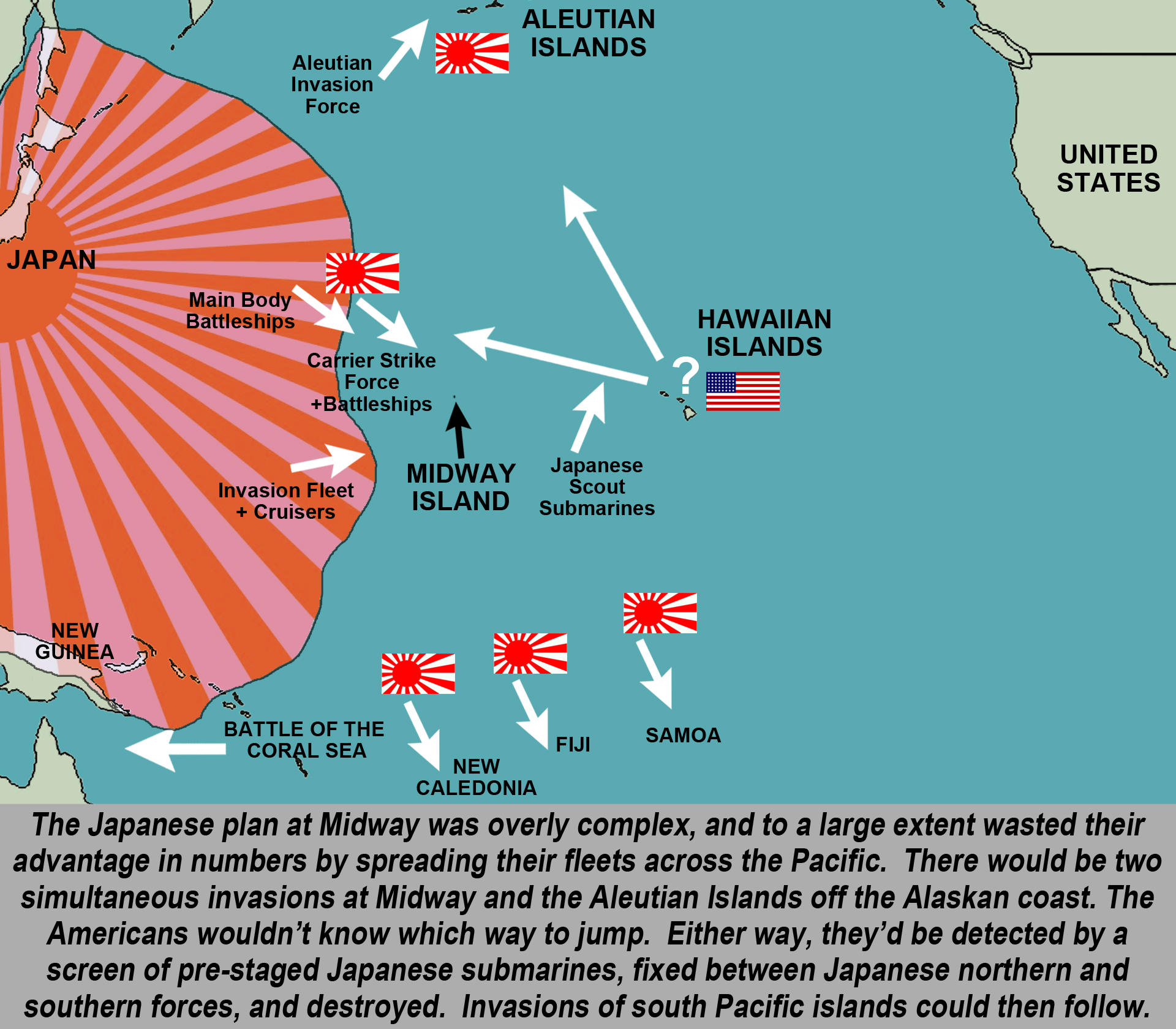
Thus, the Japanese began planning to destroy the American aircraft carrier force once and for all. They formed a complex plan based mostly on bait and deception, designed to force all remaining American aircraft carriers into a lethal trap. Japanese dominance of the Pacific could then be assured for years.
Midway: The Plan
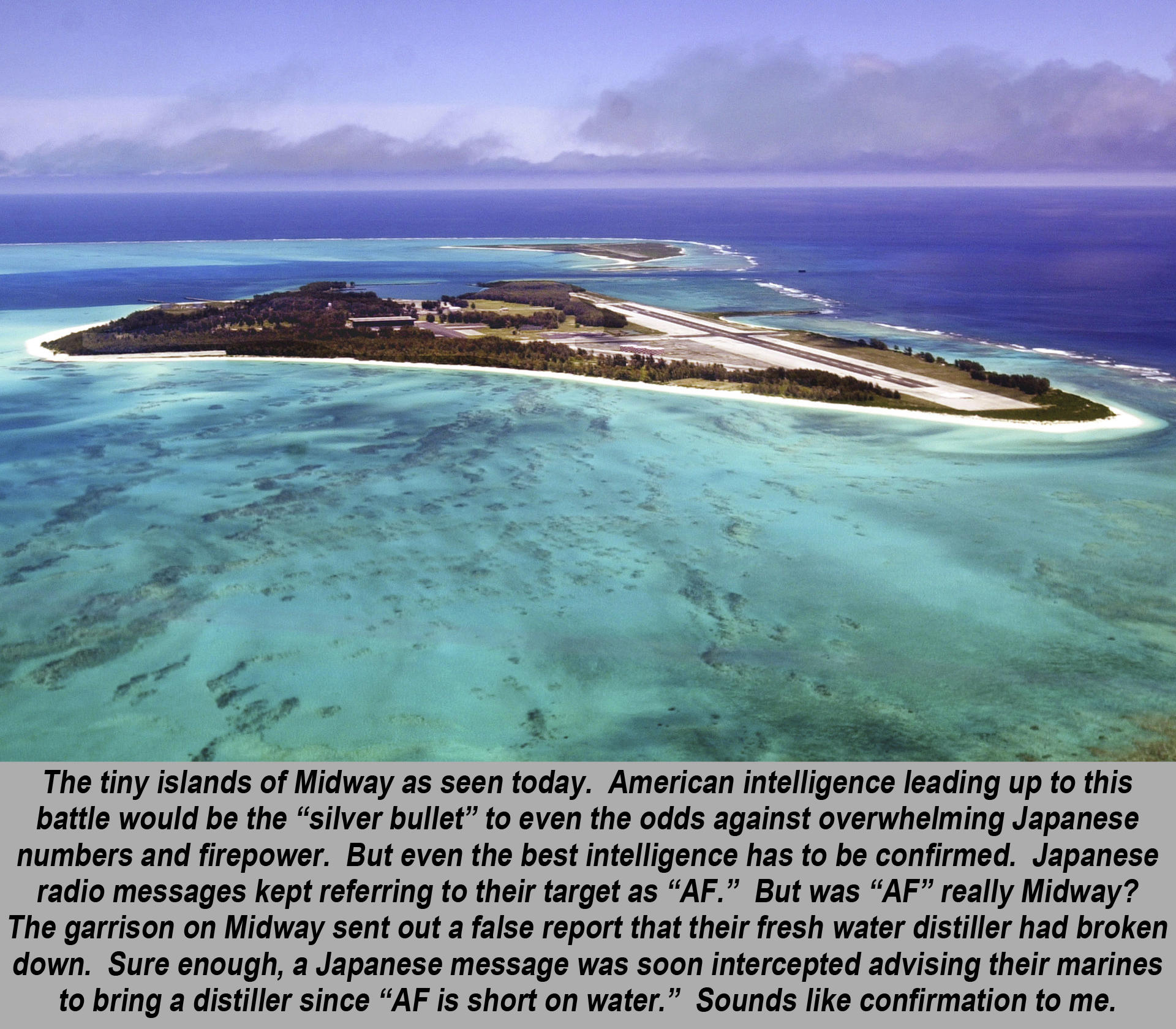
The main Japanese target was the Midway Atoll, a tiny cluster of islands smack dab in the middle of the Pacific Ocean (as its name suggests). Technically part of the Hawaiian Islands, possession of Midway would put Hawaii (and Pearl Harbor) within reach of Japanese invasion. This was a target the Americans HAD to defend.
To tilt the odds in their favour, the Japanese would also invade two tiny islands on the end of the Aleutians, far to the north off the tip of Alaska. Japanese footholds on North America was another nightmare it was thought the Americans could not allow, and would hopefully divide the American response to the real threat at Midway.
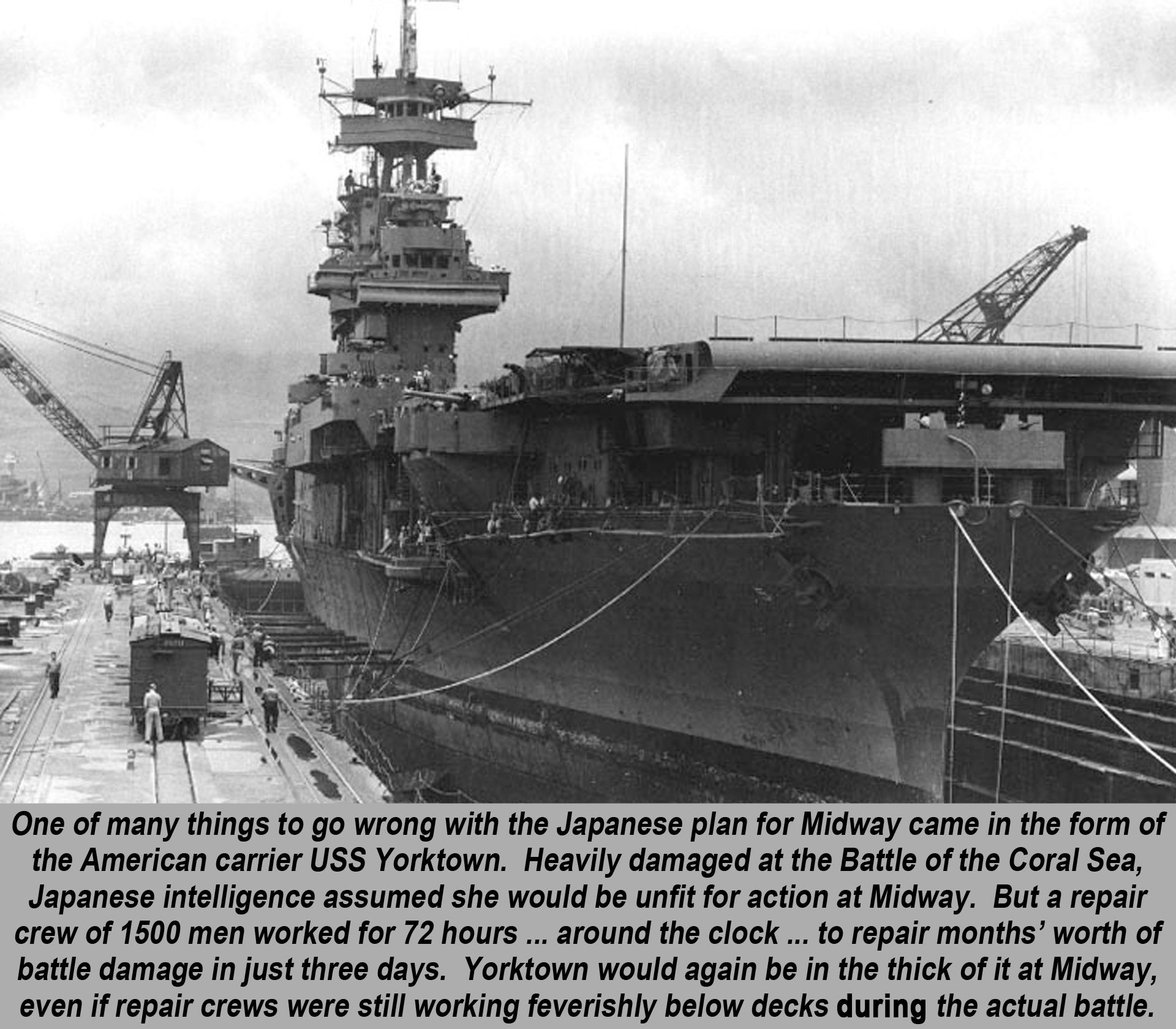
There were three basic problems with the Japanese plan, however. First, it was very complex (we’ve sketched it only the very broadest of strokes here), and complex plans are prone to failure.
Second, the Japanese wouldn’t be striking with their full force. Of their original six carriers that had hit Midway, two had fought at the Coral Sea. One was badly damaged and one had lost almost all of its air group, and since a carrier without aircraft is little more than a gigantic target, the Japanese would have just four carriers at Midway, not six.
Three, the Americans knew everything because they’d broken almost all Japanese naval codes. Just like the British with the German Enigma codes, the Americans were reading “enemy mail” almost as fast as the Japanese were. So the Americans weren’t falling for any traps at Midway, and in fact were hoping to set up an ambush of their own.
Of course, we’re just getting started. In the next part, we’ll look at the opening moves made by both sides at Midway, and look at some of the opening actions through the eyes of Hendrik Jan’s “Naval War” wargame system.
We hope you’ve enjoyed this opening look at wargaming the Battle of Midway. In the meantime, please drop a comment below with your own thoughts on Midway, the Pacific side of World War II, or naval wargaming in general.
After all, what better time for this conversation than now, the 75th Anniversary of what was probably the most decisive naval battle in the last 200 years?
If you would like to write an article for Beasts of War then please contact us at [email protected] for more information!
"This was a new type of naval battle, largely putting to rest the plodding gunnery duels fought between battleships that had dominated naval warfare since the Spanish Armada almost 400 years before..."
Supported by (Turn Off)

Supported by (Turn Off)
"In the next part, we’ll look at the opening moves made by both sides at Midway, and look at some of the opening actions through the eyes of Hendrik Jan’s “Naval War” wargame system..."
Supported by (Turn Off)









Excellent article guys really makes me want to go grab some ships.
I’m always blown away by the US ability to both build lots of things and repair lots of things quickly. Although I’m more impressed with their ability to totally modernise their factories and make other countries pay for it. Genius.
So were U-Boats more of a scouting unit since there weren’t a lot of transport ships moving resources around? I mean once you have the codes Subs are pretty screwed but I imagine the temptation to torpedo an aircraft carrier would be pretty huge for the Japanese especially since being a submariner was a suicidal job as is.
Can’t wait to see the rest
In line with the Japanese idea’s of a ‘Decisive Battle’ they also put their submarine forces completely in service of this concept. So eventhough the US and Australia had very long and busy supply lines, the Japanese chose to commit their submarines to hunting down the ‘big fish’ instead of the honorless job of commerce raiding.
It did net them some impressive results, torpedoing and sinking the carriers USS Yorktown and Wasp, cruisers USS Indianapolis USS Juneau and damaging USS Saratoga (multiple times), USS North Carolina and loads of other warships. But considering the size of their submarine fleet (much larger than Germany’s at the start of the war) their potential has mostly been wasted on fighting warships instead of trying to strangle allied supply lines.
Thanks, @elessar2590 –
The US and Japanese navies indeed had markedly different ideas about how to use submarines. As @ecclesiastes has noted, the Japanese seemed to view them as “fleet combat vessels,” sinking enemy warships when and where they could. The US took a more German “U-Boat” approach, using them to strangle enemy merchant and logistics shipping.
But whereas the Germans failed to accomplish this with the UK, the Americans were much more successful with Japan. “Last Hundred Days of WW2” has reports of American submarine skippers engaging wooden junks with torpedoes and guns because the Japanese have nothing else left in the war or merchant shipping.
So successful, in fact, that when Admiral Karl Doenitz was on trial for war crimes in the North Atlantic, he was originally sentenced (or about to be sentenced) to death by hanging. A letter from American Admiral Chester Nimitz (CinC Pacific Fleet) warned not to condemn him to death, because we were doing the same thing in the Pacific. The tribunal amended the sentence, I think to 10 years.
“Although I’m more impressed with their ability to totally modernise their factories and make other countries pay for it. Genius.”
Not sure I understand that part. 😀 Are we talking about the trillions of dollars spent by the US to rebuild and modernize Japan, Germany? Or the “modernization” of American factories largely through use of war bonds?
Thanks guys I’ll have to do some more reading.
The modernisation thing was more of a WW1 comment than a WW2 comment.
Thanks very much for the comments! 😀 And not to spoil anything, but a Japanese submarine does in fact play a pretty major role at the end of the battle.
Thanks for the article, looking forward to the rest of the series. Thanks also for the naval game mechanics, only ever played Axis and Allies and Dystopia, so looking forward to another naval game.
Feel free to give it a try, the ruleset is free, so you can just put down your Axis & Allies War at Sea miniatures (Soryu as shown in the article picture is a repainted A&A War at Sea miniature) and get going!
The thing that impressed me about Naval War the most was its balance of complexity. I touched on this in the article and tried again in the interview. I don’t know what i t is about nval wargames, but almost every WW2 naval wargame I’ve tried is either too simple (Avalon Hill War at Sea, Axis and Allies War at Sea, Avalon Hill’s Midway)or waaay too complex (Avalon Hill’s Flattop, Larry Bond’s Command at Sea).
Naval War seems a great landing point right in the middle, the “Goldilocks Zone” of naval detail and complexity and depth vs. accessibility and clean game design. 😀
Great start. Looking forward to the rest of the series guys 😀 .
Thanks very much. @kantor72 . 😀
Id really like to play ,I’m going to have to ask my play group about it.
Clearly the start of yet another excellent article. Thank you for the heads up on Naval-War, a great web site and brilliant downloads. Looking forward to part 2.
Awesome, @gremlin , glad you liked it! Things start heating up in Part 2, and positively explode in Part 3. 😀 Some of @ecclesiastes ‘ photos at the end of Part 2 are really awesome.
Excellent read.
Thanks very much, @andre77 – Not exactly the sand-blown deserts of El Alamein, is it? 😀 Gotta keep changing things up to keep it interesting.
It takes something like this to emphasise the sheer scale of the engagement. Reading about naval battles is one thing, but it really does need to be broken down like this ( for me ) to properly take in the mile upon mile of ocean that these ships could ” lose ” themselves in.
Thanks very much, @kantor72 . 😀
Indeed the vastness of even this immediate “corner” of the Pacific is a little tough to grasp for those more accustomed to land battles or traditional wargaming. Speaking for myself, I found it surprisingly difficult to find source maps that actually had a SCALE in miles, kilometers, or nautical miles . . . only because the latitude and longitude measurements do not cross at perfect right angles or form a grid of perfect squares. The distance between two longitude lines at the north end of the map is significantly different than at the southern end of the map … I wasn’t kidding when I wrote “the curvature of the earth is a factor in your maps.”
Of course, this kind of scale is another issue with the Japanese plan and how the battle eventually turned out the way it did. The Japanese largely diluted their tremendous edge in numbers by spreading their fleet out in too many areas. The Aleutian Invasion force is bad enough, but even among the formations detailed to the core of the Midway operation you have at least four major forces – the Main Body, the Carrier Striking Force, Kondo’s Second Fleet, and the actual Midway Invasion Force.
Spread these fleets across 100,000 square miles of ocean and not only to you increase the probability that an American search plane or sub will run across your force, but also ensures they can’t support each other.
This kind of thing really comes into focus when you set up even the most basic of operational maps. With just a blue hex grid from a desktop printer, I made the most basic of “maps,” measured out the actual size of the engagement area, the speed of the ships, and factored all this into a time scale of four hours per turn. Spread the fleets out to their historical positions, speeds, courses, and missions, and just try to concentrate a powerful enough force against the Americans, who have been set up along the same lines of historical measurements. It’s really tough to do. By the time any Japanese battleships can get close to Midway, they’re almost always hit at least four or five times by American fighter aircraft. And Midway can’t move. Japanese battleships trying to push toward the American carriers is hopeless because not only can the American carrier planes bomb and torpedo them regularly, but the American carriers can also retire to keep a safe distance (just as they did during the night of June 4-5).
Conversely, I’ve found that if you keep the Japanese forces more concentrated, American airstrikes have a much tougher time. More AA fire means more protection for Japanese carriers, and keeping the Japanese carriers close to the battleships and troop transports means they have a much easier time of reaching Midway.
Again, it’s all about the distances and scales involved. Almost like more “realistic” space sci-fi games / movies / novels.
More on Japanese prospects in the “what if” parts of the series. 😀
Can you imagine what it’s going to be like once we get to space ?
The ocean is big, but it’s nothing when compared to finding anything in space.
I’ve done some pretty serious wargame design in space, basically an “excuse” to fight naval battles that never happened. 😀 We were talking about it on another thread.
Meanwhile, a series of books that really captures the sheer scale of space and what that would mean for naval operations is “Lost Fleet.” Not too sure about these series overall, but how they handle speeds, how the limitations of the speed of light actually effect weapons engagement ranges, communications, sensors, and navigation, and those kinds of things is pretty well handled.
I love reading / talking about the ‘ what if ‘ scenarios from an engagement in any era, this is going to be a great overall read 😀 .
Awesome! Well, we’re on every Monday for the next four weeks. Hope you keep reading, enjoying, and commenting. 😀
Hey Oriskany, Warren, and Justin. Check out this video about my Uncle Francis Rouse. He tells his strory. He was in the thick of it during the Battle of Midway. A true war hero.. I’m proud to be his family member.
https://youtu.be/hTl0lxteyBU
Awesome stuff, @thehumungus . The Yorktown is indeed one of those ships that needs to b e remembered in the history of the US Navy forever.
Awesome video. Thanks for the link.
😀 The viewpoint of veterans is always a priceless part of the historical perspective.
Indeed.
I’ve always lamented that we haven’t had more WW1 and WW2 veterans talking about their experiences. And the fact that so much material was scrapped right after WW2.
I fully understand that for many veterans it might by painful memories they’d rather forget. But soon we won’t have any living memories from those conflicts left, and then what? Do we just let it pass into myth and legend?
It’s vitally important that as much material as possible is collected and preserved, least we forget the horrors of those wars and set out to repeat them.
Absolutely. I carefully wrote “The viewpoint of veterans is always a priceless part of the historical perspective” because, to be honest, people who were there and experienced much intense events almost can’t be objective. They’re also usually too close to the event to get the wider picture. Memories fade, emotionalism creeps in, old grudges die hard, etc.
BUT, they are still the most precious historical perspective because of their rarity and limited time. No one is “making” WW2 veterans anymore 🙂 but we’ll always have plenty of armchair historians tapping away at keyboards and endlessly repeating each other (like this @oriskany guy, God he talks too much). 😀
I fully agree that every effort should b e made to record and preserve their thoughts and perspectives.
It will always be biased, yes. But on the other hand, it’s an account of how the war was experienced by the guy down in the trenches.
I mean…
Reading historical books we get an overview of what happened and why. But how did it feel? What was it actually like to walk ashore on D-day or sitting in a Panzer IV at Kursk?
Lately I’ve been reading a lot of memoirs. Makes the war feel more real, if that makes sense?
Yeah, you totally need both kinds of viewpoints. The difference is, we’ll ALWAYS have access to the one. For the other, we need to get all we can, while we can. 😀
I once heard a story (not sure if it was true) about how the Japanese played a wargame to simulate the battle.
They eventually managed to win, but only because they ‘cheated’
IIRC their admiral deployed one more carrier than they had.
Yes, @limburger – the Japanese Navy Operations staff did “test” the plan with wargames repeatedly. I don’t know if the added any additional carriers to their “wargame fleet.” It’s definitely possible. The Japanese actually had SIX fleet carriers at the time, (Akagi, Kaga, Soryu, Hiryu, Shokaku, and Zuikaku), but only four would be deployed at Midway, The remaining two (Shokaku and Zuikaku) had been at Coral Sea, Shokaku took heavy damage and Zuikaku took heavy damage to her air group.
It’s possible the Japanese planners hoped at least one of these carriers might be repaired sufficiently in time for participation in Midway? Hence the “extra” carrier? Totally guessing on that.
I have definitely read, however, that these wargames were not “honest” or “fair.” One play-through had American land-based bombers from Midway hit and sink two Japanese carriers. The result was determined to be “unacceptable” and disregarded by the game’s referee.
As far as I recall, during the wargames the “american side” deployed bombers from Midway which ended up doing a fair bit of damage to the Japanese fleet. The umpires overruled that and the invasion progressed anyway.
Still going by my fuzzy memory, it actually turned out to be accurate as the Americans did indeed deploy Midways bomber fleet (which also had the advantage of getting them off the island before the Japanese attacked) but they failed to damage the Japanese fleet.
@warworksdk – you are correct on both counts, sir. The Japanese planning wargames before the battle once produced a result where American land-based bombers sink two Japanese carriers. The result was tossed and ignored by the staff officer in charge of running the wargame – who basically said it could never happen.
Then yes, American B-17 heavy bombers, B-26 medium bombers, and SBD dive bombers attacked from the Midway. None of them scored a single hit and except for the B-17s, took incredibly heavy losses.
So maybe that staff officer was actually right. American land-based bombers were actually kind of a non-issue vs. Japanese carriers. (??)
More on this in Part 02, when we get into the initial approaches and “opening blows” of the battle. 😀
We’ll get to this… We’ll get to that…
Come on, man! Let’s get to the good stuff… 😀
Agreed, Part 02 is now up! 😀 This is a five part article series, there’s a lot to cover. And “all battles are won or lost in the preparation” after all. 😀
But yes, the high-level bombing didn’t do much. In fact, I can’t think of a single instance where it did.
Agreed 100% @warworksdk . During the Ste. Nazaire interview @johnlyons was mentioning where if a “stragetic” bomber landed a bomb within 3/4 of a mile of the aiming point, it was considered a hit. How try to hit an 800-foot target (a littler over 1/7 of a mile) while it’s moving at 30+ miles and hour and maneuvering violently to avoid being hit. Hardly surprising those B-17s didn’t hit anything.
Another great article and looking forward to the rest of the series.
I’ve generally steered clear of naval wargaming mainly due to the complex rules required to try to realistically reflect what happens. While I’m not against complex games, there are only so many rule sets that you can memorise and play and I think I reached that limit some time ago. Maybe it’s an age thing. But, I’ve downloaded the Naval War PDF and I’m looking forward to taking a look. I’m also tinkering with a fantasy naval game so it might prove interesting input to that.
I’m also interested in the strategic, high level gaming side of things. While the individual engagements are great, sometimes the high level stuff offers a completely different challenge. It’s also an area where technology can be more easily used to take care of the admin side. Done effectively, it can provide great narrative to a campaign and when used in conjunction with smaller engagements allow the shrewd admiral to gain the advantage before the battle begins. A game within a game
I totally know where you’re coming from, @redvers , regarding the over complexity of some naval wargames. While no one can fault the realism, depth, or technical nuance of games like Command at Sea and Harpoon (both designed by Larry Bond, former naval analyst who helped Tom Clancy write Hunt for Red October), and yes, I have played both, non-computerized versions. I think I was in therapy for a week afterwards. 😀
I agree 100% about looking at the higher levels of command in gaming. This is why we ran Midway at two different levels. But even my “big map” battle was only the operational scale. Strategic levels games (where the game is the whole war and the map would be the Pacific and a big slice of Asia as well) are, as you say, a whole new beast entirely.
I’ve played a fair bit of Hearts of Iron 3 on the PC which lets you control entire nations. Planning takes place on a global scale and thinking ahead to decide your strategy takes a lot of careful thought. You get the opportunity to control your fleets across vast swathes of ocean wile supporting your land units and ensuring their supply lines. I’m currently playing Germany and struggling across the vast Eastern front. Winter is coming and a break through is tough. But the level of planning and game time scales present a whole different challenge to table top gaming. And the PC can handle a whole lot of complexity that standard games just can’t.
I had always heard of Midway, but I honestly never knew why, among all the battles in the Pacific, this one was a bigger deal than the rest. This article summed it up nicely…Thanks! Of course, reading how complex it will be to “play” it properly, I’m glad I get to read about it and don’t have to do any of the difficult planning. Looking forward to the next installment.
Thanks @gladesrunner . Ehh . . . you can play Midway without getting too complex. Avalon Hill’s Midway boardgame is . . . adequate. Although some of its hidden movement and search plane mechanics seem distressingly like Milton Bradley’s “Battleship.”
“B-4 . . .”
“Miss! Ha ha! Okay, G-3!”
“Arghh! You sank my Battleship!”
It’s so good to see how much history facts you manage to put together, for people like me the simple folk.
Who know most of history through the eyes of TV programs, true (the world of war series) is actual history but films and tv series programs also excite.
But looking and reading facts helps a lot. When you know the person writing it (well i know your face lol).
Well don cant wait for more
World at War series is pretty awesome, especially for the time it came out. No axes to grind, no agendas, not TOO much bias (of course nothing can ever be complete spin-free) no conspiracy-based revisionism.
Another great one is the “Battlefield.” series. I think Part 3 of Season 1 is Midway. some people think it’s “boring” because they are 2 hours each and well into the second hour before the battle even starts. But that’s where the show excels, showing that the real decisive parts of a battle are often in the planning and preparation.
Thanks very much, @nosbigdamus ! 😀 Hope you like the rest of the series.
I really like the Battlefield series because each episode is so long. They can dedicate the first part to examining the reason why the battle was fought and who the fighters were. Then spend the second half actually looking at the battle itself, what happened and the long term consequences.
As I recall, they did two episodes on naval warfare in the Pacific and one in the Atlantic. Two very different kind of engagements.
Yep, @warworksdk – Seasons One definitely had one on Midway and I think one of the Battle of the Atlantic overall (U-boats vs. convoys, 1939-1943/44). Later seasons would also have one on the Solomons, I think (so that’s 4-5 naval battles right there), one on Leyte Gulf (largest naval battle in history).
But I totally agree, the Battlefield series is beyond epic. I usually chuckle politely (or not so politely) at TV documentaries for their sensationalism, poor fact checking, over-generalization, and just straight-out errors and omissions. Battlefield (and the later series they did, Battlefield: Vietnam) are the exception that proves the rule.
There are a few other good ones worthy of note. War and Civilization with Sir John Keegan and Walter Kronkite. Arms and Armour, etc.
I’ve got season 1 and 2 on DVD. I know they rebooted the series a bit later, but never really got into those.
I’ve got the Vietnam series as well, but I must admit I wasn’t quite as impressed with that as I was with the previous WW2 episodes.
The overall quality seemed a bit lower and the formula didn’t seem entirely appropriate to a conflict that should have been covered chronologically instead.
Still a good series though.
@warworksdk – Maybe we’re talking about different series. Battlefield Vietnam was covered chonologically, starting in Dien Bien Phu in Part 1 and ending with the last NVA invasion in 1975 in Part 12. 😀
There were a few parts that “stepped out of the timeline” and covered one aspect all together, like Air Operations / Rolling Thunder, etc.
I would agree, however, the original was best. But even the original WW2 Battlefield series starts to degrade a little as they march into successive seasons and they have to start covering smaller and more obscure campaigns (Scandinavia, Manchuria, etc).
That’s the series I’m thinking of.
Those out-of-chronology episodes really messed up the timeline. At least in my mind.
Or perhaps It’s just because I’m far more into WW2 than Vietnam. I’m finding it far easier to place the WW2 battles into the right time and place than I do with the Vietnam battles.
I think for me the Battlefield Vietnam series might stand a little higher in my mind (perhaps more than it “deserves”) is the general lack of other good Vietnam documentaries to which it can be compared. At least here in the US, Vietnam documentaries are usually a mixture of apologism, “told ya so,” and a complete lack of perspective from the NVA / NLF side. These are traps that BF Vietnam largely avoids.
WW2 has a lot more good or semi-good documentaries produced about it, I feel.
Good point.
It’s hard to find a documentary that treats Vietnam fairly from both sides of the conflict.
A Vietnam article series is always on my bucket list. I just have to build the armies for it. I have the start of some armies . . . just not enough for a full article series.
Maybe a 50th Anniversary of the Tet Offensive in January-February 2018. 😀
That’s not a bad idea.
I think…???
I’ve heard some – mostly US-based gamers – say that it’s too soon and too close to home. Maybe, for some, it is.
Interesting point. God knows I took some flak for the article series on Ukraine 2014-2015 War. Not from veterans, of course, nor anyone who lived in the Ukraine or knew anyone in the Ukraine. 🙁
But honestly, I weathered it and went forward. As a veteran myself, I’m hardly going to be stopped by that kind of thing.
Not to say I would ever do a series on, say . . . Syria. Definitely a no-fly zone for me. I’ve also thought about series on the Gulf Wars 1 and 2 and Enduring Freedom in Afghanistan (served during Gulf 1 myself). Again, I’ve held back on that for now … just in case. I still want to do it very much, though. But even if I did, rest assured it would be handled VERY carefully.
But we’re rolling out article series on 50th Anniversary of the Six-Day War soon . . . 50th Anniversary. Tet would be a 50th Anniversary as well. 50 years?
I’m certainly not saying there’s “not a line.” I just think different people might place that line in different places. Who knows? Full Metal Jacket came out before Tet was 20 years back. Apocalypse now when it was barely 10 years back. Beasts of War did a season of Flames of War: Tour of Duty (Vietnam) in 2013, I think.
Anyone who reads my work knows I’m not a “beer and pretzel” gamer who does it “just for fun.” For example, I don’t do games like Konflikt or Dust … honestly I find them a little … off-putting. Any conflict I choose to cover in the future is going to be covered with utmost respect, objectivity, and tact.
People who have a problem with that, well, I’m sorry. I can’t change their minds on that, and they have the right to their opinions. 😀 So do I.
Oh crap. That wasn’t supposed to be all bold like that.
a nice start to a navel saga I remember the AF reference from the film.
“AF is short on water!”
😀
One of the many things that film gets right. 😀 Of course, still just a movie. But much more forgivable than most. Hey, at least it tries to be fair.
Thanks for the comment! 😀
Look forward to the next one where we get to the real action
Impatient, are we? 😀 Just kidding, @rasmus . Thanks for the comment! Part 2 does have some serious action in it, but Part 3 is where thing really cook off.
Except for constant comments about George Gay Fightin Texas Aggie, this was straight out of WWII at the 300 level. Good job buddy.
Thanks, @ghent99 – I presume you’re talking about Ensign Gay, TBD Devastator Pilot from USS Hornet. You know, I never knew where he went to school (Texas A&M evidently). Awesome! Thanks again, and I hope you like the rest of the series. Check in next week to see how Torpedo Squadron Eight does in its attack against the “Kidō Butai” carrier group – although it sounds like you might already know. 🙁
Yeah our prof that semester and his only at Purdue after calling the French surrender monkeys in front of the dept head. Seriously did a whole lecture on him, it was awesome.
Just looked him up, he ended his career as a Lt. Commander. Flew airliners for 30 years, wrote a book, and was a consultant for the 1976 movie Midway. Awesome.
Great article. I cannot wait for the rest of the story since I am a big fan of WW II naval battles. I have read extensively about the Coral sea and Midway battle and to make a realistic naval battle game about them is fantastic.
Thanks, @silverfox . Coral Sea is indeed an interesting prequel to Midway, and really sets the tone for how Midway would unfold (first “carrier battle” where opposing ships never saw each other, etc.).
Thing is, as BoW Historical Editor I’d already “missed” the 75th Anniversary of Coral Sea, and because historical naval battles are a little out of the BoW mainstream, it usually makes sense for us to at least start with what’s really famous and most members have heard of (i.e., Midway).
No reason we can’t go back and do Coral Sea, though. Maybe in the forum thread that we usually start to support these articles. That’s actually a hell of an idea. Thanks! 😀
I, for one, would love to see more historical wargaming on BoW.
You and me both, @warworksdk , and @warzan too. 😀 He brought me on as Historical Editor so we could try to make this happen.
+100 for this comment. 😀
Let me know if you need help. I’d love to see historical warfare get more coverage.
Thanks, @warworksdk !
My “Achilles Heel” on this kind of coverage is miniatures and photos. This is what made @ecclesiastes ‘ help on this Midway project so vital. I can write about Napoleonic battles, for example, for weeks at a time, but I have no Napoleonic miniatures so I can’t take good table photos.
And no, I don’t troll through Google Images and just grab gaming photos from other sources. That’s borderline illegal, and the last thing I want is to get anyone in trouble. Even paintings you’ll see in this series I’m always careful to attribute to the artist and owner of the work. Other than that, all images are either mine, or another BoW member like Hendrik Jan. 😀 Lots of others have helped me in this regard in the past. (BoW: chrisg, unclejimmy, piers, nakchak, commodorerob, broadsword, etc).
So if you, your friends, or your club have good historical miniature armies or navies pertaining to a period / conflict you’d like to see covered, let’s talk! 😀 I’m always open to PM.
No problem. 🙂
I’ve been looking at buying some 1/6000 scale ships from Magister Militum. Why 1/6000? Because the a 4′ x 6′ board is approaching a somewhat reasonable scale for battleship engagements.
I really want to play some naval action. Just don’t have anyone to share that passion with in the local club… 🙁
Been looking at getting into Battlegroup as well. Got a lot of Battlefront figures stashed away unpainted. Just lost my mojo og Flames of War. Too unrealistic and too much stuff on the table at once.
Got a handful of Napoleonic players in the club. But their preference is 28mm and I’m more not really interest in that scale. Takes too long to paint and doesn’t feel “scale-right” (is that even a word) on a 4′ x 6′ table. Would much rather get into it at 15mm, but ehhh… What can you do?
WW2 really is my passion, but I’ve recently started digging into other periods. So many interesting battles throughout the ages.
Wow, 1/6000. Makes sense, though. At that scale a 6′ table = 36000 feet, or 12000 yards, or 6 nautical miles. Man, at that point it’s almost time for hexes and counters. 😀
Yeah, it’s really small.
I kinda like small though. Easy to paint when you don’t have that many details to worry about.
But for me, having a sense of the right scale is quite important to my enjoyment of tabletop gaming. This isn’t World of Warships where battleships are trading broadsides at 100 meters.
Well…
To be honest, it’s still a bit cramped for battleship-on-battleship action, but any smaller and you’d need a magnifier to see destroyers so… :-p
@warworksdk – I think those tables might work pretty well, at least for WW2 gun battles in the Pacific. In a war dominated by aircraft carriers, most of these gunnery duels (and there were quite a few) took place in narrow, confined waters like Suigao Strait, Savo Island, Guadalcanal, the Slot, etc . . . and almost always at night (when carrier based aircraft couldn’t fly in those days). Ranges were pretty short. Unlike some of the daylight gunnery exchanges like Hood vs. Bismarck, etc.
Personally, I’d prefer to avoid having carriers and aircraft on the table.
They would end up acting like artillery in Flames of War, operating at an unrealistic short range. And let’s be honest, if you allow the enemy surface ships to engage your carriers you’ve really goofed.
If I were to use aircraft I think you’re on the right track with having a large-scale map to show the movement of carriers and aircraft.
But mostly, I’d like to concentrate on ship-to-ship action, both real and hypothetical.
I mean…
Don’t we all want to know what would have happened if Tirpitz had left her lair and gone convoy hunting… 🙂
@warworksdk – yeah, if you want to leave aircraft out of it than hypotheticals and / or night battles are the way to go. Hypothetical battles like the Tirpitz commerce raiding, or maybe Scharnhost too, up against the Arctic convoys to Russia (sometimes escorted by battleships, if memory serves – i.e., HMS Duke of York vs. Scharnhorst).
Up in those arctic storms, maybe the weather is “just too bad for aircraft” while battleships and heavy cruisers plow through the frosty seas to exchange gunnery broadsides. 😀
There’s solid historical basis for these kinds of battles: Battle of Barents Sea, Battle of North Cape.
https://en.wikipedia.org/wiki/Battle_of_the_Barents_Sea
I was thinking of doing a what-if mission based on the PQ 17 debacle in which the Kriegsmarine did indeed oblige the Royal Navy and came out of the fjords to fight.
Could be an interesting scenario with the Germans ambushing the convoy, only to be ambushed themselves.
Yep, I was actually thinking almost the same thing (when I was doing some quick fact-checking to make sure I had the right British battleship vs. Scharnhorst).
http://www.naval-war.com would be perfect for that kind of engagement. 😀
I’m more familiar with WWI naval battles than WWII, but I can remember hearing about how the Battle of Jutland was described as the the last proper battleship engagement in history due to the advances in technology and tactics.
Now, I know why!
Oriskany, I remember you saying on the Weekender, that a carrier could send out 10 sorties in the time that the big ships would take to get into gun range; yep coastal bombardment only from now on for you guys…
Yeah, @chillreaper that “10 sorties” might have been a bit of hyperbole, but definitely a lot. At Midway, say we have Kondo’s Second Fleet (built around two battleships and four heavy cruisers) heading toward the American carriers of Task Forces 16 and 17. Say they start from 250 miles away before they’re spotted. Assuming a SUSTAINED speed of 20 knots, it would take them about 10 hours to come to blows with the American carriers, in which time (assuming this is daylight), the Americans could hit that force at least 3 times (accounting for flight time over a decreasing distance, recovering strikes, rearming,and re-launching strikes).
That’s IF Kondo’s battleships could find and track the American carriers with its own float planes (unlikely in the face of American fighter defenses) and IF the Americans simply didn’t turn around and steam away from the approaching Japanese dreadnoughts while not launching and recovering strikes. Probably enough to stretch that out to 20 hours or more, potentially stretching this to six strikes, ten, or even more (so maybe “ten strikes” wasn’t hyperbole after all). 😀
In any event, the survivability of a force built around two battleships and four heavy cruisers (add a light cruiser and a screen of destroyers) isn’t great. Granted, Second Fleet did have a light carrier Zuiho with some A6M “Zero” fighters for defense, but not a lot, certainly not much against three successive strikes mounted by three fleet carriers (Hornet, Enterprise, Yorktown), so basically being hit by “nine” carriers.
I would agree that Jutland was the last “big” battleship battle. The last time battleships fired at each other in combat was the Battle of Surigao Strait (October 1944, part of the Battle of Leyte Gulf). Nowhere even CLOSE to Jutland’s size, of course. A real favorite of mine, although I admit I am biased and it would make a terrible wargame (:D), as it’s a very one-sided battle. Most of the American battleships sunk or heavily damaged at Pearl Harbor have been raised, repaired, modernized three years later, and “cross the T” on a Japanese battleship group coming up through a narrow channel. True “payback” for these grand old ladies in history’s last gunfight between battleships.
I agree with you on most points @oriskany, the chances of a battleship force closing with a carrier-centered force are very small. Quotes like:
“the Americans could hit that force at least 3 times (accounting for flight time over a decreasing distance, recovering strikes, rearming, and re-launching strikes)”
“That’s IF Kondo’s battleships could find and track the American carriers with its own float planes (unlikely in the face of American fighter defenses) and IF the Americans simply didn’t turn around and steam away from the approaching Japanese dreadnoughts while not launching and recovering strikes. Probably enough to stretch that out to 20 hours or more, potentially stretching this to six strikes, ten, or even more (so maybe “ten strikes” wasn’t hyperbole after all)”
…are very true, in theory.
And that’s my problem with naval wargaming in general and one of the main reasons for writing Naval War, and that is that theory is usually taken for granted. But when looking at the facts of the war at sea, theory almost never works out as intended.
In theory, carriers can run away from any threat because of their superb scouting ability. Still, there are multiple occasions during the war that that scouting utterly failed and carriers were caught with their pants down by surface ships. The sinking of HMS Glorious and the battle of Leyte come to mind. Here you have TF 38, with 9! Fleet carriers, 8 light carriers and a load of the most modern fast battleships. In theory, nothing would be able to come even close to this force. In practice, the world wondered where the hell all those ships were on the 25th of October.
Then there is armor theory for example. Again, in theory, most battleships had an ‘immunity zone’ at which they would be immune to guns of a certain caliber (usually their own caliber main guns in a balanced scheme). Still, can someone please quote me any engagement where this worked in practice? Not being able to penetrate the main armor of a ship means jack squat if you pummeled the crap out of the rest of the ship. Bismarck wasn’t sunk by gunfire, but it’s belt didn’t help it when her rudder, superstructure and guns were taken out, which rendered the whole point of her main armor moot.
My point is, if you go just by theory, you might as well not play a game at all, you can just calculate all the odds like @oriskany did in the above post on how pointless it would be to ever sail a battleship at all.
But reality is nothing like that, and I wanted to play a game that would not only takes that into account but actually models the entire game around it. So in Naval War there is no point to coldly calculate the odds, you have to play against your opponent to beat those odds. You can use your command station commands to get those rare occurrences and oddities you read about in battle-reports, but at the same time, use your disruption tokens to ruin your opponents’ plans while he tries to turn the odds against you.
If you take a cold analysis approach, there would be no way ever to have a surface engagement involving carriers, there are even games that just leave them out completely. But that is not how it works in reality. At the Coral Sea, it was just plain luck that there wasn’t a surface engagement, at one point both fleets were less than 190km apart (that might sound like a lot, but it isn’t!). Naval engagements suffered from so much fog of war that those engagements just happened. So if you’re fielding a carrier force in Naval War, prepare to be caught with your pants down with your carrier on her own on the map desperately trying to defend itself and escape while the escorts rush to the battle area to intervene.
So yes, you are absolutely right, and no, theory in naval engagements is usually just rubbish 🙂
I agree with you, but that does leave us with a problem.
Either we need to tediously plot our carriers and aircraft on a large scale map to simulate the effect of scouting and the use of fighters and torpedobombers to defend and attack, or we only use carriers in “you goofed really badly son” scenarios.
I think that the “you goofed really badly son” situation has been far more common in the war at sea than most people think. Not just with carriers, but with any type of ship.
So if your aiming to make a wargame that includes carriers on the table for those who would want that; (Mind, I’m talking about the “It’s game night, let’s both bring a 300 points fleet and have a battle”, not historical scenario’s which you can tailor in any way you want) you either end up with two carrier forces, which might allow you to do a game with a line across the table representing the hundreds of miles of ocean between you. Or a surface vs carrier force, which either becomes a “I’ll take pot shots at you for the entire game without even putting my fleet on the table’ game (which might not be too much fun for either player, I think there are air-games that would better fit that bill) or an “you goofed really badly son” game in which the carrier is on the table, not close enough to be sunk outright, but still close enough to be in danger. There aren’t a lot more options than those.
Closely related, I really like the way Flames of War in V4 has the optional ‘battle plans mission selection’ system. It links the available scenario’s to the type of force you have brought with you. I am really thinking on how to implement something like that in Naval War as it could differentiate the available scenario’s for carrier forces depending on the force they face.
Agreed. Digging into WW2, there’s a lot of points where mere luck changed the course of war.
Of course, a good general makes his own luck…
Anyway, it’s an interesting concept. But how to implement it?
Most players want to play a fair battle with evenly matched forces. But historically, that rarely happened. You were always looking for an advantage, be it in sheer manpower, a good defensive position, or whatever…
I once worked on a concept for Flames of War where the attacker got three times as many troops as the defender, but the defender got to place the terrain (including fortifications) and the attacker had to break through the defenders line within a set number of turns or lose the game.
The same, I suppose, could be done for naval warfare. Take, for example, the desperate rearguard action at Leyte when the Americans realised they’d goofed really badly.
All you need (Ha! “All…”) is to convince one of the players that it’s okay to play a scenario he’s doomed to lose and where the only objective is to stall the enemy for six turns.
Another would be, as you suggest, to place carriers on the board. In that case, carriers could have a rule (much like Fortified Companies in Flames of War) that modified the scenario so the carrier player would always be defending and the other player would always be in a position to spring an ambush.
Good morning, @ecclesiastes and @warworksdk – There indeed have been some incredible blunders in naval history. Without even “trying” a few spring to mind:
1) The Graf Spee’s captain (can’t remember his name right now) thought a much larger force awaited him outside Montevideo Harbor so he blew up his ship and shot himself.
2) Leyte Gulf 01 – Halsey, thinking he’s hammered Kurita’s Center Force into ruin, turns Third Fleet northward after Ozawa’s northern (decoy) force, leaving San Bernadino Strait open. Kurita doubles back, slips through the strait undetected (through the side door Halsey left open) and threatens the American 6th Army landing force at Leyte.
3) Leyte Gulf 02 – Kurita, despite having actually penetrated to within a few miles of the American landing fleet (his mission), now faces a few destroyers, destroyer escorts, and escort carriers at Samar Island. His massive force of heavy cruisers and battleships (including Yamato) doesn’t break through this desperately weak force (which it outguns, what, 100-1?) because Kurita misjudges the situation.
4) Luetjens aboard the Bismarck doesn’t realize he’s actually escaped British tracking. Sends a bunch of unnecessary radio messages to Berlin, since he thinks radio silence doesn’t matter. But the British have lost him, and thanks to these messages, ironically are able to re-acquire him.
I mean, the list must be endless. 😀
Asymmetrical victory conditions or objective-based victory conditions (rather than points) are the way to make an “unfair battle” into a fair game. I would agree with you guys that if you have carriers on the mini table, ensure they’re on defense. I don’t think anyone deliberately attacks surface ships with carriers in a surface battle. They’ve been surprised, attacked, or ambushed in some way.
@oriskany said: Asymmetrical victory conditions or objective-based victory conditions (rather than points) are the way to make an “unfair battle” into a fair game.
This is something I’ve been struggling with for quite some time and still haven’t figured out completely. Can you guys come up with some objectives or victory conditions that would be generally applicable for tactical naval games? I’m still looking for that ‘silver bullet’ to make games interesting from a victory conditions point of view.
Currently I’m working with ‘make more than half of the enemy fleet break off (or sink)’ which is the most I could come up with honestly. If a fleet breaks off it leaves sea control to the enemy, achieving whatever the overarching goal might be. Still, it is a bit abstract in my opinion. Very open to suggestions here.
These threads are starting to become a little tangled, @ecclesiastes . This is a great question I tried to answer here (on page 2 of this thread):
http://www.beastsofwar.com/historical/midway-75th-anniversary-turning-point-part-one/comment-page-2/#comment-374373
Thanks @ecclesiastes. 😀
I agree with you on most points …
I would certainly hope so. 😀
It sounds like we may be having two different conversations here. So if I misunderstand anything here, I apologize in advance.
These aren’t my “theories.” I don’t think anyone on BoW would care about my theories. 😀 I’m just a wargamer like everyone else.
On the other hand, the last thing I’m trying to do “invalidate” Naval War, I’ve done nothing but praise it since we started.
Even in a half-ass, slap-dash, dining-room-table, design-for-one-weekend-of-play operations “game” (and I use that term loosely) like the one I built for Midway, it’s definitely possible for Japanese battleships to close with American carriers, especially . . .
1) at night
2) if the Japanese player is not compelled to stick with historical deployments (i.e., keep Main Body and Kondo’s Second Fleet much closer together).
3) Near the end of the game, when Japanese task forces close on Midway Island itself and the Americans run out of room to retreat.
4) if you force both sides to re-acquire contact with enemy fleets with each sunrise (even fleets that have been positively located get to “spawn” new false task force counters during the two 4-hour movement turns of darkness, if you manage your “dummies” right the other player basically has to start searching all over again in the morning).
It’s just pretty unlikely. Make that VERY unlikely. But still definitely possible.
In these conversations about Midway, two things make a surface engagements very unlikely. 1) Carriers (obviously). 2) The Americans don’t HAVE a surface fleet to fight with. I’ve run my Midway Operations game four times now and all four times Kondo has reached Midway with Hiei and Kongo and the Americans have just been WISHIING they had some damned battleships to fight them with because their carriers are still tangled up with Nagumo up north.
My point is, if you go just by theory, you might as well not play a game at all, you can just calculate all the odds like @oriskany did in the above post on how pointless it would be to ever sail a battleship at all.
Okay, so I’ve been discouraging people from playing wargames? (??) A big slice of this thread has been about how to have battleship / cruiser battles. Night battles, arctic convoys, we’ve been talking about surface engagements all day.
Seriously, I don’t get it. There’s GOT to be something I’m misunderstanding on my end.
I don’t know much about HMS Glorious (Scharnhorst, Norway, that’s about it), but in regards to Leyte Gulf:
TF 38 and Sibuyan Sea, Samar Island, and Cape Engaño . . . these are failures in American command (much as I love William F. “Bull” Halsey, definitely one of my favorites, he really “goofed” as @warworksdk suggests). And yes, they lead to Japanese battleships firing on American carriers at Samar Island. Escort carriers, but still. 😀 If Halsey had kept Mitscher’s TF 38 where it belonged we might have seen a Second Battle of Sibuyan Sea after Kurita turns the Center Force around, but nothing like Samar Island.
I’ve never heard of the “armor theory” you mention, but fully agree with you it sounds little silly.
Again, I really apologize if I’ve misunderstood anything here.
Very sorry @oriskany, I obviously did not manage to make my point clearly in that wall of text. I’ll retry later today to try to make amends 🙂 It was not about you at all
Sooo, here we go. First let me apologise again @oriskany, with rereading my post I think I can see where it went downhill 🙂
The point I was trying to make was that a lot of people make the same analysis that you did in the above post, crunching the numbers and calculating the odds (which on paper, as you showed, practically rules out the possibility of, in this case, a surface engagement vs carriers). But! (and this is where my post went wrong) a lot of those people just stop there. Ofcourse our resident history-buff would NEVER stop there, something I might have taken for so obvious that I forgot to mention it.
It happened to me, people passing by the gaming table, looking at the carrier and starting to tell us how that could NEVER happen in real-life because of the scouting etc. and then just passing on. But those people and game designers (again, obviously not you @oriskany) who stop there, just running the numbers and nothing else are missing one of the biggest points of naval wargaming, since the immense fog of war and the insane amount of random forces involved actually show that anything can still happen. That was the point I was trying to make, I am VERY sorry that I’ve worded it so that it might have looked like a personal critique on your approach @oriskany.
Absolutely no worries, @ecclesiastes – I had a real feeling I was just missing something there, so I just wanted to make my position without becoming aggressive or defensive (I hope). 😀 It wasn’t until I was responding to someone else’s posts that I think I was starting to say what you were trying to say, and your original intention finally sunk in.
Thanks very much for clearing it up. Yeah, I think we’re on the same page on this question. 😀
@oriskany
Having a gun large enough to defeat your opponents armour, and enough armour to be immune to it yourself was, at least as far as I understand it, an idea used in the design of both tanks and battleships.
But then again, WW2 saw many different ideas and concepts tried out, not all of which made any sense.
As for Midway, the problem with refighting this kind of engagement is that we know what went wrong so it’s easy to correct the errors.
As far as I recall, the Japanese didn’t even have a clear picture of the American strength at Midway. How could they, being completely unaware that their naval codes had been broken and that the Americans were waiting for them?
But refighting the engagement they do know that there are American carriers lurking somewhere and can take the appropriate countermeasures.
@warworksdk – Having a gun large enough to defeat your opponents armour, and enough armour to be immune to it yourself was, at least as far as I understand it, an idea used in the design of both tanks and battleships.
Absolutely, that was the idea. “Every battleship should be able to take a hit from its own guns,” etc. It just rarely worked out that way, and that’s where I 100% agree with @ecclesiastes . I mean, Bismarck was hobbled by a torpedo dropped from a plane you could practically launch with a bungee cord (just going for a laugh there). How many Tigers were taken out by molotov cocktails? Tiger 131 was crippled by a 6-pounder that should have had no effect, etc.
As far as re-fighting Midway and knowing what went wrong and correcting errors, that’s certainly true in any wargame . . . to a point.
If a given historical wargame allows everything to go perfectly and with complete information at all times, it’s probably not a good game. I think maybe this was part of what @ecclesiastes was trying to get across. Again, it’s a terrible example. but my Midway Operations “game” tries to put the same constraints on the players that the commanders faced. The game is baked in with a decided advantage to the American player on intelligence (fewer “dummy” Japanese counters compared to real task forces) to reflect the code-breaking factors, the failure of Operation K, and the Japanese submarine arc west of Pearl Harbor. Then there’s the advantage afforded by the Catalina seaplanes, which we get into in Part 2. Then again, it gives a massive advantage to the Japanese player in warships. Then again, it gives a massive advantage to the Americans in position and deployment. Then again, it gives the Japanese player a massive advantage in . . . and so on and so on.
These were 30-year professionals commanding these forces. They KNEW what they were doing. When things went wrong, it’s usually because of adverse conditions that should be baked into a game. Then again, there’s blind luck (we see plenty of that at Midway, to be sure). And of course the commanders are only human. But I don’t think it should be too easy for players to correct things that went wrong.
They can certainly try, that’s 90% of the fun. But the game should then challenge players with the vicarious obstacles and difficulties the real commander faced.
More on what the Japanese and American commander knew, and didn’t know, in the days leading up to Midway on part 2. 😀
@oriskany “If a given historical wargame allows everything to go perfectly and with complete information at all times, it’s probably not a good game. I think maybe this was part of what @ecclesiastes was trying to get across”
You DID get my point 😀
Yay! Awesome, @ecclesiastes – sometimes it takes me a little while, but I get there eventually. 😀
@warworksdk
The hallmark ships are lovely
I checked out the site @torros – and found their “Jutand pack” Damn, 188 pounds! Then again, you get like 19-20 PACKS of ships, they look like 4 ships each. So 80 ships for about 2.25 each. Destroyers must be just over half an inch (1.5 cm).
And then you’d have all you need. 🙂
How far would £200 get you with a game like 40K?
That’s really been a bit of a culture shock for me when switching to historical. You can really get a lot of stuff for a reasonable price.
I think its the same with the majority of non historical figures but I think thats entire longwinded thread all by itself
I’ll say. I built my whole DAK Desert War army for the boot camp for $52.00 USD (£40). I’ve heard of 40K single vehicles that cost more than that.
OK, so £188 for the British pack, £122 for the Germans…
Hmm… how much floorspace do I need to do this at 1:6000?
Think I might need to add the cost of a new house (house? more like a mansion!) to the £310 ship bill.
Good grief @chillreaper , are you really going to do this? (=O !!
I’ll defer to the the WW1 experts a little here, but with my source Atlas of Maritime History , I’m looking at engagement ranges between the main battle lines of about 20 km (3.3 meters, or almost 11 feet. But the fleets ranged over an general engagement area about three times that distance.
So we should rent a hotel conference hall for the weekend, and just move out all the furniture. Just make sure it has blue carpet. 😀
Goodness gracious me, no!!!
It’s filed under “Things That I’d Do If I Had A Few Million Spare And Can Obtain Permission”.
Love the blue carpet plan, though!
Gotta admit though, that kind of battle game would be fun to see just once. 😀
@torros
They are indeed. I just need to summon the courage to order a couple of packs and break out the airbrush… :-p
Ugh. Don’t remind me of airbrushes. I have a stack of German desert panzers and American Shermans that still need building and painting. 😀
@oriskany From what I have seen a large /35 Tamiya kit would probably cost that these days. Just checked and a 1/35 MKIV WW1 tank ins £69.99
@torros – Remind me not to game in that scale. 😀 Although Tamiya makes great scale model kits.
Great lead-in article @ecclesiastes and @oriskany!
I find true turning points difficult to pin down. Many battles are acclaimed to be such. Many would site Stalingrad and El Alamein to be such battles. Both are in the moment of turning but would there be a turning point if one or the other did not happen.
I am always in two minds about comparing the conquests of Germany with those of the Japanese. Yes the area you can plot out is vast but had little land mass compared with Germany. The friction of war ways heavy on the Japanese but on the other hand don’t the towns and cities of Russia become like islands in the Pacific?
Most certainly the Japanese are drawn to over complicate plans to the point of being counter productive to the aim. I always look at Pearl harbor as a grand strategic example of this. Their aim was to prevent US intervention by knocking it out by a carrier strike and get spent the rest of the war seeking an all decisive”Jutland” and yet by the default of their actions turned the war in the Pacific into a carrier war. Yet at Pearl harbor they went for glory by going after the battleships and by not going for the repair and fuel storage they only delayed a US response rather than crippling them.
To me a global navy is about power projection and in this light aircraft only extends this. So we go from ram to aircraft like arrow to missile. The painful part comes down to politics and prestige with old school trying to stop new school. We see this more overtly with cavalry verses armored fighting vehicles within the almost same time frame. So just like the tank the aircraft should have been the next logical step in power projection. After all the carrier based torpedo and dive bombers along with their anti-shipping doctrine just did not suddenly happen. The old guard of the battleships were not willing to hand over the prestige to the carrier boys. Once again counter-productively the Japanese sorted that one out for them.
I am certainly going to be extremely interested in Naval War playing particular interest in how it handles the air war in regards to how it may help me in a multi layer wargame project I am working on.
Thanks @ecclesiastes and @oriskany for bringing the Battle of Midway and WW2 naval wargaming in general into to spot light.
It sounds like this is going to be a very interesting article series along with the naval come air war wargames to follow.
🙂 🙂
I suppose the first question is: how do you define a turning point?
Was Stalingrad a turning point? I’d say no. It was an important battle for sure, but it didn’t have long term consequences.
Even if Paulus had defied Hitler and successfully broken out of the Stalingrad pocket, saving the bulk of the 6th Army, I can’t see it changing must on the Eastern Front. The Germans would have had a bit more manpower in the long run, but in the end Russia just had so much more that it hardly mattered.
El Alamein then? Weellllll… It was hugely important in giving the Brits a much needed moral boost, but did it truly swing the Battle for Africa around? I’m not sure. Rommel was way beyond his logistical limits by that point and would have had to retreat anyway. He might have won, but it would have been a pyrrhic victory.
Midway, I would say, was a true turning point in that it was an absolutely vital battle with far reaching consequences.
Had Japan won, Midway would have fallen, Pearl Harbor would have been under threat, and the Americans would have lost enough carriers to prevent them from recapturing the islands that would later become a springboard for the push on Japan itself.
On the other hand, with hardly any carriers left after Midway, the Japanese navy was effectively knocked out of the war. Sure, they still had a surface fleet, but the Americans wisely didn’t oblige them and simply avoid fleet actions where possible.
Just to put the cat among the pigeons for a second. Would a Battle of Midway wargame be better run using an air combat set of rules rather than a naval set?
If you want to do a historical refight, I would say yes.
On the other hand, if you do a what-if refight, the Japanese navy could succeed in cornering the American carriers and which point we might see some proper naval action.
Just to add my two cents, I don’t think you can run Midway with an “air combat” system. Sure, fighters tangle with fighters in dogfights, but what happens when it’s time for bomb and torpedo hits on warships? Or AA fire from the warships?
While you can abstract this stuff away by simply recording hits (starting on the end of Turn 3, American SBDs can declare their next turn will be making dive bombing attacks. Roll a 5+ and record how many hits are scored”) – that kind of thing . . . or “every plane has to make so many AA saves per turn” – leaving aside the fact that most navies don’t fire AA into dogfights where their own fighters are engaged anyway . . .
The real problem is how to resolve hits or damage. Even if your “Midway” follows the historical model and is entirely fought by airstrikes, hits have to be determined, damage assessed, cascade damage resolved (fire and flooding), repairs tracked before successive strikes come in, etc.
This is part of what made Naval War such a great system, I feel. It treats aircraft almost as the “weapons” that naval ships now fire at each other, just like shells or torpedoes. The air rules are secondary, but still there. As we’ll see in Parts 2 and 3 and 4, Naval War kept delivering different results for air strikes in different conditions (escort fighter or no, surprise or no, etc), and was just detailed enough to deliver convincing results without letting the air game overwhelm the naval game.
I feel that this was the new model of many naval battles in 1942 and going forward. Trying to divide “air” from “naval” is like trying to play Jutland with either a “torpedo game” or a “gunfire game.”
Airstrikes ARE naval combat, or at least a very big part of it in this setting. 😀
Just my two cents, though.
@warworksdk
I think I would rather have Interesting over fair when it comes to gaming
Personally I’d agree.
But I know quite a few who won’t…
Although I am more a fan of the classic gunship battles (let’s say Bismarck vs. Hood) just for the purpose of being able to put both fleets on the same gaming board, the Battle of Midway has always been a miracle to me, which I never got around to put the research in and understand. So I am really looking forward to this article and hope to gather a few insight, I didn’t had before.
Thanks for the comment, @bothi . 😀
With Midway, you can put both fleets on the table at once, in a way.
Just like with Flames of War, where you certainly can’t put a whole division on the table, you can use a larger operations map to track the movements and component formations of units like 15th Panzer, 7th Armoured, or even Royal Scots Greys. 😀 Once they come to grips, you set up a FoW table and resolve the battle properly, using the conditions, force levels, and objectives portrayed on the operations table to build lists and choose a mission profile for the FoW game.
A similar format can be used here, with an operations map tracking the initial approaches, fleet movements, concealments, weather fronts, and search operations (the ops map here is 500 nautical miles, or just over 900 kilometers, across). The turns are four hours, and most task forces are assumed to have a movement of about 4” a turn (the hexes were set at 1” size for ease of translation between hexes and inches). That assuming a constant speed of 20 knots for four hours.
Once fleets find each other through submarines or (more commonly) search planes, they can launch airstrikes at each other, bearing in mind risks like navigation errors, range, enemy fleet movements WHILE your airstrike is en route, etc.
But whatever the case, once enemy units physically sight each other (be they surface ships, aircraft, or submarines), the “Naval War” tactical miniature table is set up based on what’s been happening at this moment in this part of the operations table. The results of the tactical encounter are then applied to the ops map, with ships sunk or damaged, aircraft shot down, etc.
All this said, Midway is still a “naval battle without gunnery” almost for sure. There are dozens of desperate gunnery battles in the Pacific where Naval War could easily encompass the whole action (yes, even in the “Age of the Carrier”). In the Pacific, this was mostly due to night actions, especially in the Solomons or the Philippines, where the islands are so close to each other that the side WITHOUT aircraft carriers could sortie surface ships like battleships and cruisers to attack enemy forces under cover of LAND based aircraft, strike at night, and get back under cover of their land based aircraft before sunrise (when the enemy carriers could start launching aircraft again).
Midway just isn’t one of these battles . . . 😀 . . . at least not historically. But who knows what can happen on the gaming table?
Thanks for you answer @oriskany . As always very sound argumentation here. I know exactly what you mean with the operational level and (when fleets/aircraft/subs meet) the tabletop/battle level. I played a board game a lot called “Second World War at Sea” by Avalanche Press ( http://www.avalanchepress.com/line_WWIISea.php ).
In this game you have a lot of operational level action and sometimes battle action. Everything is counter based and rules are quite complex.
We have two versions of the game (Midway Deluxe Edition and Bismarck, Raiding in the North Atlantic Edition). Though the Midway Edition is much larger with many more ships and scenarios we found that the Bismarck Edition was more fun for us. Mostly this is due that in the Midway Edition most of the time one player only has Aircraft and/or Subs attacking the other players big fleet or flotilla and trying to take out central elements like aircraft carries. In the Bismarck Edition most of time there are no big fleets but a lot of flotilla vs flotilla/convoy action. This was more fun at least for us, because it felt more like a real battle and not so much like a strategic/surgical strike.
What I mean that Midway (on a Battle level) has much more asynchronous warfare (airplanes/subs vs. fleets and vice versa) and the North Atlantic had more “balanced” warfare (flotilla vs. flotilla action).
Don’t get me wrong. I’m still completly up for some Pacific Action. The style of those gigantic fleets trying to get the best of each other while ducking around islands and hundreds of planes darkening the sky is just insane and very fascinating. I just didn’t had a quite satisfying wargaming experience in that theatre (yet).
Absolutely, @bothi , these carrier battles are a very different kind of naval action that some people just don’t prefer. Like some people like melee games (Saga, Kings of War) and some like firepower games like Bolt Action or FoW. 😀
Checking out those Avalanche Press War at Sea series games at BGG and other sites. Indeed it does seem a bit hefty in the rules (I found a turn sequence document – twelve steps and two pages long). 😀 But then again, a lot of operational games are, because its needs rules for everything that happens before, between, and after the battles as well as the battles themselves.
If you’re ever serious about Pacific battles in a more gunnery-themed way, I suggest reading about or trying to game through some of the actions that take place in the Solomons in the fall of 42 through spring of 43. Both sides had very few carriers, and the islands were close enough where night surface actions became almost commonplace (so many ships were sunk in the channel north of Guadalcanal they called it “Ironbottom Sound”). Again, these actions were almost always at night, so the ranges get quite close and it adds a feeling determination and desperation to the battles. There are also Australian warships involved (so it’s not just Americans vs. Japanese) and the two sides are actually pretty well balanced, trading victories on a regular basis. 😀
Good Morning @oriskany.
Thanks to all who commented on “Turning Points” it is great to see conversations and not just comments. Something most definitely happened that made Midway an action that happened in a moment where a coarse of history was decided. My point raised was not aimed at Midway. It just that it is a term used too often to grab attention to the point where it is nearly meaningless and as such it now means more than one thing to different people. It can over-simply mean a big battle to others it is where the war was decided. Look at many documentaries claiming their battle to be the turning point. It is not the first time @oriskany that I have seen a documentary claiming that Moscow was the turning point. I have even seen one that claimed Barbarossa was the turning point. If we follow this logic to its next logical step would mean that it was actually Poland. I completely agree that this war is way too complex for this logical to be correct just by host of variable inputs. It is human nature to force something into a pigeon hole or to use romantic descriptions as rising and ebbing tides to make simplistic sense of a complicated subject.
Certainly a war this long involving so many stake holders with so many aims to a peace to follow is going to need several turning points. Not just to be victorious of the enemy but also to force allies to except what kind of peace they will and must except. Even agreeing when the war started and finished is argued. The broadest statement I have heard says the war started in 1914 and finished in 1953. A certain amount of issues concerned with geopolitics would support this. A more strategic military view would dispute this with many good reason. So yes I agree @oriskany that it is all shades of grey, which is not a good foundation to place a point. It is all a multitude of actions and reactions, cause and consequence, and ripple effects. That is why I use terms like ‘in the moment of’. To me a number of battles are more confirmation rather than cause of. An example I would put forward would be the Battle of Kursk that was the confirmation of the German loss of strategic initiative rather than the cause as it had passed before this battle.
The definition of turning point that I use at the level we are talking about is that at the grand strategic level a decision has been forced that cannot be reversed. There is of coarse strategical, operational and tactical turning points that are there and sometimes add to the confusion. Such as the Battle of Waterloo you put forward. No it is not a turning point at the Strategical or above that decision was cast in the Wars of Napoleon prior 1814. That said Waterloo was a operational turning point to his current strategical aims of 1815. For Midway realistically we are looking at possibly the Japanese loss of strategic initiative and the military ability to force a different decision at a later point. For Midway the loss of the large carrier at Coral Sea, the offensive use of a broken code and a carrier repaired in super human time that needed to be sunk, the ripples and knock effects are in motion and the decision is being set prior to battle. Although the decision will be set the Battle of Midway occurs within the moment. To the point that if the US lost the battle but the Japanese still lose about the same number of carriers the strategic outcome would remain the same. Given this the Battle of Midway is one of the more solid turning points of WW2.
I think we are on the same page here I prefer to look at the ripple and knock effects from actions and reactions that concentrate in the moment of a decision being cast and is now irreversible. This can be applied to when a trench works was lost, a battle or a global war. The hard part is then how long with it take to force the acceptance of the resultant and the ending of lethal actions. This is of coarse an entirely different thing.
I agree about the differences between the Japanese Navy and Army. As such I can happily play a naval wargame involving their navy, but I have a lot of issues with wargaming that involves their army. What that organisation did to members of my family is still to raw for my family, even after all this time.
Concerning the conversation about whether Midway should be fought as an air wargame or Naval one is an interesting point, but I don’t think it matters. It would be up for personal preference and what rules you know best. Either way the carriers become airfields that float. The Naval air rules while offering plenty of tactical decisions are usually less complicate. A number of air rules out there would allow you to drill down to more detail but usually at the cost of a longer game so it would come down to what you wanted to get out of the game. What I would be interested in is a comparison of the two approaches. So if some air wargamers would run their version of Midway we could see what both offer and what can expect to take away from both. In my groups up coming Operation Sea Lion the air war will be conducted using the rules from the naval game. This keeps air and sea actions on the same map. The supply system will run through it as well. As our focus will be on a study of the Home Guard but these will have impact on them we want a simple system that operates between the campaign turns that will not bog us down or distracts us to much while have impact on the next turn.
The guy that I am teaching FoW to came over today. During things he told me that he is currently reading about the war in the Pacific and how the Battle of Midway has grabbed his attention. So I told him about this article and emailed him its address for when he got home. He is amazed about being able to wargame naval battles on a table rather than the floor and has enthusiastically offered to help me out with our Operation Sea Lion naval operations. Great some help at last on this project. 😀
I agree with what you say re: turning points, @jamesevans140 – the phrase is badly overused and forget about trying to find a single turning point for WW2. Hard enough to determine what really changed the course of a single campaign, let alone the whole conflict (if it even WAS “one” conflict).
Yeah, I have tremendous respect for the IJN, but even they weren’t perfect (execution of the handful of captured US pilots aboard Japanese destroyers after Midway is a regrettable example) But of course, no one’s perfect in a war. Many people cite the expert defense and determination of Japanese “Army” troops on many of these islands, as well. Certainly true, just remember that on many of these islands, they’re actually fighting SNLF (Special Naval Landing Force) – Japanese marines (i.e., Navy).
Glad to year you’ve drummed up some help at last with Sea Lion! 😀 From the sounds of it, that project is already too much to be carried on the shoulders of one person. 😀
@oriskany,
Thanks for the article. I already learned a lot. Great little trick, confirming the enemies target with fake news 😉
Could I kindly ask you to give a short overview of the discussions in the comments, as I am sure there is a lot of information, but I do not have the time (nor knowledge) to sort it. It would be great if you could give that overview by picking the most important discussions and points made.
Thanks, @severon – You want me to summarize 119 posts? 😀 That’s a tall order. Some people have learned a lot, people have liked the article, they’re looking forward to the upcoming parts when the fighting actually gets started, and they’re talking about the best ways to put WW2 naval action on the tabletop … specifically how to best incorporate aircraft operations and gunnery duels.
There’s also a great discussion on what kind of a “turning point” Midway was, whether it was in fact a turning point, or whether there’s such a thing as “turning points” at all in post-industrial warfare.
Big sea battle. Lots of planes. Americans won
@torros has cracked the code, ladies and gentlemen! 😀
LoL; That IS a nice summary 😀
Okay, let me take this opportunity to answer @ecclesiastes ‘ question from page 1 (some parts of this thread are a little convoluted . . . 🙂 )
I said: “Asymmetrical victory conditions or objective-based victory conditions (rather than points) are the way to make an “unfair battle” into a fair game.”
And Hendrik Jan asked:
This is something I’ve been struggling with for quite some time and still haven’t figured out completely. Can you guys come up with some objectives or victory conditions that would be generally applicable for tactical naval games? I’m still looking for that ‘silver bullet’ to make games interesting from a victory conditions point of view.
Currently I’m working with ‘make more than half of the enemy fleet break off (or sink)’ which is the most I could come up with honestly. If a fleet breaks off it leaves sea control to the enemy, achieving whatever the overarching goal might be. Still, it is a bit abstract in my opinion. Very open to suggestions here.
>>>>>>>>>>>>>>>>
This is a tough one. I’ll admit that while I’ve become (false modesty aside) pretty good at this in land-based war games, naval warfare has proven a tougher nut to crack. I’ve never really tried to design a “blue water” navy game from the ground up (well, not to the extent of Naval War) – but @aras , @gladesrunner , and I have worked for years on “Darkstar,” my tactical starship combat game. In this game, the ships are shamelessly “copied” from historical warships and navies, and the game strives for what can best be described as a much more serious and grounded feel of “Space Battleship Yamato.”
Anyway, it’s basically a naval game from a design standpoint, and here are some of the ideas I’ve found work passably well.
VARIABLE POINT AWARDS
I’ve noticed Naval War has Victory Points. In a straight “sink ‘em” attritional game where one side has more ships than the other, you might try a math-based VPOM, or victory point modifier. If my Japanese have 150 points worth of ships and your Americans have 200, that’s a -33% disadvantage to the Japanese. Maybe any victory points they score at the end of the game are multiplied by +33%? So If I was only able to sink 40 points of ships and you sank 50 points worth of my ships (clearly the Americans had an advantage in this example, and won the battle 50 to 40), the Japanese “win” the game (even while losing the battle” because 40 x 1.33 = 53.2 which is > the Americans’ base 50).
The stronger side could be changed with having to sink ALL the weaker sides ships while sustaining no more than ½ the weaker side’s total victory point value in damage. (Strong American fleet of 100 VP of ships attacks a weaker Japanese fleet of 50 VP of ships. Americans must sink all 50 points – Japanese are not allowed to withdrawal – while losing no more than 25 points of damage themselves. As soon as they lose that 26th VP worth of shipping, Japanese wins as American losses are judged to be too high).
This is sort of the model I’ve been tinkering with in a game I’ve bought recently – Fire When Ready (pre-dreadnought battleships, 1875-1905). Some of the battles included are some of the most one-sided in history, Santiago Bay and Manila, during the Spanish American War. The game goes so far as to make these battles solitaire games, and the player (as the Americans) have to sink the whole Spanish Fleet (which moves and shoots back according to predetermined scenario rules) without taking hardly any damage in return.
OBJECTIVE BASED
I notice in some of the Naval War scenarios, such as Convoy Battle (p. 29) – the victory conditions can be independent of victory POINTS? I.e., the victory is determined by when the convoy reaches the table edge and what state the convoy is in (half destroyed or immobilized, etc). THEN victory points are assessed, with the attacker using different math depending on whether he has won (unless I’m misunderstanding something).
That’s definitely interesting, I’ve never seen that before. The games that I have played / designed, victory points are assessed and that decides the winner, the two cannot be independent. I’m not criticizing, it’s genuinely interesting. The attacker could lose by the objective-based victory conditions but possibly win in victory points (?) resulting in pyrrhic victory for the defender?
ATTACKS VS. ASSAULTS
In Darkstar, we distinguish between raids and assaults when assessing victory conditions. Raids are fast encounters where the attacker isn’t really trying to take anything, just damage the enemy. VP are assessed by ships destroyed, crippled, or driven off (half VP). Ships the at leave voluntarily are not counted for VP. In an ASSAULT (landing troops, trying to destroy or take an enemy base, permanently establish naval dominance around an island or coastline, we don’t care about what’s sunk, crippled, or driven off. We care about what’s LEFT at the end of the battle. Whoever has MORE SHIPS (or more VP’s worth of ships) LEFT IN THE BATTLE AREA is assumed to have established / defended dominance in that area and controls it going forward.
It actually makes a difference. Ships that are driven off or flee under their own accord are of course not counted as VP, and thus might be thought of as “full losses” where as in a raid, it’s only half VP or no VP. Players are much more likely to tough it out and have ships slug it out to the bitter end because if she flees or if she sinks, she’s still worth zero VP so she may as well “sell her life dearly” and help clear that coastline for the Marines about to come in . . .
Of course, in ASSAULT games, the stronger side will almost always win with the weaker side 100% destroyed. The only way to give a weaker side a chance is to limit the game in turns. Say, if the last ship on the weaker side is sunk on . . .
Turn 6, it’s a decisive attacker victory.
Turn 7 = tactical attacker victory.
Turn 8 = marginal attacker victory.
Turn 9-10 = draw.
Turn 11 = marginal defender victory (even though by definition he has lost all his ships, he has delayed the enemy landing and thrown off his time table).
Turn 12 = tactical defender victory.
Turn 13+ decisive defender victory
Just some ideas. Hope they help a little?
A tough question indeed.
I think we need to look at why naval battles were thought.
Did you simply hunt down the enemy fleet in a battle of attrition? Sometimes, yes. But I think it would mainly be done if you have a clear superiority and want to kick an opponent that’s always down. Or, as with the Bismarck, it’s a matter of honour…
I think you were far more likely to engage an enemy fleet when you have an objective, be it escorting a convoy or protecting a landing fleet.
So victory shouldn’t depend on points but rather on accomplishing your mission.
But that still leaves the question of a pyrrhic victory. What happens if you accomplish your mission but lose most of your fleet – especially the all important battleships and carriers – in the process?
Thanks @warworksdk – you bring up some great points.
Okay, I’ve handled this “asymmetrical victory conditions” issue twice now in wargaming projects 2012-2014. PanzerBlitz Barbarossa and Avalon Hill’s The Arab-Israeli Wars. In both settings, one side has a massive superiority in quality, training, operational dominance, etc. In summary, one side WILL win almost all the battles. The challenge is how to make fair, fun, games out of this where the player on the “inferior” side has a solid chance of winning and the player on the “superior” side is legitimately challenged.
One thing I’ve learned. If you want balanced games in such situations, it’s GOTTA be based on points.
BUT . . .
This doesn’t mean it has to be based on VICTORY points. You can get points for accomplishing objectives too.
For example, in some of my Arab-Israeli wars games we have, just a fast example, part of Sharon’s Division trying to cross back over the Suez Canal during the Dervesoir counteroffensive of October 16-18, 1973. The Israelis might get 1 point for each Egyptian unit they destroy, but 5 points for every unit they get across that bridge, 10 points if it’s a tank unit. The Egyptians might get 3 points for every Israeli unit they destroy, 5 points if its a tank unit, 20 points for dropping that bridge in the canal, and 1 point for every Israeli unit stuck on the east bank (i.e., never managed to cross).
In this example, note the Israelis get less points per kill than the Egyptians do. That’s the simple part. The real game is in the OBJECTIVE based point awards. Note the Israelis win more points by surviving. How many units, especially armored, units get across the canal. The Egyptians get no points for how many units they have left, no matter where they are. This is a stand and die mission for them, they get the most points for destroying Israeli bridges and tanks, and stranding Israelis on the wrong side of the canal.
This is going to encourage OBJECTIVE based play, and much different behavior from the two sides.
The reason points work so well is that they are easy to fix without changing the game. In the Arab-Israeli Wars example, I spent months playing all 24 scenarios that came with the box at least three or four times, recording all point results in a spreadsheet. Of course, the game doesn’t have the best balance, so most games were wildly won by one side or the other. But with enough playtesting data, I was able to then go back and try different points combinations in these tables, the Excel sheet automatically retabulating results according to each new points award profile, until I came up with a point system that worked for that scenario.
Recently @aras and I have been replaying some of these scenarios (3-4 years later) and thanks to this data, we’ve had some very balanced and excellent objective, point-driven games in a system that’s actually infamous for being wildly unbalanced as published.
Now . . . how to do that in a NAVAL setting is a little tough because I don’t know quite as much about some naval battles. I consider myself pretty well versed in Pacific battles, so I can start with that. I’ll say this much up front, the points methodology would work best, just don’t make them all about sinking enemy ships (i.e., victory points). Some, sure. Just not all.
Some good points there, @oriskany
Still though, I’m not entirely sure I agree with you.
What maters is the mission first, limiting your own casualties second, and inflicting casualties third.
At least in my mind…
Take an encirclement scenario, for example. The encircled player have a clear objective: get out before the pocket is eliminated. It doesn’t really matter how many enemies are killed in the process, all that matters is getting out.
That translates to some rather simple victory conditions:
– Get less than 25% of our force out -> crushing defeat.
– Get between 25% and 50% of your force out -> minor defeat.
– Get between 50% and 75% of your force out -> minor victory.
– Get more than 75% of your force out -> crushing victory.
If you want to ensure that the attacker isn’t simply throwing his men away to win the game you can add secondary objectives:
– Defending player destroys at least 50% of the attacking force -> game will end no worse than a minor victory for the defender no matter how much of the defenders force got out (a pyrrhic victory for the attacker).
Or take the last stand of the Bismarck as another example. Again you have a clear objective.
– Bismarck sunk -> British victory.
– Bismarck manages to disengage-> German victory.
Secondary objectives:
– Bismarck sunk but managed to sink or cripple at least one British battleship -> draw (a pyrrhic victory for the attacker).
Just coming up with a few examples on the spot…
Cool deal.,@warworksdk
What maters is the mission first, limiting your own casualties second, and inflicting casualties third.
That absolutely, totally depends on the scenario. I would agree with this from a doctrine perspective in the “real” military (at least this is how they trained us). But in too many historical situations inflicting casualties IS the mission, and so you wind up in a logic loop there. 😀
I agree in general with your example re: breakout from encirclement. I’ve designed and published scenarios like this for Panzer Leader, Desert Leader, and PanzerBlitz. Whether its New Zealanders, Free French, Germans, or Soviets, points are awarded for how many units get out of the pocket (i.e., how many units escape off a certain predesignated edge of the board).
If you want to ensure that the attacker isn’t simply throwing his men away to win the game you can add secondary objectives:
Again, we’re in agreement on what the end goal is here. In a points driven game, you award points for more than one thing. Destroying enemy units, taking certain objectives, crossing the board in X time, etc. Defensive “objectives” are simply preventing your opponent from scoring points on his own criteria. After all, in any game, from chess to football, preventing the enemy from doing what you’re trying to do is half the game.
Please don’t get me wrong, probably my favorite wargame in my 30+ years playing wargames uses objective models and victory conditions like you’re describing (Avalon Hill’s PanzerBlitz). And for 40+ years people have been arguing over the balance of the game and its hundreds of published scenarios. Fixing / adjusting the balance of these scenarios is much more difficult when this kind of model is used, butt he play itself is fine.
Also, in “strict” historical games (the kind I like to play) you’re not at liberty to adjust game balance by adding or subtracting units, or even adjusting objectives. THOSE were the orders those officers had, and those were the forces and conditions they had, I don’t feel comfortable changing them because the game is either too hard or too easy. I’ve just found from a design / publication standpoint that tweaking points awarded for various objectives / kills / survival / whatever allows a game to be maintained and adjusted without “opening the hood” and reaching for wrenches. 😀
Of course, I’m much more persuadable when it comes to naval games. Much less experienced in this area.
Hope I didn’t dumb it down too much
Totally joking here …
Actually, ehm … I just logged onto Wikipedia and you may not realize it, but in your quote: “Big sea battle. Lots of planes. Americans won” – I feel you may have overlooked the role of submarine I-168 in her torpedoing of USS Yorktown. I know you knew that, I know almost everyone else reading this knows that, I just had to make sure the whole internet knew that I knew that too. I also know this was just a summary and we haven’t reached that part of the article series yet and I may have just spoiled some of it, but I think it’s important to represent the facts clearly and completely to the BoW community and besides I’ve been watching TV documentaries and blah-bler-blah-buh-buh-blah-bler-blah . . .
Sorry. 😀 I just wanted to try being one of “those” people once. The “Actually” People. The “Gotcha Brigade.” The “Ambush Abteilung.” 😀 I mean so many people do it, and they do it so often, it MUST be fun, right?
Ehhh . . . I must be dull. Because I tried it and still don’t get it. I must not be doing it right.
Again, completely joking. Your summary @torros actually nails it. 😀
THANKS EVERYONE for keeping this thread going on a second page, and on the second page of the BoW site! 😀
Great article! I’m also kind of intrigued by the system. I meant to ask you about the system itself.
Thanks! By “system” I’m assuming you’re talking about Midway Operations – not @ecclesiastes ‘ “Naval War” system. If you’re asking about Naval War, I certainly defer to him.
As far as Midway Operations, I almost hesitate to call it a “system.” It’s almost more of a “big picture” framework by which you can set up and stage smaller encounters and engagements to be pursued via systems like “Naval War.”
There is a rudimentary turn sequence and combat system built in, though, which could use a little playtesting to be honest. We can try it this weekend if you’d like. 😀
@oriskany I like the use of victory points and conditions. Basically the conditions will tell you have won and the victory points show by how much, such as a marginal victory or a win but at possible too great loss.
Ok so it is a big pond, big squabble with lots of mosquitoes with a croc poking his nose into it. 😉
Thanks, @jamesevans140 – my only possible issue with this kind of model (interesting as it may be) is that it involves two ways of determining victory that may prove contradictory, not to mention additional complications.
Then again, for naval battles, this might be desirable. Battles like Jutland and Coral Sea certainly yielded contradictory results, where one side won an undeniable tactical victory but the other won an operational / strategic victory every bit as undeniable.
For cleanliness of game design, though, its just a personal preference on mine for one methodology to yield one “source of truth” re: victory in a game. With careful design, playtesting, analysis, and re-design of victory conditions based on a points system (where the most important two steps are easiest: analysis and RE-design) can yield games where objectives are met but the game is still lost if too much damage in sustained in other aspects of the game
e.g., I’m on the attack, trying to clear a prospective beachhead for invasion in a points-based naval game. I get 20 points for clearing the beach, which I do, so I “win” by objectives. But your defensive fleet / shore batteries get 5 points for each of my ships you sink, and you sink 5 ships, for a score of 25. So I win the battle by objectives, but at too high a cost since the score is 20-25. This is the whole point of asymmetrical victory conditions, the stronger side will always win the battle, but either player can win the game in a fun, fair, and challenging contest.
Thanks for all the feedback and idea’s @jamesevans140, @oriskany and @warworksdk
The beauty of designing your own game and having a living ruleset is that those things are allowed to evolve.
The idea’s I’ve been reading here might point in a direction of redesigning the scenario’s and victory conditions.
Here’s what I’ve picked up till now.
– My current system accounts for sea control only, which is not bad at all, because most battles were fought over sea control. Still, there is more if you dig deeper and assess the objectives a fleet might have. Sea control may not be the only important factor here.
– So you would be looking at the tactical and sub-strategic objectives that might come into play. So a fleet that is escorting vital cargo transports might just need to buy time. Savo island was a complete tactical loss, but the transports were untouched, so the US may have actually won that one in game terms (strategic win), they just wouldn’t get a lot of points for it (tactical loss). Same for a lot of the Malta convoy’s, the British lost a shitload of ships including carriers and a battleship, but still those transports arriving at malta won them the campaign.
Then there are the carrier duels, which just focus on establishing air superiority instead of naval supremacy in a region, battles like Coral Sea, Midway, Eastern Solomons, Santa Cruz Islands, etc.
– So the tactical and strategic objectives are actually dependent on the role of the force your sailing, and how that interacts with the force of your opponent.
Interesting idea’s, this could be worked into some kind of matrix resulting in different scenario’s depending on both force compositions.
Sorry, I didn’t mind my language there, is there a way to edit a post?
Editing a post on the front page (as opposed to a forum post) – I don’t think so. But I wouldn’t worry about it. When it comes to language, I’ve seen a “shitload” worse. 😀
I just hope some of what we all said (and everyone’s had great ideas so far) was helpful in some way. While I’ve designed a lot of games, they’ve all been on land. Nevertheless, I find that points work well, especially when awarded both for eliminating enemy units and for accomplishing objectives.
That way you can accomplish your objectives but lose to many ships, OR preserve your fleet but perhaps be too cautious at a critical moment. Now how many times have we seen THAT in naval history, from Jutland to Samar Island to God knows how many other places?
Best of all, points are EASY TO CHANGE if playtesting is showing that one side has it too easy. You don’t have to change ships, starting lists, beginning positions, special rules, etc. But shave down the point awards for the side that seems to have an advantage, and you can adjust the game’s balance “from the outside” . . . “without surgery.” 😀
At least that’s what I’ve seen.
One of the main issues in wargaming naval battles is the nature of naval warfare. Ever since the first ships of the line nations gained an excellent tool for global power projection.
In land warfare battles are fought at the tactical that can advance the operational, but not always. Several tactical victories advances operational victory to the strategic.
All naval battles are fought at the tactical level but all results have immediate strategic effect. Such as the British loose a sea battle against the Dutch. They immediately lose their only access to mahogany and nutmeg. Just about all naval battles have an immediate strategic impact in one way or another. So to the loser it is always about more than losing a handful of ships. For naval wargaming the issue is how to present the tactical and the strategic to the same table.
I think it is truly great that you have taken the time to write your own rules. Naval wargame rules tend to be the hardest to get right. Most players prefer blow by blow very tactical. I prefer a strategic view, so I want a much faster game with more simple rules that delivery a quick result that would be in keeping with the results of the more complex tactical rules. Yet if you look at both systems set up on some tables, both tables would look the same. This is issue and nature of naval warfare.
Where I can I would be happy to support you and @oriskany in these live rules. Later this week I will be going through your rules with an eye on how they could help solve strategic issues in an Operation Sea Lion project our group is working on.
@jamesevans140 said: “All naval battles are fought at the tactical level but all results have immediate strategic effect. (…..) Just about all naval battles have an immediate strategic impact in one way or another. So to the loser it is always about more than losing a handful of ships. For naval wargaming the issue is how to present the tactical and the strategic to the same table.”
This! Very much this. Because of the vastness of the oceans and the fewness of naval assets compared to land warfare (even 1000 tanks couldn’t compare to a single battleship or carrier in strategic value) practically EVERY battle that is fought is being fought because of a overarching strategic objective.
In a campaign setting this objective will become apparent quite quickly. But as the primary goal for my game was to accomodate pick-up and tournament games (in addition to campaign and scenario games) the need to draw up ad-hoc strategic reasons for the battle to happen in the first place will greatly influence how the battle is to be decided.
I’m currently brainstorming on some sort of matrix not unlike the new Flames of War v4 Battle plans system. This would require every fleet list in my Orders of Battle to get a designation on the role of that list. So you would get something along the lines of ‘Carrier Fleet’, ‘Bombardment force’, ‘Distant support force’, ‘Supply interdiction force’, ‘Battle fleet’ etc. (just pulling these from my mind as I type.)
Then, I’ll consider what strategic considerations could make a battle likely between each combination of forces. So two carrier forces would probably battle eachother out of visual range with victory conditions modeled on the strategic consideration of establishing air superiority (Coral Sea, Midway).
Then a carrier force versus a bombardment force would probably see the carriers harass the force from a distance, possibly sending some covering ships to intercept, victory would be determined by the bombardment force weathering the attacks or the carrier force driving off the enemy (something along the Prince of Wales and Repulse, although that wasn’t really a bombardment mission as we would call it).
A carrier force facing a covering force or a battle fleet would be at risk of being caught off-guard with the escorts rushing in to protect and extract the carrier.
Depending on which forces are brought to the table for a pick-up game by the players, the matrix will provide a choice of 1-3 scenario’s fitting to the fleets at hand. The more I think and write about this now, the better it seems to become 🙂
You both bring up some good points.
Creating an “army list” depending on the current mission is a good idea. But even so, how do you represent the long term strategic impact of the battle?
Seems to me that you’ll need some sort XP / progression / campaign mechanic to represent the idea that a battleship or carrier is a seriously important asset on a strategic level.
@warworksdk said: “Creating an “army list” depending on the current mission is a good idea. But even so, how do you represent the long term strategic impact of the battle?”
I’m actually reversing that in my example, the type of fleet you choose determines what missions are available. Still, the incentives in the battle itself need to be provided by the victory conditions, be it points or something else. These conditions artificially push the players towards force conservation or other strategic outcomes without the need for a follow-up. For real long term implications that the players will actually feel, I agree that you will need a campaign system.
I’m currently focussing on the specific problem of pick-up games as this type of games is usually ignored in naval gaming/games. This usually results in the ‘kill as much as you can’ setups for those games, or the playing of solely historic scenario’s ad nauseam. Doesn’t anyone ever get bored playing Denmark Strait or River Plate over and over and over again?
@oriskany: “Then again, for naval battles, this might be desirable. Battles like Jutland and Coral Sea certainly yielded contradictory results, where one side won an undeniable tactical victory but the other won an operational / strategic victory every bit as undeniable.”
The way I see it, the contradiction arises from playing one-off games versus campaign games.
When playing one-off games, the strategic outcome isn’t really important. On the other hand, in campaign games the long term strategic outcome becomes much more important, to the point where you might want to accept a tactical defeat in order to preserve your force in the long run.
In general, I think the need to preserve your own force is something that’s often overlooked in wargames.
@warworksdk – I would agree with most of this. 😀
“In general, I think the need to preserve your own force is something that’s often overlooked in wargames”
Yes I would agree with this. If the game is well designed, though, the enemy’s scoring points / victory conditions, too. Half of every game isn’t just “scoring points” – it’s preventing the enemy from scoring points as well. Racking up a killer score 1000 points does no good if the enemy scores 1001. In this way, I believe the importance of scoring protecting / maintaining your own force comes back into the balance.
One thing that might help in this is the year/month the Battle would occur. It sets the types of arms (ships, planes and subs) and their numbers of availability. The major battles that have just occurred may put one or the others fleets on the back foot. As could a major battle about to occur. Which means a number of assets must survive or are not available at all. So the influence of the major battles set the scene. I would not force this on pick up game players as they wish to be entirely in the tactical. Rather these should be optional for players wishing to add depth and challenges. I would believe at the tournament level players would be expected to demonstrate competence in both tactical and strategical arenas. If you want to be an admiral, now prove it.
At a different level I feel a fleet commander is constantly facing the same decision. What they must decide upon is two actions. The first is an aggressive action that will place his ships in harms way with ships being damaged or sunk. The other decision is defensive action that reduces harm and loss. This decision making will happen many times during the battle. Victory goes to the one who choose defensive actions but knew when to use offensive actions. Most commanders must face these decisions during battle but it is far more important for the naval commander to get it right. So perhaps the number of ships sunk, damaged and intact could also have impact on the strategic victory conditions.
Take a look at the battle of Jutland. Both sides argue today on who actually won the tactical battle. Both sides offer convincing arguments. Yet does it really matter as the strategic decision had been set. The blockade was not broken and the German fleet was left behind it. The British could have been far more aggressive gaining a total tactical victory. Yet if they lost too many ships gaining this victory would they have had enough ships to maintain the blockade?
This is where @oriskany and I differ as I believe mixed victory conditions are not just possible but natural. The Russo-Finnish wars are another example where the Russians had a 120%+ military victory yet history gives the Finns a marginal victory.
However it should be at the end of the day the decision of the players to decide the depth of detail and the types of victory conditions. I would suggest not a single rules set being all things to all players. I think a very basic rule set as a core. Then all other systems are optional extras that interface with the core rules. This way the game can easily tailor itself to the player’s requirements. This would also include a number of victory systems to choose from.
So I am not suggesting a rewrite of the rules you have rather modules to be added to them. You can b buy a muscle car. Then it it’s up to you if you want to a add new wheels, suspension and performance engine parts or just keep it standard. It’s up to you what you do.
As you said the rules are alive and can be change, so why not fashion a system for easy and optional change. This could be in the forms of advanced rules and rule modules. The important part would be for the players to decide what is in and what is out. All this is just my opinion that is meant only to present possible options for your consideration only.
Interesting thoughts there, thank you. Funny thing is that such a thing is the current subject on the Naval War forum, with some members asking for a demo-command station with limited options and a standard scenario to introduce players to the rules-system. I’m following that development and eventually will construct the Command Station as we’ve discussed there. That would be right in line with our conversation here, enabling players to select the level of complexity their comfortable with.
That would also work the other way around ofcourse, for players that like some extra challenge with linked battles or a campaign system (argh, if I could only find a member with some experience and fresh idea’s on that, it’s definately not my specialty)
A number of commercial games have a quick start guide. The very basics are taught by stepping the players through a basic game.
A command version would be great for those wishing a fast game. The use of cards for ships, planes and subs collects together all their relevant data and their special rule speeds learning, like you have already done. Weather makers with their data cards also helps along with cards with Combat tables. All these cards with their consolidated data really helps to speed play and learning as the players don’t have to flick through manuals or cross check through a number of tales as much. Even cards for missions, objective and the like are better than being in some manual somewhere. You could even use cards to build your fleets with. All this adds to speeding play.
Naval warfare actually comes to the aid here via its tactical/strategic nature.
Most naval gamers want to fight in the tactical. They are interested in every shot and every bit of damage. Because of this the strategical side in much ignored until you get to grand strategy when they are looking at fleet actions.
Yet a strategical game would look the same as a tactical game but the point of view is totally different. We are back in harbour or on the flagship plotting the battle, taking note of the ships status and issuing orders. We are not interested in how many shots from this ship hitting that ship. We are simply interested that this ship or these ships fired upon that ship and what the total effects were. We would then be interested it what the ship that was fired upon is capable of now. The time scale would be different as well. In the tactical turns would be of a few minutes where the strategical turns would be 30 minutes or more in length. So ship facing becomes less important as a ship could be facing with bow, stern or broadside many times during the strategic turn. It may have dodge torpedoes and the like. It would gain an attack bonus against another ship that has lost some or all of its ability to maneuver.
@ecclesiastes – “argh, if I could only find a member with some experience and fresh idea’s on [a camapign system], it’s definitely not my specialty”
When we start the support thread I plan on posting a complete “battle report” on the “Midway Operations” large-scale area map game. Hopefully it might give some ideas??? 😀 The only difference would be, when ships and aircraft come into contact, don’t use my half-ass combat resolution system, set up a “Naval War” table and resolve the results that way. 😀
@oriskany I meant to ask this last week when I read the article and was reminded when I read part 2. You say that this battle was a new kind of naval battle fought between aircraft carriers rather than the gunnery duels seen previously and I am not disputing that you’re right there. But I have a question for you about an earlier engagement where I think that the signs of what was to come were actually very present but, until you pointed out in this article I simply hadn’t considered it. The Bismark. Although the Bismark was involved in a rather protracted gunnery duel with HMS Hood, HMS Prince of Wales and a few other smaller ships (whose names I can’t remember) which it could be very easily argued the Bismark won. However in the aftermath of this, in their desperation to sink the Bismarck, the British attacked her twice with Swordfish torpedo planes eventually crippling her and forcing the captain to scuttle her. Now when I first read this I interpreted as desperation on the part of the Royal Navy, that they sent any available ships to prevent Bismarck getting to port for repairs. However, in light of what you’re saying about Midway, I think that perhaps carriers proved their superiority over battleships in that battle. Although it’s not a true carrier action, aircraft carriers with a force of obsolete bi-planes (and I think it’s important to note they were considered obsolete!) succeeded where one of Britain’s most modern warships (HMS Prince of Wales) could not. What do you think?
I would agree with these points, @onlyonepinman .
I’ll have to go back and re-read exactly what I wrote.
The Battle of Midway, at its most fundamental level, was a naval battle fought between Japanese and American aircraft carriers. This was a new type of naval battle, largely putting to rest the plodding gunnery duels fought between battleships that had dominated naval warfare since the Spanish Armada almost 400 years before.
Okay, yes. It’s a new type of naval battle because it’s fought between carrier fleets where the ships never saw each other. Aircraft from here on out would be the primary weapons of a navy.
Strikes like Pearl Harbor and Taranto are just that, strikes. One side has carriers, the other doesn’t. I don’t know it too many people would consider Taranto or Pearl Harbor (or sinking HMS Repulse and Price of Wales, Dec 10 1941 or even Bismarck with Swordfish torpedo planes) as actual battles.
Coral Sea . . . presents me with a problem. That was also a true carrier battle fought a solid month before Midway. I do mention it and explain my way around it a little in the next paragraph, but on second reading, II would say Midway SOLIDIFIED and CONFIRMED this new model of naval battle, rather than pioneered it. That “title” should go to Coral Sea.
As far as “hints” about the dominance of carrier airpower over battleships, you’re absolutely right about that, that goes WAAAAY back. Working our way backwards from Coral Sea (May 1942) we have . . .
Sinking of HMS Repulse and Prince of Wales (Dec 1941)
Pearl Harbor (Dec 1941)
Ark Royal torpedo planes hobbling the Bismarck (May 1941) – again, they didn’t sink her or even slow her down, they made it impossible for her to steer so the rest of the Royal Navy Home Fleet (Force H and some elements of Force M, other commands as well) could catch up with and destroy her.
Taranto is the big one, British carrier strike again with Swordfish torpedo planes sink a big part of the Italian Navy in Taranto Harbor. The Italian Pearl Harbor, if you will.
And in truth carrier strikes go back as far as World War I, when the British had ships like the Argus, Furious, Hermes (I don’t know for sure and I don’t want to “cheat” by going to Wikipedia) launching strikes against German zeppelin bases in northern Germany.
For a little more detail on Bismarck, she basically fights two battles: Denmark Strait where she and heavy cruiser Prinz Eugen faces battlcruiser Hood and battleship Prince of Wales. You mention that Prince of Wales was one of the Royal Navy’s most modern ships. 😀 I’ll say. She wasn’t even finished yet. Crews of workmen were still aboard as she sailed and one of her 14″ guns malfunctioned in the middle of that battle, never tested / properly mounted in its housing.
Bismarck would win that battle, detach Prinz Eugen off on her own, and eventually be torpedoed by the Swordfish torpedo planes you mention. Once this happened it was only a matter of time before she was caught and surrounded by . . . God, I don’t even know how many battleships, cruisers, and destroyers. Rodney, Nelson, King George V (I could be wrong on some of these), 20 other heavy cruisers and destroyers, and eventually sent to the bottom. This was her second and final battle.
Leaving aside the evidence that she was also scuttled by her German crew, Bismarck was finally eliminated by the “old tools” of big battleship guns and torpedoes.
And even after Midway, the “age of the battleship gun duel” didn’t end at once. Carriers couldn’t operate aircraft at night in those days, so the Pacific would see plenty more gun duels between heavy cruisers and battleships (Second Guadalcanal and my favorite – Surigao Strait) come to mind, with battleships slugging it out at brutally short ranges . . . in the dark. 😀
From my own experiments with new rules systems or rules of expansion no matter how careful you are some players bring ambiguity with them @oriskany.
I understand and actually agree with you on clarity of victory when the battle or battles are all fought in only one sphere of the military and not part of a campaign. I say campaign as the campaign itself is normally itself a layer or two above the tabletop games. Like the old saying goes, who can win all the battles and still lose the war. A victory at the tactical may not convert to the advancement in the operational. On the other hand a loss can lead to a positive advancement in the operational. On my first citing you would have to ask the general why he chose to fight a non productive battle and on the last it is usually cause by over commitment of forces to gain a victory at the cost of maybe two other battles for lack of available forces. Historically there are examples of both, but these are surprisingly common results for players especially to those new to campaigning or playing in two spheres at the same time. So that is where we differ. To me if multi layers are present then to me mixed results are possible and players may need to examine their performance. I also totally respect your differences here. I am just trying to put a pin in the map at the point where we start to differ and by no means am I trying to put the pin in you. Honestly, but if you could move a little to the right for me. 😉
@jamesevans140 – but if you could move a little to the right for me
No worries. Just gimme some room my scooting a little to the left. 😀 😀 😀
@jamesevans140 – Re-reading your post I think I may have misunderstood.
Multi Layer games? Campaign games? In that case I would toss all notions of victory conditions for the tactical games out the window. Who cares? It’s all about winning the FINAL campaign game, whatever those objectives would be.
Even these can be point-based (I would consider my publication of world War 2.5 a success), but however their measured, they’re all that matters. I would admit that in such games victory conditions are not points-based.
If you lose 10 little tabletop games (or dice rolls or CRT results resolutions or however you’re driving it), but it was all part of a strategy that delivered what the game was looking for (Japanese sinking American carriers, taking Midway Island, etc), you win.
I would just watch out for enemy fulfilling victory conditions as well.
One play through of Midway Operations had:
1) Japanese must sink all three American carriers,
2) Japanese must land “x” troops on Midway.
3) Americans must sink at least three Japanese carriers.
4) Americans must prevent Japanese troops from landing on Midway.
Well, the American and Japanese task forces basically annihilated each other (each side had one heavily damaged carrier left), and Japanese battleships shelled Midway for the better part of a day allowing a successful landing. So the Japanese won, 2 victory conditions to 1.
Does this sound like the Japanese lost because they lost too many carriers?
I don’t think so. A battle that would have turne dout this way would have proven well for the Japanese overall. Shokaku and Zuikaku were not engaged at Midway, after all. so the Japanese still have a carrier strike force. The Americans don’t. (Midway cripple + Saratoga? Saratoga was too slow for fleet operations).
Meanwhile, the Japanese have a huge battleships fleet, and with few carriers left on either side, maybe they regain some level of relevance (however briefly).
Plus, the Japanese have Midway Island and can now probably start hitting Pear Harbor with land based bombers on a limited basis. The American defense must now be anchored at . . . where? San Francisco?
I’m not playing at theorycraft here. Just saying that if the Battle of Midway had turned out like my silly little “Midway Operations” play test did, the Japanese 2-1 victory seems justified.
Sooner or later, you need a result. And honestly, my wargames (both the ones I design and the ones I play), grind ambiguity down to just about zero. One of many reasons miniatures games (blasphemy alert) aren’t usually my first choice. 😀
That’s it! Go to your room, you heretic. 🙂
I agree with what you are saying. In multi layered games it is all about engineering the final important results. I will happily lose a game if I can get them to over extend their supply line so I can destroy a much larger force in the next campaign turn, if that will advance me to the final outcome.
We have added pressure from above by adding conditions from the strategic level when the campaign is fought out on tactical battles driving operational results. As an example your Operation Sea Lion could have had a condition set for campaign turn four that states that on that turn the German player must have at least five strategic victory points (SVP) or he loses the campaign. In your version the German player had failed to meet this requirement and lost. Obviously with SVPs players must know how to obtain, gain or remove from the other side, before the campaign starts. As long as the strategic pressures are dealt with the campaign will be won or lost at the operational level.
Some of our players are very performance based and would not be interested if there was not victory points for each tactical battle so they can have a marker for their performance. As if to be able to say at the end of the campaign I did my job but it is you guys that failed to carry the ball. These mainly the younger ones that are like this. So they easily get lost within the tactical games.
If our whole group comes on board to do a campaign then we can get around 8 tactical battles and do any maintenance to set up for the next campaign in one session out at the warehouse. When we do Barbarossa this may take two sessions per campaign turn due to the size of it and depending on what our focus will be.
Maybe for the Japanese admirals they were trying to get rid of this silly carrier stuff so they could get on to the real work of winning the battle for the Pacific the proper way, with battleships.
It did get a bit messy there as we started looking at some way to translate the tactical win or loss to the strategic in keeping with how naval battles seem to work and then in the same breath we looked campaigns and from a tactical based game vs strategic based games would pay out. This also included the differences. So things almost got away from us. I do apologise for the confusion of the discussion. I keep forgetting the writing rule of one paragraph has one topic.
That’s it! Go to your room, you heretic 🙂
Never! Burn me at the stake if you will, but the Cult of Hexes and Counters will rise again! 😀
As an example your Operation Sea Lion could have had a condition set for campaign turn four that states that on that turn the German player must have at least five strategic victory points (SVP) or he loses the campaign. In your version the German player had failed to meet this requirement and lost.
Absolutely. Or to make it a little more nuanced, something like giving the German player a strategic victory point for every regiment / brigade they destroy, but give the British player 2 SVPs for every day the invasion goes on. The Germans are assumed to destroy plenty of British formations in the first few turns, but the game is giving the British player SVPs just for surviving. The rule could be if either player ever builds up a +5 SVP lead at the end the ENEMY turn, they win. This way it’s momentum that counts, if the Germans destroy too many British flag formations too quickly the government ousts Churchill and reaches out to cut a deal. If the Germans are slowed down, however, to where they aren’t killing British units fast enough and the battle is dragging on too long, then time, season, nad weather, and supplies have caught up with them and Hitler pulls the plug.
Some of our players are very performance based and would not be interested if there was not victory points for each tactical battle so they can have a marker for their performance.
Be careful. 😀 If they get obsessed with the “body count” or similar performance metrics for individual battles they might lose sight of the larger picture, much like ole’ Westmoreland in Vietnam.
On a more serious note – maybe a “tournament” is more their thing? Add up not even wins and losses after 8 games or so . . . but total victory points / conditions achieved?
Again I agree with what you say @oriskany. Like much of the strategic pressures of the Western Desert are difficult to translate to the tabletop. We have found pressure from above coming down from the strategic level was one way of doing it. Back when you did the D-Day games we looked at Utah Beach and was going to tell it through the eyes of an individual and the several battles he fought that day. We found a veteran’s account that was just what we were looking for. There was not enough pressure on the U.S. side. Many on both sides describe this day in terms of history coming like a huge wave and overtaking them. To get this feeling onto the table and add pressure and a sense of urgency we plotted out where the historic lines would be. For each campaign turn the U.S. player would get a sweet poisoned apple in the form of P-47 strike packages. All victory points earned by the P-47s they keep and the U.S. player losses them. Yes in the end it could be a U.S.victory but not the players. Rather embarrassing if the P-47s win Utah. If the player gets ahead of history for each turn he is ahead he gets a point to delay or remove a P-47 strike package. We believed we had something good here but at the time we had no North-Western France late war armies. So the campaign was cancelled on two grounds. Firstly by the time we got our armies ready your online game would be finished, models were hard to get hold of as everyone seemed to be doing D-Day things. The second was purely base on finances.
Yes the guys I am talking about do at least the two largest local tournaments, CanCon and Winter Con. There are a couple smaller events but they are not as committed. So they do have this tenancy to lose focus in the heat of battle. We split them up so it remains balanced. We are slowly getting through to them that patience is a great virtue of war. I find it more interesting when you are campaigning in the operational, fighting in the tactical while feeling pressure from the strategic.
Even after stand alone games we old guys tend to talk about the game after it is finished and will move the results around a bit. We first look at what condition both armies are in at the end of the last turn. I player may have got the most outstanding victory ever but if he has around 10% of his army left that is going to change. If he has less than that he gets to do the walk of shame. Generally a battle will have happened around a certain date on a given front, so we are aware the forces available to the front. Then we look at possible next actions would be and the ability of what is left to stop or effect them. Then we look at what effects it would have on the wider Battlefront.
We kick these stones around until we have common agreement on what the final results be. These are fast, friendly discussions. At least the Russian player gets to claim that Stalin made him do it to avoid the walk of shame.
After all we are historical not tournament players.
Yeah the mini campaign you ran at bootcamp brought back memories of WWDDC with its pint size similarities.
I think players get trapped in one way or the other in playing stand alone battles. Many forget that with a little extra setup time series linked battles and campaign have such fullness and depth over the single game and if interested they can offer a range of new challenges.
Maybe that could be the next step writing campaign modules for gamers that they download and is ready to play. You never know.
Good afternoon, @jamesevans140 –
Yeah the mini campaign you ran at bootcamp brought back memories of WWDDC with its pint size similarities.
That WWDDC was pretty pint-sized as well, in all fairness. 38 players, at the boot camp we had about 20. The biggest difference was the the WWDDC had more systems involved, whereas the El Alamein campaign was “phased” where wins or losses in one camapign turn could actually effect the next turn. In WWDDC the games all too place at once (system wise) and pretty much we just added up victories at the end.
The one exception was the Bolt Action Pegasus Bridge game run at Beasts of War early in late May. The German victory there (and we had another German win at nearby Horsa Bridge) was allowed to influence games at Sword and, to a lesser extent, Juno.
I think players get trapped in one way or the other in playing stand alone battles.
A symptom of limited attention spans which afflicts far too many wargamers I’m afraid.
Maybe that could be the next step writing campaign modules for gamers that they download and is ready to play. You never know.
That’s not a bad idea. I gotta come up with something besides just writing articles. It’s hitting a point of diminishing return.
I honestly don’t think it’s a matter of limited attention.
I think – just my own personal hypothesis, mind you – that we’re dealing with two separate issues here…
Firstly, there’s a general lack of historical awareness among many people – tabletop gamers most certainly included. The more hard-core historical they are, the more likely they are to have at least an overview of history and a basic idea of the chain of events leading to and from a particular battle.
Secondly, there’s a general lack over historical context in the games themselves. This is, I supposed, somewhat understandable given that most players are interested in one-off battles rather than long campaigns. But it does mean that we quickly get focused on these one-off batles, caring only about the victory here and now and not at all about the long term consequences.
Can it be changed?
Hmmmm…
Not sure…
Playing campaign games – umpired by someone who knows the difference between El Alamein and Waterloo – would certainly help. But we all know that this takes a lot of time and dedication and that most campaigns die an ignoble death as the players slowly leave.
Basing mission on real-life battles might also help, but… Well… If players don’t care about the historical aspect, does it really matter if the mission is called Tank Clash or Battle of Prokhorovka?
In the end, while you can lead a horse to the water, you can’t force it to drink. If players want to play one-off battles, what can you do?
I’d agree overall, @warworksdk – the point of a wargame is to have fun in the end. I’m just wrapping up a series of “one-off” games in The Arab-Israeli Wars with my friend @aras . We didn’t build a campaign out of it or anything.
It’s just different players will have different definitions of “fun.” Speaking only for myself casual, beer-and-pretzel, or even tournament games are not fun. Probably why I don’t get that into sci-fi, fantasy, or “pub” games.
For other players the exact opposite is true. 😀
Kinda curious here…
If you don’t like casual or tournament games, what kind of games do you like?
But sure, “fun” is a hard thing to pin down. For better or worse, I think Games Workshop is onto something with their idea of narrative gaming. Just put all your plastic soldiers on the table and go pew-pew.
Of course… Their demographic is a bit younger than the average historical player, so it might not be that great an idea for us…
Interesting thoughts there @warworksdk. I have also noticed that age of the player also makes a huge difference as well. The first group is generally over 45, built models over planes and or tanks. They may have built dioramas. This has triggered an interest in history and from this they have found historical wargaming. Most started playing with Napoleonics or WW2 using 20mm or 25mm figures representing around 30 to 60 men each. A number in this group also explored large battles using map and counters. They play just for the fun of it or are exploring one point or another concerning the history of the battle. So they lean more towards simulation than game.
The other group was exposed to fantasy or science fiction games at high school and have carried on. So their approach to historical wargaming is mostly geared towards simply a game and most historical reference is discarded as fluff. In the same manner they discard the history of a Space Marine chapter or Ork Clan. Their understanding of war comes from a diet of Hollywood movies.
For a few in our group including myself we use wargaming to explore history and go so far as to get a better understanding behind the decisions of the day. Rules will be modified to allow the outstanding factors to impact. We are not playing to win, games are not balanced and we only use doctrinal tactics of the day. The fun here is getting a better understanding of history. So playing a side that can’t win is not a problem.
Our group is a large non club private group that had played together for over 30 years. We play at a warehouse and we have an area larger than four double garages. As the company caters for large social events we have all the tables of any size we want. The company sees us as their Saturday night security so they put on all the tea, coffee and biscuits we want for free.
Our group has a good mix of all the types of players we have discussed here. For balanced one off games we even have a running handicap systems. Such as we might set a basic game of 1000 points but if I play against this guy he gets to use 1800 points to balance against all the previous losses against me. He gets a better chance at winning and I get a more challenging game.
Players of all types and backgrounds are welcome. We are carefully to ensure that new comers personalities basically fit in with the group. This is the most important to us and the group as a whole is having fun. In most sessions they are one off games that are organised from the previous session. This means we play a large selection of games.
As a group we will play a number of campaigns that have been researched. We will discuss the different points and see which players will buy into it from where. To help stop a campaign from fizzling out as one side believes it will not win, we story board the battles. This is usually a top down binary pyramid that goes down five levels or more. It has several historical storylines woven into it. Depending on what side had won or if it is a draw will decide at which point you will drop to on the next later down. This may allow a side that is currently losing to pull back on a different storyline. It gives them something else for them to buy back into the campaign. Will will still get the occasional drop out. We will try to find out why and add things that will hold their interest in the next one. The campaigns are never forced upon the group as a whole, it is just for anyone to opted into.
It has become a matter of looking at the diverse dynamics of the group and ensuring there is something for everyone. Constantly asking each player what the want or would like to see. It not the first time that the historians have written linked battle storyline for Necromunda our the like. The next campaign we are working on its based on Operation Sea Lion. Here we want to look at two aspects. Firstly of what effect would the Home Guard would have been. Secondly from a strategy view point concerning the control of English Channel and its effect on the ground.
Our group is comfortable with campaigning but for a group to start out with it needs to be done in small fun steps.
@jamesevans140 – Our group is comfortable with campaigning but for a group to start out with it needs to be done in small fun steps.
Couldn’t agree more. I’ve long lost count of the campaigns I’ve seen come into the world “stillborn” because their designers / organizers tried to pile too much into the campaign up front. Start small and modest, and let it grow organically (but still controlled) from there. 😀
In my experience, what usually kills a campaign is a lack of dedication from the players.
They’re all fired up for a campaign… The umpire has put hours and hours of work into it… And a few weeks down the road half the players are missing. One lost the first game and couldn’t be bothered to have another go… One is sick… One is busy at work… One has to take care of the kids… One disagrees vehemently with the umpire’s rulings…
And so the campaign slowly peters out and eventually dies as the last remaining players can’t see any reason to keep it going.
Good evening @oriskany.
Perhaps we could kick some cans around concerning downloadable modules and their content.
Perhaps you could look at some of you older articles and use this new format to shed more light or a deeper look at pivotal or interesting points of them.
Not a bad idea, @jamesevans140 – we’ve certainly done it before with Star Wars: Pocket Models, World War 2.5, and the History of Lloydoslavia. 😀 Just remember I can’t post .pdfs directly on the site, we’d have to engage with the BoW core team.
I have no problems with involving BoW. In fact they could use it as a benefit of being a back stagger. Although I would like to see the material passed down to the rest of the community after a set time or other mechanism.
This older material when released would help attract new people to the community.
I also believe it sits in the brief of historical editor.
We’ll see. 😀
We can talk more in emails on this. We could also start a thread to find out what people are looking for, whether they want game specific or generic, etc.
I dunno, man. Maybe after a little while. Frankly I think its time to start scaling things way back.
Weeks of work for 5 comments here, 10 comments there, just doesn’t seem worth it anymore. Don’t get me wrong, you’ve been extremely supportive. But you’re one of about three people. I can’t keep doing this for three people.
It’s a catch-22.
You need to do the work to get people interested. Yet, there’s no reason to do the work if they aren’t interested so…
Anyway… As I’ve said before – reach out if you need help. No reason you have to carry it all on your own shoulders.
Thanks, @warwoldsdk – Oh, it’s not the amount of work. I enjoy doing the work, It’s the very small amount of return / interest that gets me. And that’s something no one can really help with. Even Warren tries, but when a new edition of 40K comes out, or a new Infinity “something” comes out . . .
Yawn. There’s just no beating it. What can you do?
I dunno, I don’t want to get into sour grapes here. So the best option is just to scale back.
And yes, I remember your offer quite clearly (trust me, anyone who offers their name is added to a black file stored in a place no one will ever find, bwahaha!)
Again, it’s really just photos. Photos from @ecclesiastes is what made this Midway series possible, plain and simple. The writing is the easy part. So anything gaming-wise you have photos of, or might get lots of nice photos of in the future, is a potential subject. 😀
Meanwhile, we’re working on the Midway forum thread, Part IV of Midway comes out tomorrow, and of course the Six-Day War article series has already started! 😀
Well, I also have quite extensive German and British fleets, as you can see the Naval War systems also caters wel to historical scenario’s, so I would definately be interested in doing more stuff. But one of the comments at the start (can’t find it right now) rung a bell of sorts:
It was something like how nice it was to have the actual battle ‘illustrated’ by the gaming photo’s. Once I thought about it, we usually play a scenario along the lines of the battle or make a ‘what if’ because that tickles our gaming needs. The results may not be exactly like history. But what if we did just that? Take a battle like Coral Sea, River Plate, Denmark Strait, you name it, and just play out what happened historically scene by scene. We did something like that here, with me putting together ‘mini-scenario’s’ set up to recreate the conditions and therefore largely the same outcomes as history.
It would enable us to focus more on the ‘flavor-shots’ like the one with the clouds and dauntlesses and such instead of trying to get all the dice results in view? That could possibly help to get some more interest in a gaming niche generally considered pretty grey and dull?
Great, I seem to make a habit about putting in a lot of text without making my actual point 😀
My point is (drumroll):
Usually we treat the gaming part seperately from the history part. But what if we actually merge the two together and tell the actual history through the ‘gaming’ lens?
Good afternoon, @warworksdk –
‘You’re fighting an uphill battle.”
All the more reason to give it up.
We’ve had a big weekender segment on Midway. About 40 minutes.
http://www.beastsofwar.com/the-weekender/sneak-peek-fabled-realms-faction-wargaming-wwii-midway/
Of course the ships aren’t mine – but Hendrik’s 😀
Not sure where the best “line” can be drawn between historical “recreation” and historical wargaming. Personally, I like the most detailed, realistic, faithful START of the game, and then take the shackles off and then see where the game takes you. If the system is resilient enough, these can almost play out like “thought experiment simulations” where alternate courses and decisions in a given battle can be theoretically tested.
But of course that’s just me, Sometimes it’s fun to just line up some ships and have am ash up. 😀
Dang! I missed that one. Thank’s for the link – I’ll go watch it ASAP.
As for fighting… Well… Personally, I see a difference between an uphill and a loosing battle. Of course, at some point you might have to accept that you are indeed fighting a loosing battle, but I’m not sure we’re quite there yet.
@oriskany you and I have been down a long road together, so email me if you decide to carry on with this.
Thanks as always, @jamesevans140 – It’ll be a few weeks at least. AT LAST all Midway and Six-Day War articles are done, now gearing up to support Midway / naval forum thread, an Arab-Israeli Wars forum thread one of these days, respond to comments, etc.
After that I’m off to Canada to see a friend and his group for a long weekend of epic wargaming! 😀
And apologies for misspelling your userID above, @warworksdk ! That’ll teach me to stick to copy/paste.
No problems at all @oriskany. The long weekend of friends and gaming sounds great and a great way to recharge the batteries. 😀
Sorry @warworksdk with all due respect having used Flames of War since version 2 for historic research I have to totally disagree with your comment. But in fairness to yourself there has never been a rules system every written that can’t be abused to just a game. It is really up to the players involved who could use the most game like rules and turn them into something serious or not.
True. Most, if not all, rules can be abused.
My problem with Flames of War is a combination of the basic rules alongside the way armies are constructed.
It’s extremely rigid, making it virtually impossible to run certain armies (try to do Tigers under 2000 points) and having some armies that just doesn’t make much much sense (the aforementioned Tigers in massed formations).
But mainly I just don’t like the way it looks on the tabletop. Tanks, infantry and artillery all crammed together within an area a few hundred meters wide as airplanes are strafing left and right.
Yes, I know they use a sliding ground scale to explain why artillery is on the board, but that gives rise to a whole bunch of game technical issue with movement and weapon range.
I would agree – all games can eventually be “broken” or tuned into a WWE-style mash-up. Some games are tougher to break than others. Alternatively, almost any game can be used to create something “serious” in a research project. Again, some games are easier than others. 😀
My favorite game – PanzerBlitz – is totally broken out of the box, but has been repaired and redesigned through successive editions and dining-room table designers. 😀 Once repaired, it can be great “thought-experiment” game – but again, it needs that love beforehand to produce realistic, plausible, and reliable results,
Totally agree with you both. It is all about the player not the rules. It is completely about the player and their perception of what battles and wars are. Everyone I have met has a different take on what they are and how they should behave. When you consider its dynamics from minor tactics to the operational and how you are looking at it no one set of rules can handle it. So you must ask yourself what you are really looking at and what you are trying to achieve. If it is a WW2 raid or small fire flight we use a modification of the Battlegroup rules. This is great for situations where individual action has influence and is good up to platoon size engagements. Next we use FoW when look at team based action has influence. So a guy throwing a lucky grenade is not going to win this battle for you. Due to our general groups interest this is where most of our games are played. Realistically we are still looking at a battle through a key while. After this one tank or fire team now represent a platoon just like @oriskany‘s Panzer Leader map and tile game. Anything above this we to go to map and tile.
Our next campaign is Operation Sea Lion. We don’t care if the Germans get to London. We don’t care about winning our losing our games. What we are looking at is how effective the Home Guard would have been in this campaign. Given that they were part of a multi layered defence called points and line. This was never put to the test. Most of this was designed around company sized units so FoW will be a main tool of investigation. We will be looking at smaller and larger engagements. But sitting at the top at strategic level we will be using maps with playing pieces representing divisions. We have copies of the platoon and company size units Home Guard training manuals. The first thing that sticks out its there is no training in the use of oblique formations, so how would this effect their performance for starters. We will investigate. Many Gamers today don’t seem to know that formations were used in WW2.
The next issue are the game makers themselves add to the breaking of the game. FoW has the largest range of artillery miniatures and as such what to recover their development costs and profit. Before this there as a rule for just deploying the battery’s forward observer only. I wonder why that rule went missing. 😉
Next come the army lists they produce. There is no way they can research all the units used in say WW2. These even charge for different battles. The part is our responsibility to research, it’s called historical wargaming for a reason. They also have to cater for many tastes from tournaments to pickup games to lunatics such as myself. But to their credit they were trying to put full combined arms on the table. For the other two cases a points system works well as these are just games and are not historical recreations. For all game are competitive and must have a winner or loser. In this respect this is why you can’t have mass tigers as it represents a huge imbalance for just playing a game.
Our group is a historical wargaming group so we don’t use points. We use order of battle lists instead. Now take your massed tigers. Why do you want to use them. If it is just for an easy win for a pickup game then I have no interest in playing that game with you. On the other if you were interested in testing tiger tactics and the tactics used against them in a particular battle that’s different. I want to play with you. I am excited and can’t wait to lose. However after the game there will be lists of discussion and recording of our findings. We would also examine possibilities that came up and are they worth pursuing in another set of games. Testing tiger tactics would be interesting. In that doctrine should an AT gun reveal itself the first tiger ignores it and stays on mission. The second tiger covers it in smoke but stays on mission protecting the first. It is the responsibility of the next zug to take the gun out. So there is things to be explored.
The issue of artillery on the table. The research on your battle will tell you if they are on or not. If a battle looks at a divisional or higher being hit then there should be lots of artillery pieces on the table. Most artillery parks were sited with these HQs, but if history of this battle says they were not there then they are not on the table. Then you have mortars that can go either way and then you have small field artillery which are called field for a reason. Many where placed with the forward elements to break up attack formations before they make contact.
I must admit that when playing my Germans I have never used tigers. After Operation Sea Lion there is a battle slated and history tells me I will be using a zug of them. So I have bought them already and will build and paint them later. But I feel almost dirty. 😉
To be honest most of our group never use them as believe it or not we find them too fragile. From above any cannon 20mm or large will easily pop them and any barrage using 155s or above will do the same. The tigers can’t deal will the guns as they are off table and they have too many immediate threats to deal with.
The other interesting thing our group finds with new comers when they bring their forces along is that these forces tend to be too tank top heavy. They also have too little in the way of supporting elements. This means their force is almost unable of multi missions. The most feared vehicles in our group are unnamed armored cars and unarmed aircraft. Smoke is also a nasty offensive weapon.
I have not seen a rules set that does no have a purely game rule that needs extracting. So I have never seen a rules that does not need fixing. Over time with tender love and care all can be developed to being very good. Just like @oriskany‘s Panzer Leader. 🙂
Sounds like you have a pretty nice group to play with. Lucky you…
Now, I don’t want to imply that my group isn’t good – far from it – but it’s much more traditional in the way it plays the game. Points are agree upon… Lists are chosen… Terrain placed on the table…
It’s very rare indeed that there’s any historical backing behind the game. And even more rare to see uneven armies clash. It’s basically just your average pick-up game.
For better or worse, that seem to be the way most people want to play these days. And most games and missions are designed to account for that.
I mean… Just look at all the brown stuff that went flying when Games Workshop released Age of Sigmar without points…
Good morning, all ~
It is all about the player not the rules.
Absolutely. I know it sounds like generic tripe, but “wargame” has three letters of “war” … and FOUR letters of “game.” If it’s not fun for the group you have in hand, you’re not doing it right. The FoW Bootcamp is a great example. The ranges were completely wrong. The force composition was wrong (17 pounders at El Alamein?). The numbers were wrong. Not even going into the historical issues with FoW 4th E. That whole weekend should have made a “history fanatic” like me weep. But I swear that was one of the most fun and enjoyable gaming experiences I’ve ever had. So at least for me, it was a huge success.
When you consider its dynamics from minor tactics to the operational and how you are looking at it no one set of rules can handle it.
Not … directly. Tactical games try to handle operational considerations through special scenario rules, win conditions, etc. Operational games try to handle tactical results through some kind of combat resolution system (a CRT or some such). Either way, the level handled by the “primary” game at least pays lip service to the other level through some form of abstraction. But to directly handle it, no. You’re right, unless you’re playing a multilevel game (even then it’s really two systems interacting, not one holistic system).
After this one tank or fire team …
FoW does this passably well. If not, or for a really big game, we use Valor and Victory, essentially an unofficial reboot of the classic Advanced Squad Leader. MUUUUCH simpler and faster. Used to be free to print and play. The game got so popular 5-7 years ago I think the writer got smart and started charging for new content. Hex and counter, which allows much more scalability into battles that might be harder for minis games like FoW. But still smaller than Panzer Leader.
Valor & Victory: 1 counter = Squad, 1 stack = platoon, game = company to battalion (-).
Panzer Leader: 1 counter = platoon, 1 stack = company, game = battalion+ to regiment of even brigade.
Many Gamers today don’t seem to know that formations were used in WW2.
OH MY GOD, this is so true. 😀 We tried that three-part interview series for the FoW boot camp to at least give a basic primer of what a platoon, company, battalion, regiment, etc. even IS. So many times in gamer conversation people throw these words around like they were interchangeable military jargon. Like the Team Yankee “battalions” of seven tanks. Seven tanks? Are these the survivors of a battalion that’s been through 17 battles? 😀
Our group is a historical wargaming group so we don’t use points.
Amen, brother.
I am excited and can’t wait to lose. However after the game there will be lists of discussion and recording of our findings.
Sounds like us playing Arab-Israeli Wars. Take the Syrians or Iraqis or even Egyptians against elite Israeli Armor of Tal’s Division or the Golani Brigade or the 77th Battalion at the Valley of Tears. It’s almost masochistic. 😀 But every victory point is annotated in a spreadsheet that builds up over months or years, and is then applied to formulas that drive analysis into new victory point award levels, that then deliver games that are nearly perfectly balanced (even if the battles are not).
The issue of artillery on the table.
Practically never, if by artillery you mean howitzers. This is another term that’s often misused in wargaming. AN 88 or 17 pounder is NOT artillery. They do not belong to artillery REGIMENTS. They belong to antitank or flak or panzerjaeger abteilung or some such. Same with mortars. They belong to infantry battalions or regiments.
So I would have mortars (light battalion-level mortars like 8.0 cm – 82mm range) on the table, and of course ATGs on the table. Like **gasp** Battlegroup does. Anything else, “you” as the company / battlegroup commander, DON’T command. This is why Battlegroup has “artillery priority” you can purchase at certain echelon levels (regiment, division, corps, etc.). But you never get to actually buy the guns themselves into your list.
I must admit that when playing my Germans I have never used tigers.
I almost never “get” to play Tigers, because I tend to play strictly historical games where Tigers of an actual schwerepanzerabteilung was actually present, and considering how rare they were … I used a couple in the Desert War article series 2 years ago for Madjez al Bab, where Tiger 131 was captured (504th sPzAbtg vs. 44th RTR, I think, going from memory here). Before that I’ve tried using a couple in the Battle of the Bulge series where I THOUGHT 9th Panzer Division had a few. Wrong. But the article had already published.
@warworksdk –
Points are agree upon… Lists are chosen… Terrain placed on the table…
Not usually the way we play, but again, that’s how we played at FoW Boot Camp and damn, that was fun.
I mean… Just look at all the brown stuff that went flying when Games Workshop released Age of Sigmar without points…
God, don’t remind me. 😀
HEY< JUST ASKING
Is there any way we could move some of this conversation to the Part IV Midway article thread on page 1 instead of this one back on page 5 or 6 of the website? No one’s seeing the conversation back here. 😀
Or perhaps we should move it to the forums?
Don’t get me wrong, I really do enjoy going back and forth on the intricacies of the various rules and what constitutes a good mission, but maybe we’ve moved a bit too far from the Midway battle…? 😀
Thanks, @warworksdk – the variation of subject matter doesn’t bother me at all, in fact it’s more than welcome. And I appreciate comments on my article threads no matter where they come.
It’s just the nature of web content and “Ziph’s Law” . . . the more attention a given thing gets, the more attention it WILL get. The more certain words are used in the English language, the more those words WILL be used because people become more familiar and new nuances of meaning are added. The more a YouTube video is “liked,” the more it will be liked as it’s forwarded to more people, pops up in more algorithms, etc. The more traffic a certain road gets, the more it WILL get because people will want to open businesses on those roads, etc . . .
Anyway, the Part IV thread was looking a little poorly. And when people log on and scroll down a page, if they see only 5 or 10 comments, they pass a piece of content by because there’s not a conversation going on in there. They see almost 200 comments, and clearly there’s something going on, and they want to click on it.
Trouble is, no one’s seeing this 200-post thread because it’s not on Page 5, soon page 6 of the site. But if some of these could be shifted to the Part IV thread, still on the front page, it might attract additional people.
Maybe not anymore, since it’s entering its third day and that’s an eternity in internet attention spans. 🙂
In the end, I’m just a web content creator trying to drum up more views, comments, likes, etc. 😀
I have no problems in moving this conversation to another location. It just seems that doing this kind thing on the first article well into the series has been a bit of a tradition for us. A bit like grabbing a coffee in a quiet room at a convention.
I see nothing wrong in pickup games, non historical or in the way any group plays their games. I will not use the word fun, rather enjoyment. That’s it, as long as your group enjoys what they do and how they do it is what matters.
@oriskany don’t blame FoW4 rules for the 17lbers, blame Battlefront’s marketing department. We have always had issues with their supplements as they keep to the very broad early, mid and late war divisions. This is just too broad. In any of these divisions tanks used in the beginning are obsolete compared to the ones being released at the end of a period. These broad divisions then allow for silly things like 17lbers at El Alamein or tigers in Libya. For non historical pickup games this should not matter either, but this should be a big problem to historical.
The definition I use here comes from the general dictionary so it would include heavy crossbows and catapults. I don’t care if artillery is on or off but I do care about what is the actual history telling me whether they are on or off.
True you can add things to a game that gives a very basic impression from layers above or below the level at which the game is aimed. This is not the same or what I was talking about. I was talking about the mechanics of the game. A game to be used on the three layers I was talking about would be very complex indeed. At any moment a fire team should be able to break apart for individual action or form up to be a company depending on the latter you are interested in. The biggest problem I see in this is there would be a high probability of the game becoming too abstract to accommodate all three layers. One of my personal dislikes for Battlegroup comes from just this.
It is a game that would work best at minor tactics. Yet the combat rolls incorporates the use of all weapons and tactical smoke, I can’t even call in a smoke barrage. All this abstraction belongs to a game at a higher level than FoW. I have been robbed of my minor tactics choices. Your focus off interest should change according to the level of the game. With Battlegroup I am interested in how a village was taken and that village occupies most of the table. In FoW I am only interested in if the village was taken or not and that village may occupy only 1/8 of the table. Your prospective should change with the level. As you were saying about the civil war rules that used 7 figures to represent a regiment. The terrain size remained the same and the firing was about the 7 figures. You end up realistically for all purpose of having a regiment of 7 men. This games prospective is no different to a 28mm skirmish game. One of the candidates for a tabletop game at a level above FoW is Combat HQ. It is a battalion level game. It’s focus is on your commands as assisted by your staff members and your ability to maintain control of you battalion/s as things get complicated. You are only looking at a cumulative effect of fire and assaults in a similar fashion to PL. It’s drawback is that it is not fully baked yet but by years end it should be there.:-D
We’re just not letting this thing go until it hits 200, eh? That’s cool. 😀
I like your distinction between “fun” and “enjoyment.” I may use that next time someone tries to goad me into a flame war over modern wargaming, and “making fun” out of wars that are too recent or even ongoing. Clearly their idea of “fun” in a wargame is different from mine. For people who play fun “beer and pretzel” kinds of games, YES, a game about Afghanistan or Ukraine or some such definitely WOULD be inappropriate. But for people who take it a little more serious and respectful . . .
Oh, don’t worry, I don’t “blame anyone” for including 17 pounders. The book, after all, is “North Africa 1942-43.” In that broad context, Tigers and 17 pounders are of course fine. I also think the 17 pounders were something of a balance issue, as the Germans got 88s in that set and what would the British get? 6 pounders? 😀
I’ve never even heard of a game that tried to fully integrate game mechanics of different levels in the same system. Or at least I can’t think of one now. It’s either a multi-level game or a game that handles either the larger or smaller elements with a thick layer of abstraction.
Maybe we’re talking about different things, but I don’t even know if I would WANT to play in a game like that. This may sound juvenile, but I almost see wargames as “role playing” – where you’re faced with the decisions of a sergeant, captain, lt. colonel, general, or head of state. The battalion commander doesn’t tell each MG team where to site the weapon, that’s the captain or even the sergeant’s job, etc.
I would agree that Battlegroup works best in smaller engagements. I ran one battalion sized game in World War 2.5, and even then we cut out certain things like ammo counts on tanks. Company-size seems to be my favorite.
Why can’t you call in smoke? I always try to include at least a section of company-level mortars (60mm, 5.0 cm, or 2-inch) or even battalion-level mortars (8.0 cm – 82mm). They’re not allowed to call in smoke? I did that once in WW 2.5 in the French game. I hope I didn’t screw anything up.
Your perspective should change with the level. I would agree. In your example, the “village” takes up only 2-3 hexes of your 600-1000 hex table in PanzerBlitz/Leader, but you may have to take five such villages. In Bolt Action the table might only include the first two or three buildings of ONE village. 😀
Combat HQ sounds interesting. 😀
SUCCESS!!!!!!!!!!!!!!!!!!!!!!!!!!!!!# yeah.
The new guy has a name at last.
May I introduce you to BoW member @timp764.
In part 4 he asked you if the Japanese had radar, to which you have replied to.
By all means feel free to use my distinction.
That is a major difference between pickup games and historical players. Most cut their teeth with 40K, it’s just a game for fun. This is their approach to history gaming, it’s just a game. That is why Bolt Action has such a large following. It uses 40k v4 rules for its core rules, so if you play 40K you can master Bolt Action in just an hour or two. Still it is just for kicks. Our enjoyment comes from our love of history and the wargames increases this by giving us better or deeper understanding. When the game is confronted by reality of it the over react. It it’s sort of like when at a party a group of Christians mingle with a much larger group of non practicing ones. Towards the end of the night you can pick out the practicing ones as they are not overdoing the Christianity thing. Hard to explain its an offer reaction thing due to their lack of exposure causing them to react as they perceive they should rather than as they should. I hope you get what I mean. I do apologise as I try never to bring the topic of religion and current politicals to an audience who in this case is looking for things wargaming and I assume they left those this by the front door as they came in. Unfortunately the example I used here is as close as I could think of to the point I was trying to get across.
Maybe you can call in smoke. I only have the first edition rules and blitzkrieg book. Next year I was planning to add Barbarossa. I was told that only a couple of lines where changed or added to the rules and a name change to suppressive fire for better clarity. I have no idea if one of the other books added this or not. I just about went crazy looking for the rules for smoke grenades. So just in case that I had gone blind or stupid or both it asked @piers about them. He kindly replied that the rolls in assaults have the use of smoke grenades built into them. I replied that that was a gutsy move for a game that is aimed at minor tactics level, but he did not seem to think so. So I cannot say with any authority that you did something wrong by using smoke.
When we first started talking to you that I was a sort of strange or even weird type of Wargamer who roleplays almost as much as I play the game. I use the roleplay to keep in the bounds of history. I could use blitzkrieg tactics for my 1918 ANZAC army as all the pieces are in place to do it but that would just so wrong. In our upcoming Operation Sea Lion campaign if Yarrick uses a sniper from one of his AUX unit to kill a senior officer in some village, I would have no choice left to me. In the next strategic turn I have to place as many bombers right up to the stacking limits on that village. This was one of the jobs that the AUX units was trained to do and this is how the Germans would have reacted. If Yarrick is lucky I will not have any SS units nearby to unleash on the surviving populace. This would be so far from my moral centre, but Yarrick is playing against the Germans and not me. Role-playing allows us to happily play a game we can win because we will be winning on the role-playing side as we get deeper understanding of the subject matter. Who can’t win with that.
Exactly about the levels thing. You rank would be sergeant or lieutenant at best for the lowest level, at the next level you would be a captain or major. The next a major or brigadier and do on. Each is trained over see different tasks which means they have a different level of focus and so have different aims that work towards the same goal.
Too often I hear gamers complain about games. When I go through the complaints too often I see it is them, not the game, it is them. Players basically are attacked to one level we are talking about but the game they choose is meant for another. No wonder they cannot connect to the game. To be fair especially for the players that are just for fun pickup plays, many don’t seem to know that the tactical has layers. While most can talk about tactics and strategy fairly well.
I honestly believe the there could be a game the can handle all three layers. If it tried it would be a Jack of all trades but master of none. So I would much prefer to use 3 games with each being a master of one. However there seems to be some expectation out there that the games they play should be able to do this. Again I think this has more to do with the lack of understanding of the layers. I would not expect a person who is playing for fun to know this either.
Combat HQ is coming along. This weekend I have to play some games testing the new assault rules. They read as a great improvement. I am not to sure about units that fail to make contact in a charge either because it did not have enough movement or repelled by fire. All movement has a small random element to it due to unexpected resistance of the terrain, unit commander failed to get his men moving quick enough. This is why they can fall short. These new rules state they are now pinned. This takes only one command to recover from, activation roll depending. I think they should be disrupted which will consume 2 commands to fix. After all they have broken into smaller groups trying to survive. Under the barrels of the enemy. To me this would require more pushing by the commander to get them going again. If an activation roll failed but almost got there you can use a staff order to raise or lower the roll result by one per order. If you over use your commands and staff commands on one thing the rest of you force becomes reactionary because you ran out of orders and they are expecting them. You have 5 grades of troop level with each being better at reaction than the grades below it. You can order a barrage but normally you staff (commands) maintain it. If you have you staff running around doing too many other things then barrages start to fall apart. You might also like it’s semi hidden movement system. You group some units together and they are represented by a large maker called a hide. Unless they reveal themselves through fire or you recon the hide successfully as hidden troop you have little chance of hitting something in the hide but you could impede it movement. Yes you can have a dummy hides. There is still a ways to go yet. The units know how to do the fighting but it is about your focus. Has that village been taken, what do you mean no. Now listen son I want that village taken now!
You will shall be done, unless there is something more pressing that is about to slap you in the face.
So scale wise it is on pare with LD but has an emphasis on command and control.
The gamer designer, another Jim, is great to talk with and listens to what you have to say.
Awesome, @jamesevans140 – and welcome to BoW – @timp764 ! 😀
Our enjoyment comes from our love of history and the wargames increases this by giving us better or deeper understanding.
Absolutely. And yeah, I understand what you mean by your analogy. 😀
Yeah, I called in smoke with American 81mm mortars. I would probably agree with @piers about the smoke grenades thing in an assault. But the smoke grenades carried by infantry are a different matter than an actual smoke screen called in by a battery of mortars.
Honestly, I don’t even know if there’s a rule in there for mortar smoke or not. I just said, hey, that battery’s calling in smoke, used the same spotting round, adjustment, and fire for effect rules. But instead of dropping attack dice on nearby Soviet units, I just grabbed a big handful of cotton bunting and tossed it on the table. Sorted. 😀
“RPG-ing” in a wargame – Yeah, I agree, but a big part of this also needs to be baked into special rules and victory conditions. I’m still wanting to try a Vietnam game that doesn’t allow Americans to drop artillery or helicopters into certain villages, etc. I like how in some of the AIW scenarios, the Egyptians get victory points for Israeli units killed or stuck on the wrong side of the Suez Canal, etc. But while the Israelis get points for surviving units, the Egyptians only get points for Israeli platoons destroyed or held in check, i.e., this is a desperate defense and we’re holding at all costs. I can lose my entire army and still win the game.
Needless to say, we baked a lot of this into our PanzerBlitz Barbarossa campaign series the following year.
Yay, we made it to 200! 😀
Yep I feel like a father now, one of my boys made it.
We went through the rules and charts in our copies of Battlegroup stuff and found nothing on smoke rounds or their effect. We just used the FoW smoke rules.
I really prefer to choose my own tactics at the minor tactics level games rather than forcing them upon me. What if one side does not have smoke grenades, they get an advantage they should not have. While in good supply most armies in WW2 had them. When you look at some of the pockets on the Eastern front. The Germans after an extended battle try to break out. They are low on supplies and smoke grenades are a truly missed luxury.
If I assault a squad position I may decide to smoke to MG position but leave the rifle section unobstructed by smoke to give any shooting part of the assault better accuracy. I firmly believe that at minor tactics level there should be hardly any abstraction at all, best of all avoided. As you climb the tactics tree where team results are what you are looking at is where abstraction should begin. The higher you go in the tree the more abstraction there should be.
Another example of smoke that I can think of, but involve tanks, are the armoured actions of the Germans during the Lorraine. While their tanks actual had an abundance of HE and AT rounds, special rounds including smoke were almost non existent. I admit most players would not be bothered with all this, but I am.
I forgot to mention that it seems you and I have never allowed rules to get in the way of what we would call a good game. 🙂
If 200 is a good number then I am happy to but this thread to bed. Otherwise if we are close to some sort of record then let’s go for it, if you like. 😉
I forgot to mention that it seems you and I have never allowed rules to get in the way of what we would call a good game.
Nope – game first, rules 2nd.
Yeah, we can close down this thread and carry on through more recent Midway article threads, Six Day War article threads, or the Midway Naval forum thread.
Sadly, we are no where near breaking a record. Part 01 of the Battletech article series hit 305? Something like that? 😀