




























![Very Cool! Make Your Own Star Wars: Legion Imperial Agent & Officer | Review [7 Days Early Access]](https://images.beastsofwar.com/2025/12/Star-Wars-Imperial-Agent-_-Officer-coverimage-V3-225-127.jpg)


The Battle Of Midway 75th Anniversary: Turning Point In The Pacific [Part Two]
May 29, 2017 by oriskany

Welcome back, one and all, to our commemorative article series marking the 75th Anniversary of the Battle of Midway. We’re not only looking at this epic naval battle from a historical perspective, but also through the “gaming eyes” of Hendrik Jan Seijmonsbergen’s (@ecclesiastes) “Naval War” miniatures system.
The Battle of Midway was a decisive naval battle fought between the United States and the Japanese Empire in early June, 1942. In Part One, we introduced the Naval War system, sketched out the background of the Pacific War, and looked at both sides’ planning as the Battle of Midway began to take shape.
But now, it’s time to “weigh anchor and raise steam” … and set a course into the maelstrom of this historic battle.
Initial Approaches
As discussed in Part One, the Japanese plan was to launch invasions at the Midway Atoll in the central Pacific and the Aleutian Islands off the coast of Alaska. When the Americans responded, perhaps dividing their all-important aircraft carriers between the two threats, the more numerous Japanese would ambush and destroy them forever.
In overall command was Admiral Isoroku Yamamoto, naval mastermind behind the attack on Pearl Harbor. Commanding the main Japanese carrier strike force would be Vice-Admiral Chuichi Nagumo. This was the heart of the Japanese Navy’s offensive power, built around the huge aircraft carriers Akagi, Kaga, Sōryu, and Hiryū.
Outgunning the American Pacific Fleet perhaps three-to-one, the Japanese were supremely confident. In fact, the only flaw most Japanese admirals saw in their plan was that the possibility that the Americans might not come out and fight at all, faced with such an obviously superior force.
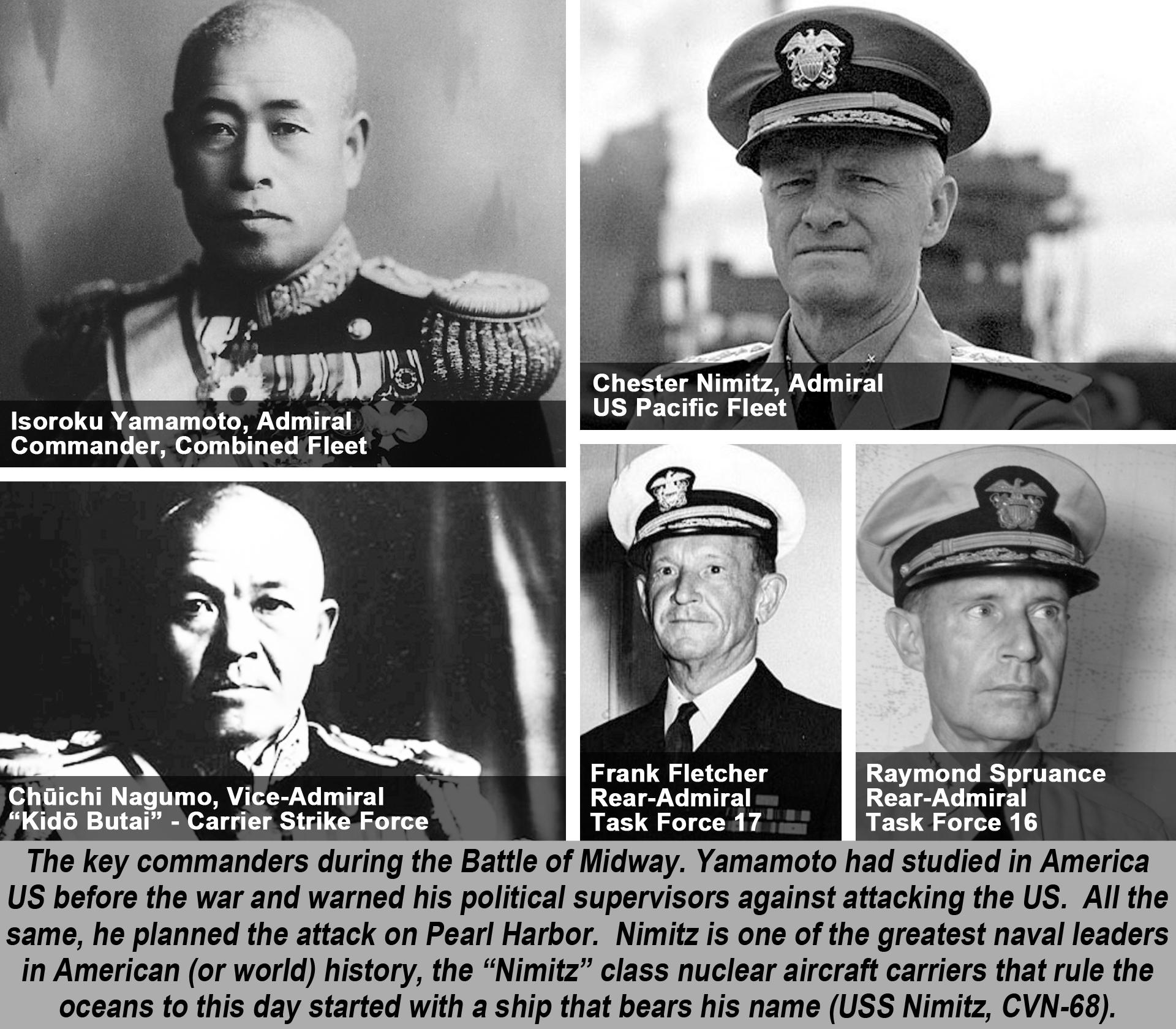
Although badly outnumbered, the Americans had broken Japanese naval codes and knew every move the Japanese were making. Under the overall command of Admiral Chester Nimitz, the Americans thus knew to ignore the bait of the Aleutians landings, and instead concentrate everything on counter-ambushing the Japanese at Midway.
The Americans thus divided their aircraft carriers into two main groups. First of these was Task Force 16, built around the carriers Enterprise and Hornet, under the command of Rear Admiral Raymond A. Spruance. The hastily-repaired carrier Yorktown formed the heart of Task Force 17, under Rear Admiral Frank Jack Fletcher.

Task Force 16 left the base at Pearl Harbor first, while Yorktown left two days later. Repair crews were still on-board, welding together damage suffered in the Battle of the Coral Sea in May. The two task forces would meet up at “Point Luck,” a spot in the Pacific about 325 nautical miles northeast of Midway.
Despite their vast numerical superiority, important parts of the Japanese plan were already coming apart. First off, the screen of submarines they stationed west of Pearl Harbor to report the departure of the American carriers arrived too late. Forewarned of Japanese plans, the American carriers had already left.
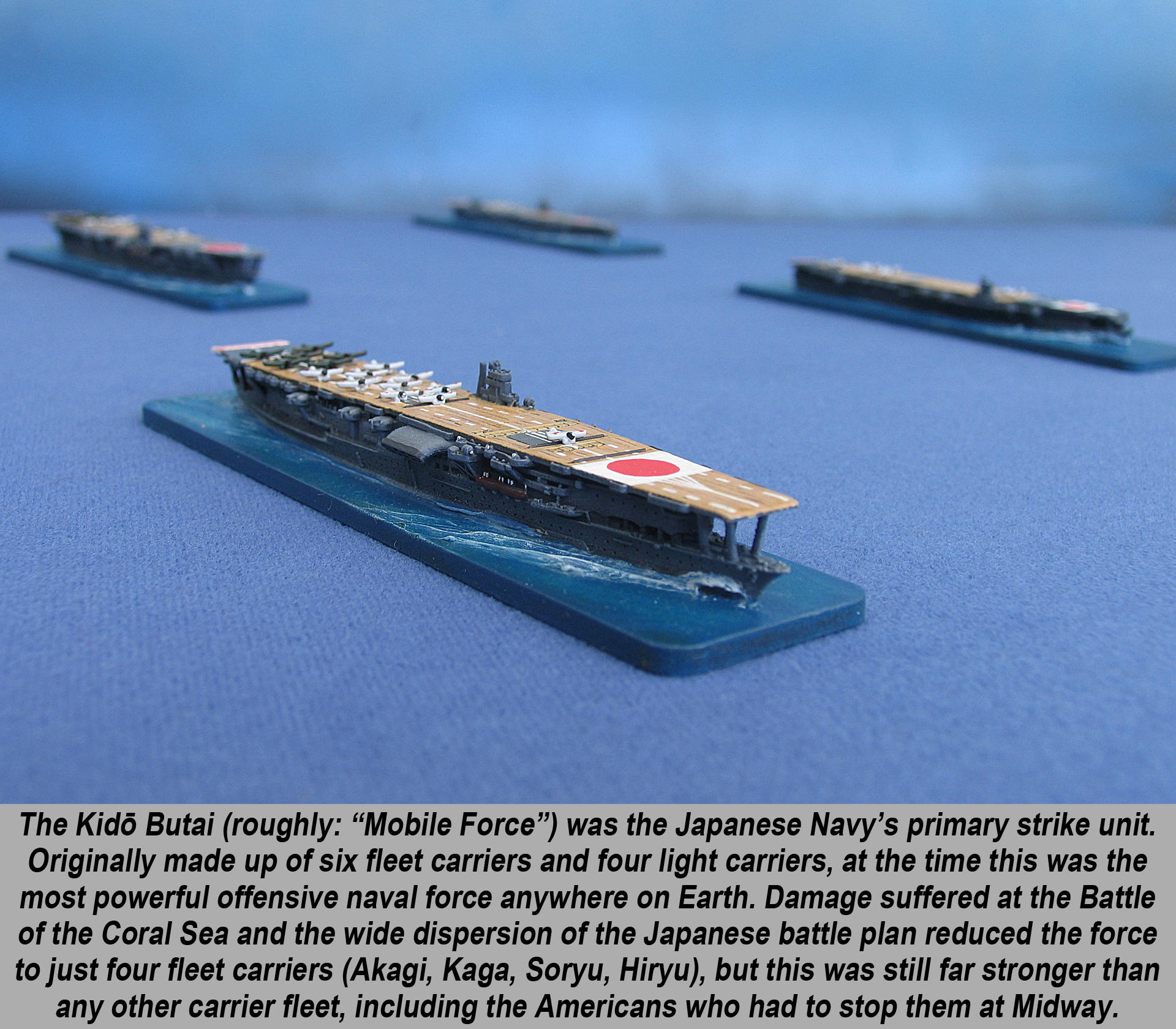
The Japanese carriers sailed on May 27th. On the next day, the Aleutian and Midway invasion forces also put to sea. Finally, on May 29th Yamamoto’s main force of battleships and heavy cruisers sortied. Hundreds of warships were now in motion, sailing from different bases far across the Pacific. The complex Japanese plan had been launched.
First Strikes
The Aleutian invasion force reached their targets in the far north of the Pacific, landing Japanese marines on the islands of Attu and Kiska, starting on June 3rd, 1942. Although these landings were successful and the islands captured, they failed to lure the American carrier fleet away from Midway, some 1,600 miles to the south.
Meanwhile, Nagumo’s powerful carrier strike force was closing on Midway from the northwest. Although the Americans knew the approximate direction and date of the attack, they still had to actually FIND the Japanese. Thus, both sides began launching scout planes, each task force attempting to find the other.
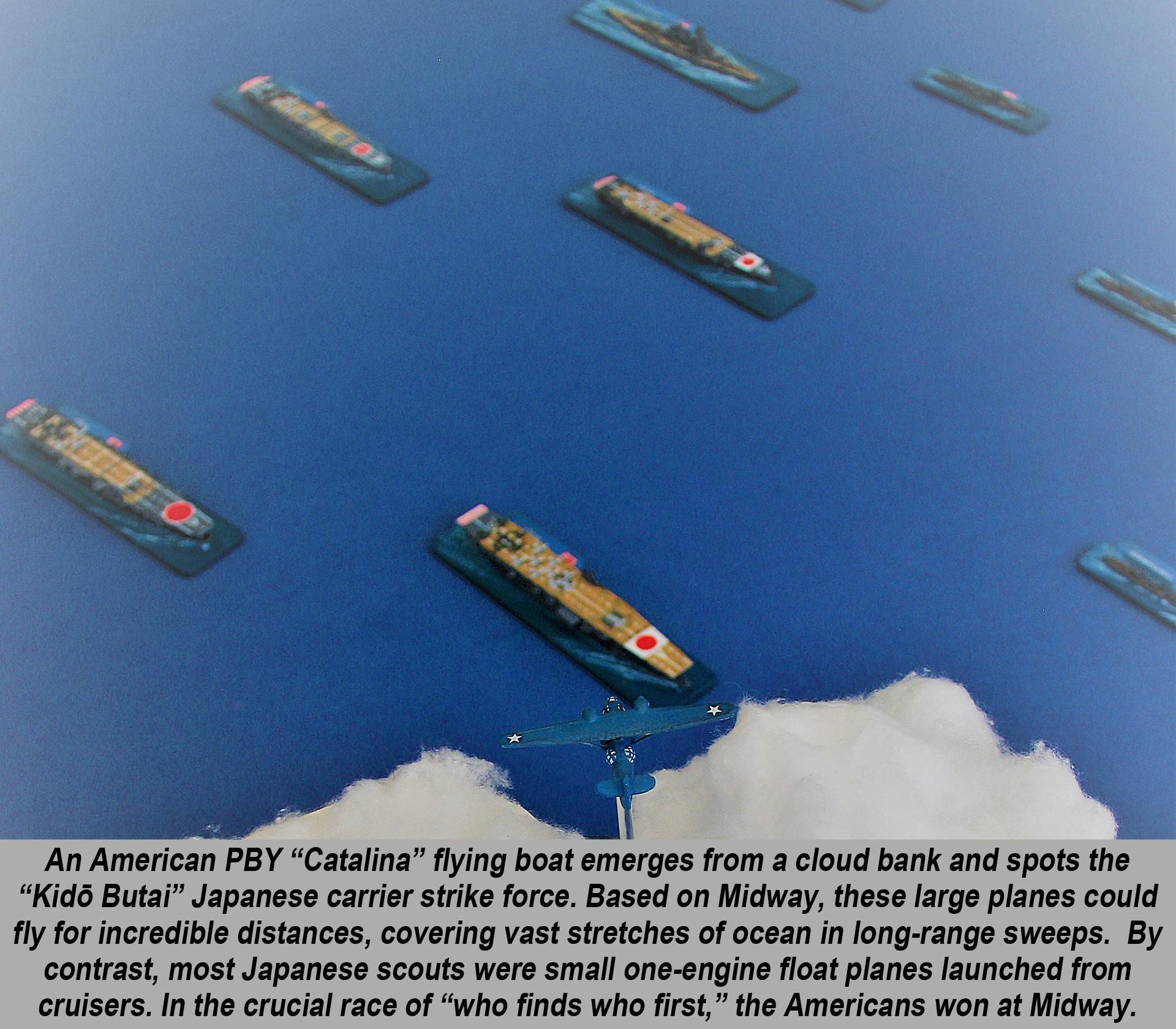
In this search effort, the Americans had a distinct advantage. Based on Midway, big PBY “Catalina” seaplanes could sweep much larger tracks of ocean than small Japanese float planes usually launched from cruisers or battleships. The Japanese search pattern was also very thin, thanks in part to mechanical failures in some of the search planes.
The end result was that the Americans found the Japanese first, with the main body sighted around 09:30 on June 3rd. B-17 “Flying Fortress” bombers were launched from Midway to bomb the Japanese (still 700 miles away), but the big four-engine bombers were unable to hit any Japanese ships in their high-altitude runs.
Nagumo knew he’d been spotted (and now attacked), but by LAND-based planes. He still had no idea American carriers were about, and so started preparations for a massive air strike on the Island of Midway itself.
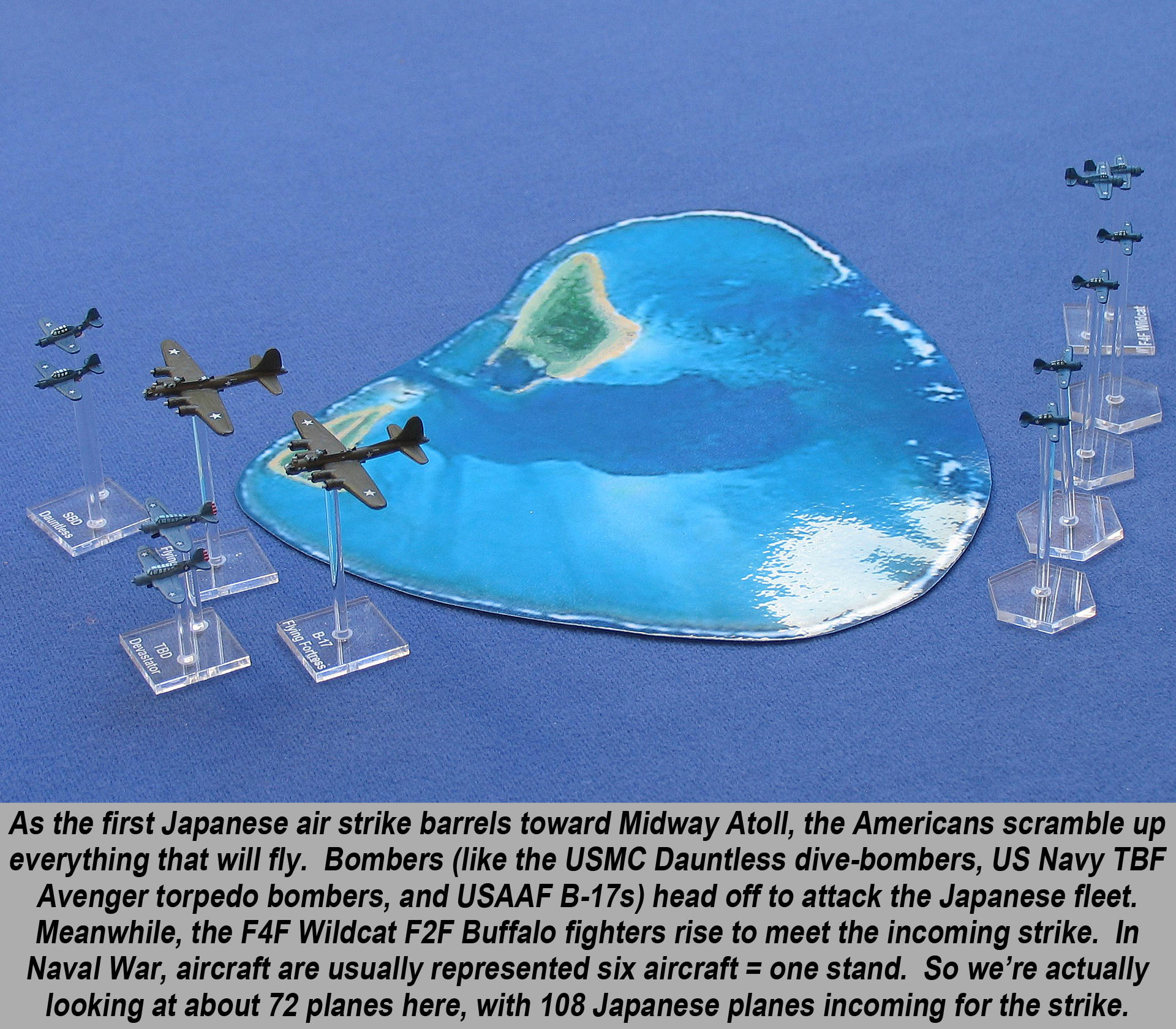
The next morning (June 4th), the four Japanese carriers struck Midway with over a hundred aircraft. US Marine Corps fighter pilots stationed on the island did they best they could, but they were heavily outnumbered and flying mostly outdated F2F “Buffalo” type fighter planes.
Yet despite heavy damage to Midway’s airfields, Midway had already launched more Navy, Marine Corps, and Army Air Force bombers for another attack on the Japanese carrier force. The result was a slaughter, with terrible losses sustained by the American planes without a single Japanese ship being hit by bombs or torpedoes.
The first Marine pilot to go down was Major Lofton Henderson, leading Squadron VMSB-241 in an attack on the aircraft carrier Hiryū. He was posthumously awarded the Navy Cross, and “Henderson Field” was named after him on Guadalcanal. One badly-damaged Army B-26 bomber also tried to crash into Nagumo’s bridge, barely missing.
Fatal Decisions
It was clear to Nagumo that despite the mauling they had received, the Americans on Midway still posed a lethal threat. Accordingly, he ordered his carriers to prepare the remainder of his planes for another strike. Meanwhile, his first strike wave was just returning, and urgently needed to land before they ran out of fuel.
At this precise moment, however, a scout plane from the cruiser Tone reported that it had sighted a collection of American ships, but didn’t say what kind. The flight and hangar decks of Nagumo’s carriers became more crowded as preparations for the second strike continued. Perhaps forty minutes later, another message came in...
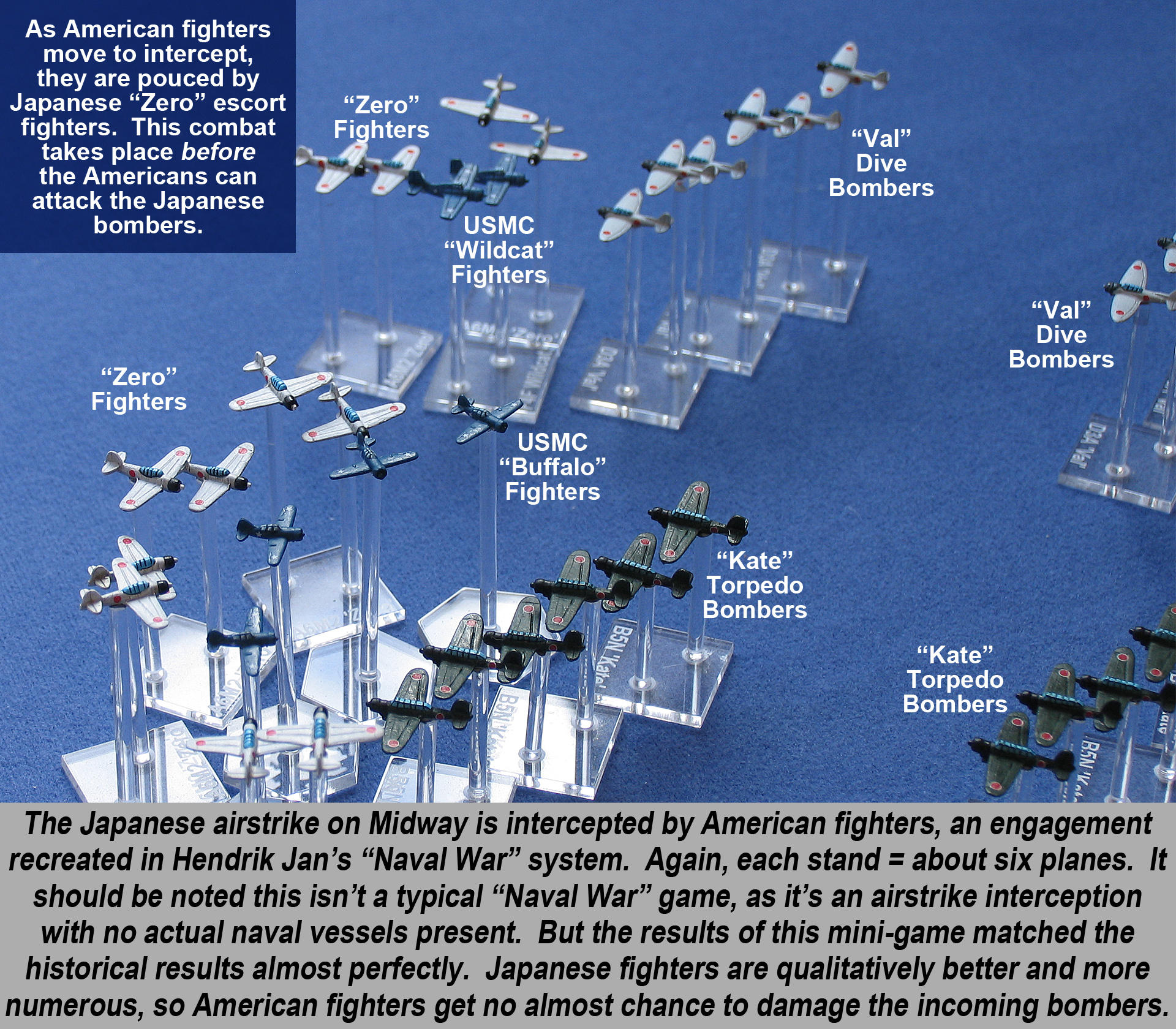
“American force is accompanied by what appears to be an aircraft carrier.”
Nagumo now had one hell of a problem. His orders were to sink American aircraft carriers (the whole point of the Midway operation), which posed an even bigger threat than Midway. But his flight decks were crammed with planes loaded for a LAND strike, armed with contact bombs instead of armour-piercing bombs and torpedoes.
The flight and hangar decks were in chaos as the carriers tried to recover the planes of the first Midway strike, then prepare a second full-strength strike at Midway, only to have these orders changed for a naval strike against American warships. Each of these tasks takes a carrier hangar crew (hundreds of men) about an hour to prepare.
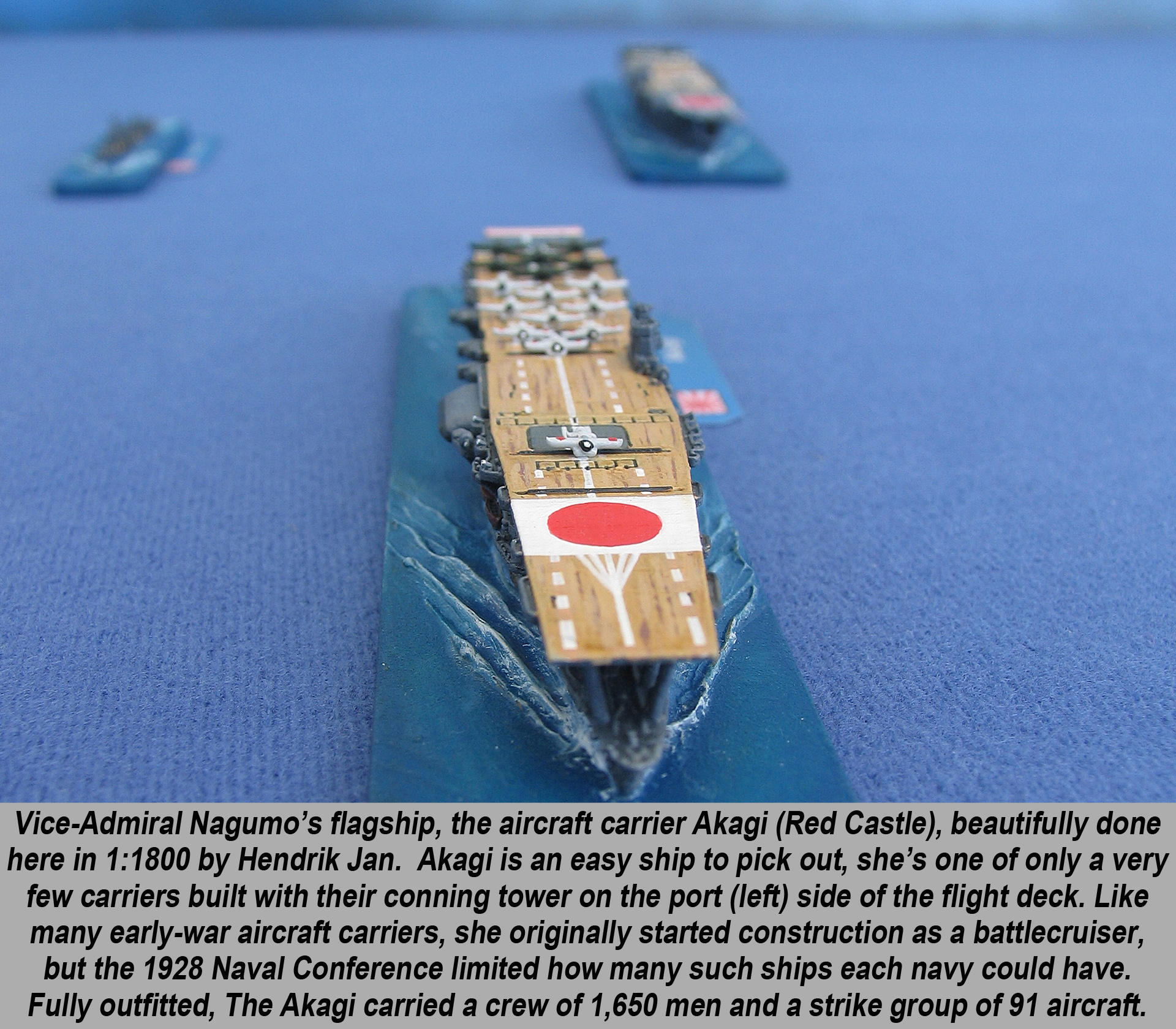
In a frantic attempt to do execute these three tasks almost at once, the Japanese carrier crews slaved at top speed. As orders were passed down to arm the planes for shipping strikes, then land strikes, then shipping strikes again, ordinance was left stacked up on the hangar and flight decks instead of being safely stored in the ships’ magazines.
Nagumo, meanwhile, wasn’t the only one facing deadly choices during the fateful morning hours of June 4th. Since the Japanese carriers were first spotted about twenty-four hours ago, the carriers Enterprise, Hornet, and Yorktown had been making top speed to close the distance in a desperate effort to get in that all important first strike.
Being outnumbered, the Americans HAD to hit the Japanese first. A first strike, with a little luck, just MIGHT cripple one or two Japanese carriers and even the odds. Thus we see the desperate, unescorted, and tragically doomed bomber strikes from Midway Island on the morning of June 4th.
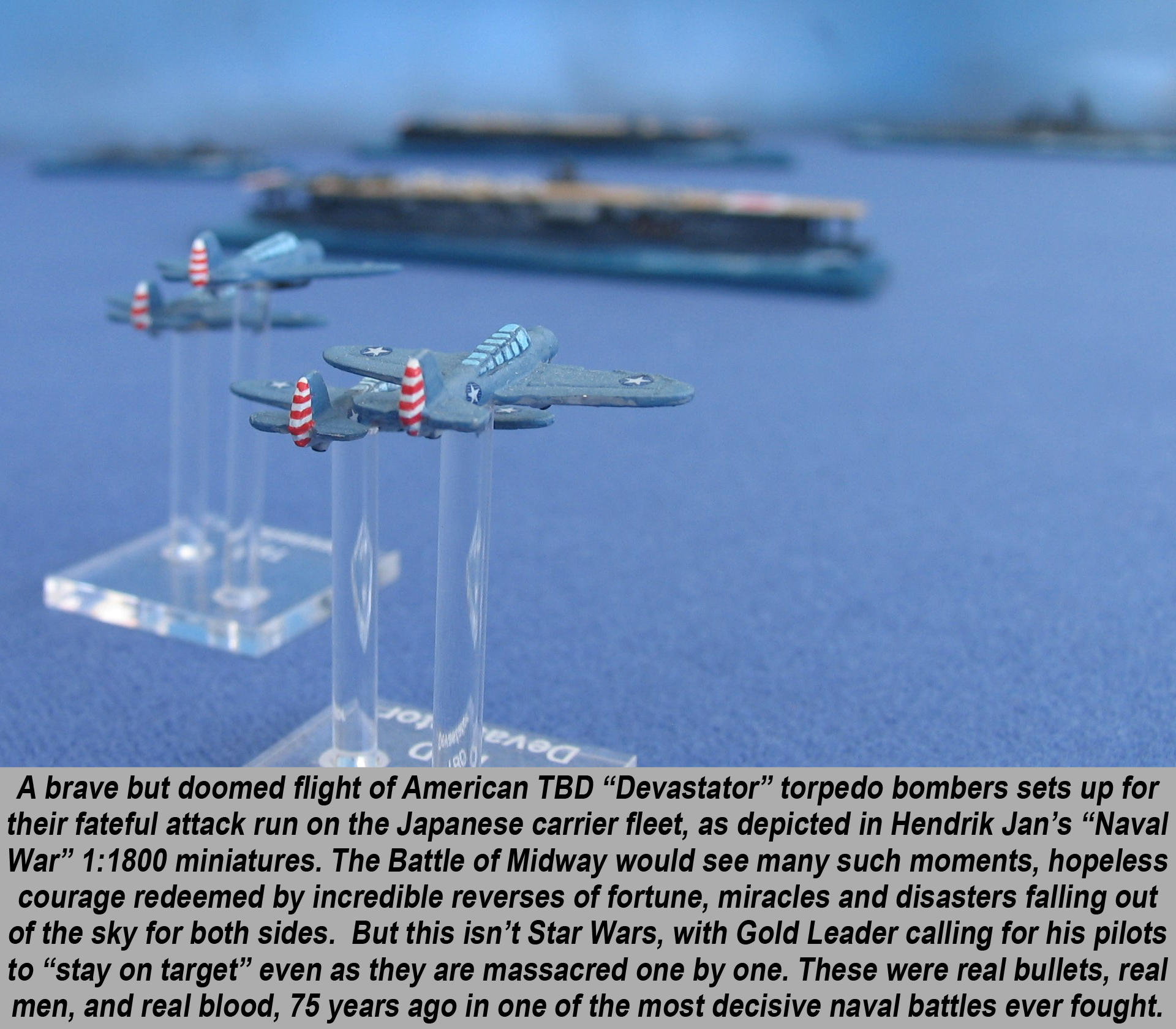
As grim reports of these missions came in, the American carriers now launched their own strikes. They still weren’t quite close enough for some of their older TBD “Devastator” torpedo bombers to make it back before their fuel ran out. They were launched anyway…on a one-way mission.
Everything went wrong for the Americans. In their haste to launch a first strike against the Japanese carriers, the fighters, torpedo bombers, and dive bombers were not massed into a single strike that headed toward the Japanese all at once. Remember it takes at least half an hour to get all these planes in the air, that’s thirty minutes of fuel.
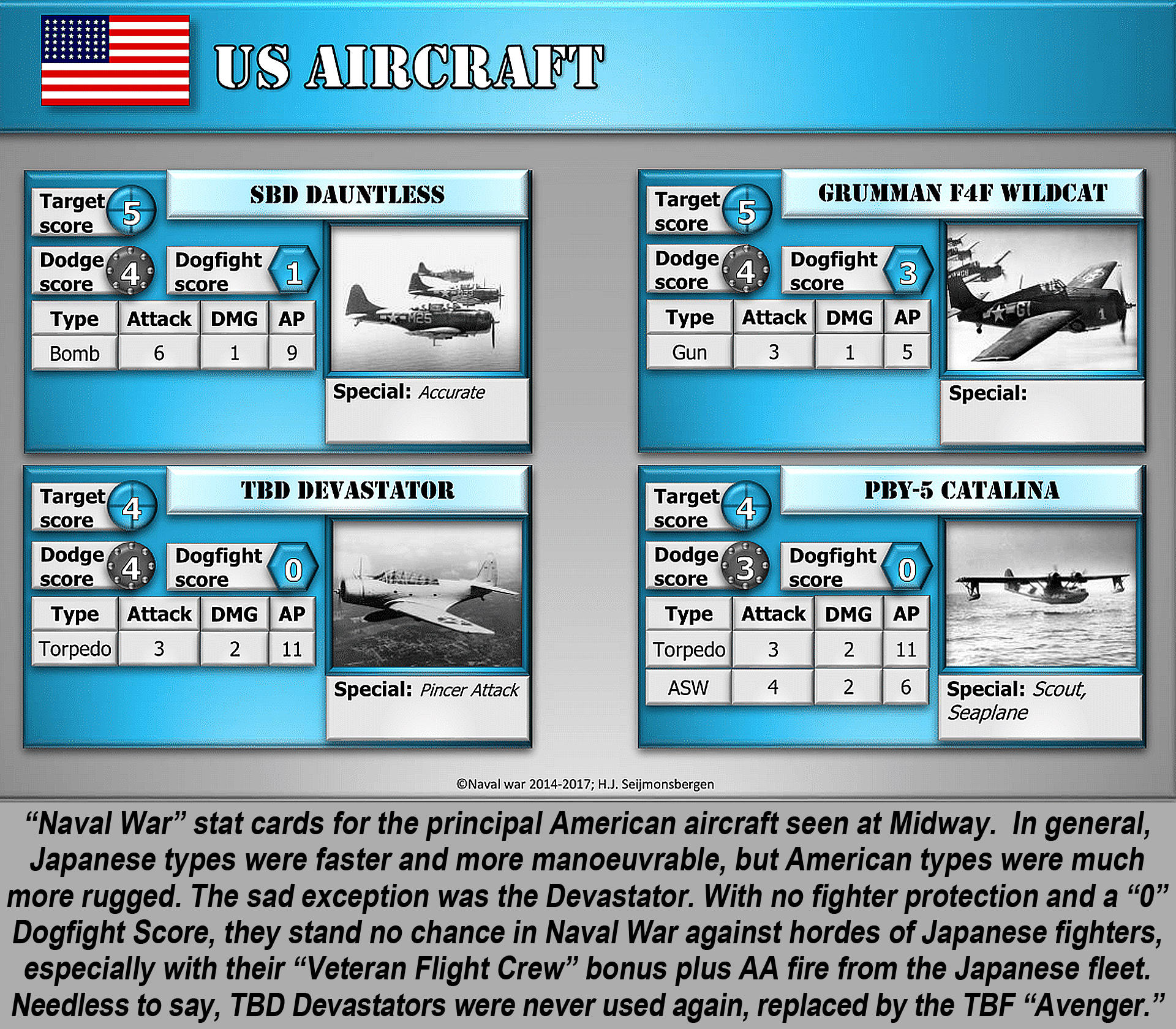
Thus, the American strike force flew out in patches, along different vectors. Many got lost. They did not arrive over the target together. When the TBD “Devastators” arrived, they had no fighter cover. Already past the point of no return on fuel and flying tragically obsolete aircraft, they more or less knew they were doomed…
They attacked the Japanese fleet anyway.
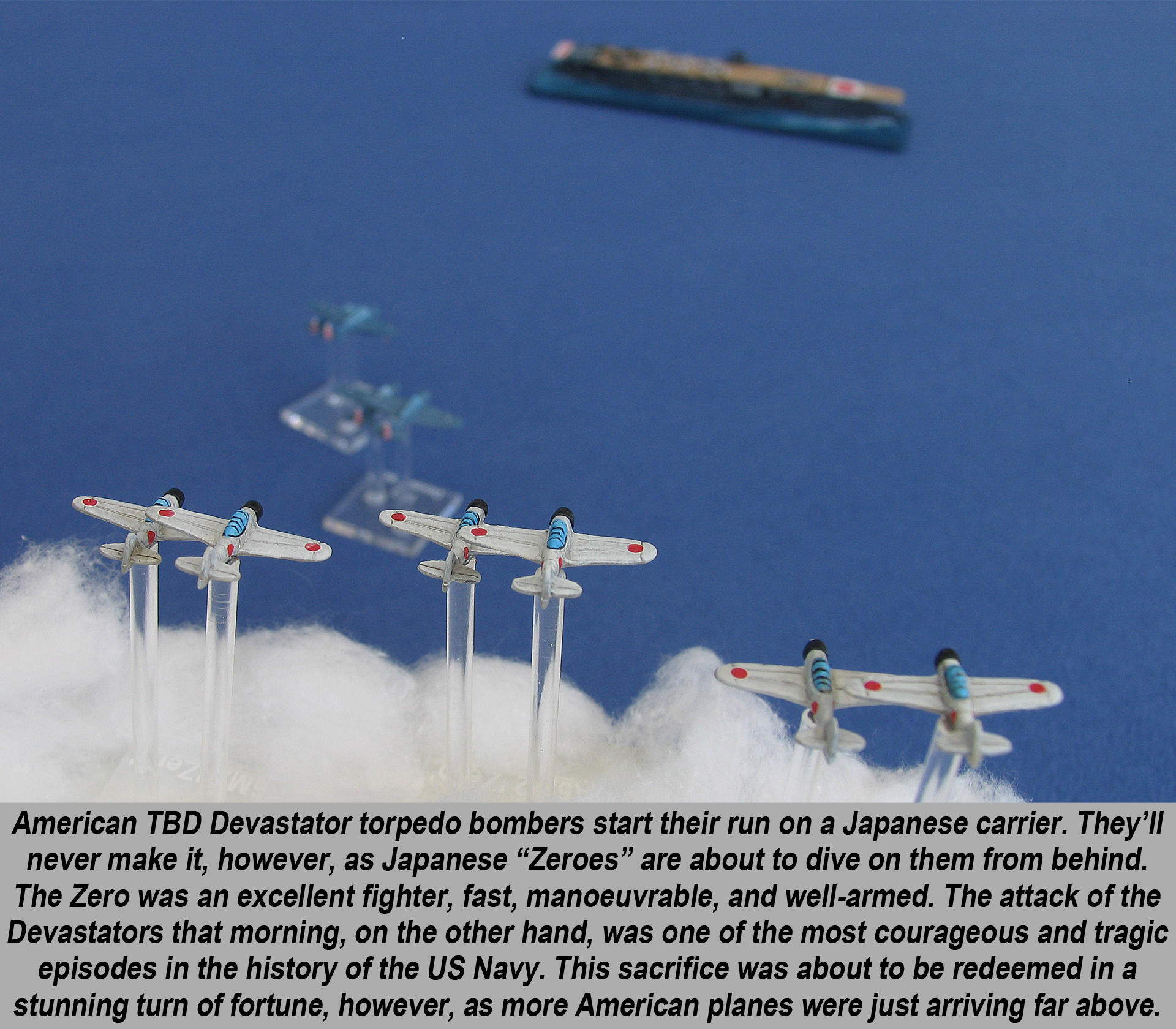
The hail of anti-aircraft fire from dozens of huge Japanese warships was incredible. Meanwhile, nimble “Zero” fighter planes also ravaged the lumbering torpedo bombers as they struggled to come in on shallow, flat attack runs to drop torpedoes in the water toward the Japanese ships.
The results were as horrific as they were predictable. Every single Devastator torpedo bomber was shot down. Each plane had two men aboard, and only one man survived from the entire force (rescued later from the water). Not a single hit was scored on a Japanese warship.
Miracle In The Making?
However, the grisly massacre of the Devastators had, in an ironic twist, left the Japanese carrier fleet completely exposed to a new threat. A force of SBD “Dauntless” dive-bombers from the carriers Enterprise and Yorktown, previously lost, just happened to re-find their bearings and arrive over the Japanese fleet at just that very moment.

These dive-bombers arrived at high altitude, mostly from the northeast. The Zero fighters were all at low level, tearing apart the luckless torpedo bombers to the southwest. Below the American dive-bombers was the entire Japanese fleet, exposed and unaware, their hangars packed with extra ordinance and fuelled warplanes.
What would follow would be five of the most decisive minutes in the history of naval warfare.
We hope you’ll join us next week for Part Three of our look at the Battle of Midway. As you can see, things are about to kick off in a really big way. Meanwhile, we hope you enjoyed the article, and will post your comments and questions below!
If you would like to write an article for Beasts of War then please contact us at [email protected] for more information!
"But now, it’s time to “weigh anchor and raise steam" and set a course into the maelstrom of this historic battle..."
Supported by (Turn Off)

Supported by (Turn Off)
"Already past the point of no return on fuel and flying tragically obsolete aircraft, they more or less knew they were doomed [...] they attacked the Japanese fleet anyway..."
Supported by (Turn Off)








Excellent as ever. Have enjoyed stories about Midway ever since reading about it in a comic book back in the 60’s. Looking forward to reading about Charlton Heston’s part in the battle.
The ship models are brilliant, are they scratch built or retail? Roll on part 3.
Thanks, @gremlin . 😀 Ah, good ole’ Charleston Heston. He plays a fictional character in the movie, that I think takes part in the strike against the carrier Hiryu. We get to that in Part 04.
Except this time it’s the crew of the Hiryu who have to yell that iconic line:
You blew it up, Charleton Heston! You maniacs! Damn you! Damn you all to hell!
😀 😀 😀
https://www.youtube.com/watch?v=sPbjPOgRtyA
@gremlin The ship mini’s are a combination of Shapeways 3D printed models (mainly from Tiny Thingamajigs’ shop https://www.shapeways.com/shops/tinythingamajigs) and repainted Axis & Allies War at Sea miniatures.
I still say that @ecclesiates ‘ last photo in this article, of those SBD Dauntlesses coming out of the sun above Akagi is one of the best wargaming table photos every taken – full friggin’ stop – cut, dry, the end. 😀 When he proposed this as a “cliffhanger” photo to Part 02 leading into Part 03, I thought it was genius. 😀
I have to agree…that is a great photo! At first glance I thought he took his mini to an air show and had fantastic timing with the camera!
The lens flare is great. 😀
Agreed. That’s a really purty picture.
Any chance of seeing how it was done? Scratching my head as to how he got down so low with such small models.
I didn’t take a picture of me taking a picture ofcourse 🙂
The model was balanced at the very edge of the table (even hanging over a bit, holding my breath) and I took the shot from the ground looking up at the sun and the dive-bombers past the ship. I really had that shot in my mind for a while and it took some waiting for a clear sunny day to make it happen 🙂
I figured it might be something like that.
Great idea and a good execution. Not often we see that in our hobby. 🙂
This probably goes without saying, but just in case …
Users can click on any of these images to expand, then right click to “Open Image in New Tab” (the command in Chrome, I’m sure in other browsers the command is similar) to open the image in its full 1920p size and resolution. 😀
Brilliant stuff!
Thanks, @dawfydd ! 😀
Fantastic stuff, thanks for the write-up, and to @ecclesiastes for the pictorial accompaniment.
Thanks, @evilstu – and I second the thought re: @ecclesieastes ‘ photos. Couldn’t have done this article series without it, or at the very most, it would have just been photos of counters on a grid and historical images. 🙂
Great stuff, while I have seen a number of documentaries on the battle. I like getting it down in games height
Thanks very much, @rasmus – I agree the wargames angle is critical, especially when publishing on Beasts of War. After all, I can write history for years, but without that connection to a wargame, it;s just a class where many of us used to fall asleep in our younger days. 😀
I think if more history teachers presented history in terms of a war game, less of those students would be falling asleep. I know I now feel a little more comfortable talking about the battle and I am NOT a “history buff”
Well, there’s always Simulating War by Phillip Sabin – where he discusses teaching through wargames.
A little pretentious, but still a great read.
https://www.amazon.com/Simulating-War-Studying-Conflict-Simulation/dp/1472533917
I love how clearly you broke down the events leading up to the day and the day itself. Also, the pictures really help tell the tale. However, it’s your captions that really tie it all together for me. They give great information that might have weighed down the article if squeezed in and while highlighting the great shots and @ecclesiastes gaming efforts.
Looking forward to the next part.
Thanks, @gladesrunner – Captions are the “secret sauce” to an Oriskany article. Of the other writers who’ve contributed articles, I’ve only seen one put in captions. They’re required to “place” the image in the article and tie in with context. Plus, I can squeeze in more words that way. 😀
Read Shattered Sword: The Untold Story of the Battle of Midway
Book by Jonathan B. Parshall
the miracle 5 minutes explained,,,,,it wasn’t a miracle and it wasn’t 5 minutes. Buying into the account by Fuchida to explain away the failure of the japanese at midway.
Read it. Maybe we should wait until Part 03, when we get the segment of the battle you’re talking about, you’re talking about before you start picking apart our work.
So far, the article is great. Far too few historical games covered and just finished a Leyte Gulf 1944 game ( article is coming )
You’re writing an article on Leyte Gulf? That that sounds interesting. 😀 My only thought is, are you covering the whole battle in one article? Or a series?
Once again I’ve negligent in getting to this series, and I do apologize. I suppose I have better than a layman’s understanding of the battle, and could once rattle off the names of the carriers on both sides, but it’s always good to see a new take on this pivotal battle, and the gorgeous models of course!
The outside armchair arguments I could do without (and a major reason why I steer clear of gaming historical conflicts), but that aside, wonderful work @oriskany , and beautiful models @ecclesiates . Love the photo! Well done to both of you! 🙂
@gladesrunner I tried the whole history-as-wargame thingy in my Greek Warfare class, and had city-state factions drawn up and assigned to students, miniatures costed (with some generous donations I might add) and a simple system for strategic movement, economics, and tactical battles, but in the end it got scrubbed, despite student acclaim, because it took up too much time. I’ll have another crack at it one day.
Thanks, @cpauls1 . 😀
I agree that “armchair arguments” are annoying, but as you say, they are part and parcel of historical wargaming. And since they’re wargames (and not recreations or reenactments) I feel they have to have at least a little “what if” opportunity for players to try different solutions to the tactical or operational problems at hand.
And besides, as BoW Historical Editor, it’s kind of my “job.” 🙂
Glad you liked the article!
Always enjoy your historical wargaming articles Oriskany – and, of course,
your not so secret secret weapon, sorry sauce: key scenes using models,
the strategic and tactical maps, as well as the historical photos – combined
with the detailed annotations. Excellent work!
You’ve almost certainly already read John Keegan’s “Battle At Sea” which
Includes Midway. For those of you who haven’t read it, this book gives a
good Introduction to key naval battles, such as Midway, Trafalgar and
Jutland.
To be honest, I bought Battle At Sea as I am interested in Jutland – my
Grandfather was an officer on HMS Malaya, one of the Queen Elisabeth
class of Super Dreadnoughts, and fought in that battle.
But, as usual, I digress. So, looking foward to Part 3.
Thanks, @aztecjaguar – Actually, sorry to say I don’t have that one. I know, right? John Keegan? In my defense, the man wrote quite a bit. To own a copy of it all you’d almost need an addition on your house. 😀
I was mentioning Jutland the other day on the Hobby Night Live thread. I built a fleet of battleships, cruisers, and destroyers for Fire When Ready, 60 ships in all – well, 60 playing pieces, not sure I would call my ships miniatures – they’re certainly nothing like Q@ecclesiastes ‘ miniatures. Anyway, looks pretty sweet all set up on the table at once, but this is still only about ONE-THIRD of what would be needed for Jutland. 🙁
I know they would be huge but I want a 1:200 US and Japanese carriers so that I can display my Wings of Glory Aircraft.
Thanks, @turbocooler . Eh . . . they wouldn’t be too big (cough, cough) at 1:200. A fleet carrier’s flight deck of the day would be four feet long. Great, eh? Even at 1:200 a single “unit” is bigger than many gaming tables. 😀
great work @oriskany @ecclesiastes on the article and models will definitely see the battle in a different light.
Thanks, @zorg . Glad you liked the article and hope you like Part 03. 😀
cant wait.
Cool deal. Those dive-bombers mentioned at the end of this article really kick things off in Part 03. 😀
a free run with no fighters definitely makes it easier.
Part 03 MIGHT be slightly delayed in publication – site issues. 😀 We’ll see what happens and hope for the best!
Do I sniff a sense of pride in the author about the American Attitude this battle was fought in and the American Navy in total (then and today) ? 😀
Don’t get me wrong, there is nothing wrong with “being proud” or at least there should be nothing wrong with it. We Germans just have a very complicated relationship with being proud of military achievements. And Midway is definately one of hell of a military achievement. So I actually envy you to be able to “feel proud” without remorse whether this is “right” or “politically correct”.
Great article again. Did a little of my own research so I guess I know what’s coming. And you are already hinting at it 😀 But I don’t want to spoiler anything. But can you really spoiler history? That would be another discussion I guess.
The models (ships and planes) look awesome. I really like them. And there are some great shots of them. Especially the one from “down below” with the lense flare, as already mentioned above. Great job. Looking forward to next week’s article.
@bothi, I get a lot of the complicated relationship you are talking about from my German friends here in Australia. The answer is that you are not guilty of the sins of the father, so speak your mind without guilt. Unless of coarse you start talking about playground domination and the extermination of all hamsters as a final solution. Then it becomes a whole new problem. Around the post war generations you can speak with pride of German achievements, there is a lot to talk about. Just be sensitive around the generation that did the actual fighting.
My family originally comes from Montana in the American northwest, where at least 20 major battles against Native American tribes took place in the 1860s, 70s, and 80s. Included among these is Little Bighorn, probably the most famous (and infamous) “Indian Battle” of all. Needless to say we have to be a little careful with our relationship with these wars and political, social, and cultural background against which they stand.
I tried to recall the first time I read a history of the war in the Pacific: I think it was around 44/45 years ago. You summation of events thus far around Midway and the ‘noises off stage’ are fabulous!
Great part 2 @oriskany. As it is 3am here I will talk more when I wake up, but by that time you will be asleep.
No worries, sir. Thanks for the comment and get a good night’s sleep! 😀
Great article and I’m really looking forward to part three, and those photo’s really set the mood, especially that last one
Indeed that last photo is beyond epic, @hairybrains . Full credit to @ecclesiates on that one, not only the photo but the IDEA for the photo and where it would go in the series.
The Battles of the Coral Sea and Midway are both observed out here and around their anniversaries documentaries are aired. At least one of them focused purely on the moment you are about to describe. However knowing exactly what is about to happen does not spoil the enjoyment of this article series.
Oddly an insight to carrier warfare for me came from a documentary on the making of the 1960’s film of The Battle of Britain. They wanted shots of the bombers and fighter streams crossing the channel from France. They had tremendous issues in getting this shot. By the time all the bombers and fighters were in historic formations and were about to cross the French coast a number of formations broke off. They were out of fuel and had to land. The producers where mystified how the Germans could form up over France and strike deep in Britain. Dispute historical experts and veterans it took many attempts to get the formation to form up and cross the Channel and land in Britain. So forming up consumes a vast amount of fuel especially when lacking experience to form up under war conditions.
This is very evident in early US carrier bourn attacks that lead to the coordinated attack braking up and becoming disjointed. Let’s face it at this point of time the carrier warfare manual was still a work in progress, with much still to be learned. I also believe the Japanese ignored many of these lessons while at the top level the Japanese were chasing a Jutland style decisive battle to decide the outcome to the war in the Pacific. I find it interesting that they ushered in carrier warfare on the U.S. while seeking a battleship solution.
I see many parallels with this and the political battles that most armies had with the supremacy of traditional cavalry and mechanized armour. In both cases the traditional arm failed to see they other as the next logical evolution of itself.
Yes I had a good sleep. The new guy in our group is coming around today. My evil intention is to give me a taste of naval wargaming with War at Sea with our rule modifications. I see WaS as a good intro that will allow for an easy step up to these rules your running on. I am still learning these rules so I would be more confident using WaS.
Thanks, @jamesevans140 – Such “management” mechanics are important in more complex carrier-themed games like Avalon Hill’s Flattop, where it’s important to know where you aircraft squadrons are, they’re furl status, whether they can make it back to your carriers before night falls … And when they’re on your carriers, whether they’re prepared on the flight deck or in the hangar being maintained / loaded, and with what ordinance.
In a game specifically about carriers, that kind of detail is important. Not sure if we’d need it in a system like Naval War or War at Sea. 😀
At Midway, the Americans were just desperate to get that first strike in. I think (cold be wrong here) that Soryu’s scout plane had in fact already overflown one / both the American task forces, but was having radio trouble? Also, I don’t think the Americans knew that another Japanese scout plane had reported simply that he’d found American ships, and had initially left out the information on the carrier.
i.e., I believe the Americans expected to be hit much sooner than they actually would be, hence the rushed and disorganized strike. In fact, one of my sources has the first Zero launching down the flight deck of Akagi when the first of McClusky’s divebombers drops its bomb. So they may not have been far off in their timing estimate or their estimation of the imminent Japanese threat.
@ecclesiastes I left a comment for you under part one as I did not want to clutter up part two with a conversation started in part one.
Sorry, almost meant to add that IO 100% agree with your mention of the strange dichotomies of Japanese naval doctrine and thought. Yes, they’d proven moreso than anyone else just how “dead” the battleship really was with Pearl Harbor, Renown and Repulse, etc. Yet they still believed in their OWN battleships somehow.
At least many of them did. I’ve always been interested in Yamamoto’s quote: These battleships in our navy are like carrying a samurai sword in battle. They are more religious objects than military resources.”
Given how much of Japanese culture (i.e., the Army) felt about Shinto religion and samurai swords, I’m tempted to say I don’t think Yamamoto picked quite the right metaphors if he was trying to get a point across about the declining role of the battleship. 😀
Yamamoto may have realized the battleship’s day had passed, but he was still hung up on the whole “kantai kessen” decisive battle thing. I think he just wanted the war ended as fast as possible before American shipyards could “pave the Pacific” in carrier flight decks. But given what had happened at Pearl Harbor, there was no chance of that. Then again, Yamamoto had been against that strike or a war against America in general.
Definitely a complex subject.
To be fair to the Japanese, all major powers clung to their battleships. Even Hitler wanted a high seas fleet and only switched to submarines after the surface navy had suffered several major defeats.
And even after the war, several countries kept battleships in service for a decade or more. Heck, the US used several in the first Iraq war… 😮
Another strange dichotomy can be seen in the bombing campaign against Germany. The London Blitz failed entirely to break the will of the Brits to fight. Yet, for some reason, the Allies believed it would work against the Germans.
In many respects, most of the leaders, both military and politically, were still fighting WW1, having not entirely grasped the importance of the technological innovations that had been made in the inter-war years.
To be fair to the Japanese, all major powers clung to their battleships.
Well sure. What I find interesting is how some elements of the Japanese naval command structure continued to place battleships at the center of their planning, and others did not (i.e., Yamamoto, as quote above), all while Japanese naval operations repeatedly PROVED the battleship’s obsolescence through the first six months of the US-Japanese Pacific War. It’s almost like they were continually proving themselves to be more advanced than their own theories. Meanwhile, not all the Japanese naval commanders or planners clung to the battleship (e.g., Yamamoto as quoted).
After Midway, many Japanese plans had no choice but to focus on battleships (Leyte Gulf and the “Tokyo Express” of the Solomons Campaign spring to mind) because of a relative lack of carrier-borne capability.
Even Hitler wanted a high seas fleet and only switched to submarines after the surface navy had suffered several major defeats.
Hitler wanted a high seas fleet at the culmination of “Plan Z” – a massive naval construction program undertaken under the direction of Admiral E. Raeder and wouldn’t be completed until 1944. Needless to say, when the European part of WW2 started in 1939, Plan Z was nowhere close to complete. Massive losses sustained by the German Kriegsmarine during Operation Weserubung (invasion of Norway – something like half their navy) more or less compelled the Germans to adopt a U-boat based naval strategy, leaving aside one-off episodes like Bismarck (which, all symbology aside, was it really that important?)
And even after the war, several countries kept battleships in service for a decade or more. Heck, the US used several in the first Iraq war…
USS Missouri (BB-63) and USS Wisconsin (BB-64). One of my friends in Gulf One was on one of the Marine teams that called in fire missions for USS Wisconsin.
Another strange dichotomy can be seen in the bombing campaign against Germany. The London Blitz failed entirely to break the will of the Brits to fight. Yet, for some reason, the Allies believed it would work against the Germans.
Interesting. I’ve read both sides of this question. Did the Harris, Spaatz, and their superiors really think bombing of German cities would “break” German will? I don’t know, I always saw it as an economic measure to hurt German war production and also a political one to prove to the Soviets that “yes, we really are trying to do something.”
Then again, Churchill has been quoted as saying re: the bombing campaign that “We consider the civilian morale of Germany to be a legitimate military target.” And certain raids like Hamburg and Dresden were clearly motivated by vengeance for Coventry, the Blitz, etc. Not sure if that can be applied across the whole Allied strategic bombing effort, though.
… Most of the leaders … were still fighting WW1, having not entirely grasped the importance of the technological innovations that had been made in the inter-war years.
Certainly can’t argue with that one. 😀
I believe you are right in what you say. Everyone normally begins fighting a new war as if it was like the last. Yet no two wars are the same.
What does not stop is the politics and power broking especially when the dynamics and status quo are being upset. The actual winning of the war becomes secondary.
This sounds like nonsense until you read the political histories of a given war.
Take for example land warfare prior to the beginning of WW2. You have the centuries old cavalry as the prestige arm. It’s officers have most of the top jobs and it an extremely powerful political group within the any, Churchill is ex-cavalry.
Now you have a new group headed mostly by younger men with this idea if mechanized warfare. It threatens to put all these cavalry guys out of a job. They go so far to say in so many words so treat this as a paraphrase, this would make war a factory of death and its ungodly. Next they reduce mechanization to mean the tank. They then tie the word tank to trench warfare. They then say trench warfare was a one hit wonder, so the tank is not required. WW2 settled the issue.
In battleship vs carrier debate we have the same politics and power broking but at a higher and far more political level on the world stage. Since the beginning of the twentieth century the battleship was the icon of natural pride and prestige. This was driven home by Theodore Roosevelt’s white fleet visitations just before WW1. Post this war the pride and prestige placed on the battleship goes into overdrive, made worse by the battleship limitations. Then the players backing the carrier say the battleship is obsolete and the early performance of the carrier backs this. At the highest level of government we now have an embarrassing issue. Between the wars nations have spent billions on a mines bigger than yours contest in a time of worldwide economic depression and as it turns out for what. The peoples of the nation are going to want to know why and if they do they will apply responsibility and blame that may topple a government. This temps most governments and naval chiefs to hold out just in case a turn-A-round can be effected in some way. That we now know will not happen. This politics and power broken is still with us today. Some say the day of the air fleet carrier is over and the strategic missile armed submarine it what it is about. The waters of this issue is far more cloudy than it ever was. Firstly that non nuclear/nuclear line has to be crossed. Politically this would not go down well with the people. So most governments have placed a bet each way. Although it is interesting to note that the majority of carriers built today are assault carriers deigned for land based support. This is the same path that the battleship exited into history on. For me it is easy too early in the debate to see the winner, perhaps it can only be decided by the next major war.
In the end the politics of the time meant they hung into the battleships for too long.
@oriskany completely agree.
The US at this stage still were learning this new carrier based war thing. They were having trouble coordinating their bomber types within an effective fighter screen. Compared with their strikes in the latter part of the war, this looks like a drunken effort. This is not to say they were incompetent as experience and lessons learned have not had enough time to have an effect. The same as the German blitzkrieg. In Poland it was effective but not quite there yet. By the time their get to Barbarossa blitzkrieg is looking like a well oiled machine.
Like in so many organisations, Yamamoto had the right to be heard but there was nothing in the agreement to say he would be listened to. Especially if he was saying things that interfered with their version of reality.
While I would agree that many nations, America included, were still learning the trade of carrier warfare, I would maintain that the Americans of TF 16 and 17 were a little better than the morning of June 4, 1942 would have us believe. Note, I say a little better. 😀
The Americans knew the Japanese fleet was out there, USMC and USAAF bombers based off Midway bad been trying to hit them throughout the previous day to no effect. Then the Japanese hit Midway on the morning of June 4, hard. So the Americans knew the Japanese were close (based on the limited range of the carrier planes that had carried out the raid) and had so far inflicted far more damage than they’d suffered.
The Americans re-acquired the Japanese on the morning of the 4th, almost at the same time they were found themselves. They didn’t know how poorly the Japanese search effort was organized, or about the the radio problems aboard the Soryu’s (I think) search plane, etc.
So in summary, I think Spruance and Fletcher feared they were in much more trouble of an IMMINENT Japanese strike than they actually were, or would be until about 10:00 – 11:00 that morning. This, combined with the American necessity to strike FIRST and hopefully even the odds against Japanese numbers, coerced the American commanders into this initially poorly-organized raid.
So TF 16 and TF 17 launched this strike as soon as they possibly could have, actually a little sooner than they SHOULD have. The Americans were also saddled somewhat with the obsolete TBD Devastator torpedo plane, the TBF Avenger was just coming out (a handful were land-based on Midway for this battle), if American torpedo squadrons were equipped with this plane with longer range and better defenses I think they would have fared much better. With that extra fuel, they could have waited for fighter protection.
Don’t get me wrong, as you say, carrier operations were still very new to the USN. But American task forces had undertaken raids against the Caroline, Gilbert, and Marshall Islands throughout the winter and spring of 1942, mostly for morale and training purposes, teaching themselves tactics in the hopes of working out these very kinks and snags you mention. Then they’d been blooded in Coral Sea. So they knew the business (perhaps not as well as the Japanese yet).
The combination of timing, distance, and limited information in the early morning hours of June 4 just pushed many commanders, on both sides, to some very fatal decisions.
Hence the header title in the article! 😀
History can be a difficult read at times, especially so given the doomed nature some of the men faced at Midway. Their courage leaps well beyond the boundaries of many today.
On a lighter note, I particularly like the last photo of the planes appearing over the clouds behind the Japanese carrier, very dramatic. Kudos to whoever arranged that picture.
@redvers, I totally agree that photo is my favorite gaming photo to date.
All @ecclesiates on that one, @redvers and jamesevans140. 😀 We were talking about photos, what miniatures he had, what parts of the battles we wanted to cover, and how the battle’s events would be spaced out over the parts of the article series. His idea for a “cliffhanger” photo of the SBD Dauntless dive bombers arriving “out of the sun” over the Japanese flagship Akagi sounded great as soon as he mentioned it. 😀
Sorry @oriskany for the time that it had taken to reply to your comments. I wrote a reply yesterday. I then went and had a meal then I came back and finished it off. When I submitted it requested me too log on again and once I had my submition was lost. I did not feel like rewriting again.
Well between your efforts and photography your photos between your efforts have come out great. You guys have taken the wargame article to a new level where the photos are now also telling some of the story.
I agree with what you say. I was not singling out the US, I was trying to stay within the topic of the article. The Japanese had a slight edge over the US, but the rest of the world was passing catchup with the US. I am not being critical here either. First hand experience writes the first edition off any type of warfare. The rest of the world still have to fight the first carrier warfare battle, so they must take clues and guesses from the US and Japanese carrier battles. The other thing we tend not to do is appraise the actual performance when something outstanding has been done. The Wright brothers first flight was extremely sloppy given the actual performance envelope of their aircraft. Poland was a standard Prussian double envelopment with clumsy blitzkrieg knobs. By not taking out the tankers, fuel depots and repair facilities the Japanese at Pearl Harbor actually produce a strategic result that was poor and well below the potential that was there. Looking at Midway in the same light the US was not doing a bad job at all. Their mistakes here were far less in magnitude than the Japanese blunders if Pearl Harbor.
I understanding why the political history of WW2 is taught, if at all, to any depth. At depth it frankly is embarrassing at best. I amazes me that the war was actually won.
Politics, personal reputations, self seeking and other games people play do not stop during war time. It actually speed up as self centred opportunities arise and gone for. The we all stand together in unity rubbish it to pacify the public. That in turn would be horrified if they saw what was really happening. All this was an impediment to the monumental task of changing from battleships to carries as a nation’s pride and prestige. So no nation would make the first motive, not even the Japanese. So by the action of Pearl Harbour the decision was made up for the US as carrier warfare was the only viable option left too then in the Pacific. Then of course came the name calling and finger pointing followed by the public’s outrage. We also have to remember looking back in hindsight that the waters were not entirely clear concerning the obsolescence of the battleship. Yes the writing was on the wall for them to see but only battles in this war would set the confirmation. The confusion of the Japanese strategy shows the die was only in the casting. They use carries as a strong strike force and then do a back flip chasing a Jutland style decision for mastery of the Pacific. I see the Battle of Midway as the confirmation needed for the government of the US to place their bet on carrier warfare.
No worries, @jamesevans140 –
😀 Just while we’re on the topic of carrier innovation, etc., we should really point out that while the Americans and Japanese probably built the first real “carrier fleets” and showed the world what these fleets are really capable of across thousands of miles of ocean, the BRITISH really should not be forgotten as the true innovators when it comes the carrier itself.
First purpose-built aircraft carrier designed, of course – HMS Hermes 1924 (although I think Hosho was actually completed first)
First full-length flight deck (i.e., the “model” aircraft carrier) – HMS Argus
First pilot to take off from a moving ship
First steel-decked carrier
First to operate jets from a carrier
Came up with the reflector – control – optical system by which planes are guided into for approach descents when landing. I’ve heard the story of two British admirals trying to work out this system, one sweeps his desk to create an “aircraft” carrier. The other uses a pen-light and a handbag makeup mirror borrowed from his secretary to work out the angles of when the landing light reflects up to the pilot’s eye to let him know he’s at the right distance, altitude, and approach angle.
The Secretary was actually the approaching aircraft and it was her mirror, however her contribution to history is all but forgotten.
The pre purpose built history of the carrier reads in a similar fashion. The innovation of landing lines and catch hooks, the development towards the classic flight deck arrangement. I don’t remember the exact details to this. Towards the end of WW1 the RNAS laugh an attack from one or two converted carriers against a Zeplin hanger. The Sopwith Pup features large in this attack. These details of this attack are usually featured in extended histories of this aircraft. What the British add to and innovate with creates the isolated foundations of carrier warfare. All credit is due to them for their pathfinding experiments. Not to mention their carrier-borne attack against Italian battleships in a shallow harbour, literally the father of Pearl Harbor.
Here again politics interferes with natural development. The lords of the navy are dreadnaught and battleship admirals and these heretic planes off ship maniacs are perceived to challenge the status quo of their powerbase, waste good money on silly ideas and so the baby must be stabbed in the cradle. Although partially impeded it is a treatment to the few with the determination and belief in plane at sea. I would also place Billy Mitchell in the pool of believers. Mainly for demonstrating that bombers could destroy a battleship. Although his principal were from land based attacks and he had no idea carriers would one day be large enough to carry bombers. What he believed in its still a core principal of carrier warfare and hence his conclusion. Holding to this belief would lead to his dismissal, another victim to the politics.
What I suppose we are starting to look at here is the recent theory of Big History that looks at all the various steps that must be taken to reach a major point in history those effect will dominate decades to follow. Consider what steps that had to be taken to get to the transistor and the requirements of civilisation to have a need for it and how it has come to dominate modern living.
Innovation is mostly evolution but the big dynamic shifts come from revolution. This almost always involves resistance and refusal on political, power based shifts, cultural and traditional shifts that it brings about. So the birth and acceptance of carrier warfare was always going to be difficult. The aircraft and the tank had similar births. Even the deployment of rapid fire rifles for Federal troops was faced by massive resistance in the belief they could not afford the wastage of ammunition it would case. It would take the intervention of Lincoln to bring about the change. Looking back we see these points of birth and resistance to wide spread acceptance to be silly to the point of stupid. Could they not see the writing on the wall?
Here at Midway we are in one of these crucibles that will decide the issue and the old guard must accept the future and if they want to keep their power they must align themselves to it.
Thanks, @jamesevans140 – I guess I didn’t know t he particulars of the story or even how those landing “guide beams” work exactly.
I found the name of the book I was thinking of while talking about the stratification of calcification of military thought …
War: by Gwynne Dyer
https://www.amazon.com/War-1985-soft-cover-Gwynne/dp/B0013V9SJY/ref=sr_1_12?s=books&ie=UTF8&qid=1496689899&sr=1-12
Oh, no. Not Gwynne Dyer! He is the most despised ‘pundit’ the Canadian military has ever known. I believe he reached the lofty rank of sub-lieutenant before being drummed out of the navy for being a self-absorbed, tactically inept sh#t pump.
He regularly lobbies to have defence budgets slashed as retaliation.
Wow, really? Didn’t know all that. I only read the one book, I know he’s written a lot more so I don’t really know about his general “posture” or politics or body of work. A lot of what I read in “War” seemed to make sense and wasn’t too judgmental – although I think he’s re-written it with “War – the Lethal Custom” which may change my mind.
OK, now that I’ve calmed down…
Much of what Dyer writes is a rehash of the work of others. Doesn’t mean its wrong; just means the analyses aren’t his.
He also wrote firsthand accounts of conflicts he wasn’t invited to.
Much of what Dyer writes is a rehash of the work of others
You know what they say. History repeats itself. Historians repeat each other. 😀
@cpauls1 I know where you are coming from. Another author that I will not name in his books he uses quotations, some out of context, to basically do a character assassination on someone he does not like. When challenged he claims only to be quoting from history. Yet somehow managed not to use opposing quotes for balance. He comes across like a little boy blowing raspberries while hiding behind mum’s skirt.
Some would place Liddell Hart in this category for his perpetual quest for claiming blitzkrieg as his but others got the credit for it. While he can have some claim to Expanding Torrent, it is a far cry from blitzkrieg. I choose to sit on the fence on that one. His historic works are of a high standard but his books like Strategy in the appendix most certainly goes out of bounds.
Sorry @oriskany I almost forgot to thank you for looking up the title for me. If I come across it out here I will pick it up. Amazon want more in postage than the book it worth. 🙁