































![Make Your Own Star Wars: Legion Heroes! Rebel Agent & Officer Set Review [7 Days Early Access]](https://images.beastsofwar.com/2025/12/unboxing-atomic-mass-games-star-wars-legion-rebel-alliance-agent-_-officer-coverimage-225-127.jpg)









The Battle Over 3D Printing
June 21, 2012 by dracs

3D Printers have become a great way for companies to consistently produce good quality miniatures. Just put in the design and a short while later you have yourself a completed mini. But what is going to happen now that this technology is becoming more readily available to us, the average none corporate user?
Clive Thompson of the technology news site Wired has written up an article to explain to us the problems such home use could be facing.
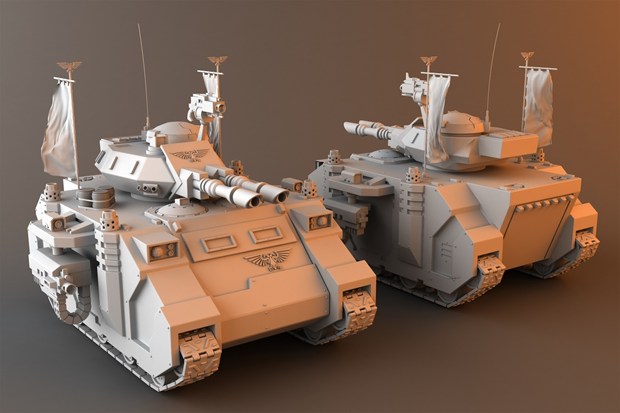
Thompson takes the example of one such user named Thomas Valenty, who used a relatively cheap 3D printer to design for himself some "Warhammer-style" miniatures based upon his brother's Imperial Guard. He proceeded to put these designs online so they could be used by others with 3D printers. Games Workshop of course immediately jumped on this, causing the site which hosted the files to take them down.
But this could be just the start of the problems being faced by both companies and those wanting to print out their own miniatures. As Thompson says in his article:
Observers predict that in a few years we'll see printers that integrate scanning capability -- so your kid can toss in a Warhammer figurine, hit copy, and get a new one. The machine will become a photocopier of stuff.
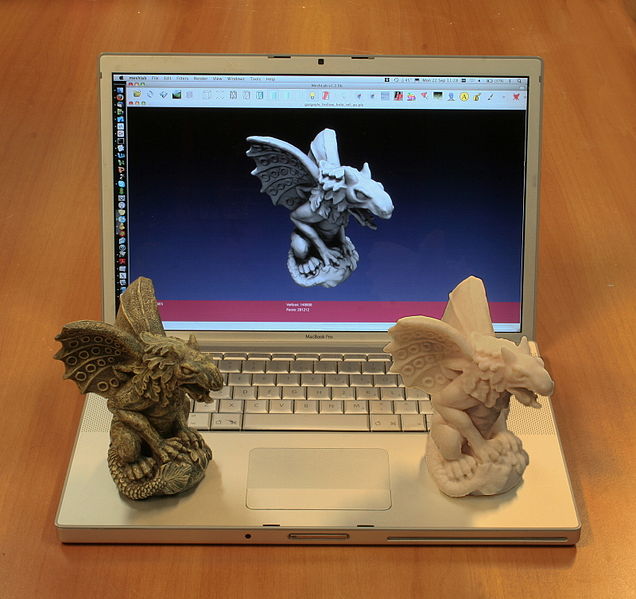
This image, taken from Wikipedia, shows the way in which the technology of 3D printers allows people to make copies of existing items.
With such possibilities appearing on the horizon it is unsurprising that companies such as Games Workshop are determined to protect their products from being copied in this manner, which could lead to much stricter rules regarding the use of 3D printers.
However, all is not so dark for those seeking to use 3D printers to help in their hobby, as Thompson explains.
Disputes over copies of physical objects are often fought using patent law, which is far less strict than copyright. For example, patents last only 20 years, which means many cool everyday objects (Lego bricks!) are long out of patent. What's more, patent law generally governs only a complete assembled product, so creating replacement parts -- a thriving pastime among hobbyists -- is probably legal.
Furthermore, issues such as those surrounding Thomas Valenty's case are something of a grey area, given that he had not directly copied the Games Workshop miniatures, rather making ones that matched with the style of Warhammer 40,000. Which leads one to ask what about all the other companies out there producing their own alternate takes upon Space Marines?
(Indeed, Weinberg isn't even sure Valenty infringed onWarhammer's copyrighted designs, because Games Workshop is accusing him of creating figurines in the style of the game, and you can't copyright style.)
So the future of home 3D printing could be anybody's guess at this time. On the one hand we should respect the company's rights to defend their own product. However, this should not be to the extent that it leads to the curbing of other people's creative use of the tech.
What is your opinion on this issue? How do you think this could pan out for private users?
Supported by (Turn Off)

Supported by (Turn Off)
Supported by (Turn Off)













Obviously this is an industry wide issue (its impact crosses all manufacturing industries potentially), however focusing on GW…
I would say its highly unlikely they own ANY patents on toy soldiers, and its now too late to patent what they already produce as they are already in the public domain… and you cannot copyright a game mechanic… nor can you copyright a ‘style’…
I’ll let you draw your own conclusions…
Nice find Sam
What I actually think we will see in the future is print on demand products from GW, they could cover themselves by making a clause that they are not for resale and then they might actually have some legal legging for knockoffs of those specific products.
I don’t know about that, it’s hard to use the term Space Marine now as GW seem to have copyrighted that term, which I think is unfair as the term has been around since 1939. Sure imho they can copyright the term ‘Adeptus Astartes’ as it’s theirs, but not ‘Space Marine’ as by definition any marine based on a starship is a Space Marine.
Oddly enough I sense a possible repeat of what happened when 2d scanners first became widespread. While yes you will have those individuals who just blatantly try to copy everything and try to sell for a discounted price, you’ll see this die off as there isn’t a guarantee on the quality with these individuals.
But I have to second the notion of making replacement parts, it’s a good idea for conversions for personal use. People have to keep in mind that there is always a tradeoff when you try to mass produce something
Games workshop are normally quite hot on percieved copywrite issues so it was probably a knee jerk reaction. Possible infringment wack with the lawsuit (war)hammer.
i could see games workshop trying to control this by jumping on the bandwagon and selling
GW 3d printer; expensive
GW resin; expensive
GW box set limited print runs; same price as normal box set.
more than likely they will simply play whack a mole with every shared scanned model.
however if someone chooses to copy their minitures in a 3d printer there is not much GW can do especially if the person doesnt shout about it.
once the technology is out there and availiable to most people by being cheaper there will be no stopping it who knows 3d colour printing said model afterwards
If 3D printers were at a price point where they can be bought at a reasonable cost then this would be great. The tech is still slightly out of reach but give it a few years.
I dont see this issue killing GW. It would be nice though if itput them in a situation where they actually supplied everything in a kit (like weapon options for a Razorback.)
Like all businesses, technology changes and technology changes the market. We already see GW making some changes by dipping their toe in the digital market. We will have to see if they go all the way and put te 6th edition rules out in digital format. What I envision is GW putting their layouts for thier products in a protected form of some type and selling you the file to use on you own printer. They will also sell you all the other necessary parts such as the resin block or even sell you a 3D printer. I think they have already thought ahead by expanding their paint line and moving their metals to resin. I guess we will have to wait and see but we are probably 2 to 5 years from having what I would deem affordable 3D printers. In the mean time companies like GW will have to gear up their digital and IT groups as well as beef up their legal and product teams to come up with strategies that will work and keep all those investors happy.
Has anyone found a photo of Valenty’s designs? I’d like to see the level of adapting he did before passing judgement here.
If he took his own designs or took WW II tanks and scaled them to 40k size with a bit of “warhammer-style” ing then he should be allowed to make what ever he wants. End of story.
However, if they are just GW tanks with minor variations (slightly rounded Russ turret or a Chimera turret on a Predator body, etc) he could be guilty of improperly using GWs intellectual property. Imagine the problems Disney would cause a rat poison company if it used a black mouse with a white face, big round ears and long blue pants (Mickey wears red shorts) in its packaging. Obviously a Mickey look a like with a minor variation would not work. But they would be okay if they came up with their own mouse design that looked vaguely like BoW Sam with a pointy nose and whiskers (maybe in plaid shorts).
I am sure intellectual property law would fall on the side of Disney and GW when someone tries to interfere with their ability to make a profit. Even if he isn’t profitting from a GW look a like he is giving it away to the world to they can get GW look a like stuff with out paying GW for it. I am not a fan of GW prices but they do have a right to make a buck or quid off something they’ve invested a lot of time and money in developing.
We’re still a long way off from this being a serious threat to any of the established players, but I would hope that they’re thinking about this.
I think, for a while at least, you’ll see companies try to sell designs that you can print at home. Not everyone has a 3D modeler and not every knows how to use one (it’s not a trivial skill). Sure, 3D scanners can theoretically make a copy, but they’re never perfect when you go that route, and it will be a long time before they are. High fidelity copies of any mini are going to require actual source files for the foreseeable future, and the scanned copies will be like cheap knockoffs.
Eventually people will realize that source files are harder to sell than they are to steal and you’ll have the same situation that you see right now in music and movies. The most convenient and customer-friendly outlets will be able to continue charging for designs, but there will always be a thriving underground of people who either pirate designs or make their own of varying quality (from terrible to extremely awesome).
Rules will be the same as they are now. Some people will buy books. Some people will pay less to buy ebooks. Many people will use freely acquired rules, legal or otherwise.
I think what we’ll see in the end (and this is long term, not tomorrow), is the hobby will become much more of a hobby and much less of a business. Players will still play, though they may play different games. Painters will still paint, though they may get their figures through different means. Events will still be held, though they may be smaller in scale without commercial support from companies like GW. This hobby does not actually need companies like GW to thrive. If we went 100% open source, we’d still have fun rolling dice and moving toy soldiers about.
I hope companies decide to integrated a 3d printing distribution network as part of the market strategy instead of being against it like what the media companies did until there was no other way than integrate it.
Papercraft terrain companies integrate the printers as part of their business model, i can’t understand why it can’t be done with miniatures. Is just because you don’t want to adapt your business model to the new reality ?
The only reason because people ended up doing this is because is far more eaiser, fast and afordable when you need to pay a lot of cost in shipping and waiting like hell for it. Also repositioning miniatures in the 3d model and print them will be a feature that you can’t give with the actual system and 3d printers can.
Really… i hate to see the story repeating itself again and again, I talked with Matt Wilson from PP and he said that this will take years ( sorry if i miss quote, i leave you the tweets here ) and i can’t convince him in looking the good side of it ( or at least that’s what i feel):
https://twitter.com/MattWilsonPrime/status/211570723855151107
https://twitter.com/MattWilsonPrime/status/211572773150146560
https://twitter.com/MattWilsonPrime/status/211575850099933184
https://twitter.com/MattWilsonPrime/status/211577432174632961
https://twitter.com/MattWilsonPrime/status/211576977407225857
https://twitter.com/MattWilsonPrime/status/211578209744060418
https://twitter.com/MattWilsonPrime/status/211688155018051586
( those are all i think, hope i didn’t missquote and i prefer to put the links instead of paste the actual text )
Hope people from Mantic Games and Wyrd Miniatures see this more as a opportunity instead of a problem 🙁
One of the immediate barriers to a kind of 3d printer free-for-all is the fact that you need to be at least somewhat familiar with the CAD software and 3d modeling. GW might be able to prevent the distribution of 3d blueprints based on their designs, but there is nothing stopping people from making their own and running off a complete army of they have the time and talent.
On that note. What we’re seeing here is the future of manufacturing. Lobbyists in the U.S. must be going nuts over this technology, but ultimately, it’s like sticking a finger in a dam. This tech is not going anywhere, and it will only get better. I’ve seen 3d printers that work with steel alloys….pretty soon all precision parts will be done using this method. Lobbyists can fight this to the bitter end, but the truth is, companies that embrace this technology and find clever ways of implementing it it are going to be the ones making money. Adapt or die, this is the future.
Imagine if gaming companies stopped manufacturing models, and instead sold you blueprints that allowed you to print out your own models using whatever materials you wanted. How much of an advantage would this company have? They would not have nearly the same level of wastage that GW has with it’s brick and mortar stores.
Just think of how much our economy relies on cheap Asian imports for everyday items. Now imagine being able to manufacture such things in your own home as needed.
any one else get visions of a wargames black market full of 3d printed GW stuff?
Not really, at least not for very long. I don’t think the copyright issues are the bigger deal for our hobby. Most wargames are already free and can use miniatures made by anyone (because most wargames are still historic and distributed online). Most players are paying GW, Privateer, Warlord, Wyrd or whoever to play what is really only a tiny minority of the actual rulesets available.
In the short term, this will be a copyright issue with piracy, lawsuits and vague definitions of fair use all coming into play. In the long term, this is the end of big gaming companies. Games will still be made by the same people who make them now, gamers. But they won’t be working for GW anymore. You may see some crowd-funded efforts to support a few very talented designers who want to do this full-time, but there’s no reason why companies like GW will need to continue existing once this technology becomes sufficiently advanced.
It will change the hobby a lot, mostly because the business side of the hobby will likely disappear entirely, including the FLGS. New gamers may start to discover the hobby through model repositories like thingiverse. “Hmmm, there are a lot of little dudes being printed by somebody. I wonder why? Oh wow, there’s games for these things.”
The barrier to entry for the free games and freely available models will be significantly lower than the barrier to entry for the copyrighted stuff and will attract more new players. The quality of the free stuff will gradually improve as well as both the technology improves and the community of players producing new content grows. The commercial offerings will fade as their player base ages or as the free alternatives get better over time and players switch over to them (which at least some will).
Spaces for actually playing games will have to find new revenue models to support themselves. I know at least one place in my town that already has. They’re a game store and a coffee shop/cafe. Most of their revenue comes from the service side of their business and that supports the tables we play at. As commercial game offerings fade you’ll see these places start to set up 3D printers for people who don’t have one, or print-on-demand machines (also getting cheaper) for people who want a nicer version of their game rules.
Eventually though, the FLGS will have to become something else. My Friendly Local Gaming Cafe is doing pretty well with their business model and I imagine they could do better if they got rid of their retail shelf space and focused more on their services. We may even have to start paying to play at some places or form dues-supported clubs, but if the price of rules/minis drops far enough, who cares?
You can already buy chinese copies of GW products on ebay for half the price. So this will not be so new.
If GW were clever, they would embrace this as a new method of producing their *own* content. Look at the rapid turnaround of design-to-print on conversion bits that Puppets War has managed. I feverishly dream of a world where GW hires their own bullpen of talented 3D sculptors to create conversion sets for their own products. As a large company, they have the resources to purchase the high-end UV/Powder printers with the best resolution, and can start producing kits to, for instance, convert Cadians into Traitor Guard (while I’m dreaming, they can even style them to fit with different patron gods). Or even create custom head and weapon sets to match up with a particular Craftworld, or Chapter. Approached enthusiastically, it can be a huge boon to their production, not a hindrance.
That would be a great thing, but lets take it even further. If GW thinks about it they don’t need to hire anyone to do the conversion kits. There are many small companies out in the web selling conversion kits. If GW where to give a out reached hand to them and say they will support them by having that company link on their website. In exchange all conversions for GW models will have the name and link to the GW online store so they can buy the real model with the conversion kit. This could be like the advertising they do for indie stores that sell GW products. It be a little give and take.
The small company gets the support of GW and it’s go ahead to make model kits that work with GW lines upon the approval of quality and such.
GW could get some small companies to sign legal papers to use their IP and get a percentage of that companies sales. Also it would help GW look like nice guys for a change as they would be helping the little guys instead of pushing them around.
Just a thought I had.
It’s a nice thought, but why would GW do that? They clearly don’t care much about their image, or they don’t think they have an image problem (which they really don’t. Most of their customers have no idea about their business practices). They don’t really profit from supporting 3rd party addons, and they don’t really need the promotion from those 3rd parties (GW players already buy GW stuff, seeing an ad next to an aftermarket kit isn’t going to sell more rhinos). Hell GW barely does anything to promote themselves as it is. Technically the customer pays to consume most of GW’s marketing (White Dwarf).
I’d like to see GW open up a bit, but I can’t think of any reason why that would actually happen. This is the company that prevents online stores from using images of GW product in order to sell GW product because they really think they’ll get more direct sales that way. The odds of them giving 3rd party companies their blessing when producing conversion kits is pretty close to zero.
Agreed, but let’s face it, everybody wishes that GW would at least put some effort into advertising. Remember the trailer for Lord Inquisitor? Of course you do, because that was single handedly the greatest source of cinematic material GW ip has been the subject of in many years, even though it was not even created by GW. It was just an ordinary fan with enough balls to publicly release a trailer on the internet and hope the least they did to him was send him a cease and desist. He got lucky that they actually took their pants off of their heads and recognized the talent put into it and decide “Mabye this could be good for it, if we let ADB work with them it could be great for getting people in and we wouldn’t spend a penny making it”.
I digress, however, in this specific matter I am actually on the side of GW, it is their models, their sculptors, their books, stories, templates etc, belong to them, people already steal their codices, Black Library books, and rulebooks off of the internet, and now people would be able to play their game with their sculpts and their books without giving them anything for it.
And you know you would see “that guy” sooner or later with an entirely fake resin army with a printed out codex stapled together and an irritating list walk in, and nobody want to play with him. It would be like how some people today refuse to play anyone without a fully painted army up to golden daemon standards, and is at least 21 or older; the elitists would side on only GW miniatures and “those guys” would sport their fresh off the printer miniatures and custom minis. The elitists would call those guys lazy and those guys would say to take the pole out their you-know-where and the normal people would get mad and leave the two to troll each other until the store closes.
In short, it’s opening up a whole new can of worms that could only complicate things more.
I second that plus I add something:
Before GW is even considering doing something like printable conversion sprues or similar, someone else will already have come up with that and it will be freely available somewhere.
The community will be far ahead of GW (as always) and if anything GW will fight with everything they have against such print-yourself versions of anything related to their products.
Something to add to the mix here.
The models themselves are not just a product in isolation, they are all part of the bigger picture which includes the background, illustration, managing of all the story material – the complete fluff behind a game.
Many of the models are amazing but even more fun to play due to the story behind them.
If 3rd parties want to make replacement or alternative versions, with no reflection of the original games companies models, then that is good for the industry.
More is good.
Coping is bad.
Artists train and are employed at great cost and the amazing work they produce deserves reward. I’d hate to see the quality of my hobby disappear because it’s not worth employing quality artists due to the work being copied in days.
Its an interesting subject.
Like copying and scanning codex’ et al , there will no doubt be segments of the players that copy stuff, but I doubt it will ever get to the point of impacting the bottom line of the bigger companies like GW and PP, especially with the prevelance of the multipart multi use plastic kits both those companies have shifted towards, they have so many options that most players will want the proper kits over the copy of a specific made up model.
It could , in time, hurt the smaller specialists though, much tighter margins based on high quality single miniature sales, having copies of those would be damaging for people like Studio McVey , or even the bits guys like puppetswar and scibor.
Don’t forget, you could copy the sprues as well …
Interesting stuff. I’ve been following the development of 3D printing for a number of years now. Where issues like this will be decided is more likely to be in the realm of consumer electronics or designer goods (this will also see the rise of a new counterfit economy similar to ones that have been seen in developing economies). The reason for this is that the ‘pioneers’ of the development of this technology aren’t concerned with making these devices into affordable, home equipment. Rather, they are working on systems that can hadndle other materials- metals, composites etc. There is also a desire to design systems which can handle more ‘assembly’ tasks in conjunction with the printing functions. This is what will lead to the development of electronics etc…
For the manufacturers (who all make money by selling minis – not rules) this does pose a problem and is worth thinking about now, I can see it as a possibility not only to copy minis, but entire sprues as well. One can only hope they tackle it in a positive manner…
I just hope that when it does become more viable for the general public (in the mean time we’ll see more businesses selling the service, perhaps even at your local art/photo/print shop before too long) – either way it’s only going to become more widespread.
I always feel copyright to be a diversive issue. Personally I feel from a creative point of view that once you release something into the world that it no longer belongs to you, that it will perhaps mean more to whoever “consumes” it than it will to you (you get obsessed fans of almost everything, nomatter how mediocre). Yet as an artist you ideally want to make enough to earn a modest living doing what you love (most ultimately want more than that), which we can all agree is respectable. Yet GW isn’t an artist or a writer, it’s a corporation – and corporations are different beasts entirely to humans.
The other thing companies like GW fail to take into account with copyright, particularly mini companies, is that we can take a product and change it (with conversions/scrath-built minis) until it becomes something else, so does that make it a different product? I fail to see how GW, or any mini company, can stop people designing their own models based off their holy IP and printing them, when there are already loads of mini companies which get away with it for commercial use, let alone personal.
In a way GW is its own worst enemy. Ever since they stopped producing their “Specialist Games” and closed down their bits service (where you could order the individual part of any model) for conversion purposes, you have had an array of games and bits companies, be they re-selling GW bits or sculpting their own, replacing this sizeable ball of cash GW dropped in their foolish pursuit of a store in every town – all over the world!!! They are like the mini company equivalent of S.P.E.C.T.R.E, Kirby is like Blofeld to Dr. Wells’ No.2 😉
This debate will rage on and I’m sure the lawyers will be in high demand. I, for one, don’t mind paying for quality minis, especially from smaller manufacturers who don’t blatantly rip me off to support a crumbling fallacy of a business plan whilst being silently rude about it 😉
Yet having said that I know I’d probably, if I had access, print some minis as well – it’s no different to recording films or copying songs – you’re not meant to do it by the strictest sense of the law yet they cannot possibly enforce such a law when the person doing the copying isn’t advertising the fact and making money out of it.
I’d like to see mini companies producing limited runs (or even print on demand services) as well as selling their designs for sale as downloads (obviosuly with somekind of identity number on each purchase). For now I’m not sure the quality of 3D printing is up to scratch yet, but I’m sure it will be.
Anyway, an interesting debate that raises many points and I’m sure we’ll revisit it a hundred times until we all at least know someone who owns one. Now we just need something to replicate our food…and beer! 🙂
I don’t want to start slinging mud or anything but saying:
“Yet having said that I know I’d probably, if I had access, print some minis as well – it’s no different to recording films or copying songs – you’re not meant to do it by the strictest sense of the law yet they cannot possibly enforce such a law when the person doing the copying isn’t advertising the fact and making money out of it. ”
Does that mean if there are no police around and no speed cameras around it’s ok to speed? Yeah you might get away with it, but what about living with some kind of morals and ethics. people in the world invent things, design things for a reason. sometimes it’s because it will make their life easier, other times they are paid. whatever the reason is, are they not allowed to make a living of what they do, just because people don’t want to pay for things. copying is theft and I know you hear it everywhere but it is wrong. OK so games workshop stuff is expensive, i know I’m trying to rebuild my space wolves that in i hindsight i never should’ve sold, and I’m a uni student so my disposable income is relatively low. does this give me the right to steal from them, no it doesn’t.
3D printers have great potential of being incorporated into peoples business model, but there is a long way to go before everyone has one sitting on their desk at home. and there are other limiting factors. someone mentioned that you could perhaps print sprues, it’s true you probably could. but have people looked at how 3d printers work, maybe there is a way that you could do it, I haven’t spent hours researching it. But for it to work well companies like GW would have to design their sprues etc to work on a 3D printer or the user would have to spend time in a 3D CAD program adding extra supports etc. so that the part could print properly. So it’s not just a case of 1. scan part 2. print part. there is more to it, and some things that require some skill and know how. And i know for me that the time and effort required to do that is probably higher than going out and just buying the GW mass produced product which will probably last longer anyway.
It’s okay to sling a little mud every now and again 🙂
All I was really saying was that if having a 3D printer became like having an ordinary one then people would use it, much like recording films off TV became normal with the invention of the VCR…and it seems an invention almost tailor-made for the mini industry – there aren’t many objects that can simply be copied as most have a function beyond the printer’s capabilities.
I have no problem with people making money from what they create (far from it) – and I said I’d still pay money for quality minis. It’s still too early to say what quality/durability printed items will have in the future – of course if the detail is obscured and the material’s soft and brittle then it’ll be next to useless. As it would if you could only copy a single mini from a single block of resin/plastic – the cost would innevitably be cheaper to buy a mass-produced original.
It’s all conjecture at the moment, but it raises a lot of questions – both practical and ethical – that us, mini companies, and to a greater extent the law of copyright, perhaps need to think about. Ultimately I don’t think we’ll see a 3D printer in every household, as it has a limited use.
There’s really no need to lecture me on morals and ethics – as I’ve never copied nor bought a recast mini in my life, nor would I consider it – but I’ve copied songs (which I’ve bought or borrowed from someone who’s bought them) as I am sure you have, which amounts (morally at any rate) to the same thing, doesn’t it? I guess it’s the physical nature of copying a mini that makes it more…visceral almost?
Most companies already have to contend with illegal copies – everything from handbags, watches to counterfit electronics and even medical supplies, are already copied – with the technology of 3D printing you can add a whole host of other objects to the list. I’m not saying it’s right to do so, but it will always happen – 3D printing has the potential to make the copying of minis commonplace – how we as consumers and the mini companies themselves deal with that is up to us.
Apologies for my rambling – but this whole subject is full of questions and links to a whole host of issues.
Right now these printers mostly use powdered materials very much like resin. So there is no real waste of material and the quality and durability is pretty much the same as if you order something from a company that produces miniatures in resin.
By the time these printers are in our homes I would imagine that there is no real difference in quality, detail and durability.
And that’s the point in my opinion. There will be loads of people out there printing their own stuff. Of course commercial mass production will still be a lot cheaper per model but the way GW drives up their prices it will be cheaper to copy/create your own models than buying them. That is where the real change is going to happen.
I don’t know which way it’s going to go but I would imagine that either models become cheaper overall or we’ll see the same thing as with the music/movie industry, lawsuits everywhere and endless debates, black markets and underground file sharing.
Personally I would put my money on the latter.
Most people forget most 3D Printers are used for rapid prototyping not mass producing. the material used by the printer can stand up to say the everyday use of a cast forged wrench. but the printed wrench could be used to make said wrench’s mold. Now I might work great for say a small company like Hirst Arts to make the Molds easier. This isnt saying all 3d printers are like this but most the object after painting and with careful handling might last around 2-3 years. some printers can even melt down/de-glue the previous object to reuse the material. which I will not lie I would love for Dnd/Pathfinder minis.
Also they might have problems with Adeptus Astartes as that is an ancient roman term that was modified by dropping the accents.
Here in America, you can record a movie on HBO, for example, and keep it for your own personal use. You can’t sell that movie, that would get you into legal trouble. You can do the same thing with music on the radio. I think if you used a 3D printer for your own personal use, no one can stop you. It doesn’t violate anything, since you do not make money off of the sale of the products. People scratch build things all the time. I saw a picture of a Forge World Chaos Hell Blade fighter that someone scratch built and I couldn’t tell the difference between it and the Forge World one.
This subject touches on a few issues. The key points here are technology, business models and economics.
Starting with economics, right now this technology is out of reach for the average person. Arguably you’d have to have a great deal of spare time and money to buy this equipment, the materials and to scan/design the objects. If we start drifting into the hundreds of man-hours and hundreds to thousands of dollars to produce realm, this won’t become a widespread issue.
Technology advances and sub markets sometimes fall victim to it. I live about an hour and a half from the Kodak headquarters in Rochester, NY USA. Twenty years ago Kodak was one of the most powerful companies in the world because it dominated the photgraphy/film industry. They pioneered manufacturing, technology and design, profiting greatly from it. Now they are on the verge of collapse. I’d be surprised if the company still existed in it’s present form in 2020. Kodak suffered from a key flaw, because so much of their business was allocated into physical film products, they were reluctant to embrace and pioneer digital photography technology. They missed the boat. I sold digital cameras and cell phones for the bulk of the 00’s, and I can tell you that while Kodak sold millions of easy to use units based on their brand name, they were never the best product at their price range and they were no longer defining the industry’s technology.
GW suffers from the Kodak mentality. They believe that because they defined this sub-sector in the Miniature market in the 70s and have been the industry leader since then that they are invincible, and can do whatever they please. I can’t imagine how much money they have made through the shady tactics they use such as legal strong arming, price gouging and market control. I can almost certainly guarantee that it pales in comparison to what they could have made if they embraced emerging trends, and changed their PR/pricing approach.
Until recently GW had dominated the market and set the prices. While they still hold a great deal of the market share, they are losing ground steadily. Companies have emerged like Privateer Press and Mantic among others that are producing lines that have miniatures of similar or equivalent quality, at better or MUCH better prices. High prices only hurt the hobby. It prohibits entry to the hobby by making the costs unreasonable to the average person. Right now to be a mini hobbyist you have to possess a real passion for the concept and the pocketbook to support it. People will dump thousands of dollars into other markets like RPGs and CCGs because the cost of entry is fairly low. You can start playing Dungeons and Dragons with a $50 rulebook and a notebook. You can start playing Magic the Gathering for even less. These games serve similar demographics…people who enjoy fantasy or sci-fi, strategy and social interaction. WHFB or WH40k cost hundreds of dollars to start playing, and thats not even addressing the time needed to assemble and paint.
The main thing that has allowed GW’s behavior to go unpunished is the lack of technology to compete with them. That is on the verge of changing. There are numerous companies that are producing everything from whole miniature lines to individual kits and sprues to augment other products. These products are much higher quality than ever before and often at fantastic prices. Coupled with GW’s PR blunders and “let them eat cake” mentality, they could be in for a rude surprise in the next few years.
People who love this hobby always want more. They want more models, more fluff, more ways to customize their own forces and play the games. Technology has made it very easy to feed this need. Emerging technology may well rip the industry right out from underneath the current leaders. If GW and the rest of the industry want to combat piracy or indie production, then they need to embrace these changes. Make the models more affordable, the rulesets more easily accessed, more custom options. When a company or individual comes out with a stellar product that compliments your line, pull them into the fold.
Just a minor note – The ‘let them eat cake’ is wrongly attributed to Antoinette, and the original speaker actually mean the opposite: far from being a distant idiot they were suggesting that cake (brioche) be reduced in price to that of bread, so the poor *could* afford it.
You’re entirely right though – the industry is changing. However, with my cynics hat on that’s why they are hiking prices: make hay while the sun shines. It’s a limited hobby so they’re soaking an ever shrinking pool.
I really don’t think copying and printing will be an initial issue. It takes skill to make the 3d files for printers, and I suspect 3d scanner technology will take an even longer time to show up in homes. So the first issue would be a talented 3d artist making a copy file of an existing product and distributing that file freely or for sale.
Here is the thing if the talented person instead makes his own design and distributes that freely or sells it reasonably priced you have something to be excited about. We the gamers then can make our own games without the overlords price gouging us to death. We the gamers can make the rules, we all no we can make better rules sets than what we have been given.
Barring a sudden and quick release of affordable 3D scanning at the same time as 3D printing, I think things will workout and hopefully for the benefits of gamers.
If we do get scanning at the same times as printing though, then we can look forward to a huge mess of copyright infringement and hostilities between gamers and game designers.
There is a reason to be worried…we forget that games companies give us a common rule set…that enables us to play people we have never met. As much as I hate paying higher prices, I in fact do enjoy the community that is built around the games I do enjoy and play. If creating a better rule set is in fact so easy…why have we not seen any good ones? I disagree and think that copying and printing miniatures and terrain will be a much bigger issue until there is a suitable distribution model in place. Hopefully the companies do not fight the change and will lead it!
There are common rule sets out there already that aren’t made by miniatures companies. Some of them are used pretty frequently in tournaments (DBM being maybe the most well-known). There are plenty of freely available rule sets already available as well. We don’t need GW to have common rule sets.
And better is obviously a subjective idea. I personally find 40k (5th ed.) really boring and I outright hate WFB’s rules. I don’t expect everyone to agree with me, but I don’t have to. I play plenty of games that you don’t and vice versa, and we all enjoy our hobby. The point is, GW’s way is not the only way. If GW disappeared tomorrow, the hobby would be fine. New rules would be made. New models would be made. Games would still be played. The hobby will be fine.
At the moment you can do 3D scanning with a webcam and a piece of software. If you have an XBox with Kinect you already have the basic 3D scanning technology at home.
It is inevitable that this technology will be part of our hobby, Games Workshop as well as other companies will need to re evaluate their whole model of business if they wish to be successful, The company that does this the best will be king in the war gaming industry. The music industry did not collapse it changed…and so will war-gaming, I personally look forward to seeing where it goes.
I agree with the general sentiment. Our hobby will not collapse. But I think the major companies will. This hobby can thrive without any commercial support. We do not need GW or Privateer or any of them. I really think this hobby could do just fine without major companies driving the rules and products.
The music industry is not collapsing, but the recording industry is. Major labels are dying, slowly but surely, their revenues falling more and more each year. Many musicians are doing just fine. Many of them are doing better on their own than they would if they had signed to a label. Many other musicians, the ones who haven’t adapated, are hurting. It’s like the shift from Vaudeville to radio/movies. Many vaudevillians died penniless and starving. But many more went on to promising careers on radio or in movies, and even more artists who never had a chance in vaudeville were successful in the new media. Music is going the same direction. Artists who are adapting are doing quite well for themselves. Artists who cling to the label system are hurting.
Games will be the same. The publishers will hurt in the long run, and most if not all will either change dramatically (unlikely) or go out of business eventually. But gaming, as a whole, will be fine.
I would *love* to see GW challenged in the courts. Eight pointed star of chaos? Moorcock. Patented the ‘tank’? Yes, some is their own work, primarchs, the eye of terror, specific chaos gods but it’s all a universe someone else has fed into. Power armour? Heinlein. Power weapons? Star wars.
They’ve built on the work of others and tweaked it a bit. That’s fine, but it doesn’t hold water.
AS for 3d scanning, one day I’ll nip off to GW, buy a tank and come home to print five more.
However, a sad bit of me knows they already know this will happen. It’s why the prices are soaring year after year. The current management will make a pile from these hikes and then flog it when printers get to a high enough res and that’ll stump the new owners, who’ll have to cut costs which – as most such people are based on greed – will see higher prices – unless the gaming community ralllies around and buys out.
I appreciate the different views that we are all sharing, I guess I am just not as cynical as some about GW or other gaming manufactures… I appreciate the fact that I can go to any gaming store and find an opponent in these game…I have been playing 40k since Rogue Trader, I have seen many incarnations of this beast. (I really do not wish to re hash the “Walked both ways up hill to school metaphors”). I agree that a shift is happening, that the internet has made distribution so easy that Individuals can compete in the market place…In fact if you want cheap models I bet you can send a sprue to china and have it mass produced for pennies…its as illegal as scanning it and printing it. We say the hobby will be fine… Those of us who are established gamers will be fine I agree, but how will new people come into the hobby? do you guys support your local stores at all? Do you play there? I have enjoyed many things that the Industry has provided us as gamers…from tournaments, magazines, conventions, and hobby stores. What was the first game you played and what drew you too it? How did you find out about it?
As stated in another comment already, my local store isn’t really just a store. They have a coffee shop and cafe. There are tables that are big enough to game at (played part of a Warmahordes escalation tournament there today) and there are tables that are just normal cafe tables like you would find at any other coffee shop. Most of their revenue comes from selling food and drinks, and the actual sales of games is supplemental.
Right now, that sales revenue is essential to them staying in business, but I could easily see them restructuring their business to shift away from retail and fully into service. Which I think would make it easier to attract new players rather than harder. Right now, there are a lot of people out there who might really enjoy playing more games but will never know it because they’ve never set foot in a game store. But if they went to their local coffee shop somewhat regularly (and who doesn’t?) and they frequently saw people near the back of the shop playing games of various types, they might start to get curious.
Again, the companies that make the minis and books are not directly supporting the stores. They’re just providing product for them to sell (often at pretty thin margins and usually at pretty low volume). Game stores had a hard time making ends meet before technology changed things. Now, they really have to find new business models. And they can. The store I play at is one example of a possible alternative. There are others I’m sure. Retail is not the only way to keep things going. The nice thing about this hobby is that the players love it. We’ll find a way to play.
Actually, he’s wrong. What a copyright protects is a specific expression of a thing. In other words, style. Or as a favorite guitarist/songwriter of mine once said, “copy from somebody else, and it’s called plagiarism. Copy from yourself, and it’s called style.” That’s a simplification since style in many ways cannot be copyrighted, but expression is to a great extent style, so his comment is un-studied or uninformed at best. What copyright does not protect is an idea. Ideas belong to everybody.
As an artist, who still sculpts the old fashioned way, and is trying to feed my kid doing so, I look at 3D printing the same way I viewed increasing integration of technology into the music industry back when I was a paid musician. And that is that new tools and new technologies are great fun and great toys, but they lead invariably to a decline in quality of meaning in art.
When I say that, I am not saying that they don’t make it easier to polish turds. They do. Computers can help the worst of performers to sound good and to achieve a perfect sounding mix. But that’s the problem: they are poor artists, so they crank out turds. Turds, that it turns out, CAN be polished. And the more turds the public is fed, the more acceptable turds become, until they are considered the norm. I live in the US, and I cannot imagine a more obvious test case for this. Not all Americans are uncultured and under educated, that is a wrongheaded cliche and a myth; however, the majority are, and they eat crap food until obesity is epidemic, and they indulge in crap entertainment and mindless pastimes until they are broke. There’s an entire region encompassing several states in the country where “book learnin'” is considered evil and school textbooks are being altered to fit their skewed and dishonest version of reality.
I can’t help but to think that all of this comes from a steady diet of crap artists and writers, who are aided by endless advances in technology, until anybody with real talent and heart is considered an elitist snob who will never enjoy the success he probably deserves. And that seems like a lousy fate for our species. Sort of a Wall-E fate. (Helped to be brought about by WalMart.)
When I go to conventions to try to sell my stuff, I encounter tons of people who assume I am in the position to simply snap my fingers and cause 3D printers to crank out new sculpts for me, but that just isn’t the case. And when I go to 3D printing sites, I occasionally run into a decent piece, but frankly it’s largely crap. Done by well-meaning people with little talent, who spy an opportunity, and I don’t hate them for it, but it’s crap nonetheless. And people are buying it, as people are wont to do with crap.
Ironically, the same fave guitarist of mine once said, “technology and fancy toys are all cool and fun, but the future will always belong to the true artists.” When I was young, and idealistic, I really believed that. But life has turned out different.
Technology can’t be stopped, and I understand that. Some artists will prevail with the new technology. But we truly, truly are losing something important about us as human beings. I used to consider that an opinion. But I don’t think so anymore. I really, really think it is a fact that technology is ruining one of the best parts of our humanity. Making being a talented person, or a creative person, an obsolete person.
Just like Rod Serling warned us (ironically enough).
The guitar didn’t always exist. When it first came into existence, most “serious” musicians who heard it when it was still new hated it. For the Europeans, it was less melodic than a lyre, lute or mandolin. For the North Africans it was less elegant than a sitar. Then those people all died and everyone else started playing whatever instrument they could get their hands on. Guitars are just tools for making music. They’re not the source of the music. The musician is.
An artist creates art. They do it with hard work, discipline and whatever you choose to believe inspiration is. What tools they use are not the important part of being an artist. An artist can sculpt out of clay or they can sculpt on a computer. One is not easier than the other. One is not better than the other. They both require skill, discipline and inspiration to achieve good results. A truly good 3D modeler is as hard to come by as a good sculptor, and they put just as much effort into their work as you do into yours.
There are no bad tools for creating art. There are only bad artists. There are no “true” tools for creating art. There are only true artists. Those who belittle others for choosing different tools have lost something of the artist in themselves.
Funnily enough I was just reading about something similar regarding copyright laws… (thank you cracked) apparently in the US there is something called “first sale doctrine”… i.e. once you own something you are free to do whatever you want with it… in the case presented it had to do with resale of goods acquired overseas. I’m guessing there are similar rules around the world.
Point is, it seems that this 3D printer case is another attempt (and this one; http://www.scotusblog.com/case-files/cases/kirtsaeng-v-john-wiley-sons-inc/) where producers of goods are trying to control the goods, intellectual or otherwise, from production to disposal. Regarding 3D printers, you could argue I suppose that they need these laws to protect the people/companies that are paying for the R&D of these innovations. But seeing as how often industry doesn’t like radical change, because of the usual associated costs of investing in new infrastructure, i would say their motivation has to do more with price control. Or rather value control.
The doctrine of first sale does not really apply to the case at hand. What the doctrine of first sale says, basically, is that I can take the product I’ve purchased and resell it to someone else without violating the copyright. I cannot, however, sell or distribute a copy that I made from the original without violating copyright. First sale is what makes ebay auctions and used book sales legal. The doctrine of first sale was conceived of during a time when all media was physical too. Since the advent of digital copying the concept of first sale has been challenged a lot, both in and out of the courts. Most of the DMCA cases involving modded game consoles, reverse-engineered DVD players and DRM-circumvention revolve around the mutually exclusive concept of first sale and the anti-circumvention clauses of the DMCA. Because no single case of anti-circumvention charges has been successfully brought to trial yet in the US, the issue of which takes precedence is still undecided. It is widely believed that the anti-circumvention measures of the DMCA are unconstitutional so prosecutors have avoided bringing these charges to court for fear of accidentally forcing the Supreme Court to overturn one of the lynchpin components of the DMCA.
As soon as this guy started distributing the files online, he crossed the line. Copying a copyrighted work for the purpose of distribution, free or otherwise, is infringement. Copying for the purpose of personal use is a legal grey area. If you’re making copies as a backup in case the original is damaged or destroyed it’s fair use. If you’re making copies of a physical object for personal use, it’s generally fair use (though there are those who would challenge this if they could get their arguments heard in court, which they haven’t yet).
Bottom line though: If this guy’s files were created by copying GW’s designs, they’re probably infringing. He could change those designs just enough to constitute a derivative work and then the legality turns very grey (and so does the definition of “just enough”). If these tanks were designed from scratch, they’re probably not really infringing, but you can tell they’re based on a Rhino. At the very least, his use of the Aquila symbol is trademark infringement, and that shouldn’t be there no matter how original the rest of his design may be.
Wow. Looks like the “replicator” will arrive a few centuries ahead of scheduled 🙂
It is very much on the horizon yes. You can find instructions online already (in fact they have been online for a good while now), on how to build yourself a cheap 3D scanner which you are then are able to mass produce using the parent scanner. The quality is still a little off to produce the level of detail right now with a cheap DIY machine but like you say, it is inching ever closer to that day.
There is not a fat lot GW can do by that point. People will find a way and GW will be a sorry bunch. Shoulda been nicer to your customers to keep em loyal eh?