







![NO Weekender Or Cult Of Games XLBS This Weekend [Updated]](https://images.beastsofwar.com/2026/03/No_Weekender_and_XLBS_this_Weekend-225-127.jpg)


Oriskany’s Final Days of the Great War – Australians + British tanks vs. Germans at Hamel



Recommendations: 238
About the Project
As some of you may know, the 100th Anniversary of the last days of the Great War are now upon us.
Digging around through some research, I found that the 36th Ulster Rifles were deeply involved in some of the very last battles (having been reformed after grievous losses in the 1916 Battles of Flanders and 1917 Passchendaele, the 1918 helping absorb the shock of the German "Georgette" Kaiserschlacht Offensive).
These include the Battle of Courtrai, during the follow-though of Second Army's push through the Fifth Battle of Ypres, and the first British and Belgian Army advances back into Belgium right before the Armistice.
So, to build on the work done earlier this year in the development of the "1918 Edition" of Barry Doyle's "Valor & Victory" squad-based infantry combat system, I decided to build up some units for the Royal Irish Rifles, Royal Irish Fusiliers, and Royal Inniskilling Fusiliers, battalions of which made up the final OOB of the 36th Ulster Division during these closing days of World War I.
The project outlines some of the work done to create these units in Valor & Victory and get them on the game board, and you might recognize some of the officers leading these platoons into combat!
Related Genre: Historical
This Project is Active
Battle Report Part 04 - 36th Ulster Division at Courtrai (October 19 1918)
All right – let’s wrap this up.
The firefight between “Johnston’s Company” 12th Royal Irish Rifles / 36th Ulster Division and “Bothi’s Kompanie” / 12th Bavarian Division in the streets of Courtrai, Belgium … concludes.
In the wake of McCabe’s bloody, but valorous and successful, assault against the German mortar pit and the east wing of the Courtrai municipal building (i.e., the “Courthouse”) – the Germans now pivot to attack from within the Courthouse. Fighting is now within the same building, no longer street to street and house to house, but room to room. Unfortunately, McCabe just took too many losses in his assault to really hold his position against a German assault of this size.
That said, the first German attack (going after just four men, a half-section previously pinned by German opportunity fire during McCabe’s assault) rolls disastrously … double sixes, the worst possible roll. The assault technically fails costing (a) number of Irish units in the target hex + (b) terrain bonus + (c) margin by which the roll was failed = total casualty points. The Irish half squad, although victorious, has to lose casualty points = the number of German units that just attacked it. Short answer … the two sides wipe each other out.
Meanwhile, 30 meters to the south in the shattered remains of that German mortar pit, Lt. McCabe (DSO) now faces assault against 13 German troops, including an officer, an 8 man squad, and a 4 man half squad, that 4-man team carrying an MG 08 15 LMG. Even with his “Valor” bonuses, McCabe is doomed to a glorious last stand. He counts as 2 units (Valor), +2 for the sandbags = he costs the Germans four casualty points, but is likewise removed from play. He goes down, but seriously takes out (kills, wounds, or panics) eight Germans before going down.
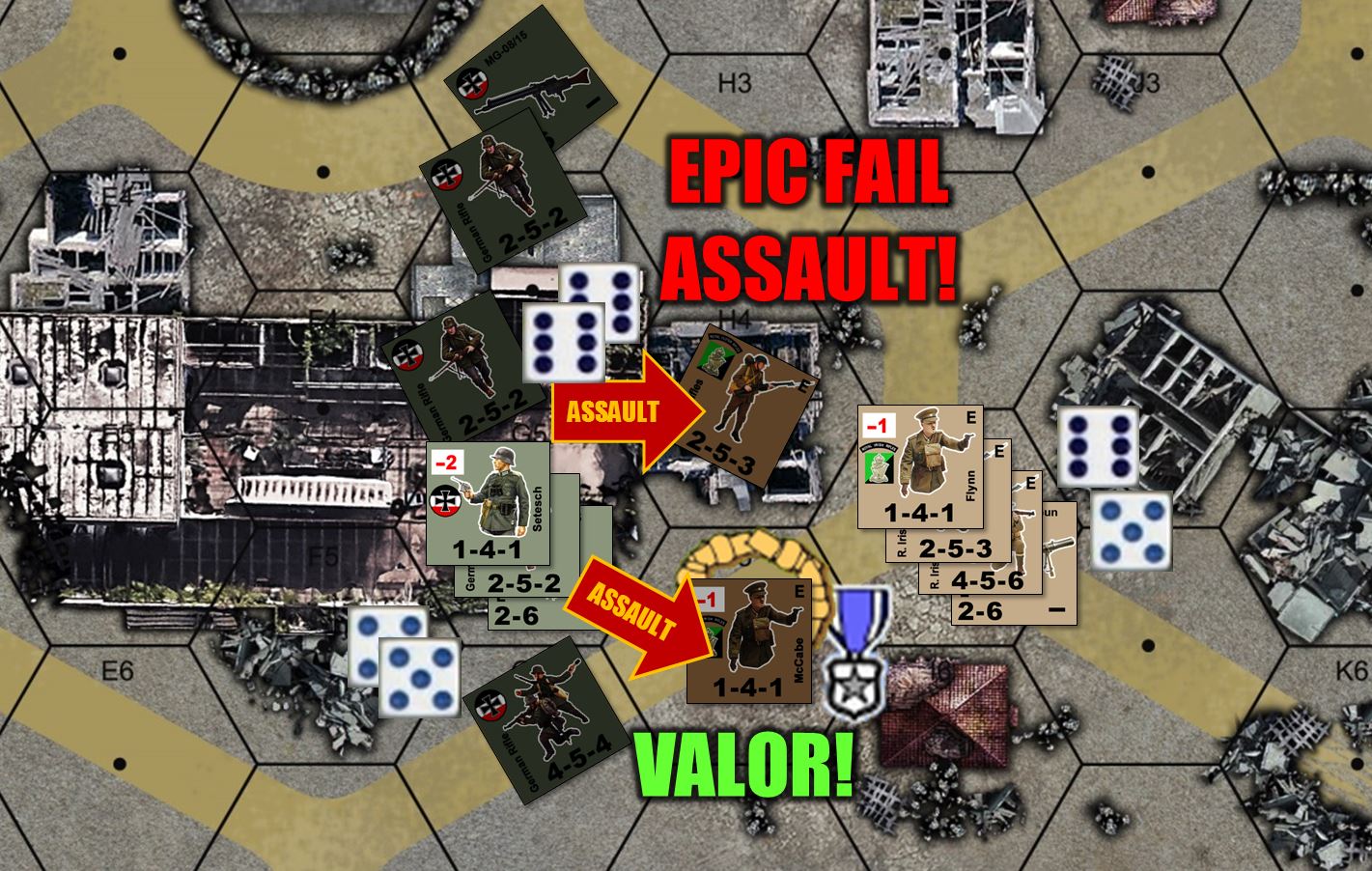
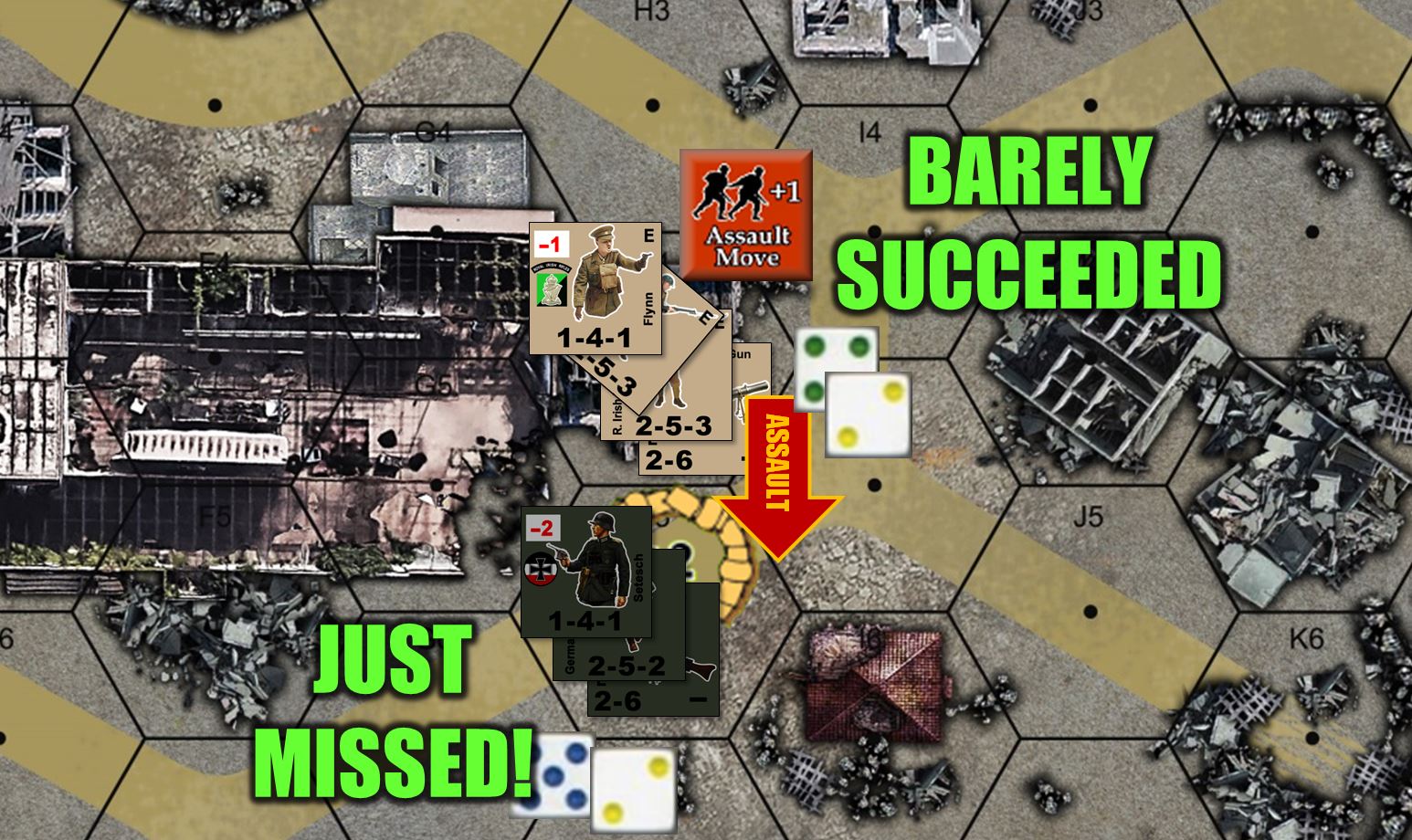
Flynn’s platoon, meanwhile, hooks north, back into those east rooms of the Courthouse, and then assaults the Germans who just overran McCabe. The assault basely succeeds, but does succeed, and Setesch’s platoon is likewise eliminated, although costing yet more Irish casualties in the process. The Irish have lost the bulk of two platoons in this firefight, but for now, they have a foothold in the Courtrai municipal building (objective if the game). They have an understrength platoon in the courthouse.
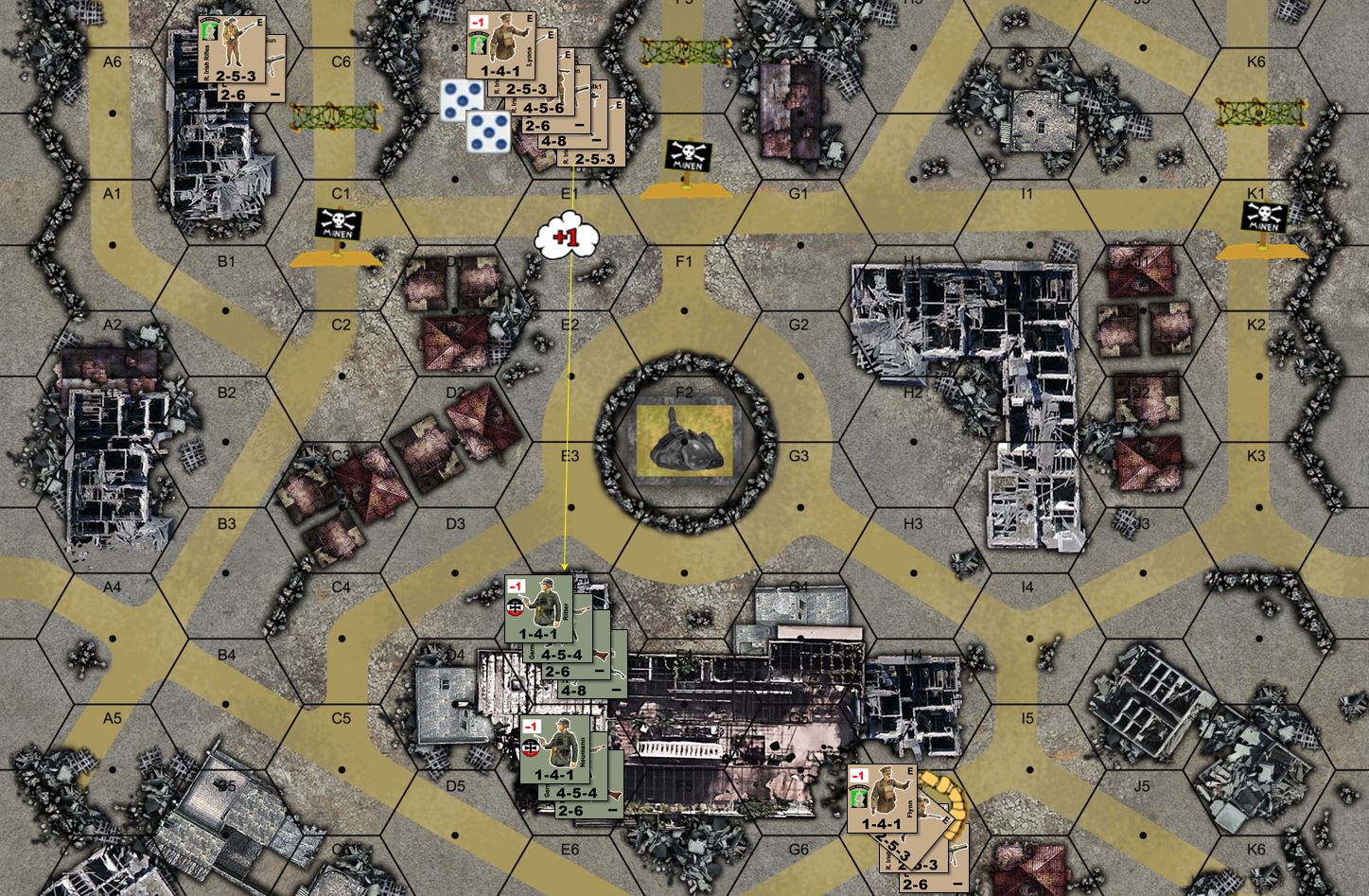
The Germans don’t miss this development. The platoon and a half facing Lyons to the northwest immediately pulls out, double-timing it back through their buildings, racing to the western offices of the Courthouse. They thus give up that whole wing of the battlefield, but have no choice if they want to continue to contest Irish possession of the Courthouse that decides the game. The smokescreen that Lyons was calling in to cover his upcoming assault is now actually an obstacle for his own MG fire (Vickers section in that stack), taking a shot at the retreating Germans of Ritter’s platoon as they cross the courtyard roundabout street back into the Courthouse. Rolling a 10, though, the shot would have done no damage anyway.
Turn 6 – last turn of the game. If the Irish are going to win this, they have to clear that courthouse, NOW. Flynn’s platoon is badly shot up, so it’s up to Lyons to carry this one in. First he directs more MG fire down the street into the courthouse, managing to pin a German half-squad with an MG 08 15 LMG (better that than the fire team manning the MG 08 HMG). Okay, now the smoke screen drops in from the mortars, landing right in front of the remaining German gunners to provide Lyon’s assault with the best possible cover. In goes the assault, Lyons taking every man with him except the Vickers crew (he’s chosen NOT to set up a “fire lane” with this MG fire, obviously, he’d be running through his own MG fire).
The assault is a nasty one. Despite the smoke screen, the German point-blank MG 08 fire inflicts enough casualty points that Lyons is forced to drop a half-section of rifles. Weakened, the assault goes in, except now he no longer outguns the German force he’s assaulting. At 1-1 odds, Lyons needs a 6 or less on 2d6 … actually pretty poor odds (41.7%, actually).
But he actually makes it, with a five!
Holy hell, the Irish have RE-breached the courthouse, although again, costing Lyons four casualty points (one non-pinned unit, one officer, +2 for building).
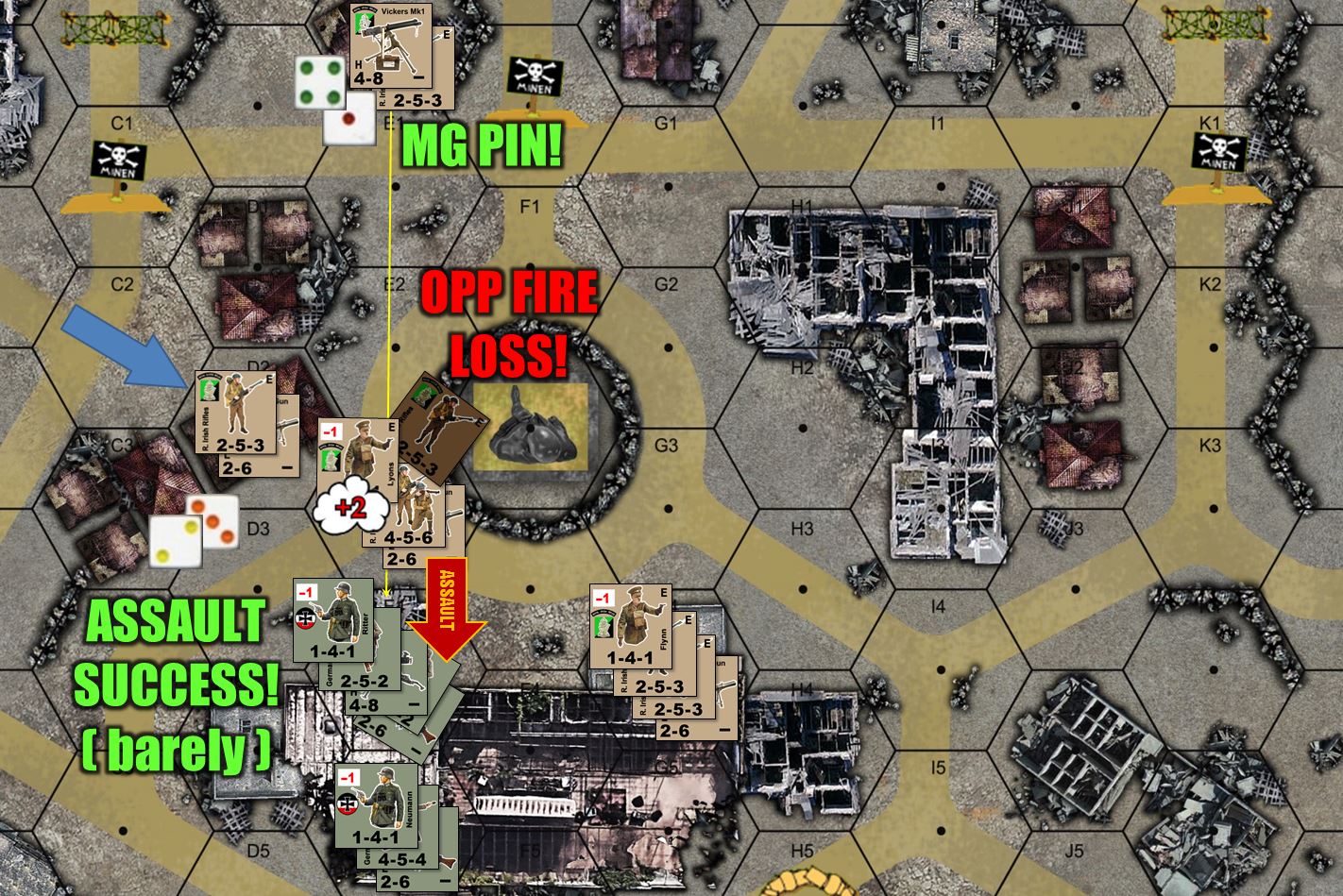
Here, however, is where Lyons’ luck desert him. He had to pay four casualty points. He only had two half-squads left, each with three casualty points. So he dropped one half squad (thus paying 3), then had to pay one more. He could either “overpay” by dropping the second half squad, “Pin” himself, or pin the other half squad. He chooses the latter. This way, he can apply his -1 leadership bonus to the difficulty of rallying that half squad (officers give bonus to rallying men, not vice-versa).
It’s the smart play. It just doesn’t work out. Normally the rally difficulty is six or less on 2d6. +1 for “E” Elite Irish Regiment. +1 for Lyon’s readership. They now need an 8 or less on 2d6 (72.22%). Except they roll a 9.
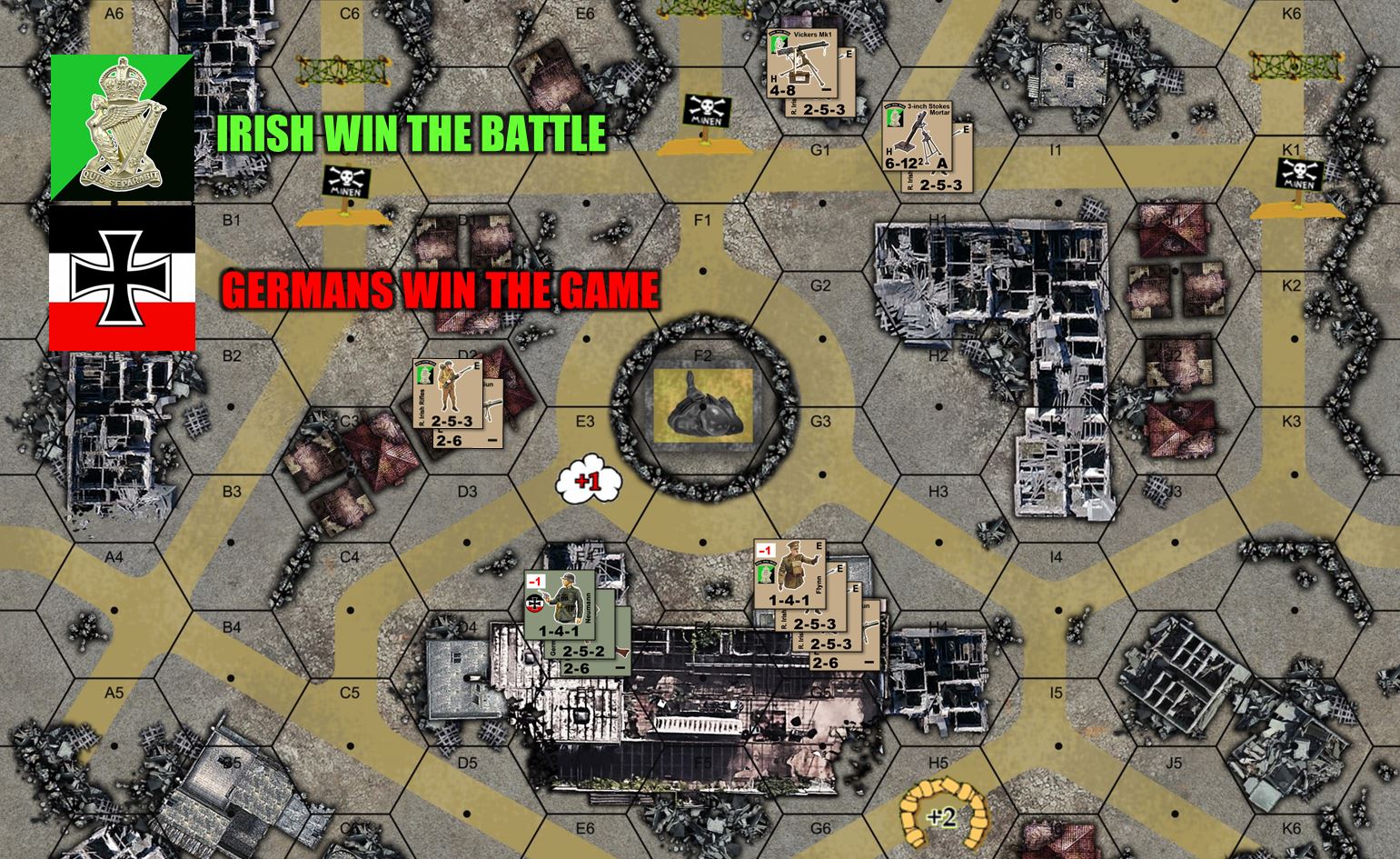
Now Neumann’s survivors can counter-assault on German Turn 6. The pinned units are automatically eliminated for free. Lyons alone fights to fend off the assault, and he’s outnumbered 9-1 (full squad + officer including MG 08 15). Lyons goes down, although costing the Germans four troops in the process.

Thus we have the final outcome of the game. The Germans have one officer and four men in the northwest corner office of the Courthouse (including an MG 08 15). Thus, technically they win the game as the Irish were unable to clear the building in the allotted time.
However, it’s pretty clear that the Irish would win this battle on Turn 7. Lt. Flynn has nine men and a Lewis Gun in the east offices of the Courthouse. There’s another four men and a Lewis Gun across the street to the northwest, plus the four men on that Vickers MG and four more commanding the 76mm Stokes Mortar section. Thus with 21 men to the Germans’ 5, Flynn would be able to clear this building “in overtime.”
But that’s asymmetrical wargaming. The weaker side (usually defense) just has to hold on for a certain amount of time, inflict a certain amount of damage, etc. In this case, timetables for Irish artillery may have been thrown off because they can’t get an observer up in the upper floors of that Courthouse on time. Other battalions might have to cancel their attacks now because of lack or artillery and failing daylight … or worse … might be ordered to go in without artillery support. Thanks to the delay of taking that Courthouse, other withdrawing German units might have made it across the Leie (Lys) River or the Bossuit Canal. Who knows?
Anyway, this concludes this battle report. Hope some of you liked it.
Battle Report Part 03 - 36th Ulster Division at Courtrai (October 19 1918)
Battle Report Part 03 – 36th Ulster Division at Courtrai (October 19 1918)
The firefight between “Johnston’s Company” 12th Royal Irish Rifles / 36th Ulster Division and “Bothi’s Kompanie” / 12th Bavarian Division in the streets of Courtrai, Belgium … continues.
When we left off, the Germans were doing very well in the west, where a powerful counterassault had actually eliminated McAuley’s platoon, and Lyons’ platoon on the far west was pinned down in the open having failed an assault against the German wing. Somehow Lyons and his survivors weren’t killed in the next phase of German fire, and now he’s managed to call in a smoke mission from the company mortar section, MG fire from one of the Vickers sections, covering a withdraw back to safety in the ruins of bombed-out building. German opportunity fire has missed, somehow Lyons has survived with enough of his platoon to … in the turn or two … put it together with the company reserve to form a new platoon that will hold together the Irish right wing.
Meanwhile, things are going badly for the Irish on the left. Flynn’s platoon has failed to suppress the German mortar crew behind the objective building, and when Captain Johnston tries to rush through said building and assault that mortar pit, he and his platoon are actually shot up so badly they are removed from play. Captain Johnston is probably badly wounded, he and most of his men on the way back to an aid station, or worse. No “bad moves” were made here, just poor nice (note the rolls, remember low rolls are better in this game).
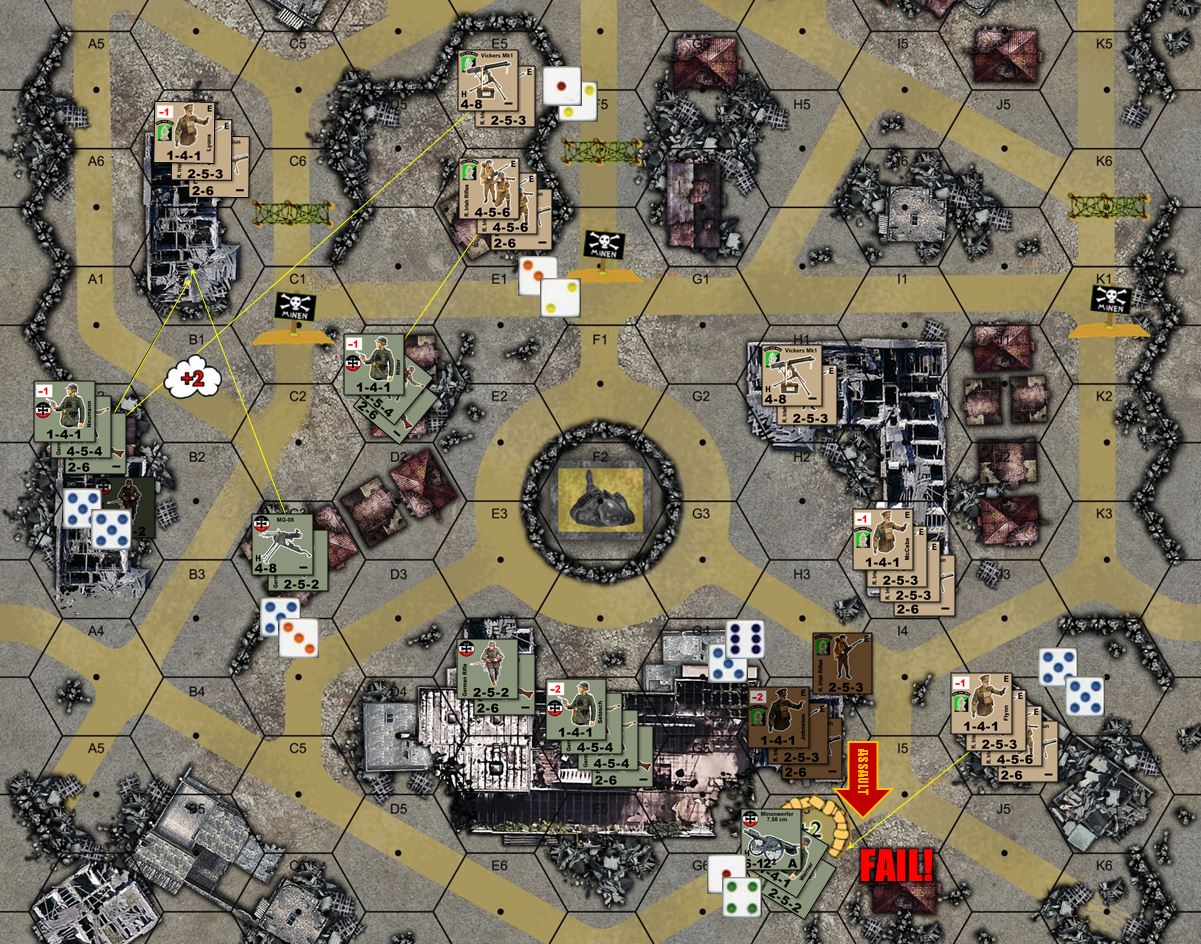
The German Turn 03 is modest, conservative, tactical, and cautious. They’re on defense, after all. They win just by surviving in that big municipal building at the south center of the board. They get some lucky rolls and take out the Vickers section that was trying to come up to support McCabe and Flynn, but other than that they’re just trying to keep the Irish at bay, make them pay for any advances, and run out the clock. So far they’re doing very well, although Lyons continues to consolidate a new Irish right wing to the northwest.
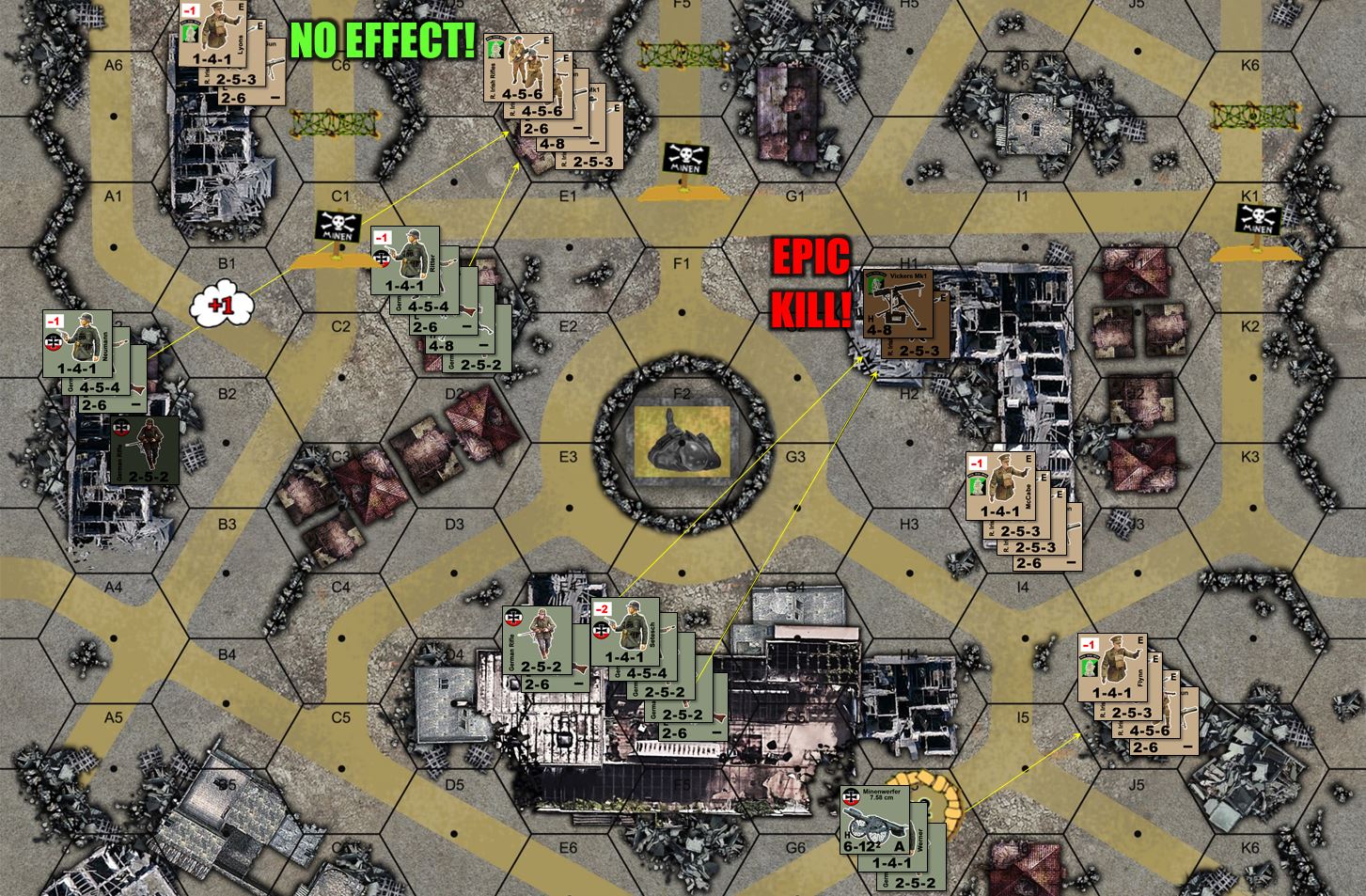
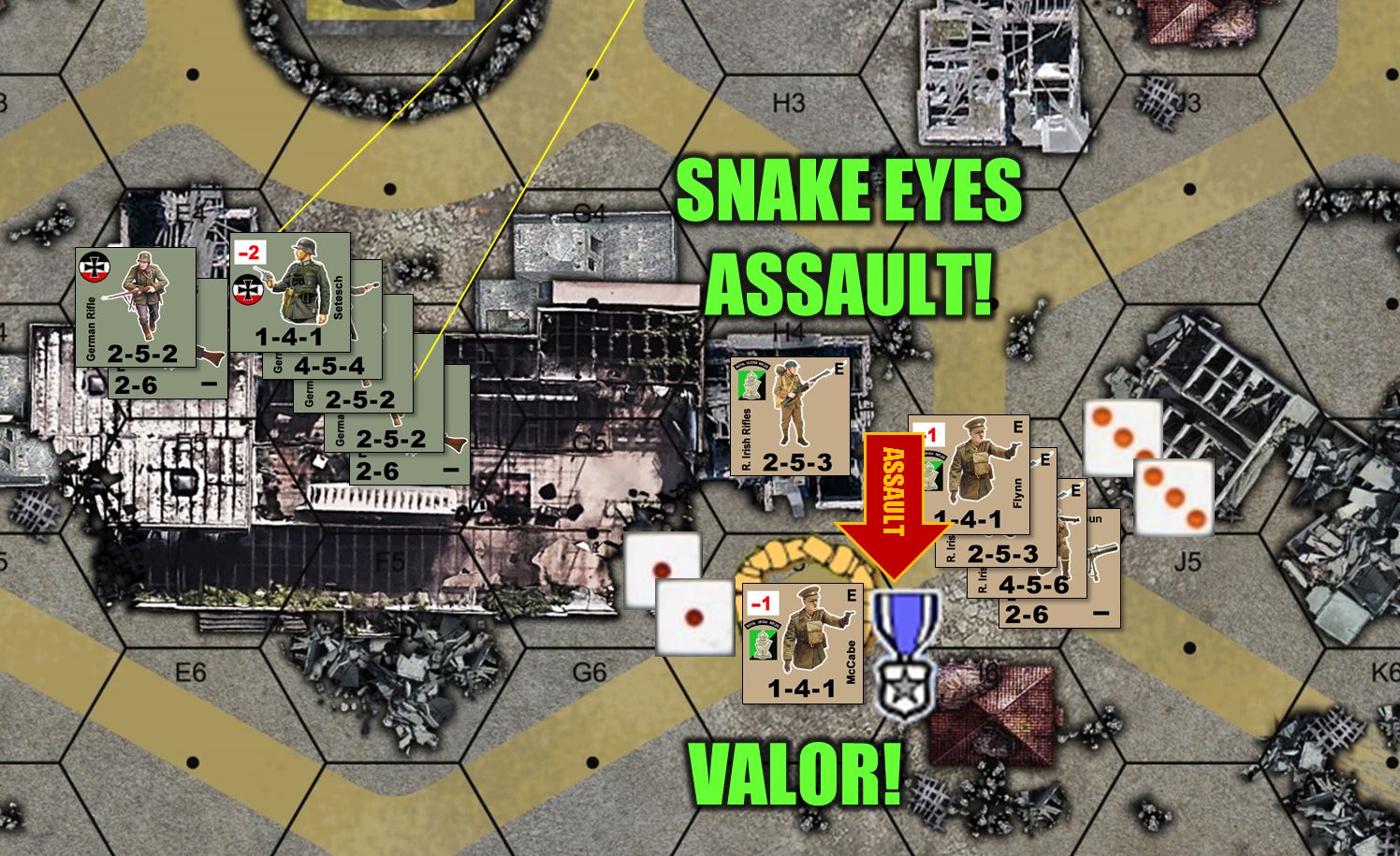
While Flynn’s platoon again tries to put down fire suppression on the mortar pit behind the German-held courthouse, McCabe’s platoon tries to rush through the same rooms Johnston tried a while ago, assaulting the same German mortar pit. Again, it’s a bloodbath, but this time the attack does succeed. Furthermore, the assault rolls snake eyes (best roll in the game), which means everyone who participated in that immediate assault gets to make a “Valor Check.” Success means that unit becomes “Valorous,” getting all kinds of bonuses.
Sure enough, he may be the last man in his platoon, but Lt. McCabe has just earned his DSO!

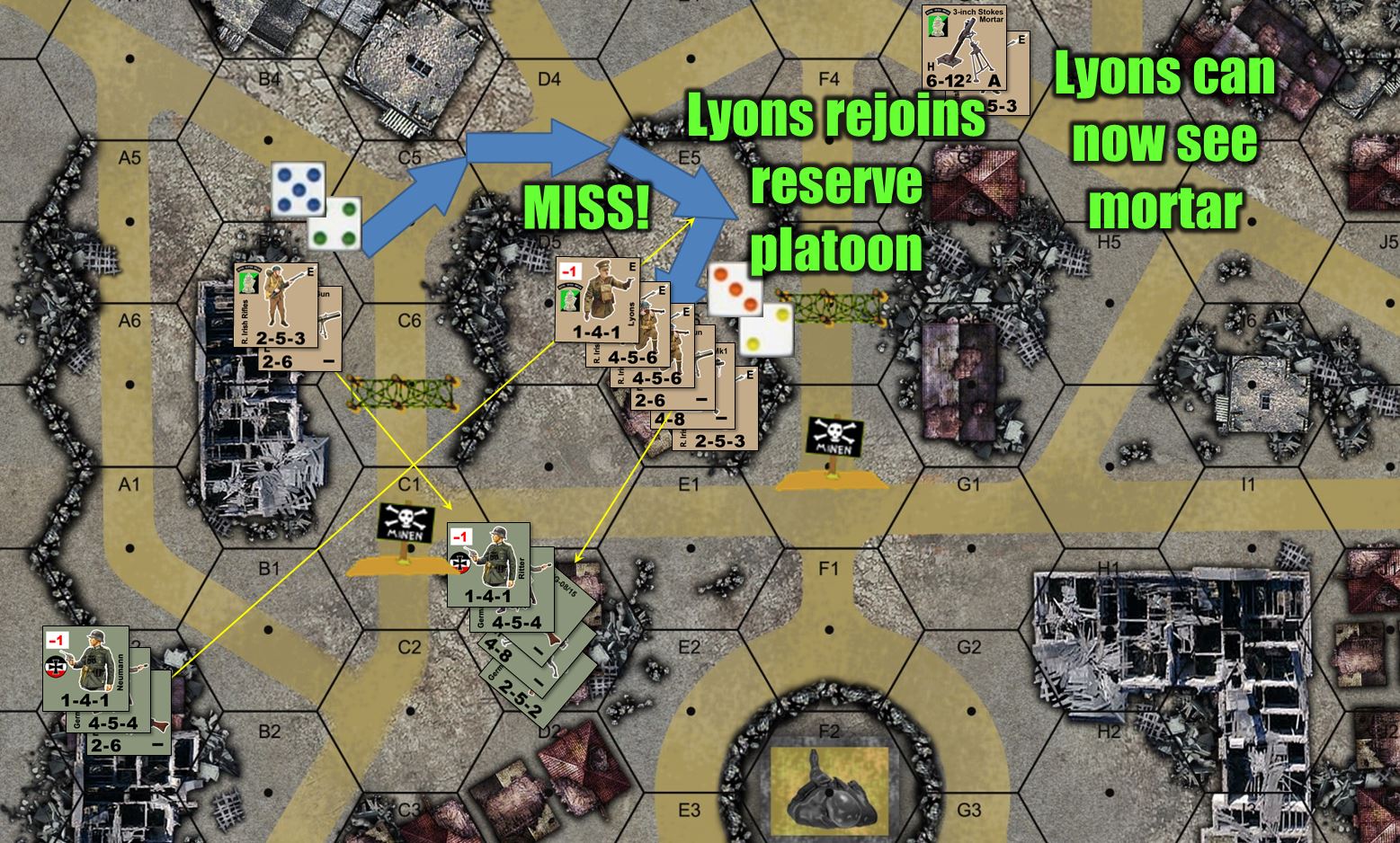
Meanwhile, in order to apply his -1 leadership bonus to the bulk of his new “battlegroup” Lyons has to be with them. Therefore, he must run backwards from his original platoon, across the street, and then back into the rear of the building in which the bulk of his new force is forming up. The Germans have one very nice moment of opportunity fire against this move, and “Lyons’ run” is very risky. But he makes it. Barely. Now Lyons can see more of the German force, and can also see the mortar section behind him. This means he can call in indirect fire from the mortar using our 1918 Edition “radio-less” indirect fire rules.
Closeup of the “Snake Eyes Assault.”
Battle Report Part 02 - 36th Ulster Division at Courtrai (October 19 1918)
Okay, with the first big MG positions cracked on the German right wing, and with Lyons’ and McAuley’s platoons closed up with the Germans on the left wing, Captain W. Johnston “blows the whistle” and makes a general assault.
This … will get messy.
Working our way from left to right, first we have Lyons’ platoon making a rush down the street toward Neumann’s platoon holed up in those ruins to the west. The company mortar section drops in some smoke to help cover this, but Lyons will be taking plenty of opportunity fire from the front, plus Ritter’s platoon to the southeast, plus a back-up MG 08 nest. I’m not sure how much cover that smoke is really going to give …
Meanwhile, McAuley’s platoon makes a shove straight at the MG o8 position facing him. He has no smoke or cover, but that MG 08 is more or less alone, so he should be all right.
McCabe’s platoon is laying down fire from one wing of that eastern building to the next, trying to pin down Steiner’s platoon to help facilitate Johnston’s charge blitzing across the street, then through the ruins, and then finally straight into the teeth of Steiner’s position.
Flynn, meanwhile, will be flanking around the far Irish left, getting at the German mortars hopefully and unhinging their right wing.
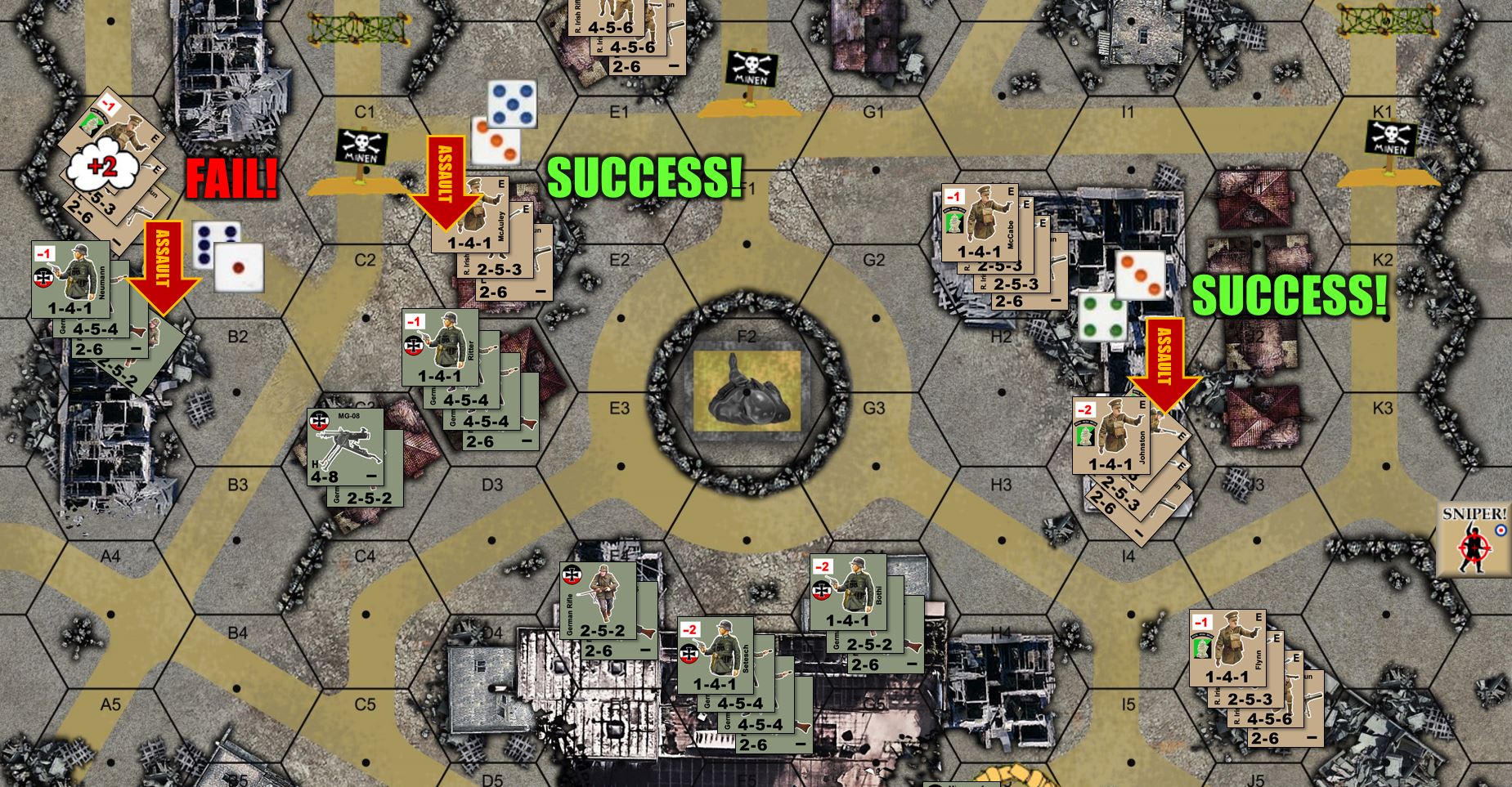
Dice show the results of the German opportunity fire and McCabe’s attempt at covering fire.

German opportunity fire has been deadly. Despite poor die rolls from Neumann and the MG 08 nest, Ritter has rolled very well against Lyons and mauled his platoon badly despite smoke cover. The assault is now underpowered, and despite committing three grenades (after Lyons carefully applies casualty points to allow the maximum use of grenade counters), the assault FAILS! The survivors of Lyon’s platoon are now pinned down in the street!
McAuley’s assault, as predicted, succeeds (it’s just hitting a MUCH weaker target) – but he must still take casualties for breaching a building holding one German unit (half-squad, MG crew).
McCabe’s support fire didn’t do very much (just a bad die roll against heavy defensive modifiers), and Johnston’s assault barely succeeds against Steiner’s platoon. Steiner’s position is wiped out, but Johnston’s platoon has paid a steep price. Johnston softens the butcher’s bill by taking additional pinned (his men are being more cautious and less reckless, thus more immobilized and but taking fewer actual losses) – he’s relying on his -2 leadership bonus and his mens’ “E” elite rating to rally before his pinned sections are counter-assaulted by Germans next turn.
Irish rallies don’t go quite as well as hoped. Although Johnston’s sections rally, Lyons’ do not (Lyons himself does, however). It doesn’t look good on the Irish right wing …
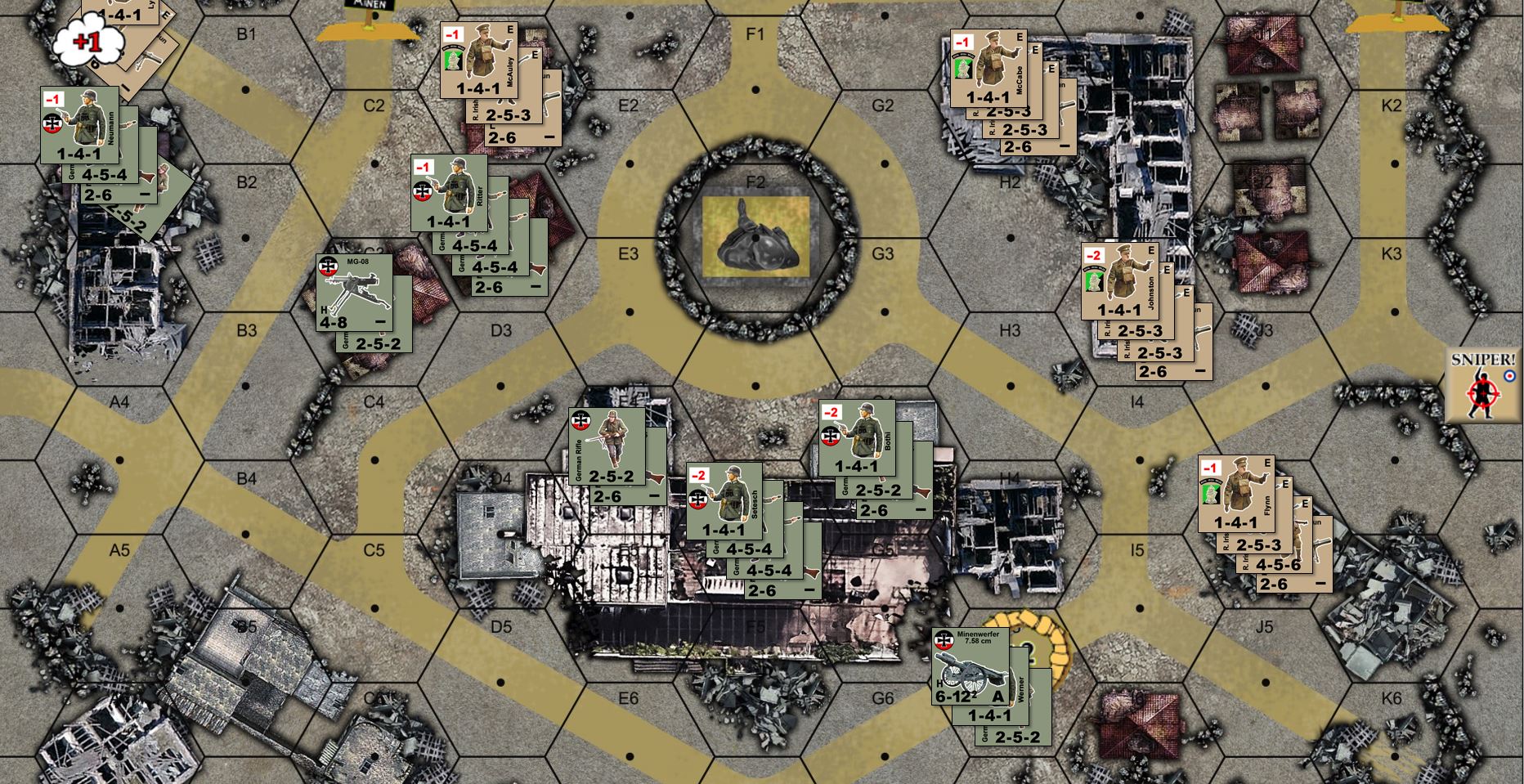
The German Turn 02 sees some wild reverses of fortune. Starting from left to right …
Lyon’s men should be meat on the table – they are pinned down in a street, the smoke cover dissipating (note the +1 instead of +2) point blank German platoon in front, and MG 08 on their flank. But they somehow survive!
McAuley, who was doing so well last turn, is not so lucky. Ritter’s platoon counterattacks (after McAuley fluffs defensive fire) and McAuley’s whole platoon is wiped out! He does take a nasty slash out of Ritter’s platoon, though.
The German Kompanie KP, meanwhile, holed up in the large, central objective building to the south, starts pouring fire down into McCabe’s position. But Bothi’s platoon rolls boxcars – summoning another British sniper attack! This time the sniper also rolls a six (best roll), inflicting automatic 6 casualty points – any terrain bonus (-2 for ruined buildings) = 4 casualty points … Bothi’s section is wiped out! Technically by its own attack roll!
The rest of the fire is pretty ineffective. Even after house-ruling all these buildings as -2 “ruined buildings” instead of the -3 “normal” buildings, these city battles just aren’t going to be decided by exchanging fire. This is going to be about pinning, assault, trench knives and shovels (because both sides are now out of grenades).

A quick close up on Lyon’s miraculous survival, McAuley’s last stand, and Bothi’s hapless encounter with an Irish sniper …

Battle Report Begins! Battle of Courtrai - October 19, 1918
Germans set up first, anywhere in the south six rows of the map. The Irish set up second, allowed to set up anywhere in the top four rows of the map as long as they are not in direct LOS of any German unit. Once they Irish set up, any Irish leader is allowed to call in a fire mission (special 1918 Edition “Preparatory Artillery Barrage” rules) with the four light mortar barrages included in their OOB.
*These OBA fire missions can only come in on Turn 1. Since Irish units cannot set up with LOS on German units, none of these will be “on target” per normal OBA rules. Therefore, the must drift to have any chance at any effect. On a d6: 1 = lands on designated hex. On a 2-5 drift one hes. On a 6 drift 2 hexes.
Also, they can set up a normal rules fire mission with their own integral 76mm Stokes section (1918 Edition “radio-less:” indirect fire rules – the spotter has to have LOS on the target, and the mortar battery has to have LOS on the spotter for visual signals for fire adjustment).
Irish use their Stokes mortar to set down smoke shells to cover the advance of McCabe’s & Flynn’s platoon.
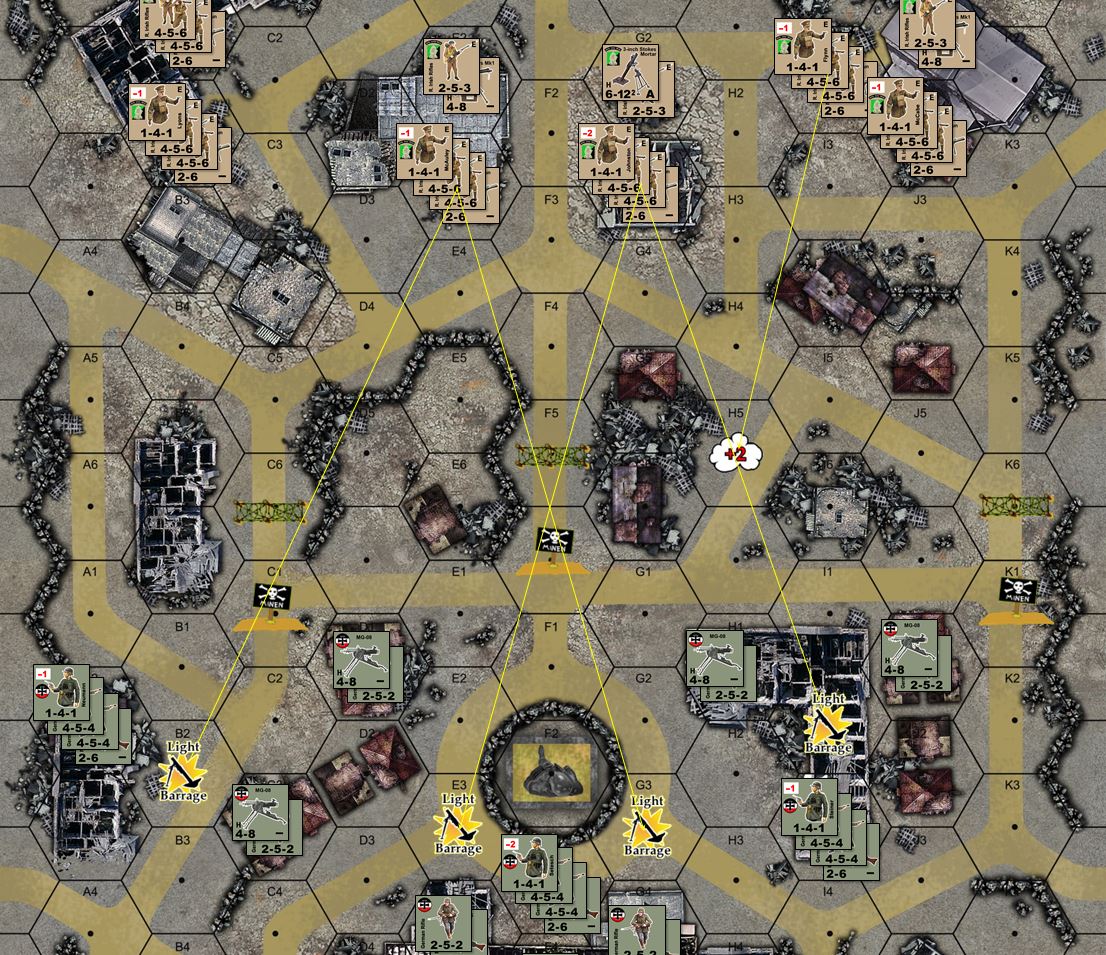
Irish mortar fire is a complete wash. Only one barrage hits anything, and rolls a 2d6 10 +3 for building = 13, a very bad roll (low rolls are better in this game), so no effect at all. Smoke screen goes down and the assault goes in.
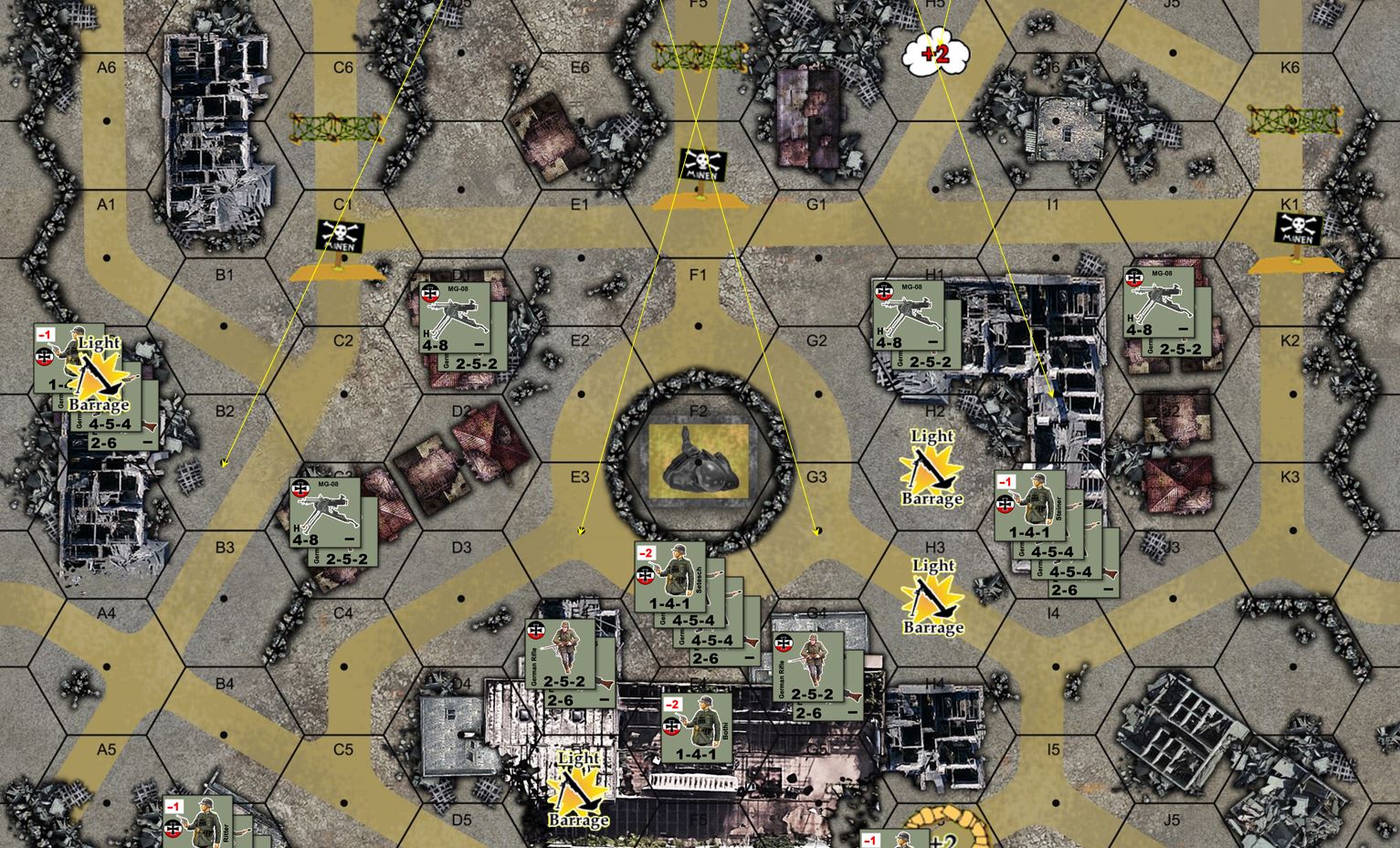
McCabe’s assault goe sin through the smoke screen. Unfortunately, the line of sight was such that the smoke rounds couldn’t be put quite far enough down the street to cover his final deadly 30 yards, and he takes opportunity fire from three angles. First, the MG 08 nest immediately in front (the one he’s assaulting) misses. Chalk it up to to panic fire.
Next, the flanking MG 08 nest rolls box cars, the worst possible roll. This results in a random Irish sniper appearing somewhere in the ruins, anywhere within line of sight of the unit that rolled the doubles sixes. The sniper is placed in a spot where he can make the immediate allowed attack on the MG 08 next (but he misses), but also pin down Steiner’s platoon somewhat should he try to move in the wing of the building behind the MG 08 nests.
Haputmann Setesch’s fire, from the southwest, ironically, scores well enough to do some damage. Lt. McCabe must take two casualty points, he can either pin down two units (both his sections) or take half a section of casualties and press home his assault. Not wanting to be pinned down in front of a German MG pit in an open street and in a a three-way crossfire , he takes the casualties and carries the assault in.

McCabe’s platoon and Flynn’s platoons make the assault. They can use up to three grenades counters (Irish have 12 in all), but the Germans (with only one unit in each target hex – the MG 08 crew / half squad) can only use one. So both Irish assaults use two grenades (giving them a surplus of +1), in addition to the +1 from each platoon’s leadership bonus (the -1 for the leaders).
Both assaults are successful but bloody, each Irish platoon must pay one casualty point for the one German unit in its target hex (half squad MG 08 crew) and three points for the building terrain bonus = four total. Both sides decide to pay -3 casualty points by knocking down a full squad to half (6 casualty points for a full squad down to 3), then pinning that half squad for the fourth required casualty point.
It’s a risky move, with Steiner’s platoon in that same building ready to immediately counter-assault. But these Irish have an “E” elite rating, plus both platoons have a -1 leader (Flynn and McCabe). So their odds of rallying before the German counterassault hits them are good. In this game, it’s all about the quality of your men and your leaders.
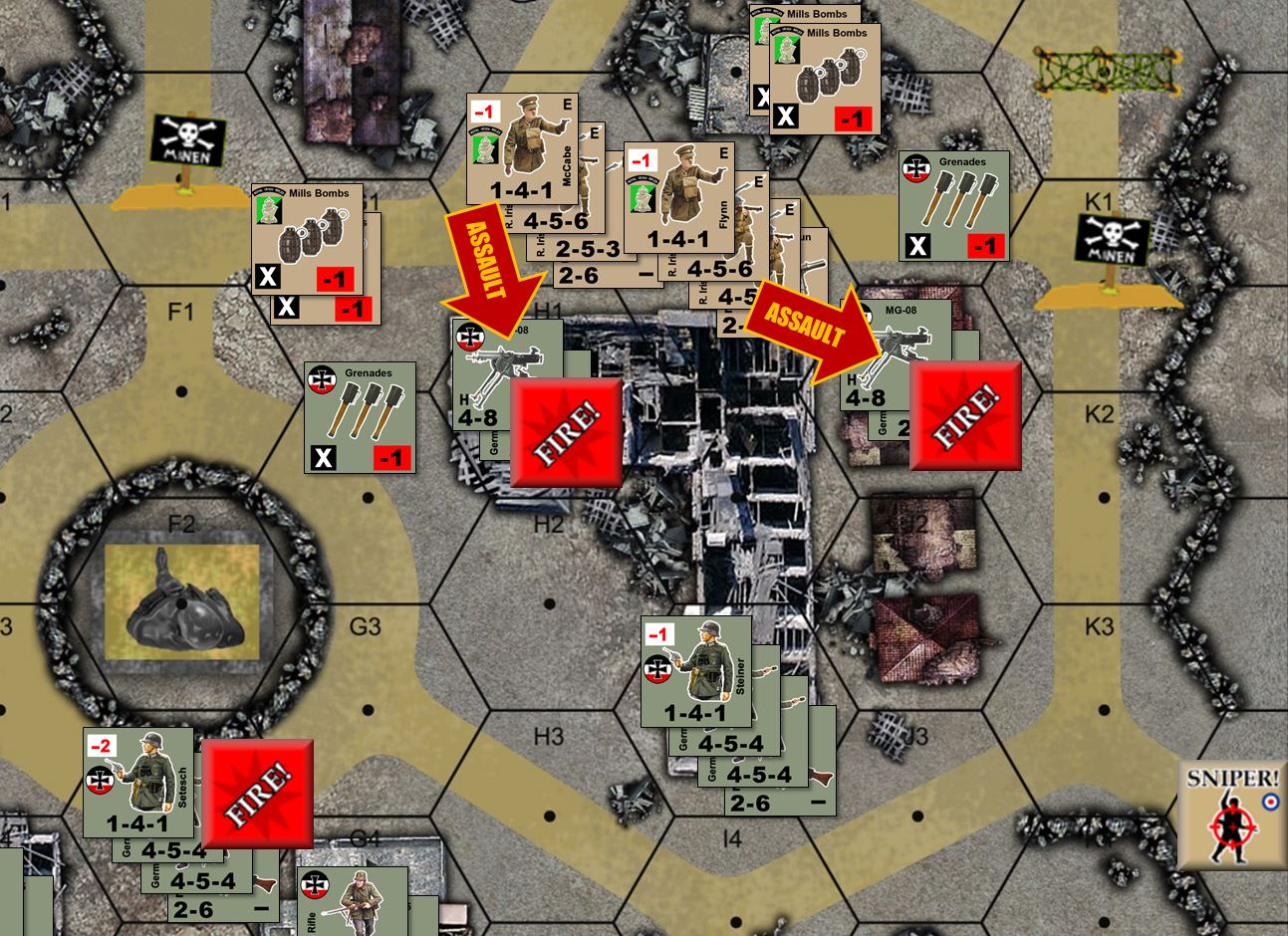
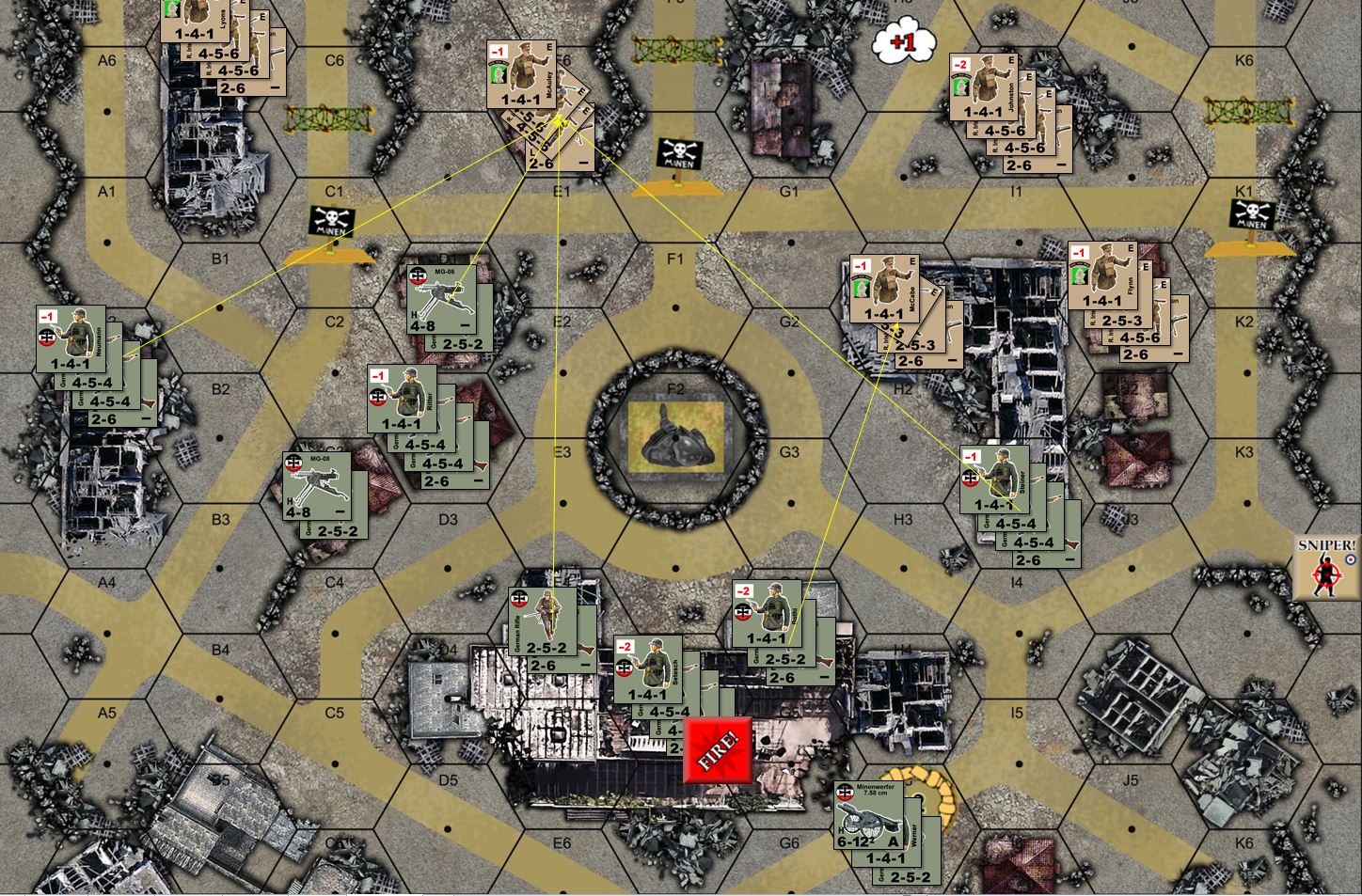
Johnston moves company command section up behind McCabe and Flynn. On the other flank, Lyons and McAuley move up, using buildings for cover. Mortar section edges out into street so Johnston can see them and pass signals, but noyt take took much fire now that McCabe and Flynn have taken out two forward MG positions. German MGs can see Lyons and McAuley, will fire during their turn, McAuley and Lyons were careful to stey in and behind buildings. Vickers sections and reserve sections try to move up as well, but with out officers, and slowed by heavy weapons, they don’t get far.
Germans, meanwhile, move up reserve squad, and put McAuley;s platoon under fire from four directions. Setesch’s platoon uses Assault Move to low-crawl back into the town hall building. Not moving on the right wing for now, they can ignore the British sniper. Werner puts mortar fire on McAuley’s platoon as well. McAuley takes some casualty point, but with elite troops in a fortified position, and with no Germans immediately ready to assault, he takes the pins, and so takes no actual killed or wounded.
Hauptmann Bothi, however, with a half squad armed with MG 08 15s, however, scores more damage on McCabe’s platoon. But again, Irish are able to take the pin and not sustain any more killed or wounded.
ROUND ONE complete.
Building New Map and Setting up Battle for Royal Irish Rifles
For best results, select the image, then expand by viewing in new tab. 😀
Game is now set up, now hopefully I’ll be able to play and include battle report tomorrow.
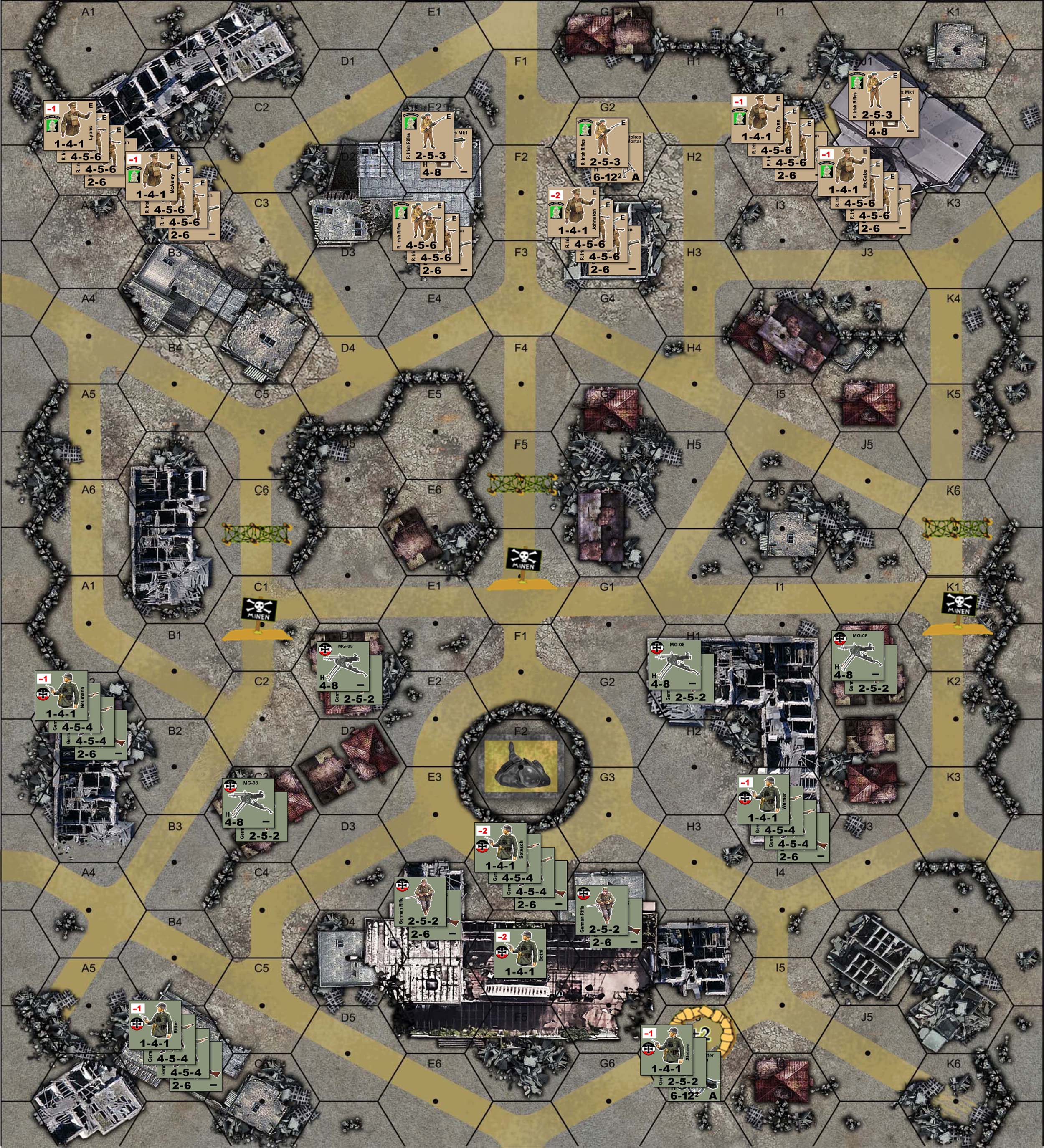 Overall double-sized map in Valor & Victory, set up for an assault of a company of 12th Royal Irish Rivals, 108th Brigade, 36th Ulster Division - against hastily-prepared positions of 12th Bavarian Division, X Reserve Corps, Fourth Army in Courtrai, Belgium, 19 October 1918. Basically, the Irish have to assault south and take that large municipal building building at the bottom of themap that is forming the keystone of this German battalion's defense.
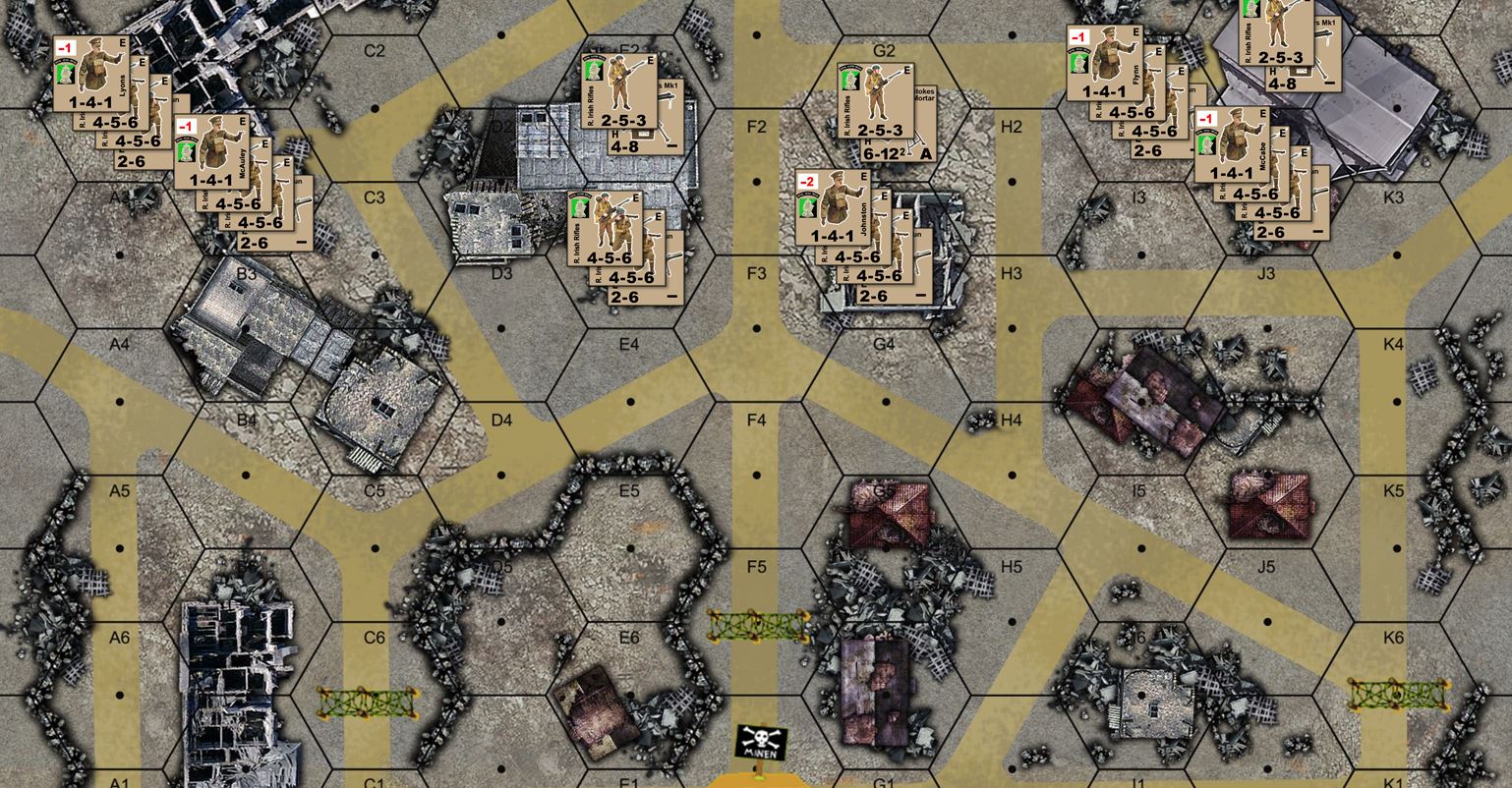 Four platoons of 12th Royal Irish RIfles, backed up by Vickers MG sections and 76mm Stokes mortars.
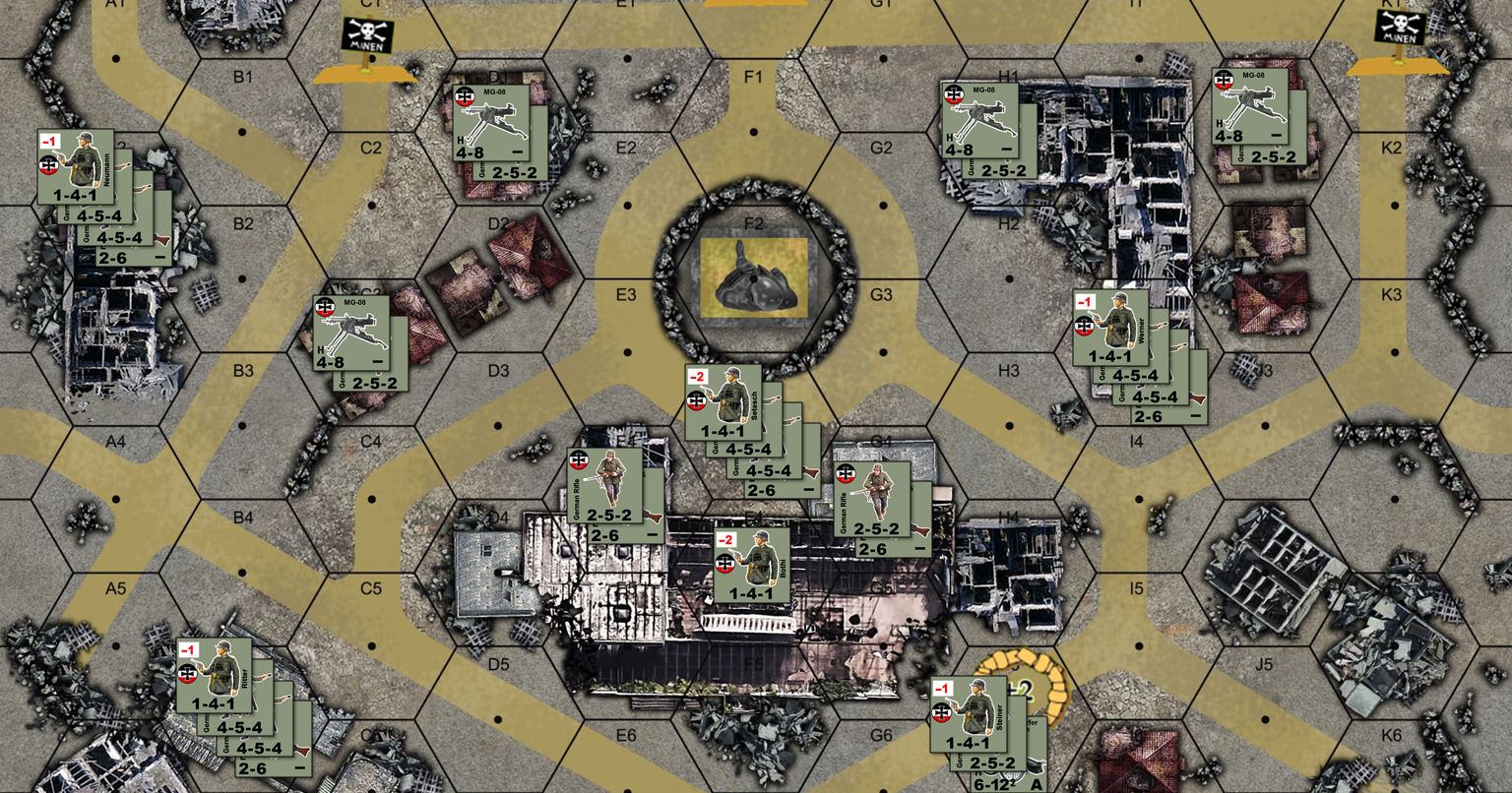 An understrength company of 12th Bavarian Division, X Corps, on defense. They have MG 08s, MG 08 15s (late war), minefields and barbed wire defenses to slow down assaults down the obvious approach routes.
 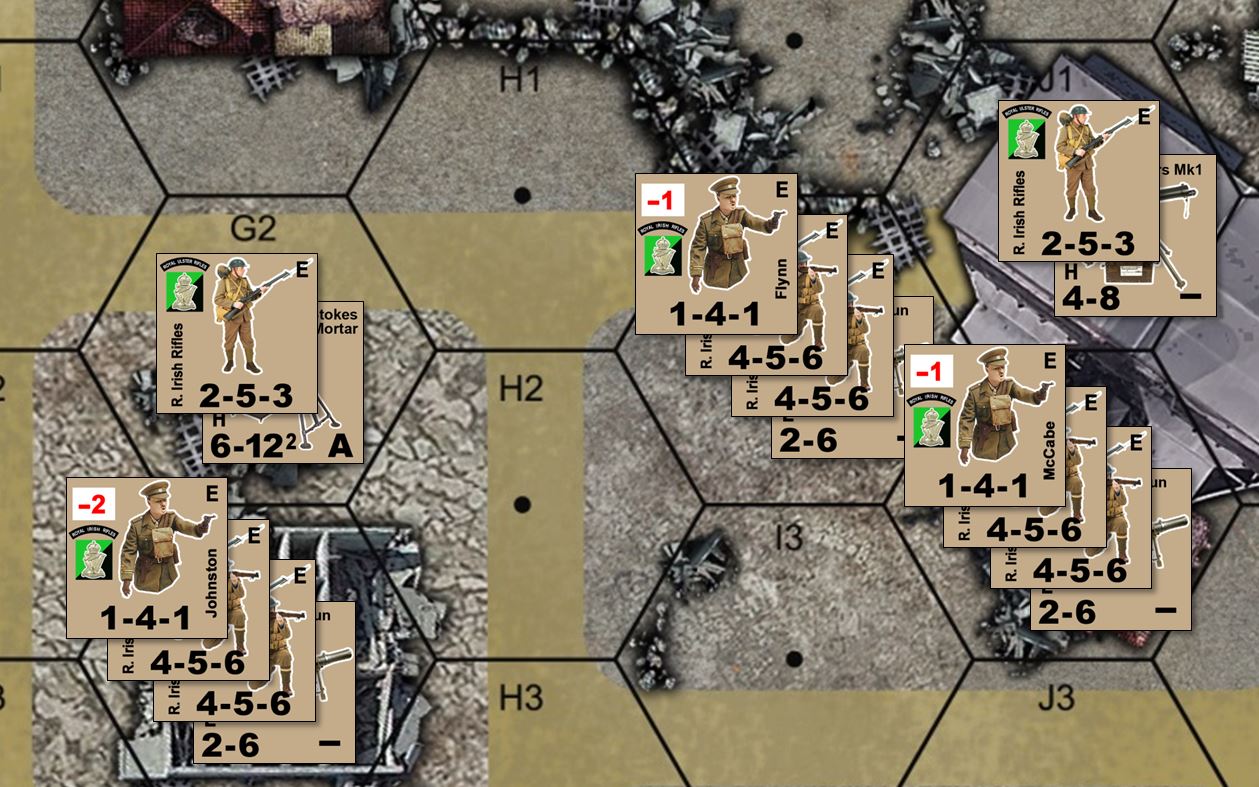 Close up of the Irish center and left wing.
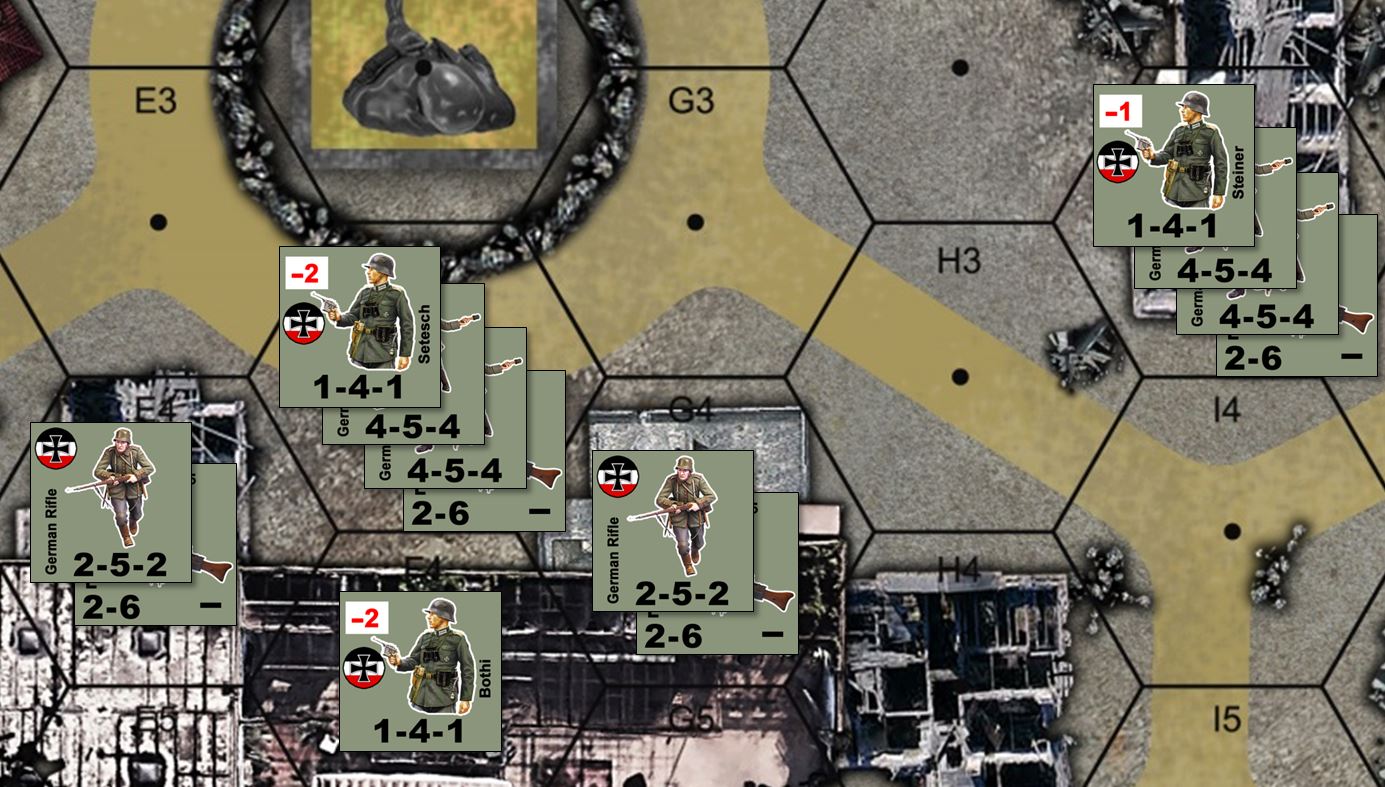 Close up of the German center and right wing
Not to be outdone, also some Australians for WW1.
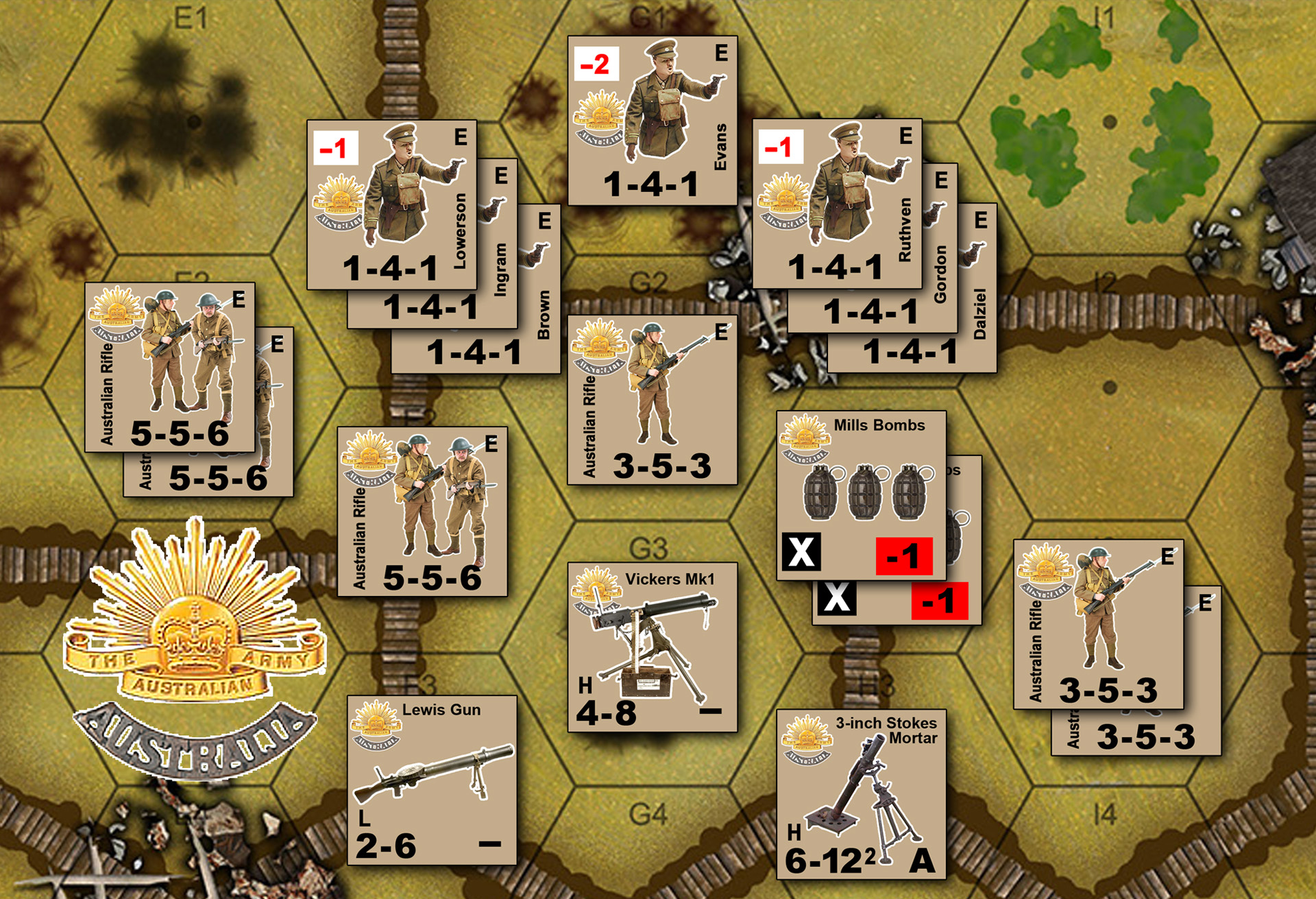
Not to be outdone, the Australians now also have a force in 1918 Edition of Valor & Victory. Some people feel the Australians were a little left out of the Great War article series we did earlier this year, I don’t think they quite realized the limited scope of that series or that most of the 1918 battles for which the Australian Corps / Fourth Army / BEF are famous actually took place afterwards.
But now we are “afterwards” so I definitely wanted to include them.
I actually made these guys really badass, note the “E” elite rating and the 5-5-6 full section combat values. This makes them actually a little better than even the US Marines I drew up for Belleau Wood. Much as I love and have close personal ties to the US Marine Corps, especially at Belleau Wood, the Marines of that era were hampered a little by inexperience, American army weapons, and especially French support weapons.
The Australians had none of those problems, and were every bit as aggressive and innovative as the Marines. They were just more experienced and had slightly better weapons (Lewis Guns instead of M1915 Chauchats, etc).
** the only difference would be I give my Marines a -1 difficulty on close assaults, that’s the Model 1897 Winchester .12 gauge shotguns and entrenching tools. Always dread the Marine and his “lobotomizer” This makes my Marines just a shade better in close assault, even though the Australians are probably better overall.
For comparison, my German “stosstruppen” (shock troop) storm troopers have an even BETTER assault value (actual SMGs, two extra pistols per man, extra grenades, etc), but a poor casualty rating (combat losses were nigh-suicidal) and a short range (4 instead of 6).
Anyway, here are the Australians for now. This would by the four infantry divisions in General Sir John Monash’s Australian Corps, Rawlinson’s Fourth Army, BEF, July-November 1918.
The -2 commander (remember, -2 is a bonus, not a penalty) is named for my Australian friend @jamesevans140. The -1 lieutenants are named for Australians who won the Victoria Cross in 1918 specifically. There were plenty to choose from, a total of 66 Australians won the Victoria Cross during the Great War.
Part Three - Corrected to "Royal Irish Rifles" (Pre-1921 Regimental Name)
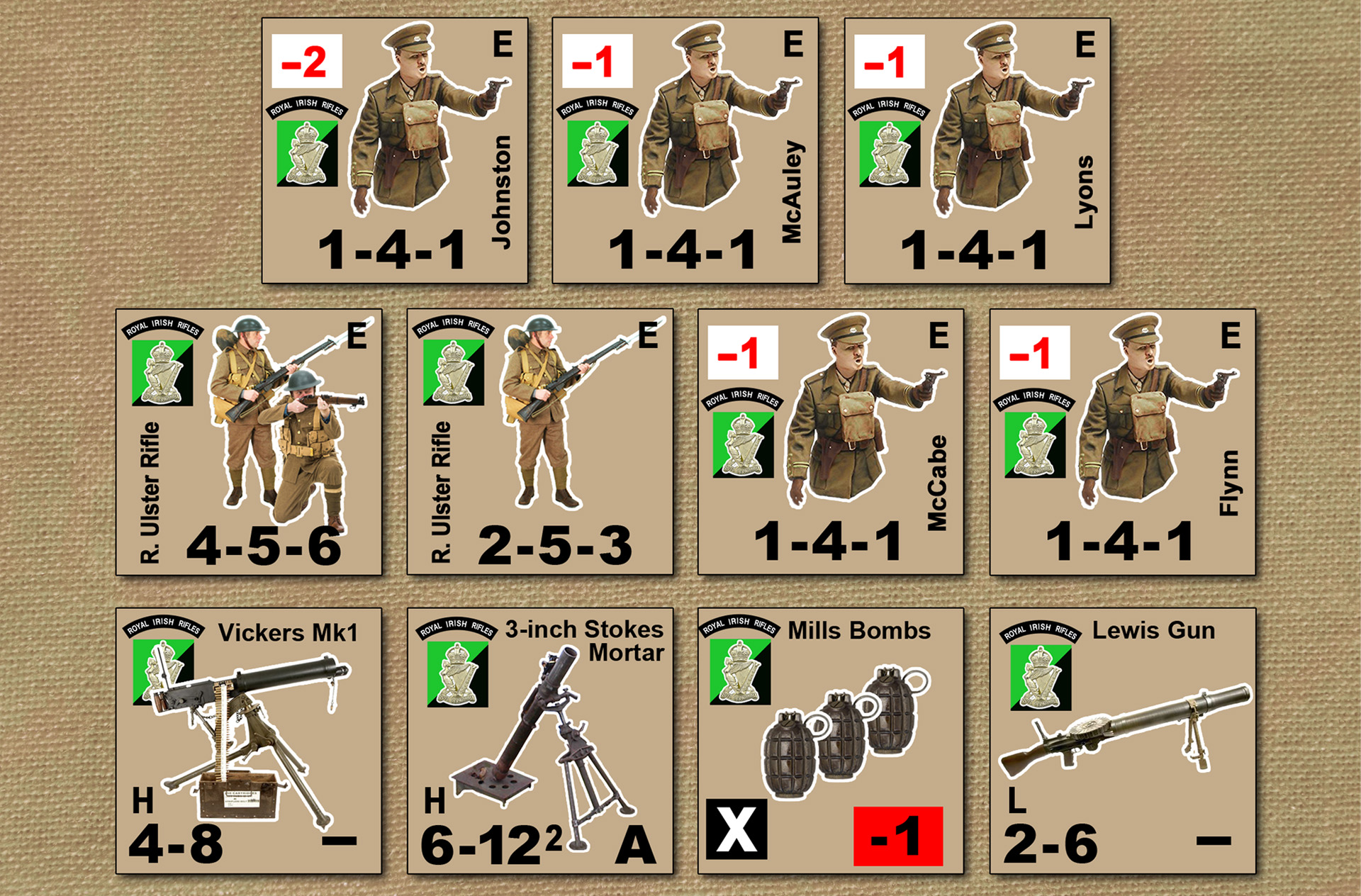 Shoulder flash corrected to "Royal Irish Rifles" (Pre-1921 Regimental Name)
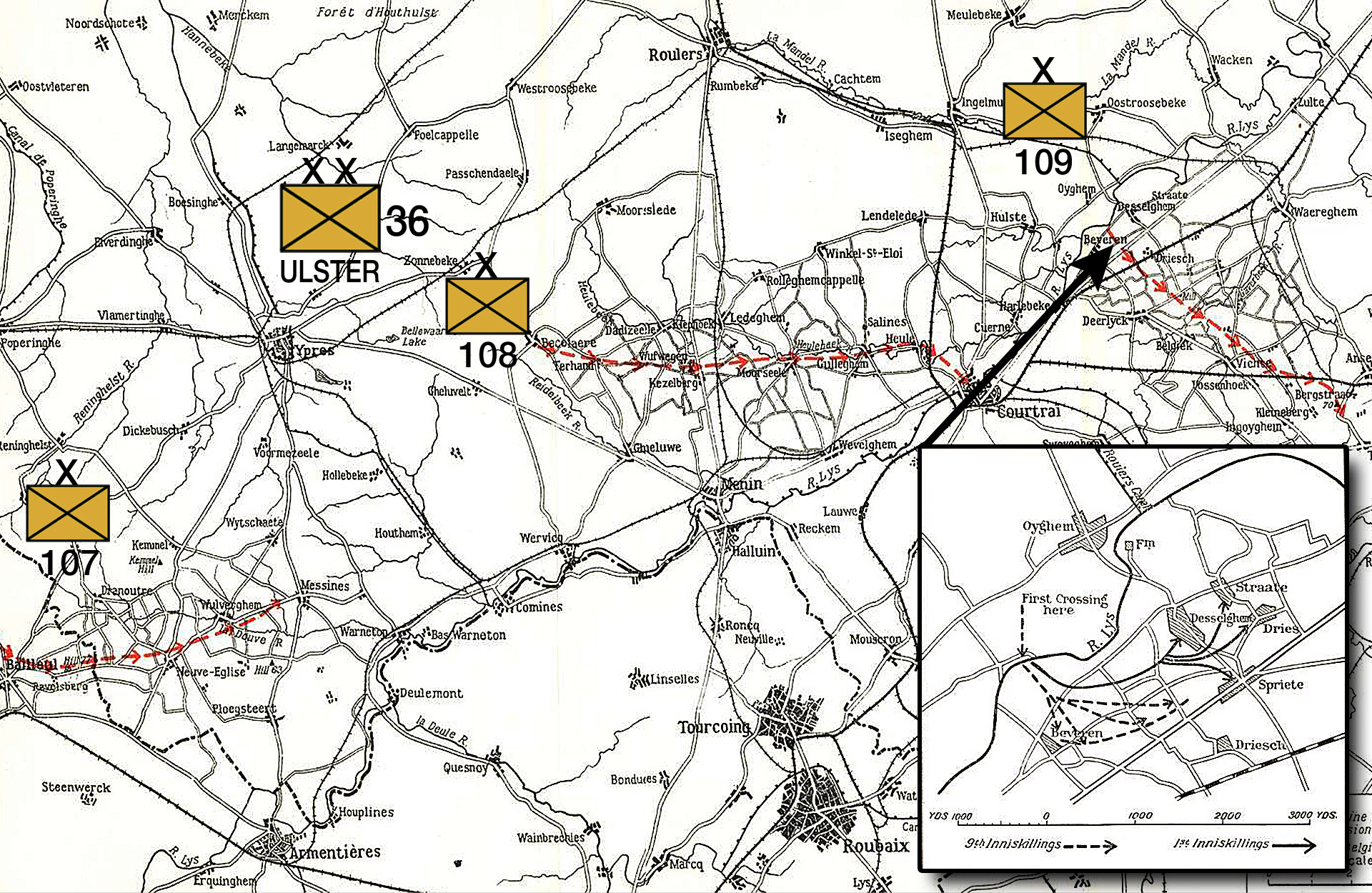
Also, found some pretty detailed maps of the 36th Ulster Division’s final advances as part of the Battle of Courtrai, October-November 1918.
Original map is from The History of the 36th (Ulster) Division by Cyril Falls.
I added some graphics based on connections I was able to draw from the text.
Part Two - Completing 36th Ulster Division for Valor & Victory
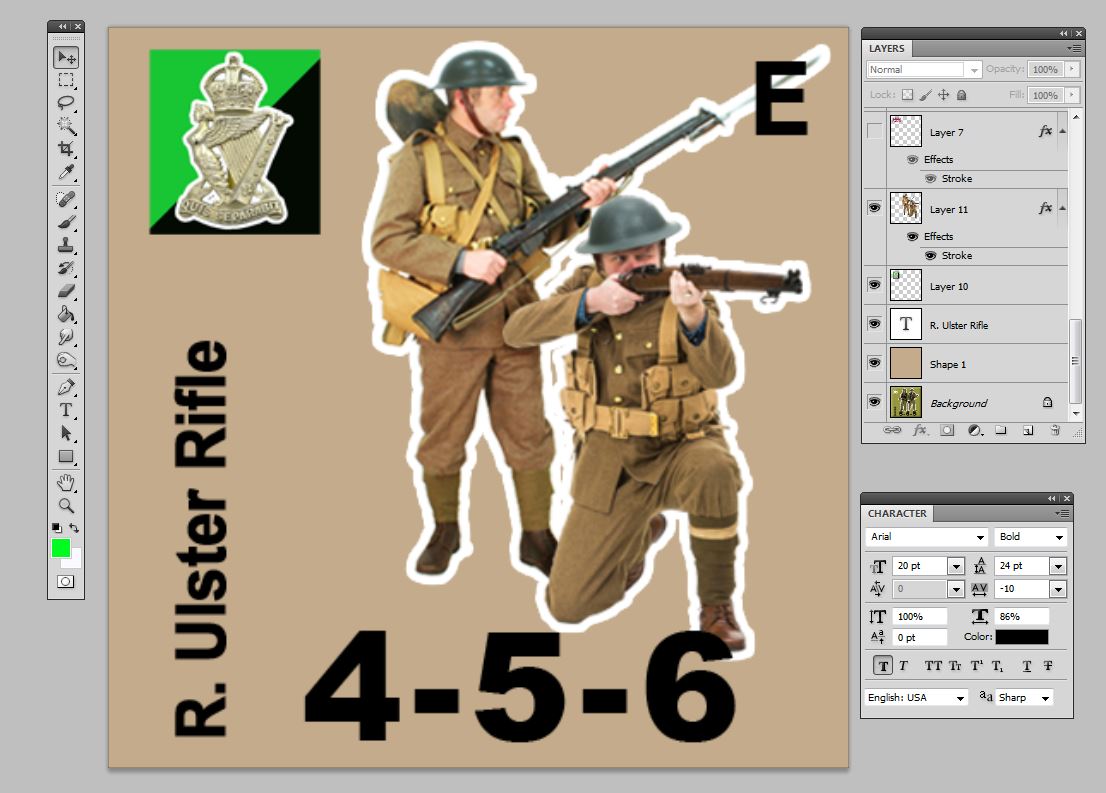 Almost done with the base counter template.
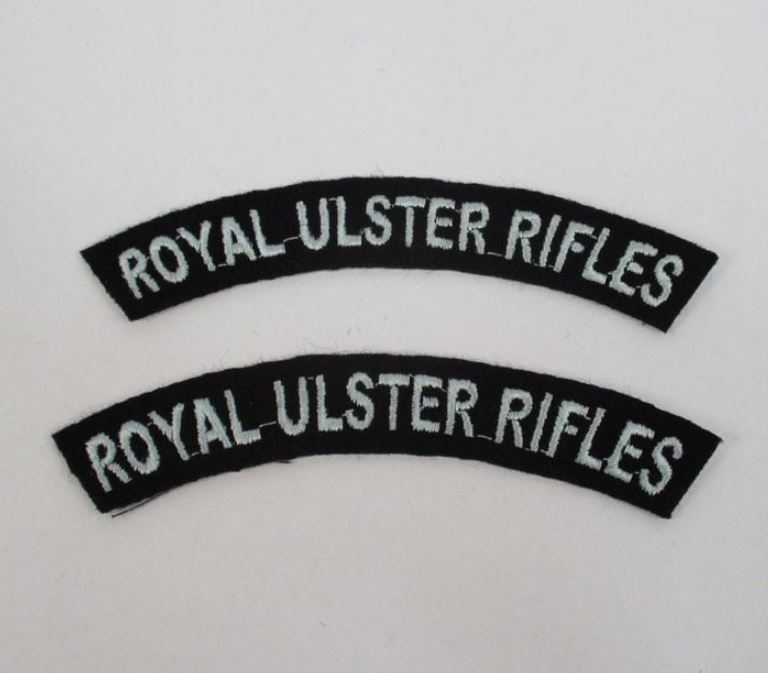 Also found some shoulder patches I will try to recreate and incorporate into the counters.
 Finished counter, at least for the full rifle section.
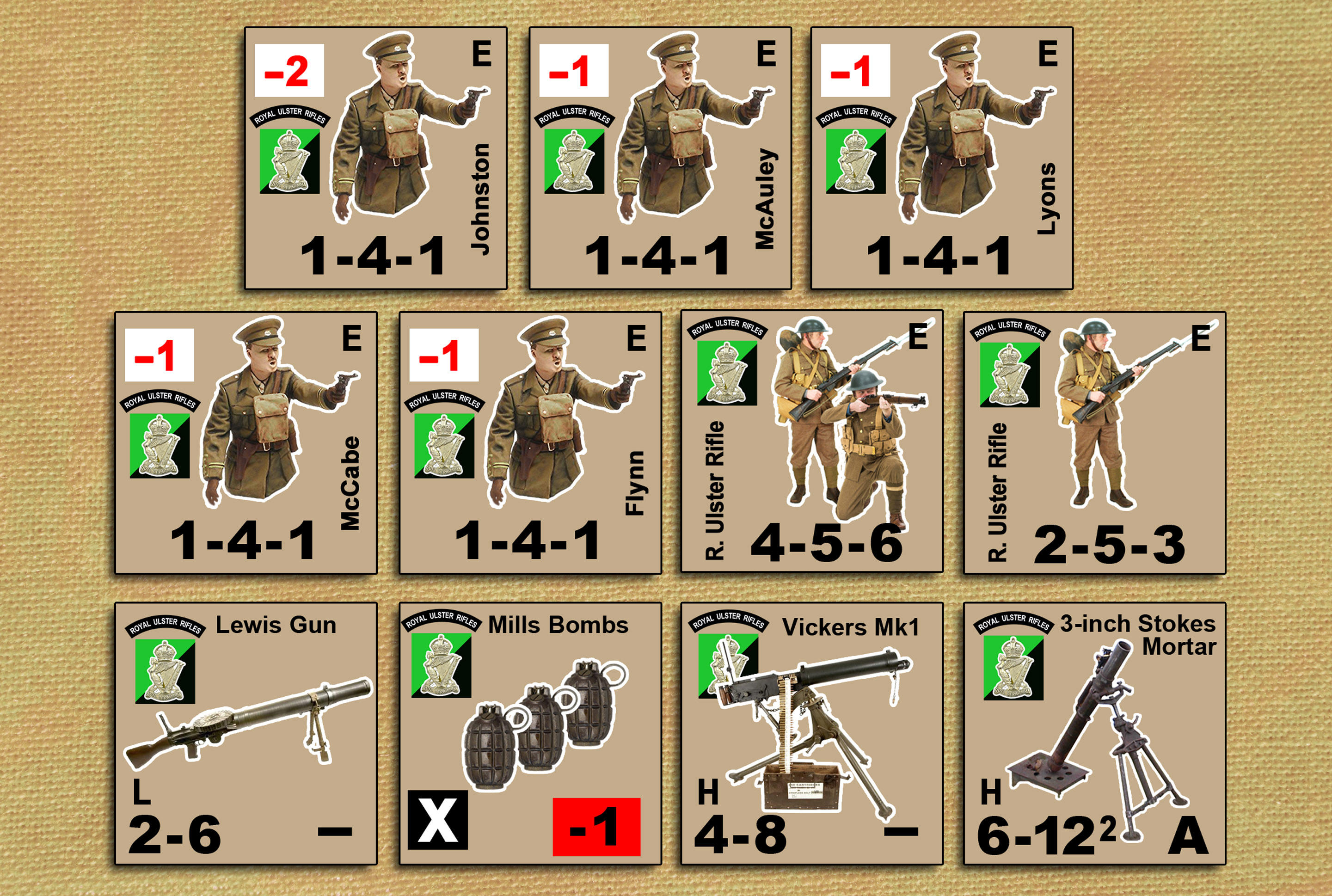 The complete "army" - not bad for a night's work. I have a -2 rated captain (the -2 is a bonus, not a penalty) - a certain fellow we may know from Coleraine. :) He's assisted by a cadre of brave lieutenants. Also, note the full rifle section, half rifle section, Vickers MG, Lewis Gun, "Mills Bomb" grenade counter, and 3-inch Stokes Mortar.
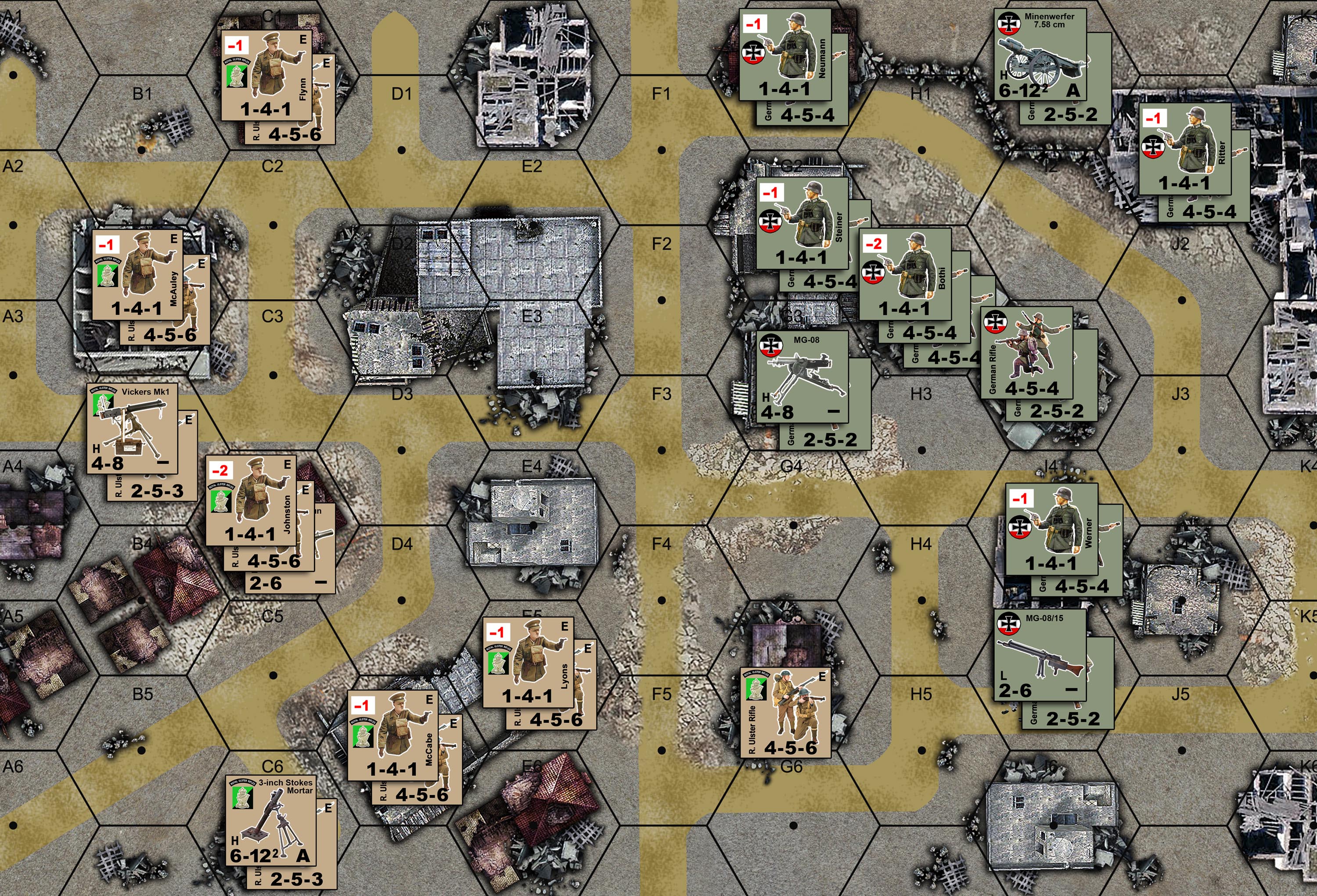 A reinforced company of the 9th Battalion, Royal Inniskilling Fusiliers, 109th Brigade, 36th Ulster Division (II Corps, British Second Army, BEF) in the streets of Beveren, Belgium (east of Ypres) - final days of the Great War.