








![NO Weekender Or Cult Of Games XLBS This Weekend [Updated]](https://images.beastsofwar.com/2026/03/No_Weekender_and_XLBS_this_Weekend-225-127.jpg)



Gaming In The Vietnam War – 50th Anniversary Of The Tet Offensive: Part Two
January 29, 2018 by oriskany


We’re back, Beasts of War, for another instalment in our series to commemorate the 50th anniversary of the Tet Offensive in the Vietnam War. In our previous article, we took a quick look at the Vietnam War’s background, as well as the origins for this massive, game-changing communist offensive in early 1968.
Read The Gaming In Vietnam Series Here
Now it’s time for us to actually begin our “tour of duty,” so to speak. In this article, we’ll be looking at the opening moves of the Tet Offensive, and examining how some of these engagements can be brought to the tabletop. So lace up those jungle boots and lock n’ load!
Build-up & Planning
The Communist Perspective
As we discussed in the previous article, the Tet Offensive was a massive series of attacks unleashed on the “Tet” Vietnamese New Year holiday in 1968. Mounted by the communist forces of the North Vietnamese Army and the Viet Cong, the objective was to topple the pro-American South Vietnamese government in Saigon and end the war.
The Tet Offensive would be spearheaded by the Viet Cong (formally known as the National Liberation Front or NLF), made up of guerrilla units of South Vietnamese communist sympathizers. They’d be supported and supplied by the formal field army of the PAVN (People’s Army of Vietnam, also known as the North Vietnamese Army, or NVA).
From the communist perspective, the notion of an all-out attack against American forces with vastly superior firepower was hardly ideal. Since American forces had become fully embroiled in Vietnam in 1965, they’d launched a massive build-up through 1966 and been on the offensive all through 1967. Communist losses had been severe.
This general American offensive also included a withering bombing campaign through most of North Vietnam. This would soon be expanded into NVA and VC base areas in Cambodia and Laos, the infamous “Ho Chi Minh” trail by which the communist war effort in South Vietnam was supplied and maintained.
By mid-1967, communist leaders had begun to worry they’d have to negotiate some kind of peace with the Saigon government. But under leaders like the Party Secretary Le Duan and the communist leader in the south Nguyen Chi Thanh, they vowed to make one more massive effort to force a favourable decision in combat.
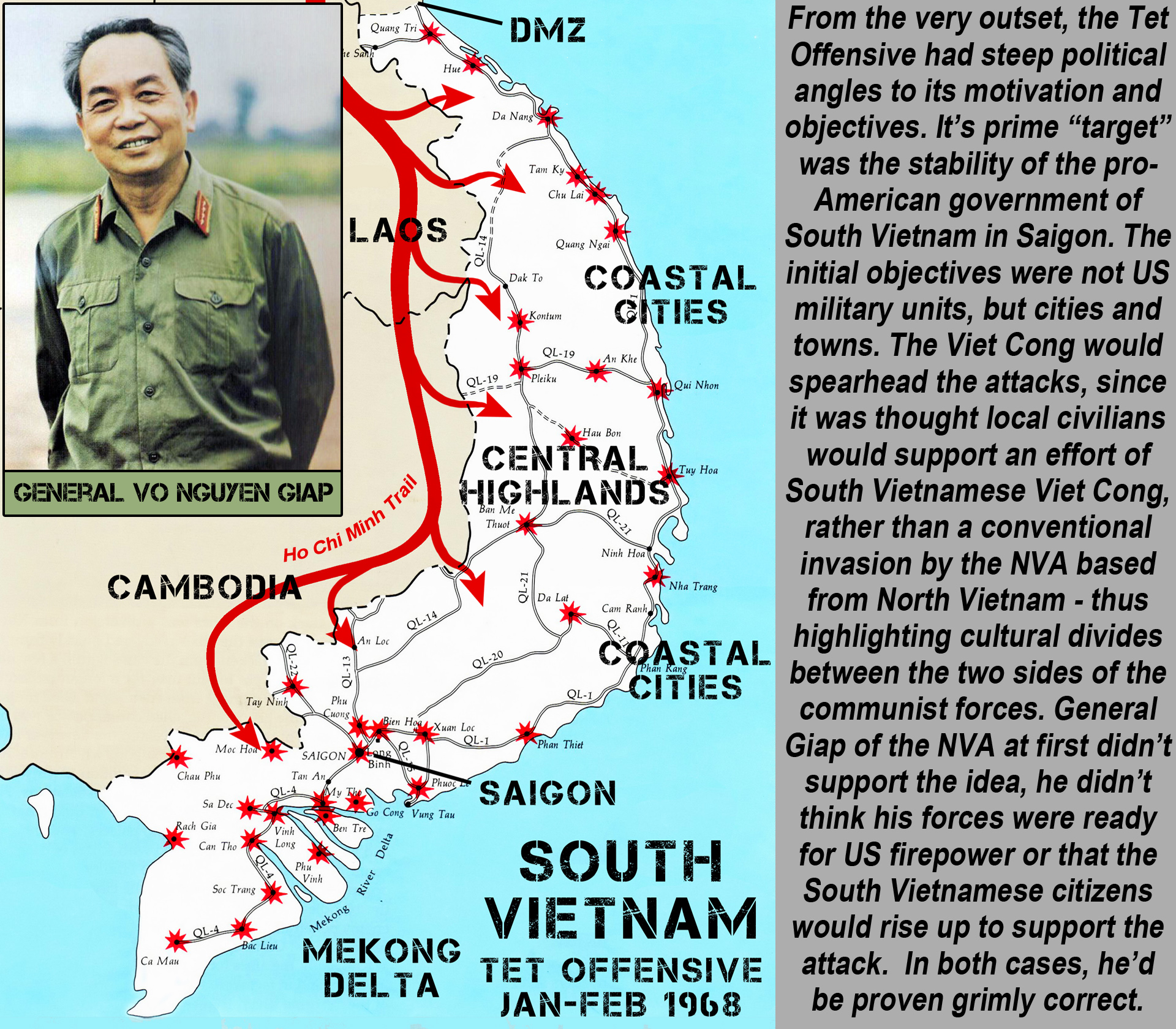
Commander of the North Vietnamese Army, General Vo Nguyen Giap, was not impressed. He maintained that NVA and VC forces were nowhere near ready to face withering American firepower. But after General Thanh died of heart disease in mid-1967, Giap inherited command of the offensive and resolved to make it work.
Preliminary Moves
Setting Up The Chessboard
Build-up and preliminary moves for the Tet Offensive began almost a year before the actual storm broke on January 30th, 1968. Since the primary target for the Tet Offensive would be the major cities in South Vietnam, General Giap worked through 1967 to draw as many American units as possible out into the remote Vietnamese backcountry.
As early as April 1967, Giap opened operations near the Demilitarized Zone (DMZ), the border area between North and South Vietnam. Ferocious battles started in the hills between US Marine Corps bases like Khe Sanh and Con Thien, where gunfire was often called in from US Navy heavy cruisers and battleships built during World War II.
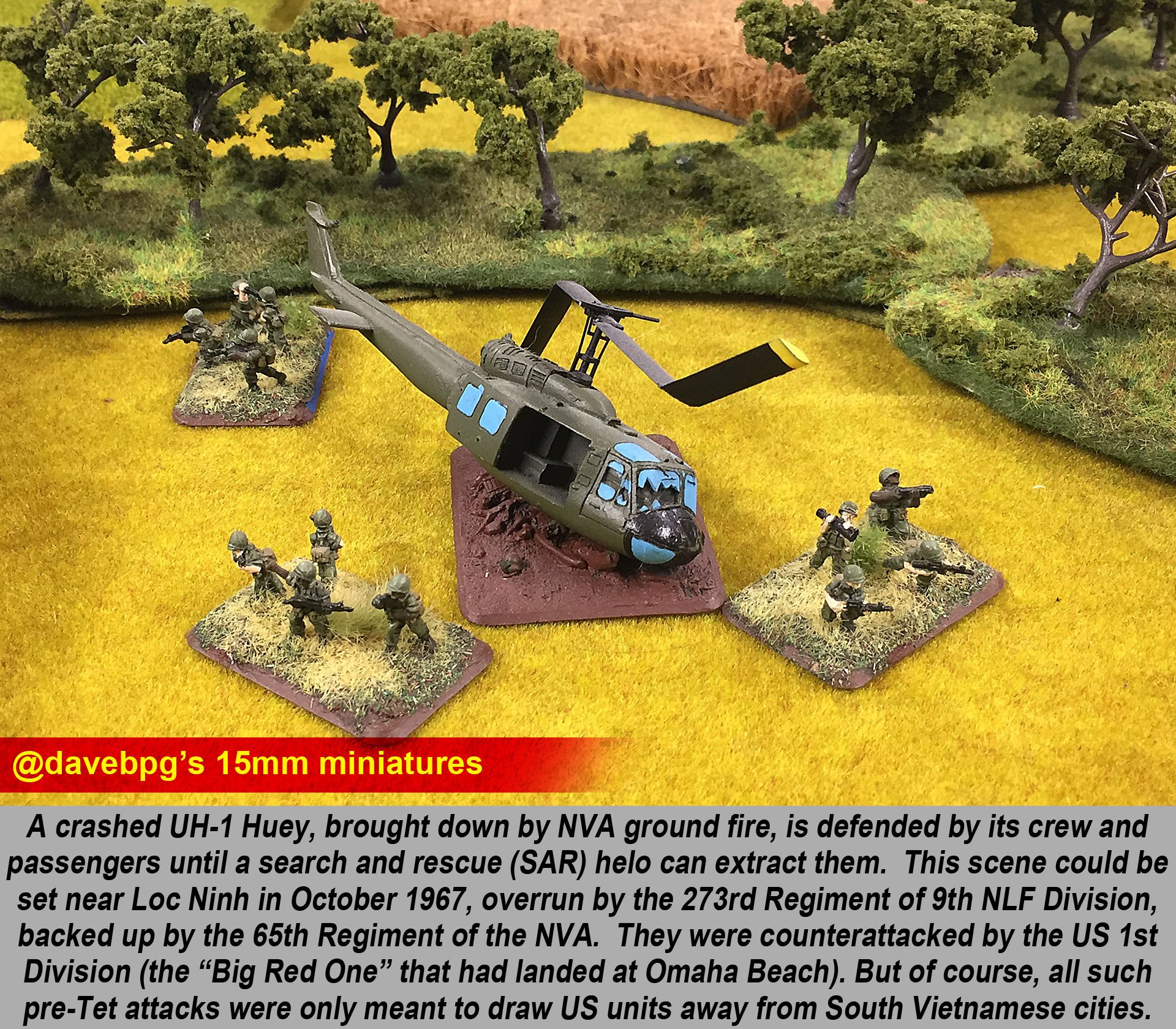
In October 1967, Giap applied pressure in the south, near the Cambodian border. He hit South Vietnamese units (ARVN, Army of the Republic of Vietnam) at Song Be, and Loch Ninh was overrun and had to be retaken. As US and ARVN units deployed to these deep jungles, the cities along South Vietnam’s coast were left increasingly open.
The worst came in November 1967 in the central highlands, near Dak To. The whole 1st NVA division backed up by two independent regiments, had to be pushed back by the US 4th Infantry and 173rd Airborne Brigade, backed up by tanks. Again, US forces were drawn away from the cities, allowing VC battalions to creep closer to their Tet targets.
The Storm Breaks
Finally, the Vietnamese New Year holiday arrived in early 1968. By now the Americans were certain something was up; such a build-up couldn’t be concealed completely. But the American commander, General Westmoreland, remained convinced that Giap was preparing for a conventional ground invasion out of North Vietnam.
Yet no plan goes perfectly, and right off the bat, the Tet Offensive tripped over a massive screw-up. The actual date for the Tet holiday depended on which version of the Vietnamese calendar different units were using, and although officially planned for January 31st, some communist units launched too early and attacked on January 30th.
Yet even with this misfire, so lax was ARVN readiness in the midst of the traditional Tet holiday cease-fire that the Viet Cong retained nearly complete surprise. US and South Vietnamese response was disjointed and off-balance. The communists hit most of the forty-four provincial capitals in South Vietnam and attacked 100 cities and towns overall.
Saigon & The US Embassy
Wars Lost On Television
One of the primary targets for the Tet Offensive was the capital of South Vietnam, Saigon. Spearheaded by the elite “C-10” sapper battalion, communists hit the presidential palace, the HQs of the ARVN Joint General Staff and Navy, the city’s radio station, Tan San Nhut Airbase, and the American Military Assistance Command, Vietnam (MACV).
Also struck was the United States Embassy, a prominent symbol of America’s presence in South Vietnam. During the opening attacks across Saigon, a force from the Viet Cong’s C-10 battalion blew a hole in the wall of the embassy compound, killed a Marine security guard and four military policemen, and stormed the embassy.
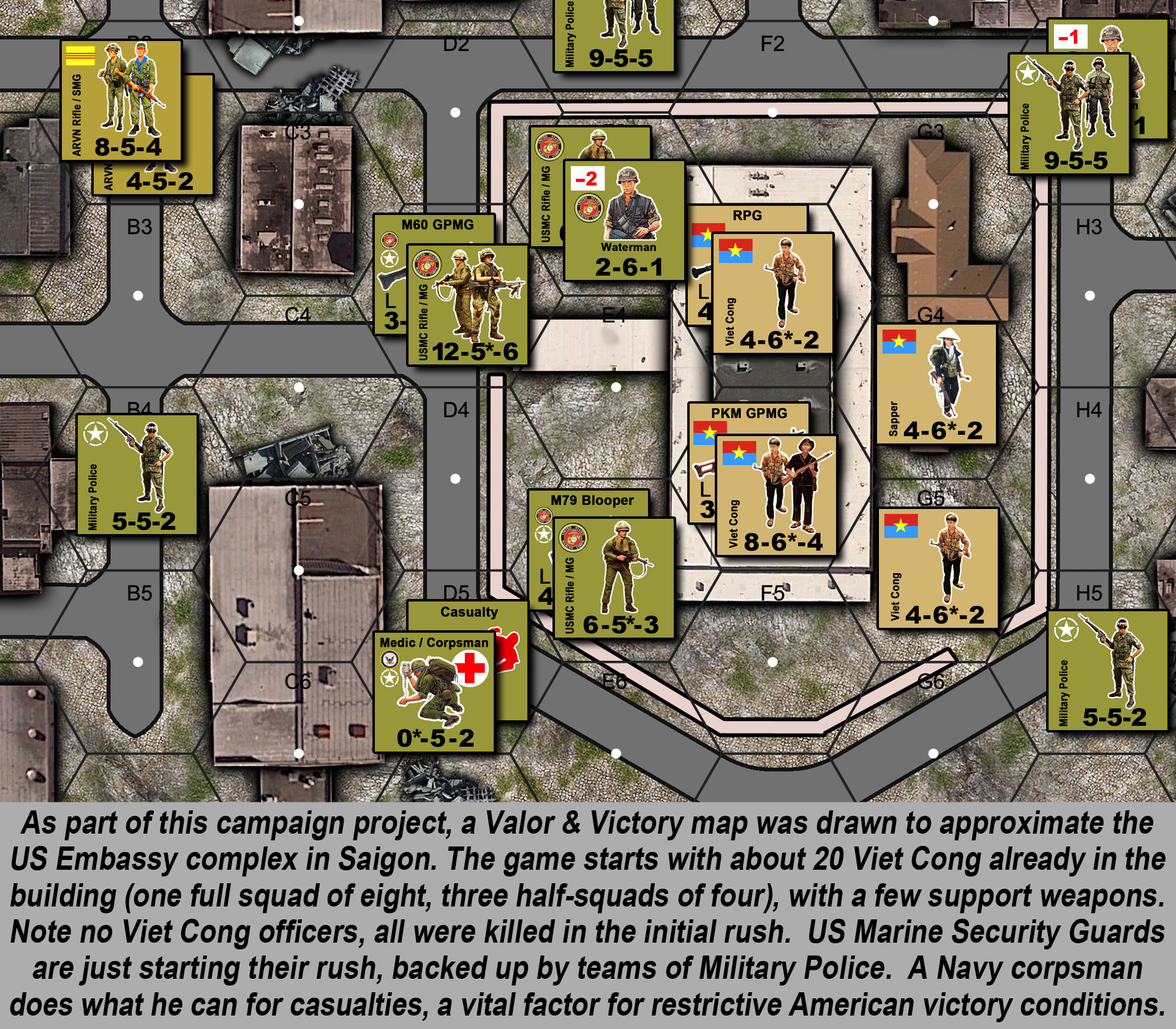
This attack sparked a six-hour firefight which was televised live around the world. The reality of the situation was almost entirely symbolic, almost all the Viet Cong’s officers had been killed in the initial skirmish and only fifteen or so remained to be rooted out of the compound.
None of that mattered. In a pattern that would be repeated throughout the Tet Offensive and the Vietnam War in general, it was the imagery on the evening news that counted. The American public, assured so many times that “the end in Vietnam was in sight,” now saw in living colour a desperate battle to retake their own embassy.
Other attacks across the city were slightly more successful. But after seizing their initial targets, VC units were surrounded by ARVN units, American military police, and reinforcements rushed in from neighbouring bases (very few American combat units were actually in Saigon itself), pinned down, and eventually destroyed.
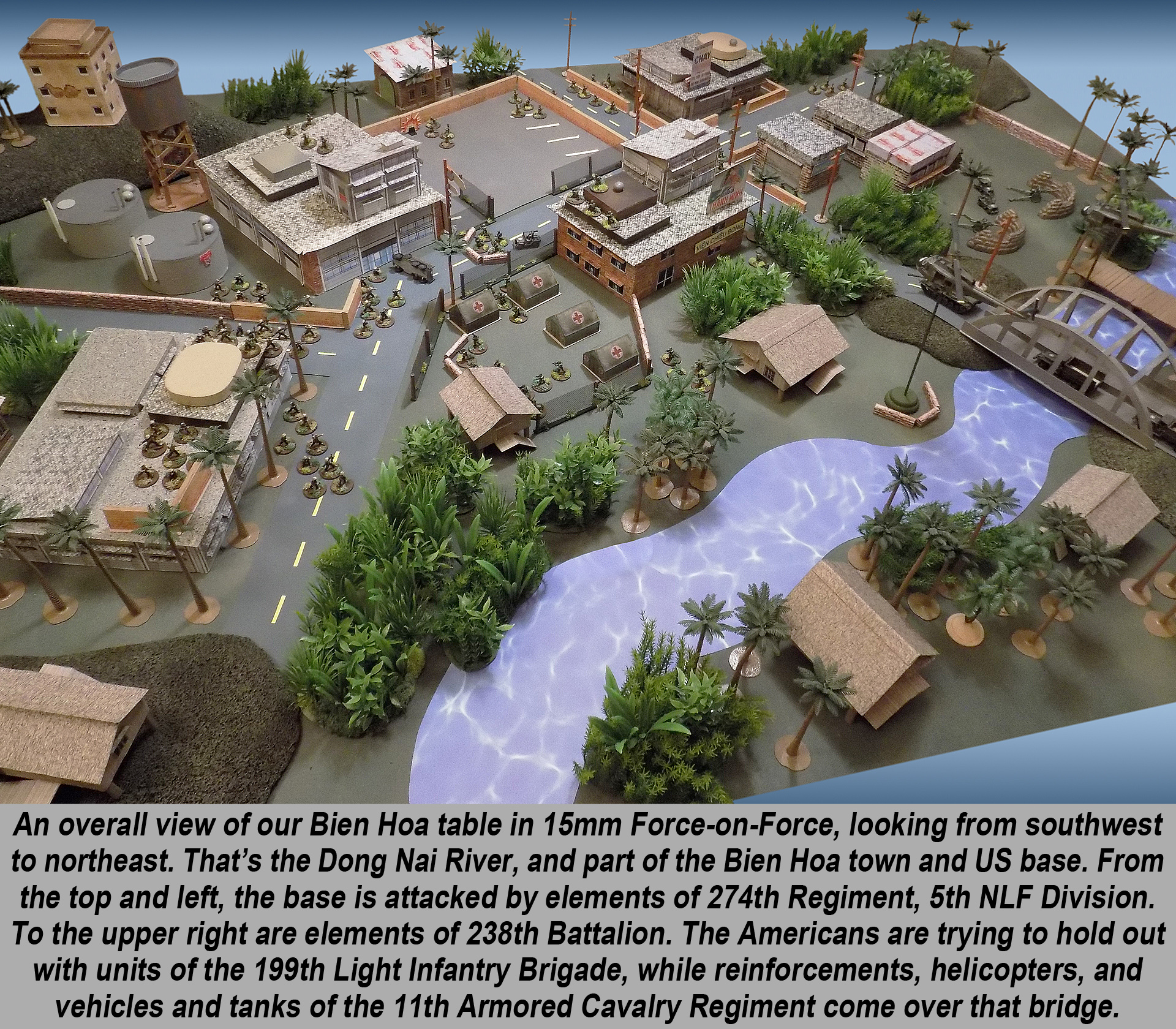
The Viet Cong had intended for these initial sapper attacks to be rapidly reinforced by main force battalions staged around the city. But these reinforcements never arrived, cut off and pinned down in vicious street fighting. Thus the sappers were left to annihilation, though it would take weeks of hard fighting to eliminate them all.
It should be noted that most of the heaviest fighting in Saigon was done by ARVN. Despite the infamous attack on the US Embassy and a similar bloodbath at an American officer’s barracks, the VC was mostly contained by South Vietnamese troops. Giap himself would credit much of Tet’s relative failure in Saigon to ARVN, not US troops.
Long Binh & Bien Hoa
Battles Around The Suburbs
In many ways, the battles around the suburbs of Saigon were even more ferocious (and militarily speaking, more important) than the fighting in Saigon itself. There were more military installations out here, and the Viet Cong had an easier time getting main force battalions closer to these targets than in the centre of the capital.
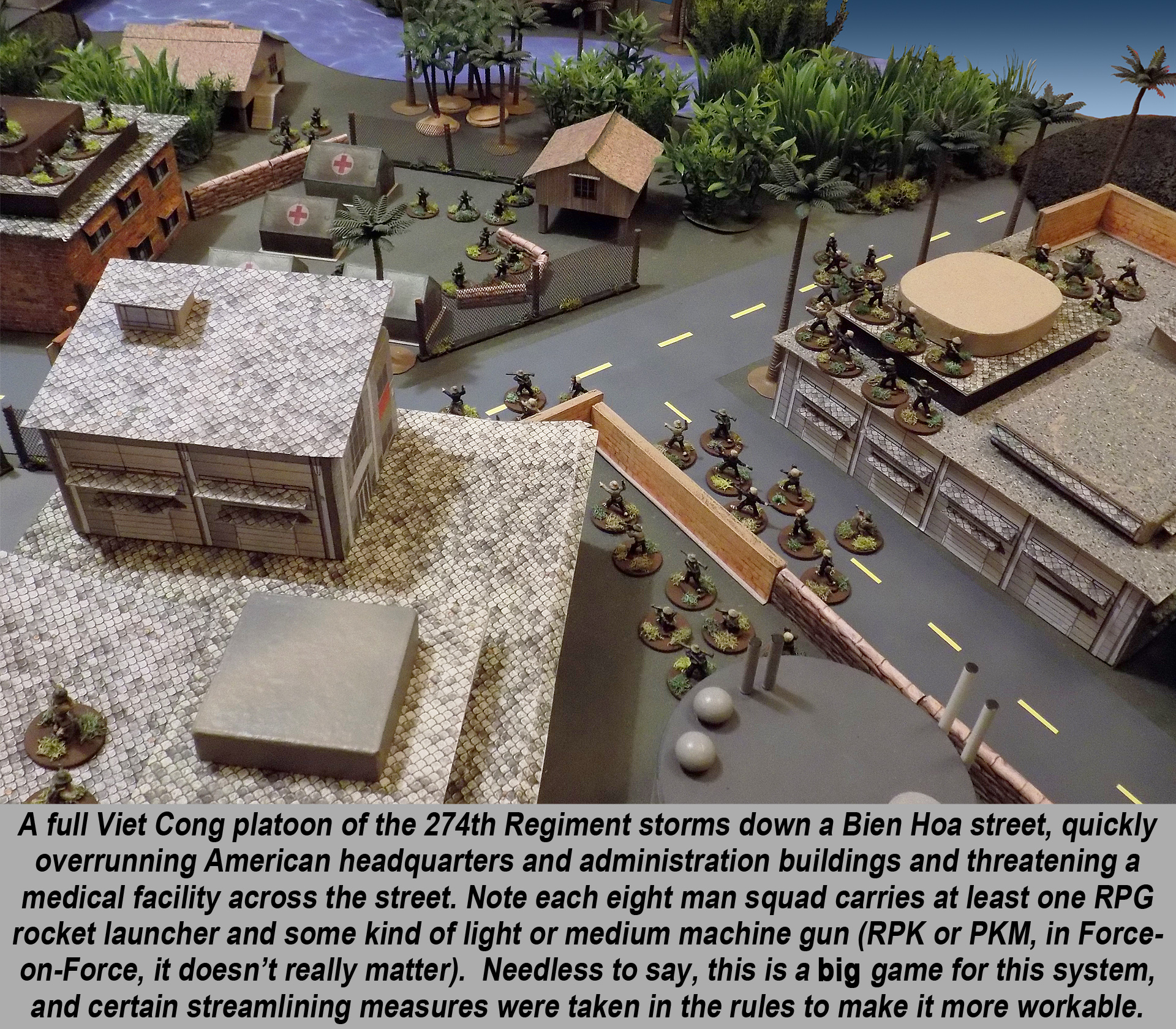
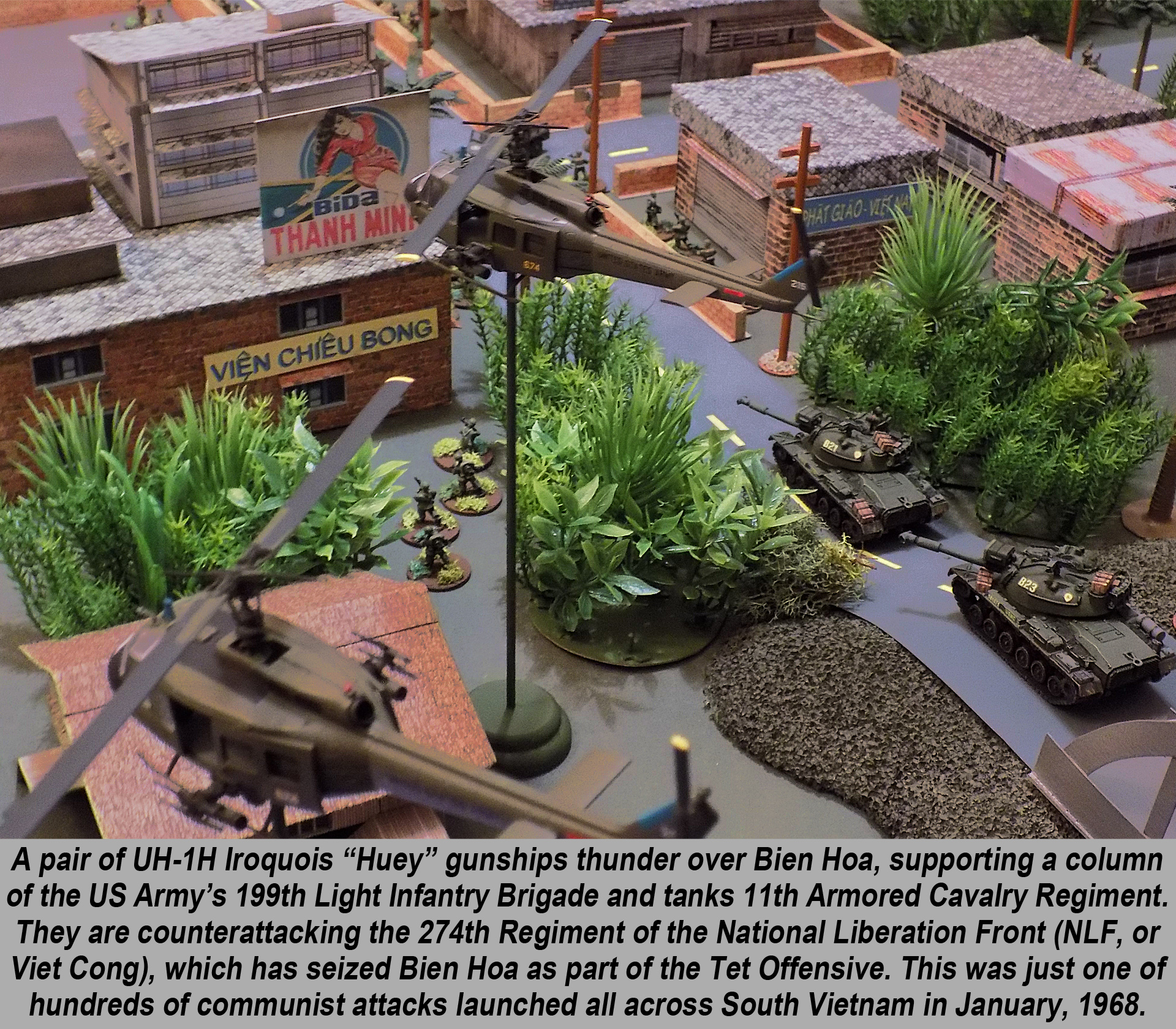
One such battle came about fifteen miles north of Saigon at the neighbouring towns of Long Binh and Bien Hoa. An extensive US logistics and headquarters centre (US 2nd Field Force and ARVN III Corps), Long Binh was hit hard by the 275th Viet Cong Regiment of the 5th NLF Division. Just up the road, Bien Hoa was hit by the 274th Regiment.
Long Binh and Bien Hoa were the American headquarters for most of the southern part of South Vietnam, and even as Lieutenant-General Frederick Weyand (commander, 2nd Field Force) coordinated responses for units in Saigon and across the country, he also directed the immediate battle to protect his own headquarters.
This is the major battle we’ve tried to recreate on the tabletop for this part of the article series, particularly a “compressed-scaled” look at the American response to the Viet Cong’s attack at Bien Hoa. Starting off, we have initial American defences and counterattacks launched by the 199th Mechanized Brigade.
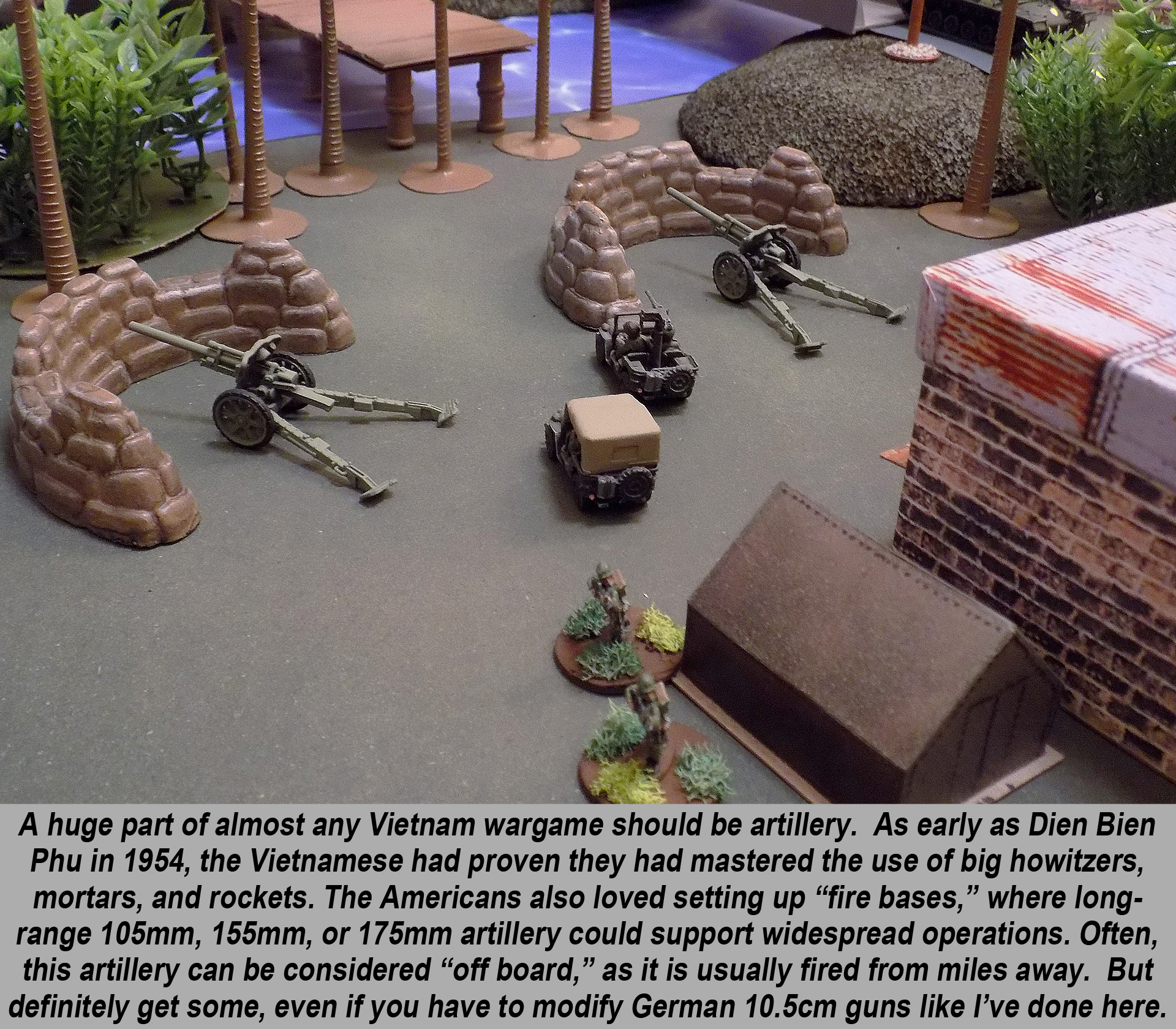
As fighting heated up between the US 199th and the Viet Cong 275th, and as American commanders steadily got a grip on the sheer scale of the nation-wide offensive, more units were coordinated into the battle. Very quickly, units of the 11th Armored Cavalry Regiment were committed at Bien Hoa, getting American tanks into the fray.
With no tanks of their own, Viet Cong forces had to rely on close urban conditions and RPG ambushes to deal with the threat. They were assisted by U-1 and 238th local Viet Cong Battalions (using mines and shaped charges), now coordinating with 5th NLF Division’s attacks on Long Binh and Bien Hoa.
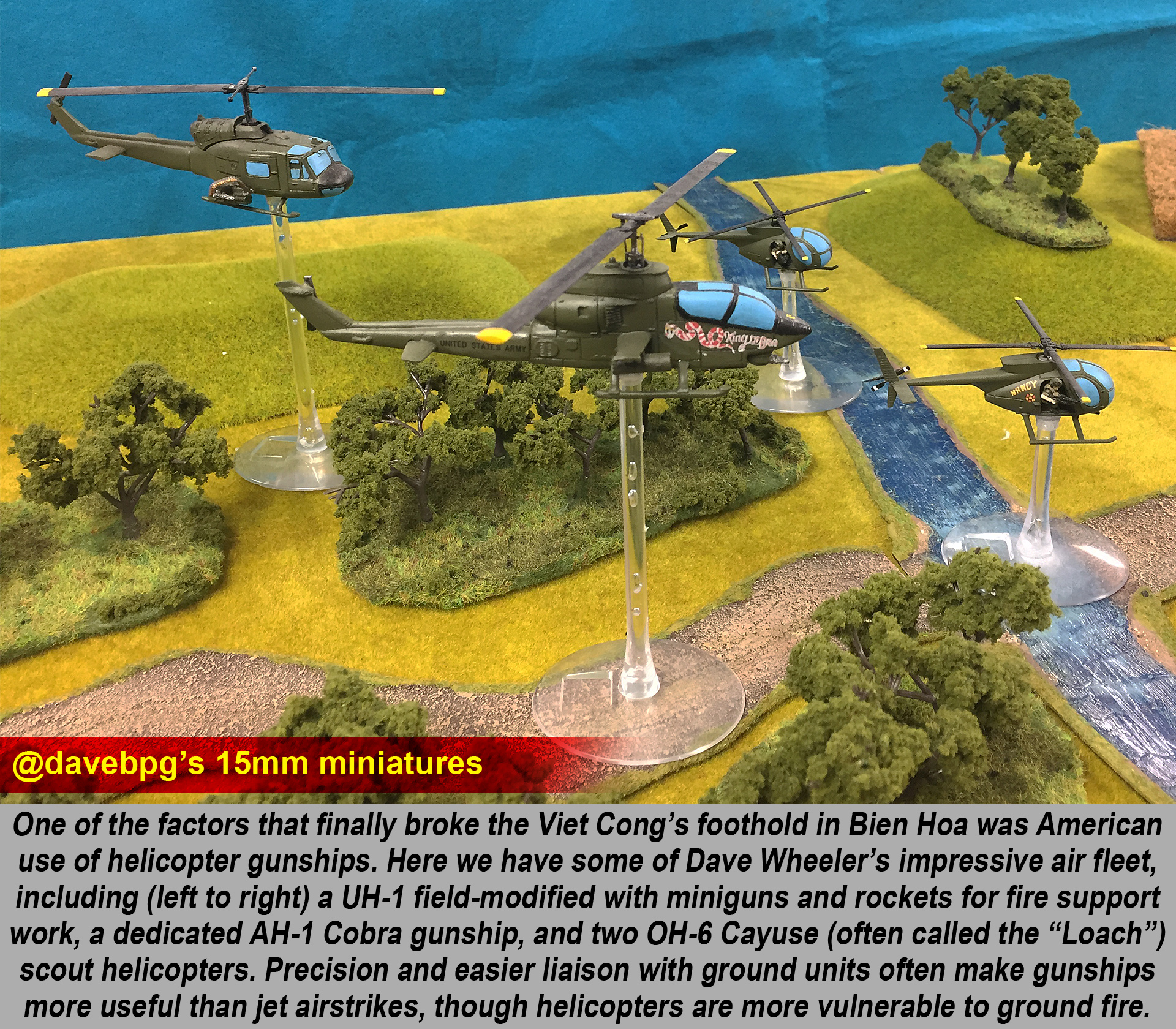
Yet again, the pattern was the same. Taking advantage of surprise and initially uncoordinated US and South Vietnamese response, Viet Cong forces took their initial objectives quickly enough but could then not hold them against concentrated American firepower.
Proof came at Bien Hoa when, in addition to the 199th Mechanized and 11th ACR, air strikes and helicopter gunships were brought in to further reduce the withering Viet Cong positions. Headquarters operations at 2nd US Field Force and ARVN III Corps were never meaningfully disrupted, and the situation steadily stabilized by the hour.
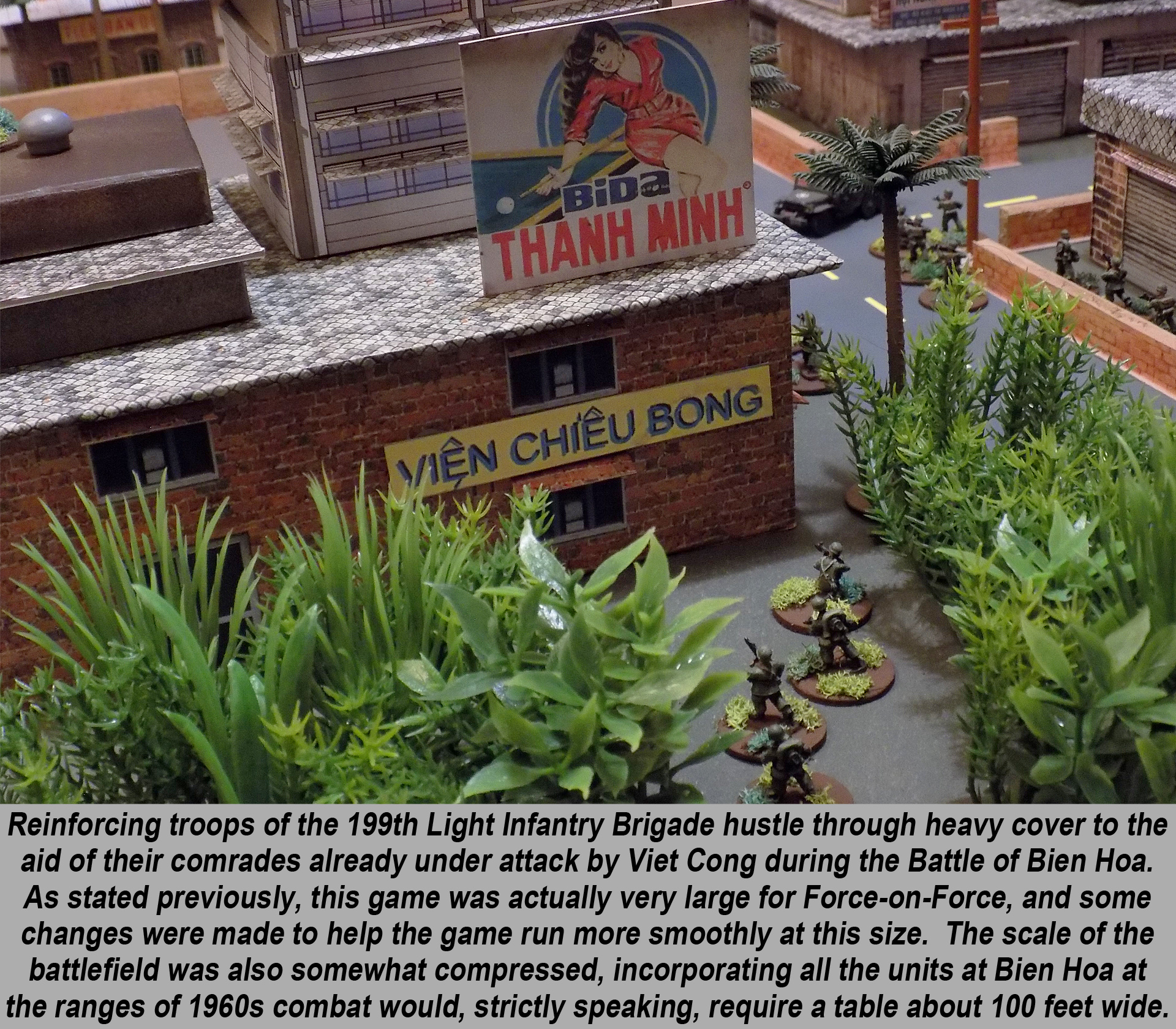
Finally, 2nd Battalion/506th Regiment of the 101st Airborne was “Huey-ed” into Bien Hoa to shift the balance decisively against the Viet Cong. If 2nd Bn/506th sounds familiar, that’s because it’s the parent unit of the famous “Easy” Company, the one from Band of Brothers fame. Here they were twenty-four years later, still winning America’s far-flung battles.
Of course, we’re just outlining a few of the battles in and around Saigon, and even if we could do them all, these Saigon battles were only a small part of what was happening all around South Vietnam. There were battles in the Mekong Delta, the central highlands, and of course very heavy action against the NVA up north near the DMZ.

So please come back next week as we look at some of these other attacks. There’s the NVA attack at the Special Forces base at Lang Vei (one of the only times the NVA was able to use tanks), the siege of Khe Sanh, and of course the brutal battle between the USMC and the NVA in Hue City (as anyone who’s seen “Full Metal Jacket” knows).
In the meantime, please post your comments, questions, and input down below. What do you think about the effect of global, real-time media in modern warfare? How can this be worked into a tabletop game’s victory conditions?
What do you think of the Tet Offensive or wargaming in Vietnam in general?
"...General Giap worked through 1967 to draw as many American units as possible out into the remote Vietnamese backcountry"
Supported by (Turn Off)

Supported by (Turn Off)
"What do you think about the effect of global, real-time media in modern warfare?"
Supported by (Turn Off)






Great work once again.
Thanks very much, @c0cky30 ! 😀
Amazing article @oriskany
I didn’t know that part of the Battle was televised I’ll have to check that out online.
Reporters and TV are tricky to do in game. Games Workshop’s Legends of the Old West skirmish game lets you hire a reporter who could follow your heroes around giving them more Fame so they can modify more dice rolls and interrupt the enemy more often.
In a campaign a televised battle could be a really cool way to put extra emphasis on an otherwise unimportant/mundane Battle. There’s a Force on Force Scenario in one of the expansion books (Secret Ops but not 100% sure) where US Special Forces are attacking a Terrorist Compound as the Terrorists are being interviewed by a Documentary crew, I’ll have a look at the way they worked in that game and post it here if it’s any good.
Looking forward to the rest of the series.
Thanks very much, @elessar2590 – yes, I have one 20mm figure with his shoulder-mounted rocket launcher modified into a camera, his body armor painted blue, with PRESS on the back. he was used as a TV guys for the Force on Force games in the Ukraine 2014 War series. Didn’t really have any game effect, really, the government just had to make sure he didn’t get hit by any splash damage, etc. The separatist player controlled him so he was used to get the in the government unit’s way, be annoying, etc. 😀
Yeah, a big piece of the Battles of Saigon, Hue, Khe Sanh, and other big Tet Offensive engagements went out live or nearly live (televised later that same day), completely uncensored. It’s a tricky conversation where the line is between “censorship” and “OpSec” (Operational Security) – or really how much of a war really should be exposed to the everyday public.
As Secretary of State at the time Dean Rusk said (paraphrasing a little here) – what if there have been TV crews broadcasting live on Omaha Beach, of Anzio or Guadalcanal? Would America really have been able to fight and win that war, especially if the other side were not also showing their public EVERYTHING?
Since Gulf War One, the military, DoD, and State Department does control what the media sees and broadcasts in a live war zone, to an extent. Again, exactly where that line should be drawn is a very complex and very interesting discussion.
Another fantastic read @oriskany!! Really impressed by the tables you’ve got, really helps immerse you into the ongoing action.
Great read!
What did you change in FoF to match such numbers? I might get into Vietnam through FoF, which doesn’t require as much stuff as FoW does.
Thanks @neves1789 – to be honest we didn’t have to change that much, although what we did change was pretty fundamental. Put most simply, we played “by squads” instead of by “by fireteams.” As you may know, you start off with one dice per figure in a unit, and the size of that dice depends on TQ (troop quality) – then there are bonuses for armor, heavy weapons, troop quality, etc. Anyway, with each action or reaction that unit takes, it loses one dice.
Well, starting with 8- or even 13-man squads is really going to stretch those reaction cycles to preposterous lengths. So we simply said “look, every unit starts at four actions.”
Kind of a sledgehammer approach, I admit, but it did get us through a large game like this much faster.
In all seriousness, I don’t recommend it too much. FoF is a great system that feels like it was well-playtested, there isn’t much reason to go monkeying around with the rules.
In our defense, we only had to do this briefly (first 3-4 turns or so). Chucking around thosekind of firepower pools, it wasn’t long until we had the table “cooked down” to a manageable scale. That, and enforcing American casualty management rules.
We also had a “hacksaw” system prepared for vehicles, but it turns out we didn’t really need it. With just two Army Pattons on the table, the original rules worked just fine.
Glad you liked the article! 😀
That makes sense! I was struggling our first game with having quite a large force (30 or so figures). Might give that approach a try!
Also I put on some Vietnam soundtrack to read the article since I completely subscribe to the music during a wargame rule 😉
Ah yes. Gotta have those tunes! I should add (and you’d probably agree) t hat the “rule” on music / ambience while gaming is strictly dependent on two caveats – it can’t be too loud to interfere with concentration, or table communication.
Honestly, I usually don’t like gaming music with lyrics, it tends to interfere with my communication. I would agree, though that a lot of 60s music associated with the Vietnam War is the exception to this.
I guess for some people, music / ambiance interferes with concentration. I can’t concentrate without it (listening to ocean waves as I type this). Nothing is as infuriating or distracting to me as silence. But of course others may be different.
Yeah, 30 figures shouldn’t be that big a deal for FoF. We had almost 80 here, in fact more than that but they come on in waves (I’m guessing 80 at once) – which again, is really too big for strict FoF.
I’ll also reiterate that our “solution” described above was … eh … I mean it worked. But it felt little clunky. 😐
Yeah, I’ve been know to do the volume dance; it’s too loud, turn it up for an epic song, can’t clearly hear my opponent,…
We try to do a big WW2 battle every year at my house, which needs German march songs and Russian choirs. Also, we eat bratwurst and sauerkraut 😀 Those games are obviously more throwing dice than tactical masterpieces ^^
Aha, we probably have some of the same tracks for German and Soviet WW2 era music.
Of course the German ones always have “for non-political use only” disclaimer on the download cover. 😐
And the Soviet ones, especially in YouTube, always have some fun comments on them. I was listening to a bunch of “Greatest Russian Military Music” during the recent Stalingrad thread. It was a 90 minute playlist.
Someone commented two years ago: “Just listened to the whole playlist. Now on the FBI watch list.” 😀
I replied: “Just listed to the whole playlist, in 2017. Now I’ve been offered a job by the Trump Administration.” 😀 😀 😀
Another great read @oriskany and like the pictures… I think that Tet is one of thse thinngs that is synonymous with Vietnam, and because it was such a large scale attack its one of those things that you can pretty much set up any scenario you like to play a table top game and just say its part of Tet…lol
I would agree with that 100%, @commodorerob . Like @warzan and I were talking about in the interview, almost half the Vietnam War movies tie directly into Tet, even though it was only 5 days to 5 weeks of a 12-year war. And because the attacks were all so large, and hit such a broad variety of targets all across South Vietnam, players can set up all kinds of scenarios to fit their available armies, terrain, and preference.
So far we’ve got mostly urban battles here. Later we’ll have special forces bases deep in the jungle, attacks on American fire support bases, battles in the jungle, @davebpg helps us out with table photos of the Mobile Riverine Force (detached brigade, 9th Infantry Division) down in the IV Corps tactical zone in the Mekong Delta.
And of course, even with all this, we’re only scratching the surface. 😀
Thanks for the comment! Glad you liked the article!
Another great read @oriskany The diverse landscape in a relatively small country is a great and, I imagine, oft-forgotten aspect to a Vietnam campaign. The mobility available to US forces could also make these different terrain options viable in an ongoing campaign.
The breadth of the offensive surprised me to read. I knew it concentrated on urban areas, but to see it marked across the map, it truly encompassed the whole country and likely impacted all US/ARVN forces in-country to some extent.
Absolutely, @donimator – the NVA and espeically the NLF / VietCong hit all over the place. Now I will admit (and some strict historians may call me out a little on this) … that I include Khe Sanh in Part 03 as part of this article series. Many historians don’t consider Khe Sanh strictly “part” of the Tet Offensive, but another battle / offensive that just happened to be going on at the same time.
There’s some validity to this argument, as the battles for Khe Sanh had been going on for at least 9 days when Tet hit, and the battles in the surrounding hill country had been going on since the previous summer. But the same could be said for battles all over the place like Song Be and Loc Ninh, where large NVA field units were deployed aggressively to draw heavy US formations deep into the countryside and AWAY from the cities that were the real objective.
Its for this reason that I include it. As a former Marine, I have to (or other former Marines might lynch me). 😀 Also, actions like the siege of Khe Sanh and the assault on Lang Vei served (intentionally so) to further convince leaders like Westmoreland that the main emphasis of Tet was a conventional ground invasion launched out of the north against US field formations, not a predominantly NLF/VC political attack aimed at the population centers / perceptions of South Vietnam.
It’s definitely true that it impacted all US in-country units. In fact that was one of the research challenges, reading about such-and-such a unit was here, also there on the same date, and also here, here, and over there … all at the same date …
These regiments, brigades, and divisions were broken up into little task forces and sent all OVER hell’s creation trying to put out so many fires at once.
It actually makes the Tet Offensive easier to recreate on the table top. Just follow these two steps:
1) Set up chaos.
2) Unleash hell.
You’ll be close. 😐
Thank you for this episode and for some points you clarified in my reception of all this.
I have a few questions and remarks.
1. The bombing attacks mentioned at the beginning were those of operation “Rolling Thunder”, right? I remember images of B-52s over North Vietnamese territory. Were the targets mainly military?
2. The third picture with GIAP on the side: Are all the red points objectives for the Vietcong and the North Vietnamese? A helluva lot, then, if they are! Everyone should be able to find his/her battle to recreate. Have there ever been so many separate battles in an operation as here, in such a short time?
3. I always had the notion the ARVN was not good at all as a fighting force. The stats in FoW “Tour of Duty” are accordingly low. However, if even Giap lauded them for their performance in Saigon, I´ve learnt something new. They were not too bad.
4. Did the Vietcong and North Vietnamese hold any of the capitals they attacked and occupied?
5. Were ANZAC troops involved in the Tet offensive as well?
6. I found it rather interesting and it was rather new for me, that so many battles in Vietnam were not fought in jungle environment at all. The idea of mainly a jungle war has surely come from the films I watched with all those poor American lads crawling about through the green.
7. How can we define the victory conditions in our games, if the outcome of the real battles was almost the same everywhere, first success of VC, then ARVN/USMC take “it” back. Have you and your friend worked something out?
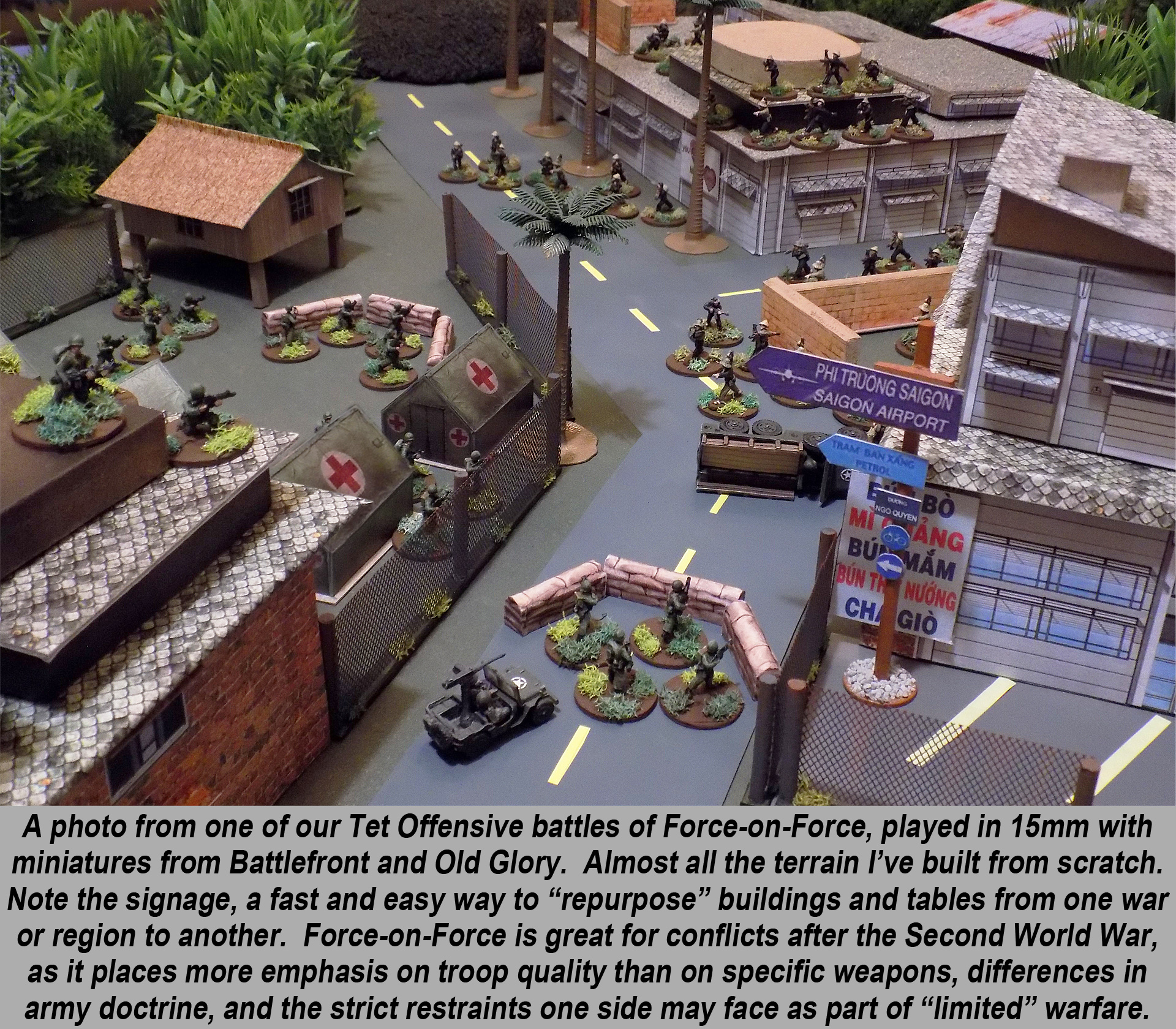
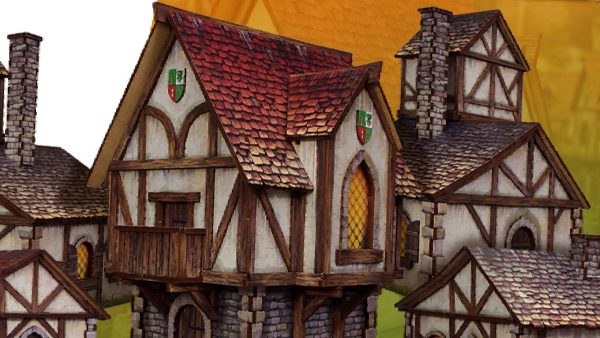
8. I don´t care for victory conditions, if I can play on gorgeous tables like the ones from your friend with minis and models like this. Are the houses scratch-built? And btw, your own, new bunkers are great.
9. Is Bolt Action (a bold question, right?) a system that can be used? Do you have suggestions to possibly tweak the rules? Do 28mm helicopters exist?
Looking forward to the next episode.
@jemmy –
Thanks for the comment and the great questions. I’ll try to answer below.
Yes, the bombing of the north was Operation Rolling Thunder. Contrary to popular belief, it really WAS having a detrimental effect on North Vietnamese warfighting capacity and civilian morale, and more recent records indicate that it was one of the prime motivators for Party Secretary Le Duan to support the Tet Offensive to begin with. (Let’s either win now, or at least get some better leverage on the bargaining table in we have to cut a deal).
Yes, there were hundreds of targets hit, that map if anything is a little simplified. There were at least 12 targets hit just in Saigon, 36 out of 44 provincial capitals, highways cut in dozens of places (Route 4 through the Mekong Delta is a great example).
Giap speaks highly of ARVN for two reasons.
One, SOME UNITS (ARVN Rangers, 18th Division at Xuân Loc, the “Black Panther” battalion in Hue City) did very well. But by and large the ARVN was pretty terrible. Corruption in the officer corps meant that morale was always low, troops had to work second jobs to support themselves and their families, etc.
Two, when the Tet Offensive largely fails in February 1968, Giap would rather concede victory to other Vietnamese instead of the American imperialists. Remember the whole point of the war from the North’s perspective was to REUNITE the country. Furthermore, the Tet Offensive’s original objective was to ignite a popular uprising in South Vietnam, the population of which the North always considered to be “on their side” (aside from “puppets” of Americans, that is).
The Viet Cong would hold on for a few weeks in the Cholon District, a largely Chinese district of Saigon. Also, 6th and 4th NVA regiments would hold on for weeks in Hue City. But by the first week of March, 1968, they’d lost all cities and towns they’d taken.
Yes, ANZAC troops are heavily engaged against the Tet offensive. Specifically, Operation Coburg was already in progress in the Phuoc Tuy and Dong Nai provinces just east and south of Saigon, including the 1st ATF (Australian Task Force). Once the offensive hit, these ANZAC forces aggressively deployed across expected Viet Cong retreat paths out of the battles of Long Binh and Bien Hoa (featured above), setting up fire support bases to block the 5th NLF Division’s escape. Having lost these larger battles against the Americans, NLF survivors tried to escape, ran across the ANZACs, and fought with all the desperation of wounded, caged animals. Animals with AK-47s, that is.
Indeed, Tet sees battles all across South Vietnam. Although jungles, rice paddies, river deltas, and mountain highlands are the “usual” classic Vietnam battlefields, Tet brings a lot of urban combat into the mix.
Victory conditions are easy tactically, but tough in a campaign / operational setting. For the Americans it’s about balancing a requirement to take a given objective against keeping casualties VERY low. For the communists it’s about holding onto an objective for the maximum number of turns (but not forever), and inflicting maximum casualties on the Americans. In short, the asymmetry for the communists is (a) holding the objectives in the end doesn’t matter, (b) your own casualties don’t matter.
Yes, all the houses and new “Vietnam hooches” are scratch built. The only terrain that is not scratch-built are the palm trees. 😀
I don’t see why Bolt Action couldn’t be adopted to a Vietnam setting. The Valor & Victory game was originally written for WW2, and turning it to Vietnam took some doing, but wasn’t impossible. The challenges would be to work in SO MANY more automatic weapons (firepower becomes much more important compared to close assaults), asymmetrical victory conditions, and some kind of very harsh casualty management system for the Free World forces.
Choppers in 28mm? I would assume someone makes 1:56 scale models. They would be HUGE, though! I want to see someone table a 28mm USMC CH-47 Chinook, friggin’ think would be almost two feet long in 28mm! 😀 That’s half the size of some tables!
Thank you very much. Extremely good point on the victory conditions. US minimize casualties, VC maximize duration of holding the objective. Splendid! And for the helis, one could play Bolt Action with single-based 15mm minis or multi-bases with “unwounded” counters, and with the 15mm infantry one could use helis of the same scale, too. For your bunkers, on the pictures, are those single-based 15mm minis?
Very interesting that Giap lauded Vietnamese troops rather than Americans. I can follow his reasons for saying this. Good to in some way pull some South Vietnamese towards his side.
No worries at all, @jemmy – the issue with victory conditions for these kinds of games comes when you try to build them into some kind of larger operational context, i.e., a campaign or some such.
Someone asked last week how you do this, how you make the outcomes of all these little battles add up to a larger result as part of a larger “outcome strategy.”
I replied that I didn’t know (only half kidding), and when we figure it out, we need to go back in time and tell the Joint Chiefs and General Westmoreland. This difficulty in establish …
What does it take to win
What does winning look like?
Are we headed in the right direction?
Are we close?
… typifies so much of the American conundrum during this war.
Yes,a all my miniatures and terrin is 15mm, and on those Force-on-Force tables, everything is “WYSWYG” – 1:1 “what you see is what you get.” I always base one figure on a base, the games I like to play usually require taking off individual figures.
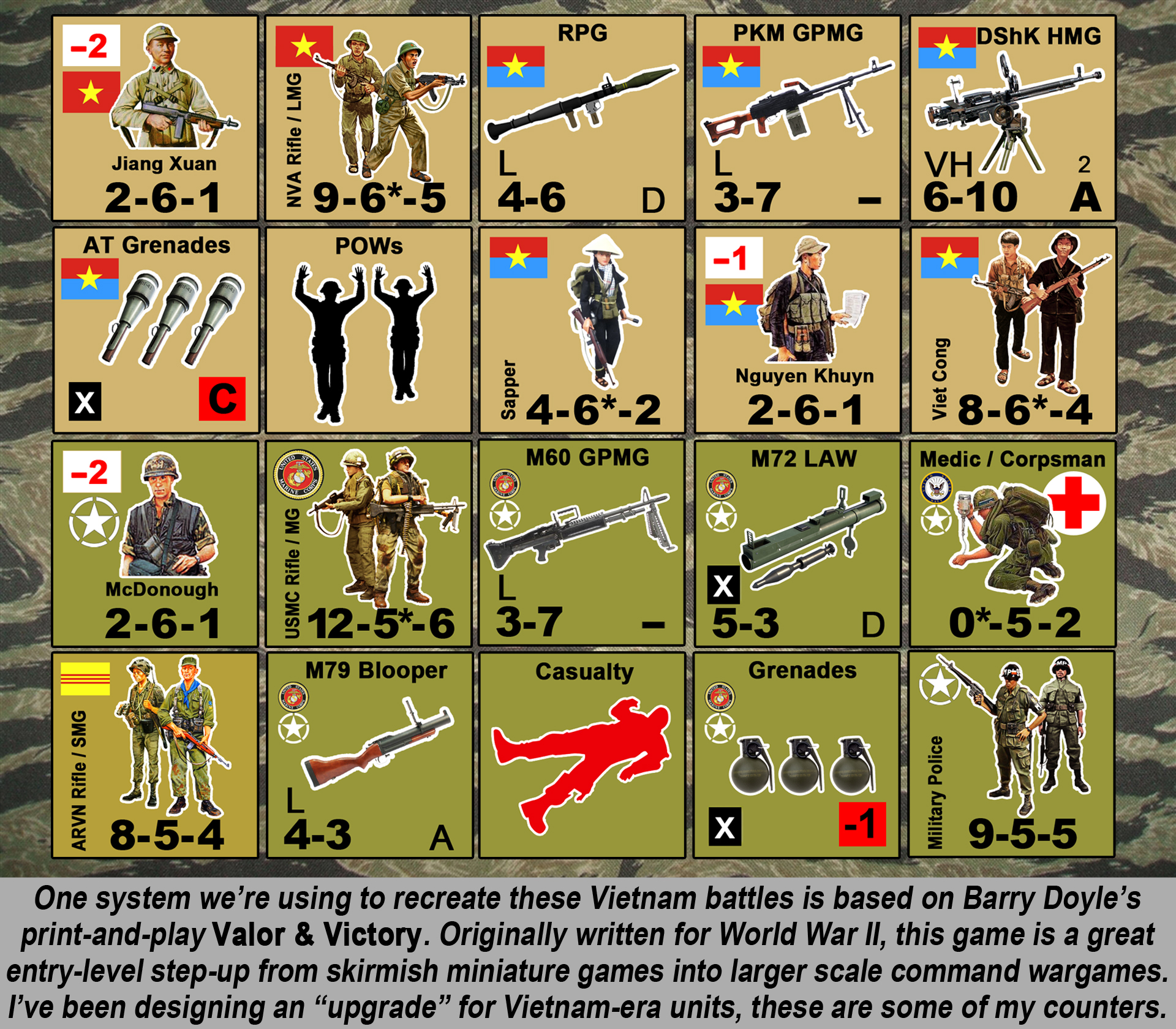
On the Valor & Victory hex boards, each counter with two figures on it is a squad of 8 men. A counter with one figure (and reduced values) is a fireteam of four. Other counters track additional support weapons like grenades, LAWs, RPGs, M60s, mortars, M79 Bloopers, PKMs, DShKs, antitank grenades, satchel charges, etc. 😀
Revell have a 1:48 scale hard-plastic kit that I bought from Amazon for €9.
Revell 04476 – Bell UH-1 “Huey Hog” 1:48
Have not assembled it but am intending to use it in Zombie apocalypse 28-32mm tabletop
and board Games – as a scenario objective or as an abandoned vehicle to search for supplies.
@ Oriskany – another excellent article Series. Thank you!
Thanks very much, @aztecjaguar ! Man, those choppers are going to look great. They’re much tougher to put together than true tabletop miniatures and more fragile, but I think I actually like scale models for helicopters over “minis” – I typically don’t need that many of them, and the canopies tend to come in clear plastic, which winds up looking more accurate on the table.
There are people and guys on this site who can paint resin or plastic with a real glass effect, I don’t I am one of them yet … I’m getting better, with blue-grays followed up with a healthy dollop of my girlfriend’s clear nailpolish for the smooth shine.
But scale models, with clear plastic canopies, especially at larger scales (so you can see into the cockpit) is often worth the extra effort.
Thanks, @cpauls –
You ask: “How much fun is it walking through a jungle and hitting booby traps and blundering into ambushes?” – In the Steel panthers MBT game you mention – NOT AT ALL! I also don’t like sending out Huey gunships just to blunder into NVA DShK 12.7mm AA nests, or even worse, ZU-57-2s. 🙁
I’m actually hung up in a river crossing now. Dumped all my support points into off-board 105mm artillery and pounding the hell out of those hooches before I send my LVTP-5s and M48A3s across the river. (I always dump support points into artillery, I like the SMALLEST possible scenarios in SP:MBT).
Thanks for the comment! 😀
Further to Huey’s running into AA trouble, what’s worse is if you’re counting on integral Huey’s for mobility, and the computer hands you a Mekong Delta scenario… nothing but flat swamp and low lying areas. Nowhere to hide. Sometimes you can fly along the rivers and not get hit, but even that is iffy.
Good luck on the crossing. Seems the NVA can even shrug off heavy artillery, and are almost fireproof. B-52’s, followed by Thuds with napalm, seem pretty effective to soften up objectives.
Another cracking piece @oriskany, one assumes you historical chaps know about the ‘NAM release from Battlefront in February?
Looking forward to the remaining parts, many thanks
Thanks, @bonesbs – yes … please rest assured that my man @davebpg addresses that in Part 05. 😀 Thanks for the comment and glad you liked the article! 😀
Awesome read. As always. Thumbs up Jim.
A few years back we played a lot of Tour of Duty. It was great fun and we even “reenacted” a few of the larger operations. Like “Silver Bayonett 1” or “Junction City”. But never the Tet Offensive, due to our terrain restrictions. We mainly own the typical “jungle stuff”. And played on jungle/rocky tables. Most famously my Ia Drang table mentioned in the hobby plog here: http://www.beastsofwar.com/groups/historical-games/forum/topic/battle-of-ia-drang-table/
So I’m looking forward to the rest of the series. City fighting always has a much more intense feeling. Because even the best trained soldier can only be so good, when someone lies in ambush around the next corner.
Also rumor has it there will be a next edition for Tour of Duty sometime this year. To bring it up to date with FoW 4th / Team Yankee. Looking forward to that too, because I think the “new” rules will bring a lot to the table for Vietnam.
Damn, I remember seeing that table. I know I saw it before because when I went to “+1” the post, it said I had already rated it. 😀 I really like the highlights you got on the peaks of that table, and the small plank bridge. Yes, the T-54/55s are a little anachronistic, but hey! Nothing says you can’t re-purpose that table for part of the 1962 or 1975 offensives – especially with all the armies @andre77 has been building. Have you seen his thread? His NVA is getting downright scary! 😀 😀
Absolutely. Just took a look at his army this weekend. And yeah the Tanks on the pictures in the threat are actually the @andre77 ‘s tanks.
Indeed it’s impressive, @bothi . Admittedly it’s not quite “Tet Offensive” (we get to North Vietnamese tanks at Tet in Part 03) – but the amount of armor that the NVA threw into the 1972 Spring Offensive and especially the 1975 “Ho Chi Minh” offensive is actually pretty staggering. Something like 600 tanks (T-34/85s, T-54s, T-55s, PT-76s) in the last drive on Saigon? So an army like @andre77 ‘s would definitely work for that.
I just had a look at your table. Terrific! I can also see battles in the Pacific theatre of WW II, New Guinea and Burma. island hopping (ok., not on the shore). You can possibly post a picture of your table with some Vietnam minis on it with a battle in full swing. I hope you still have both the table and your gaming friend 🙂
I think Andre has some on his thread. 😀
http://www.beastsofwar.com/groups/painting/forum/topic/vietnam-plog-by-andre77/
Yeah i still have those friends. And the table. We just haven’t got around playing Vietnam lately. But with a new edition I’m sure we will get back into it. We already talking about it and starting up our armies again ( @andre77 ‘s army plog for example).
For pics check this link: http://www.hamburger-tactica.de/?p=10875&lang=en
We did a presentation at the “Hamburger Tactica” miniatures convention in 2016. We tried to built up the enitre battle at Ia Drang (mainly the part seen in “We were soldiers”) in about a 6:1 ratio. So one mini would have been 6 soldier in reality. We had about 140 Americans and about 400 PAVN and NVA (the ones in the black pjs and yellow straw hats). Or in other words. A regiment was dispalyed as a battalion, a battalion as a company. A company as a platoon and so on.
It was mostly a display piece but we had a participation game in which one US player was tasked to get Herrick’s lost 2nd “Platoon” back across the dried river bed against 2 PAVN and 1 NVA player with a “Company” each. We ran it multiple times as it “only” took about an hour and at the end the North Vietnamese won with 6:5 games 😀
That sounds like an awesome game, @bothi . 😀 With 140 Americans at a x6 “command tactical” ratio, yeah, you’ve got a full reinforced battalion on the deck. And geez, the NVA, you’re looking at a full regiment … at least!
The photos in that link look amazing! Man, I am so jealous of your sandbags. That’s the one thing in these articles / photos I’m not 100% pleased with. I sure wasn’t buying them (in the quantities I’d need) and I didn’t want to make them “sandbag by sandbag.” 😀 I also love the A1 Skyraider! Man, what a beast!
One tiny thing – In your post above, I’m pretty sure you mean NLF when you say NVA.
>> PAVN (People’s Army of Vietnam) – formal North Vietnamese army (soldiers in khaki and light green), often called the NVA (North Vietnamese Army) by the US and other sources. Of course they didn’t call themselves the “North” Vietnamese Army, they saw all of Vietnam as one country, their primary objective in the war. 😀
>> NLF = National Liberation Front, often called the Viet Cong (guerrillas in black I can’t remember the journalist’s name who started the expression).
I only bring it up because I use PAVN / NVA and NLF / Viet Cong more or less interchangeably in the series and don’t want people to get confused.
Thanks for the compliments.
And yeah of course I mean NLF. Or VC. Not NVA. Just a typo 😀
No worries, @bothi . And I knew you knew that, I just didn’t want others reading these posts to get mixed up. With all the FoW gaming you’ve done in Vietnam, you definitely know more about FoW in Vietnam than I do. 😀 I think we were actually talking about it briefly during the Flames of War 4th Ed Desert boot camp.
Respect, great article once again!!
You just cost me 150 quid on a load of 28mm Vietnam figures, you naughty Yank ; )
Thanks very much, @raglan , Very glad you liked the article.
But oh no! You dropped all that money on a whole army of 28mm Vietnam figures?!?!
Bwahaha! I have no regrets! 😀
Excellent as ever @oriskany. Brings back memories, as a 15 year old watching the news, the first televised war I can remember.
Man, @gremlin – then your probably saw some of the very same images I had to skip past when I was compositing graphics for this article series. Wargaming is one thing, but some of the graphic imagery that’s out there for the US Embassy attack I thought was a little out of the “BoW norm.” 😐
Then of course there’s the “Photo That Lost the War,” the South Vietnamese Saigon police chief Nguyen Ngoc Loam Loan executing that captured Viet Cong (Nguyen Van Lem) in the street – taken as the Tet Offensive was being put down in the streets of the city.
Here is a link to an interesting article from the BBC yesterday about the circumstances related to the “Photo that lost the war” and what became of the photographer and the Saigon police chief in the years afterwards.
“Eddie Adams’ iconic Vietnam War photo: What happened next”
http://www.bbc.com/news/world-us-canada-42864421
That’s actually a really great article, @aztecjaguar . Nothing like context and background, the kind you can’t get from movies or usually from TV documentaries.
Particularly interesting were the points: “the South Vietnamese military caught a suspected Viet Cong squad leader, Nguyen Van Lem, at the site of a mass grave of more than 30 civilians … Lem was believed to have murdered the wife and six children of one of Loan’s colleagues. The general fired his pistol …”
And of course at the end: “Two people died in that photograph,” Adams wrote following Loan’s death from cancer in 1998. “The general killed the Viet Cong; I killed the general with my camera.”
This all shows that this was fundamentally an internal civil war. We had no business there. (Oriskany proudly nominated for the “Captain Obvious” Award of the Year). 😐
Wonderful write up of a subject I know so little about (and much of that is skewed through cinema / TV). Thanks @oriskany and all involved.
Thanks very much, @georgesealy – and thanks to @davebpg for some of the photos he helped me out with, and of course the BoW team for the great Weekender coverage and publishing support!
Good Morning Beasts of War
A good read @oriskany your article on the old Capital of Vietnam will be interesting with the strength of fighting in and around their.
Yep, that’s Hue City in Part 04. It features the same “Hotel Company, 2nd Battalion / 5th Marines” (part of Task Force X-Ray) that was featured in the movie Full Metal Jacket. 😀
Yes I watched a history program about the fighting their I think the only thing they never used was nuke’s to get the northern troops out in the end a very bloody situation.
Well, it depends on when in the war you’re talking about. Conventional weapons, absolutely, every kind of weapon was used. Electronic surveillance, PsyOps, you name it.
Biological warfare? Not in the Tet Offensive. And not really unless you count communist using urine and feces on punji traps and the like.
Chemical warfare? Well, technically no. Weapons like Agent Orange were targeted at foliage to deny communist insurgents cover, but obviously it can’t be denied that it had horrific effects on the people, crops, and even American veterans. So I would say that yes, chemical weapons were used, but not really in the Tet Offensive.
I take that back. NVA troops used chemical weapons against the Green Berets of “C” Company, 5th Special Force Group, Lang Vei, February 6, 1968. We get to that in Part 03. 😀
Yes hue City they started trying to minimize the damage but ended with bomber’s and battleship’s flattening big chunks of the capital.
Another great article! I like how the table photos came out and especially the billboard commercials. 🙂 And Dave’s helicopters have some amazing artwork on the sides!
Thanks very much, @gladesrunner . @davebpg indeed has an incredible air fleet. I only have four Hueys, actually only two when these photos were taken (and an F-4 Phantom).
So who’s the girl playing pool? 😀
I have no idea, but I like how the one guy in the picture is staring up at the billboard. The rest of the fireteam is all business, eyes down, muzzles in tactical arcs, but he’s gawking up at that billboard: “Wow, who is she?” 😀
Great read again
Thanks very much, @rasmus ! 😀
Another great article. I like the focus on communist strategy and objectives.
Know your enemy, as they say.
Thanks. I always feel that the better historical sources / books / documentaries or even movies have at least some kind of perspective from both sides … a quality I try to emulate.
I also love that your articles show things from both sides, but what I really like about them is I always learn a little something new. I am ashamed to admit, I always used to think the Vietcong and the North Vietnamese were just different names for the same group. I know you write them to entertain and inform about gaming, but I enjoy learning a little history while I read them.
Please don’t be “ashamed” – way too many people think this, and that includes the President, the Joint Chiefs, and the generals at MACV (Military Assistance Command –
Vietnam) at the time. The persistent perception was that we were fighting to defend South Vietnam from North Vietnam, when in fact most of the people we were actually fighting (the NLF – Viet Cong) were South Vietnamese, kept in business by the corrupt Saigon government.
The entire motivation for the US being there was thus essentially inverted. The people that our troops were supposed to be defending in many cases were actually the ones shooting them in the back.
Drilling down into a little more detail, the perception at MACV intelligence was often one of local NLF / VC battalions and guerrilla outfits (South Vietnamese communists) being supported by external North Vietnamese Army, via the Ho Chi Minh Trail, etc. In fact the exact opposite was usually the case. NVA or larger Viet Cong “main force” elements would infiltrate South Vietnam via the Ho Chi Minh Trail and then would then be “nested” in-country by local NLF units who’d been stockpiling weapons, fuel, food, and other supplies.
So bombing Cambodia and Laos all those years to interdict the Ho Chi Minh Trail as a logistics artery was more or less pointless since a great majority of these logistics were being acquired locally.
Confusing the North Vietnamese PAVN / NVA and the South Vietnamese NLF / VC (or worse, assuming they are one and the same) is a mistake Americans have been making for 50 years.
Many still make this mistake, and indicates that on some fundamental level, America still doesn’t understand exactly why it lost that war. Worrisome, given our involvement in Afghanistan, Syria, and other conflicts.
Worrisome indeed, @oriskany, given that many of the mistakes from that war are being repeated today.
My impression has always been that Americans don’t want to learn those lessons as that would mean coming to terms with the idea that they lost the war. It’s as if national pride prevents them from looking objectively at the past.
okay. 😀
For those interested in reading more about the Vietnam War there must be whole sections in public libraries with accounts from almost every perspective.
As a student in the late-1980s, I spent the summer holidays in my parents’ garden, binge-reading books on the Vietnam War, (and, once a day, pairs of RAF Jaguars, Phantoms, perhaps even Tornados, would fly overhead on their way to and from training sorties in the Derbyshire Peak District).
Anyway, here is my Vietnam War bookshelf:
• Chickenhawk by Robert Mason (a personal account of a Huey “Dust-off” pilot during the Battle of Ia-Drang Valley in 1965/1966)
• Dispatches by Michael Herr (apparently he was later a consultant on Apocalypse Now)
• A Rumor of War by Philip Caputo
• The Sorrow of War by Bao Linh (the war from a North Vietnamese soldier’s perspective)
• Meditations in Green by Stephen Wright (not a military history, perhaps more like a Vietnam Catch-22, and, in retrospect, this one may not be so great…)
• Tim Page’s Nam by Tim Page (the photographer who apparently inspired the Dennis Hopper character in Apocalypse Now, iconic colour and B/W photography, the text is somewhat 1960s “stream of consciousness” style)
• Vietnam, Inc. by Philip Jones Griffiths (iconic B/W photography, anti-war text from 1971)
Almost certainly missing some more modern classics – please feel welcome to make recommendations.
I am definitely going to look up The Sorrow of War by Bao Linh. This is one of those wars that really has so little material available to it from the other side.
When it comes to movies, I often “conditionally recommend” The Iron Triangle. It’s part of the late 1980s “everyone make Vietnam movies in the wake of Platoon and Full Metal Jacket” craze. It’s a little low-budget, a little cheesy, but at least it makes a real attempt to include characters, plotlines, and perspectives fromboth sides. The majority of the main characters are actually from the Viet Cong.
https://www.youtube.com/watch?v=a5ug-byBe_o
That said, it tends to blame much of went wrong in that war not on the US, but the French and South Vietnamese. The South Vietnamese deserve a lot of that blame, but the French had taken their lumps and were out by ’54.
@oriskany Thanks for the link to The Iron Triangle – will definitely watch it later.
“Novel without a Name” by Duong Thu Huong is another fascinating novel I read, about a North Vietnamese soldier in the PAVN, giving an insight into the day-to-day grueling conditions endured by the regular soldiers on the Ho Chi Minh Trail.
And talking of the French in Indochina, I remember in his book “Chickenhawk”, Robert Mason refers to “Hell In A Very Small Place: The Siege Of Dien Bien Phu” and “Street Without Joy: The French Debacle in Indochina” both by Bernard Fall and published in the 1960s.
They were out-of-print back in the 1980s… but I see in Amazon that both are back in print.
Maybe it is time for me to catch up on some 1950s Indochina war history.
Thanks again, @aztecjaguar –
Now before 1967, my “Vietnam knowledge” starts to get a little thin. And yes, that includes “watersheds” like Ia Drang, Operation Starlight, Tonkin Gulf, etc. To say nothing of the First Indochina War (46-54), or even further back, the OSS-Viet Minh connection fighting the Japanese during World War II.
I have done some reading on Dien Bien Phu, no books, but some great magazine articles in Strategy& Tactics and Modern War magazines. In fact, that’s where I got the base image for for the Dien Bien Phu map I put together in Part 01 (I could have sworn I put a credit in there, I’m usually kind of a stickler for that kind of thing – I’ll have to drop a comment or some such to that effect).
Some French / Vietnamese Colonial / Montagnard vs. Viet Minh action would indeed be great in Force-on-Force! 😀
Great overview article @oriskany, an overview with bite!
I don’t think it was noticed at the time but warfare was changed and taken to a new dimension. At face value the communists were fighting using a Hybrid Warfare model. Which basically trades space for time while working on reducing the the opponent’s will to fight. By the 1960’s this is tried and tested method of warfare that is especially useful in Asymmetric warfare.
However here we see an amazing shift on the centre of gravity. Using the enemy’s own news media against them to reduce their will to fight by shifting the centre of gravity to the population of the enemy’s homeland. This is brilliant as it is like rotting an apple or tooth from the inside out. At the time there was no counter measures for this kind of attack. Many battles were staged just to increase the rot in the enemy’s own population.
I will keep pace with the article series to date but do some examining of the battle so far.
Giap has scored a number of principle aims and objectives in the opening of the Tet Offensive.
1. He has emptied the target cities of US frontline combat troops.
2. He has achieved surprise.
3. He has shocked and demoralised the will of the US public.
4. He has greatly enhanced Vietnam’s position at the peace talks table.
Not bad at all for just the opening of the offensive. On the negative side he has some issues with the people’s army (VC). He was not given the time to train the VC up to the levels of conventional war combat troops. So they lack the tactics and principals of a combat soldier. So they are still fighting as guerrillas using their tactics and principals. So in the street fighting they are being bested by the security troops and the South Vietnam army. Using their guerrilla principals they target Nuns. The killing of the Nuns and other non combatants very much undermine points 3 and 4 above.
For the US there are positive and negatives as well.
Then Intel was coming in about Tet but they failed to connect the dots concerning the size and scope of the offensive. Why should they? They had this war almost won.
In a similar fashion to the Battle of the Bulge, they were not considering the dying beast may suddenly lash out.
On the positive side acting on Intel the 1AFT was moved from Phuoc Tuy province as a blocking force to Bien Hoa area northwest of Saigon. Then other thing is that the HQ units did not scatter but rather stood their ground when threatened. Normally when they scatter leaving their divisions in a state of confusion for a couple of days until C&C is restored. Both points seem minor but will have favourable impact later in the campaign as the US forces recover from surprise and start addressing the Tet Offensive as they understand its true size.
One way you could possibly factor this into a tabletop wargame is using miniatures representing news camera teams. These teams would be technically on your side, so you can’t interfere with them, but are controlled by your opponent. If these teams can observe one of your men being taken out they get a victory point. If they observe an entire squad being taken out, then they get a lot more victory points. The enemy can’t place the news teams in harm’s way to make an observation, like being in a cross fire. The news teams when moving must use best cover.
You could set a target for victory points gained this way. If it is reached regardless of how well your opponent does by the end of the game it is a strategic loss.
As a balance to this for the U.S. player we can focus on body count. Historically the player requires a 10:1 kill ratio for a strategic win, this figure would have to be reduced for smaller games.
Both these rules will bring strategic aims down to the tactical objectives levels. It will also give the game a better look and feel as players will have to use tactics of the day. The US player will have to be more reliant on his artillery and ground attack if he wishes to get his body count. The communist player is better to bug out if he has reached his news media victory points than allow the US player to get his body count target. When he does attack it will be orchestrated more for the media exposure than winning the battle.
The tactical battle becomes less important than winning the strategic battle. On the other hand if neither play can reach their strategic goals then they will become focused on the battle’s tactical objectives and victory points.
I think the duality of the Vietnam battle can be obtained through these rules and that they add little complexity to the game rules.
Thanks very much, @jamesevans140 ! 😀 Just when I thought this thread had finally “gone to bed” – the new article goes up on Monday!
I would agree with the “Hybrid Warfare” characterization, perhaps adding a “Phased” to it. You start with a guerrilla type warfare, cause enough damage and attract enough attention to get foreign aid (probably from an enemy of your enemy), and finally transition over to a more conventional warfare model for your end game.
It’s a long process, usually taking a decade or so.
The model goes back God knows how long, but would include the Americans in our Revolution against the British.
Giap had used this kind of thing against the French in the First Indochina War, beginning with a guerrilla war, taking aid from Mao and the new PRC, and then transitioning to a more formal, conventional battle at Dien Bien Phu (a very Yorktown-like siege of all things).
It’s always amazing to me that these parallels were not more obvious to the Joint Chiefs. Of course to do so would admit there were parallels between the rise of “Liberty” in 1780s America and France, and Communism in 1950s Vietnam and China. I doubt that was a popular sentiment in the US in the 1950s.
The question for me is whether the communists in Vietnam were really doing both kinetic and non-kinetic warfare at the same time (I’m sure they had different terms for it). I would say they were at first, but bloodbaths like Operation Starlight, Ia Drang, and Operation Junction City I think shut down that model very fast. Conventional attacks would have been advisable against ARVN units, but the sheer mobility of US heliborne forces and air strikes launched from South Vietnam, Thailand, or carriers in the South China Sea precludes this from 1966 onward. ARVN units are always going to be rapidly reinforced by US formations, so the PAVN/NVA from there on has to adopt nearly NLF/Viet Cong style guerrilla warfare methodologies.
So we go from “Hybrid” to “Phased Hybrid.” Just an opinion, of course (I just pulled “Phased Hybrid” straight out of my ass), but circumstantial evidence backs this up like Giap’s emphatic reluctance of embarking on any kind of “Tet Offensive” at all. He knew his forces weren’t ready, but Tet was being pushed by Nguyen Chi Thanh (NLF in the south) and Party Secretary Le Duan (the real power in North Vietnam by this point, much moreso than the aging Ho Chi Minh).
Hence one of the many points we’re driving home with this series, that the Tet Offensive was a political initiative more than a military campaign with tangible, tactical objectives.
I would somewhat . . . I don’t want to say disagree . . . but want to add to the point about using the enemy’s own media against them. A fabulous plan, yes. I don’t think this is what happened at Tet, at least not intentionally. Of course this is what happened eventually, but honestly I feel this is more of an accidental side effect. The Vietnamese communist planners are on record that the objective of Tet was to bring about an uprising among the South Vietnamese populace (a big reason the South Vietnamese Viet Cong spearheaded most of the attacks rather than the far more capable North Vietnamese NVA), the collapse of the Saigon government, and the defection of a significant part of ARVN. None of these things happened.
Tet was a flat-on-its-face failure, not only militarily but also politically . . . that has since gathered the reputation of being some kind of political success because of “accidental” side effects that took place later. I would never deny that Tet was not instrumental in bringing about communist victory in Vietnam, I make that point from the very outset of both the interview and the article series. I just like to make the point that it didn’t go according to anyone’s plan.
Giap’s objectives:
ONE – Yes, he had limited success in pulling major US and ARVN formations out of many of the coastal cities. Giap didn’t like the Tet Offensive, he knew it would end in failure, and at first wanted nothing to do with it. But with the death of Thanh in the summer of 67, he inherited the whole mess and was determined to make the best of it. One of his first initiatives (starting as early as April 67, and again, we go over this in the article) was to pull heavy Free World forces out of the cities by operations along the DMZ, Khe Sanh, the Laotian border in the central highlands, and along the Cambodian border at place like Song Be and Loc Ninh
… (which I misspelled in the article, sorry about that) …
The part that kind of failed is thanks to guys like General Weyand (US II Field Force, Long Binh) that sees what’s happening, and starts to pull US forces BACK into the intended target areas. Again, the mobility of US forces means that this re-redeployment happens several times faster than Giap could have anticipated, and places like Da Nang, Long Binh, and Bien Hoa are so heavily garrisoned. But Giap did have partial success because by the time Weyand sounds the alarm and these forces are back in place, local and main force NLF / Viet Cong forces have already slipped in and are waiting in pre-staged positions for the assault.
So we have a “perfect storm” in many places where big NLF formations are parked fight next to major US formations, in areas where they have never fought before (right in the downtown districts of major South Vietnamese cities.
TWO – He has achieved surprise. Yes, Which is amazing, given (a) the amount of warning that US intelligence tried to give ARVN and (b) the fact that the communists couldn’t even get the launch-day correct. January 31 was the intended launch date for Tet, but since Tet (a lunar holiday) fell on January 30 on some calendars, some NLF units actually misfired early.
Imagine if at Normandy, the Canadians for some reason landed alone at Juno Beach on June 5, not having received the weather-postponement recall from SHAEF.
Actually, the analogy holds. If this disaster has somehow happened, the Allies may have STILL achieved surprise because the Germans (or I should say, Hitler and his OKW circle) would have persisted in the misconception that Normandy was a feint in favor of a real attack at Pas de Calais.
THIS is the same general model for how the communists achieved impossible levels of “surprise” at Tet, Westmoreland stubbornly persisted in a belief that these were diversionary attacks to clear the way for a larger NVA-led conventional invasion out of North Vietnam and Laos … when in fact it was exactly the opposite (Khe Sanh, Con Thien, and Lang Vei were diversionary for Tet in in the cities further east and south).
THREE – He has shocked and demoralised the will of the US public. – absolutely. We go over this in much greater detail in Part 05.
FOUR – He has greatly enhanced Vietnam’s position at the peace talks table – this is down the road a bit, but undeniable.
Regarding Giap’s trouble training the NLF / Viet Cong, I would add that I don’t think he wanted to spend those kinds of resources on disposable troops, and even if had, the south-based autonomy of the NLF at this time would have prevented him from doing so. The NLF / Viet Cong and the PAVN / NVA greatly distrusted each other, and there was a lot of hate and suspicion between the two. Some have gone so far as saying the NVA-led planning for Tet from July 67 forward (i.e., after the death of Nguyen Chi Thanh) was INTENDED to kill off as much of the NLF as possible to allow Hanoi to take greater influence over communist operations in the south, which it didn’t actually have at the time. I don’t know if I would go THAT far, but it can’t be denied . . . that’s what wound up happening.
US intel at Tet had a reasonable good handle on the scope of the attack, but got the direction all wrong. Ergo, they were also wrong about also the NVA spearheading the attack instead of the NLF.
On the positive side acting on Intel the 1AFT was moved from Phuoc Tuy province as a blocking force to Bien Hoa area northwest of Saigon . . .
Right, we talked about this vis-a-vis Operation Coburg (out of Phuoc Tuy and into Dong Nai), and it’s handled in more detail in Part 04.
One way you could possibly factor this into a tabletop wargame is using miniatures representing news camera teams.
I don’t remember exactly where, but this was also brought up earlier in one of these admittedly gigantic threads. I’ve had news camera teams on the table in the article series on the Ukraine 2014-2015 War, as well.
Anyone wishing to know more on Dien Bien Phi can watch Battleplan episode on Siege warfare. It covers this battle well and looks just as well on Khe Sanh.
https://m.youtube.com/watch?v=UWHrqXw7Rus
For more basic background the Battleplan episode on guerrilla warfare is worth a look.
https://m.youtube.com/watch?v=FxdX9vDxYEE
Finally the Battleplan episode on Urban warfare covers the Battle of Hue.
https://m.youtube.com/watch?v=jv3JvJGlKWU
All three episodes are worth a watch.
Finally to get a much deeper understanding of Giap’s method and tactics reading Mao Tse-Tung’s On Guerrilla Warfare is well worth a read as this appears to be one of his main play books.
One thing I always liked about this series was how they’d compare two battles per episode, usually one successful and one unsuccessful (e.g., Dien Bien Phu and Khe Sanh). In the comparisons and contrasts they’d try to present (admittedly in a somewhat simplistic, populist. “History Channel” sort of way) the reasons for success and failure, and the critical factors that often lead to certain outcomes.
Great reply as usual @oriskany.
By its very nature Hybrid Warfare is most definitely Phased and also it is cyclic. These are its primary strengths.
I will have to go through my kindle library for you as there is an excellent book on what and what Hybrid Warfare is not. Also Mao only uses it as a framework so it is a different method in the same space. Like blitzkrieg and shock and awe are different yet look outwardly the same as they share the operational warfare space. Also form and function is far more rigidly defined in his method.
I like you terms of kinetic and non kinetic as they are precise terms that both sides can use and understate in the same reference. Historians use attrition and mobile warfare as each term is exactly opposite to both parties. Under Mao’s theory what we call regular totally mobile forces, like armoured infantry or armour, is seen as a static attritional force. No matter where it goes it has a front battle line and a relatively safe rear that is the centre of gravity in Mao’s theory. What we call attritional war he calls mobile as it has no battle line and rear areas and is ethereal in nature. Hence the expression to swim as a fish through water. As the terms are opposite so are the methods used, so they do not equate. On one point air mobility is just being applied so Mao has nothing in his theory about it. It would be a form of attritional warfare to them. The ability of the Vietnam war to be confusing just keeps on going.
I tend to give a fair bit of grace to the US generals involved in this war. Today what we see as obvious and it is just as obvious to the generals of WW2 and Korea is not so obvious to these guys. They are hung over from the nuclear battlefield party of the 50s and through glasses eyes are seeing razzle and dazzle from the civilian whiz kids back in Washington. Who are telling them holding the battlefield after the battle has no meaning or value, the shifting marketplace. The only thing that matters is unit production and monthly unit sales, body count. So for the generals not only are their heads spinning but so is the world. Stop the world, I want to get off.
I can only partly agree about accidental use of the world media if you are also saying it spontaneous to Tet.
The full framework was already in place but they were looking for the delivery method. You also need a person to have the aha moment. Mao’s method and theories do have a problem here as it relies on a land connection between the population and not the vast ocean between them. In his theories the population’s will to contest has to be broken and not the ruler or government. Break the people and they will break the government themselves. So the country’s leadership does not factor that high in their thinking. Their war aims target the occupying force and then the people. The framework for targeting the people was always there but they were looking for the best delivery method and knew how to best apply it once it was found. This also could be another one of those times we are flying at different altitudes.
Giap as you say inherited Tet and had to go with the will of his masters back in Saigon. He was also aware that doing Tet when they wanted would actually put the Hybrid War out of phase depriving him of its strengths. However his masters had a need and were focused a cheap trick at the peace talks and took their eyes off the objectives of the war. A very Churchill moment.
For me Khe Sanh was a Kasserine moment for Giap. The US forces in Tunis were trained and equipped for a better and masterful blitzkrieg 1940, but blitzkrieg had moved on.
Basically Giap’s plan for Khe Sanh was a refined version of Dien Bien Phi and these battles are very often linked for this reason. However unlike France Giap was not ready for the size of the air mobility that the US can apply and was not expecting the magnitude of the power of its response.
Yes I was aware of the use of camera crews tokens being used in wargaming. To my they represented the best way to get a second non related set of victory conditions onto the table along with adding the pressure of kill ratios. These two conditions add the pressure of what was the Vietnam war.
Thanks, @jamesevans140 . 😀 A lot of great ideas in that post.