







![NO Weekender Or Cult Of Games XLBS This Weekend [Updated]](https://images.beastsofwar.com/2026/03/No_Weekender_and_XLBS_this_Weekend-225-127.jpg)




Operation “Sea Lion” – Invading England In 1940? [Part One]
November 7, 2016 by crew


Good day, Beasts of War. Oriskany here, back from my “Sci-Fi vacation” and ready to once more plunge into the dusty labyrinth of historical wargaming. For the topic of this next article series, I thought we could explore one of the most fascinating and debated invasions of World War II that never happened: Operation Sea Lion.
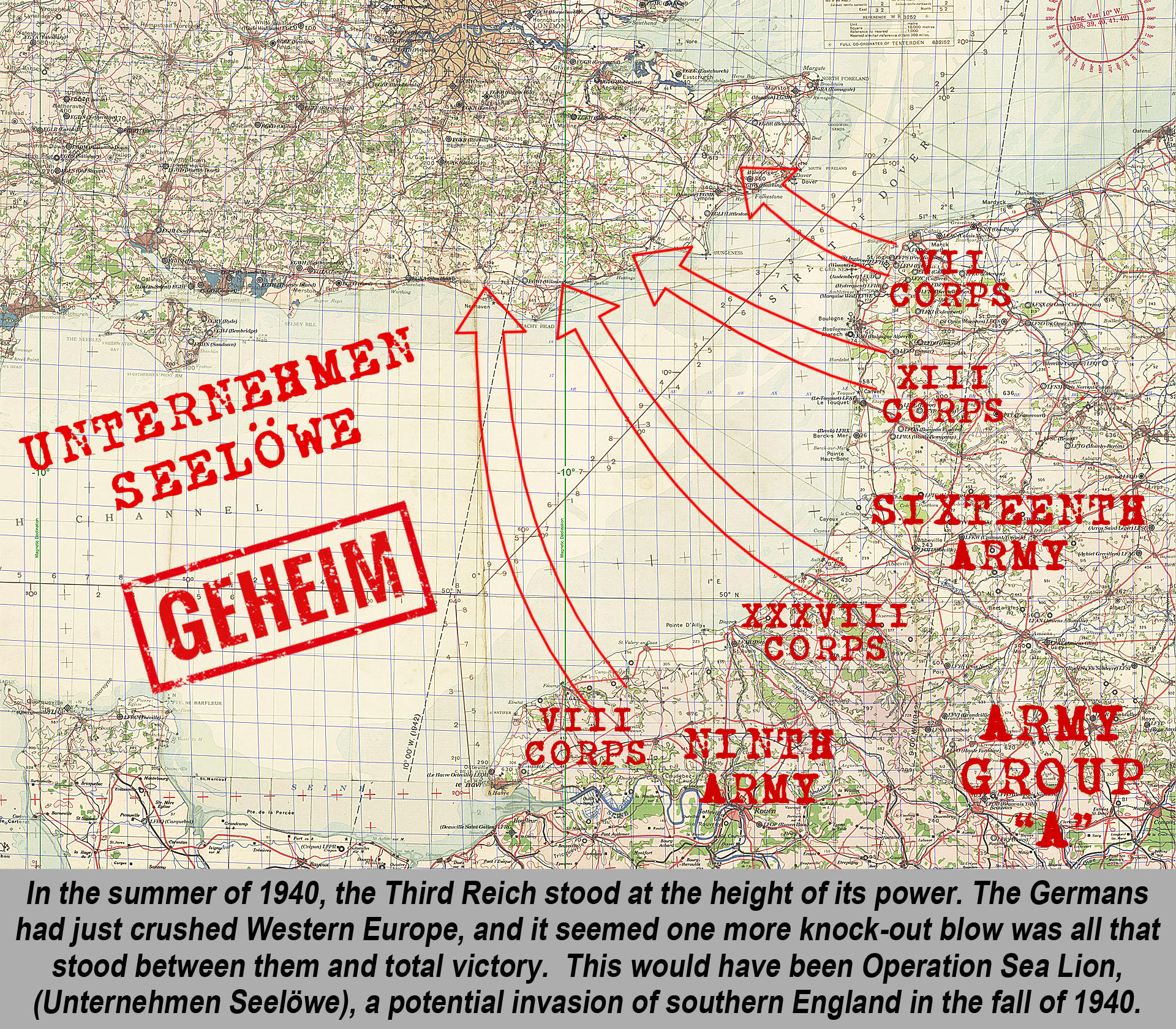
Put broadly, Operation Sea Lion (Unternehmen Seelöwe in German) was Germany’s plan to invade Great Britain in the summer or fall of 1940. After the spectacular success of “Case Yellow” and “Case Red” (the two-phased invasion of the Belgium, Holland, Luxembourg, and France), invading the UK seemed the next logical step. Or was it?
As we’ll explore in this series, the German war machine faced a staggering array of obstacles just to contemplate such an operation. However, they also enjoyed a wide range of very comfortable advantages. We all know it never happened. But could it have? Really? And if it had, what would it have looked like?
This series will look at the plans, conditions, and “best guesses” at some of Sea Lion’s possible outcomes. We’ll also feature a campaign-style series of wargames, featuring systems like Battlegroup (Ironfist Publishing) and Panzer Leader (Avalon Hill). Win, lose, or draw, we are GOING to invade England, and see what happens on the tabletop.
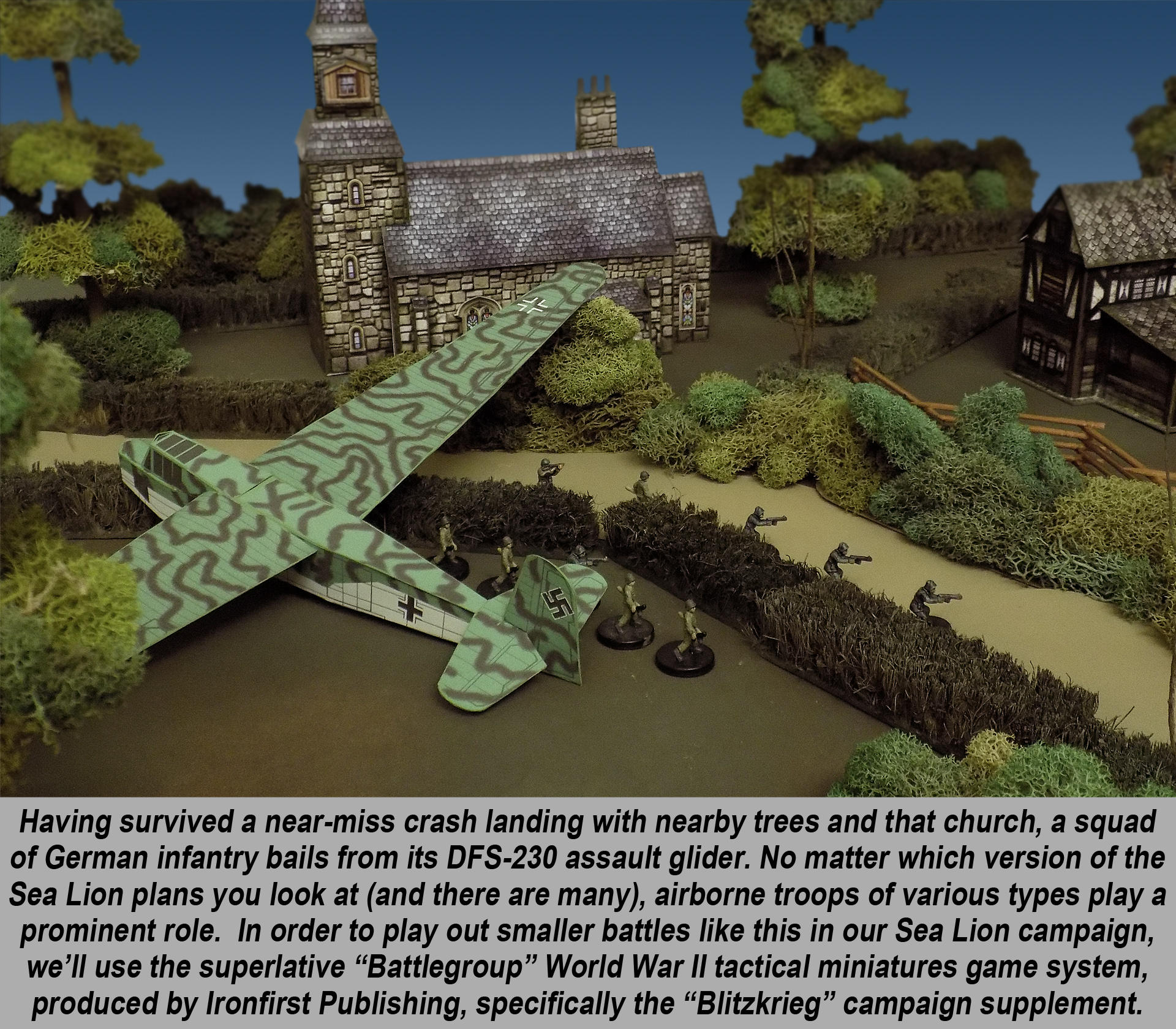
We’ll break Operation Sea Lion down in five articles. Article One will introduce the project and review some of the actual plans the OKW (Oberkommando der Wehrmacht) was looking at. The obstacles and advantages on both sides will be discussed, along with the preconditions the Germans would have to meet before Sea Lion could be launched.
Article Two will feature the assault and lodgement on the coasts of Sussex and Kent. Article Three will see the Germans expand their bridgehead, and Article Four will bring our imagined campaign to a climax. Finally, Article Five will make the case for Sea Lion, and offer a considered opinion on whether this really could have happened.
Sea Lion: The Prospects
Here on Beasts of War, we all love our alternate history. Yet while it’s chilling to imagine a swastika flying from Big Ben, or Winston Churchill and King George VI sharing a cell in the Tower of London, it’s important to take a hard look at the cold, hard facts...and measure the actual conditions faced by both sides of this prospective campaign.
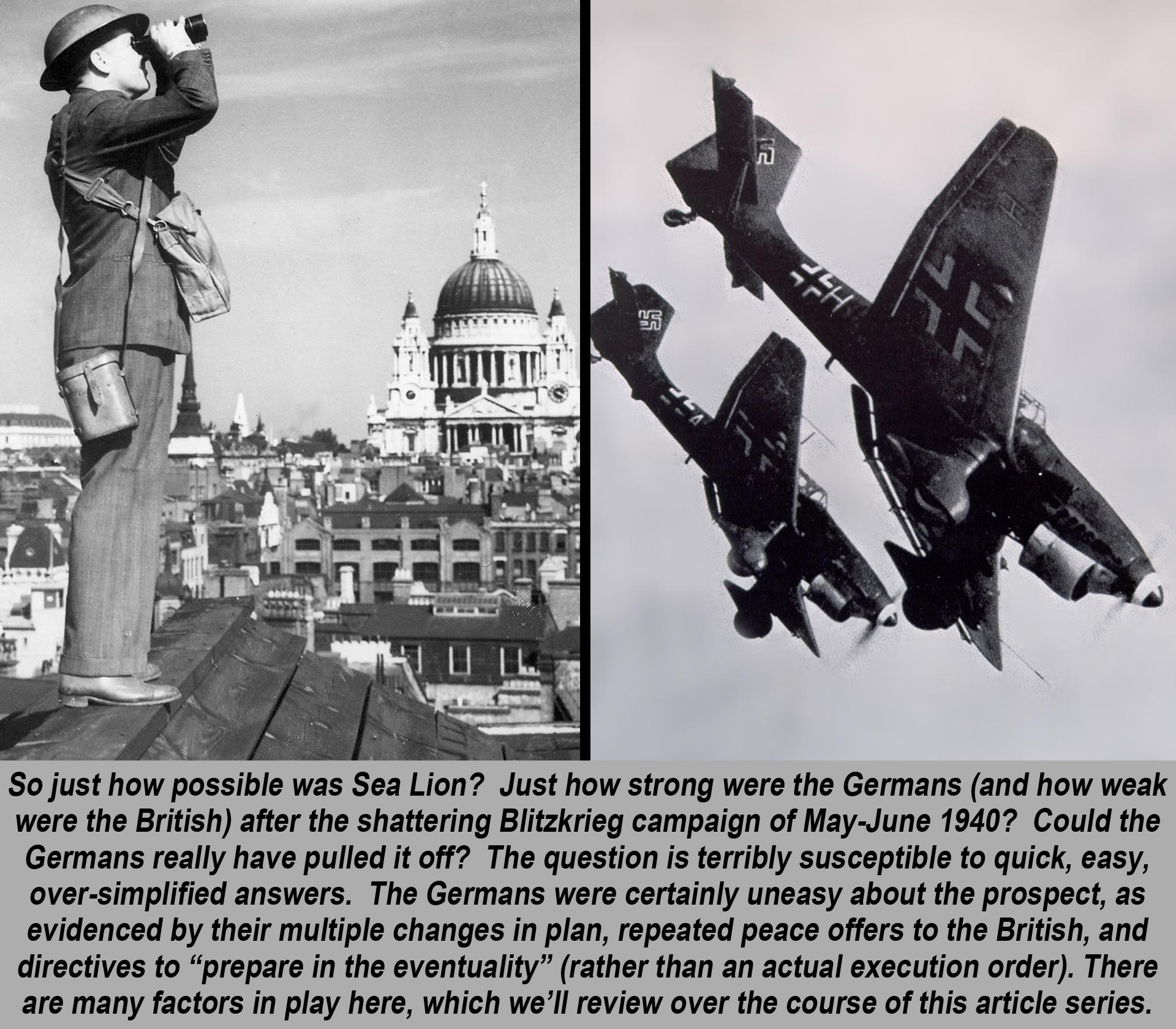
As we all know, Germany had just conquered France. The British Expeditionary Force (BEF) had just been hurled off the continent, having been forced to abandon just about anything heavier than a Bren gun. The Germans seemed unstoppable, and boasted that the English Channel “was just one more river to cross” to invade England.
This, of course, is absurd. The English Channel poses a much bigger obstacle to cross than any river, especially when defended by the largest navy in Europe. But was the Royal Navy really that strong? Most of their ships were far past their prime, and spread over the globe to protect the sea routes that kept Great Britain alive.
But if the Royal Navy wasn’t as strong as it appeared, neither was the German Army. Despite most misconceptions, the invasion of France had been no walkover. The Germans had lost tens of thousands of men, tanks, and aircraft, and most formations in the summer of 1940 were now badly understrength and in need of rest.

The Germans also had no unified command structure, critical in a sea-air-land operation like Sea Lion. Nominally, the OKW had authority over the Wehrmacht (Army), Kriegsmarine (Navy), and Luftwaffe (Air Force), but in practice cooperation was poor and inter-service rivalries would plague the German war effort throughout World War II.
Then again, the German invasion of Crete in May, 1941 shows that the Germans could follow up a mainland European invasion by quickly bounding over hostile waters controlled by enemy naval units, establish a bridgehead on a defended island, and then expand the bridgehead to secure the island.
Of course, Great Britain is not Crete. Still, it teases the imagination with what just MIGHT have been possible, at least in the early stages of Sea Lion. In any event, our fifth article will take a much more detailed “pro and con” evaluation of Sea Lion’s prospects.
Sea Lion: The Plans
Another misconception many people have about Sea Lion is that there was ever “a” plan. There were several plans, perhaps half a dozen or more. All were very different and covered a wide array of potential invasion scenarios.
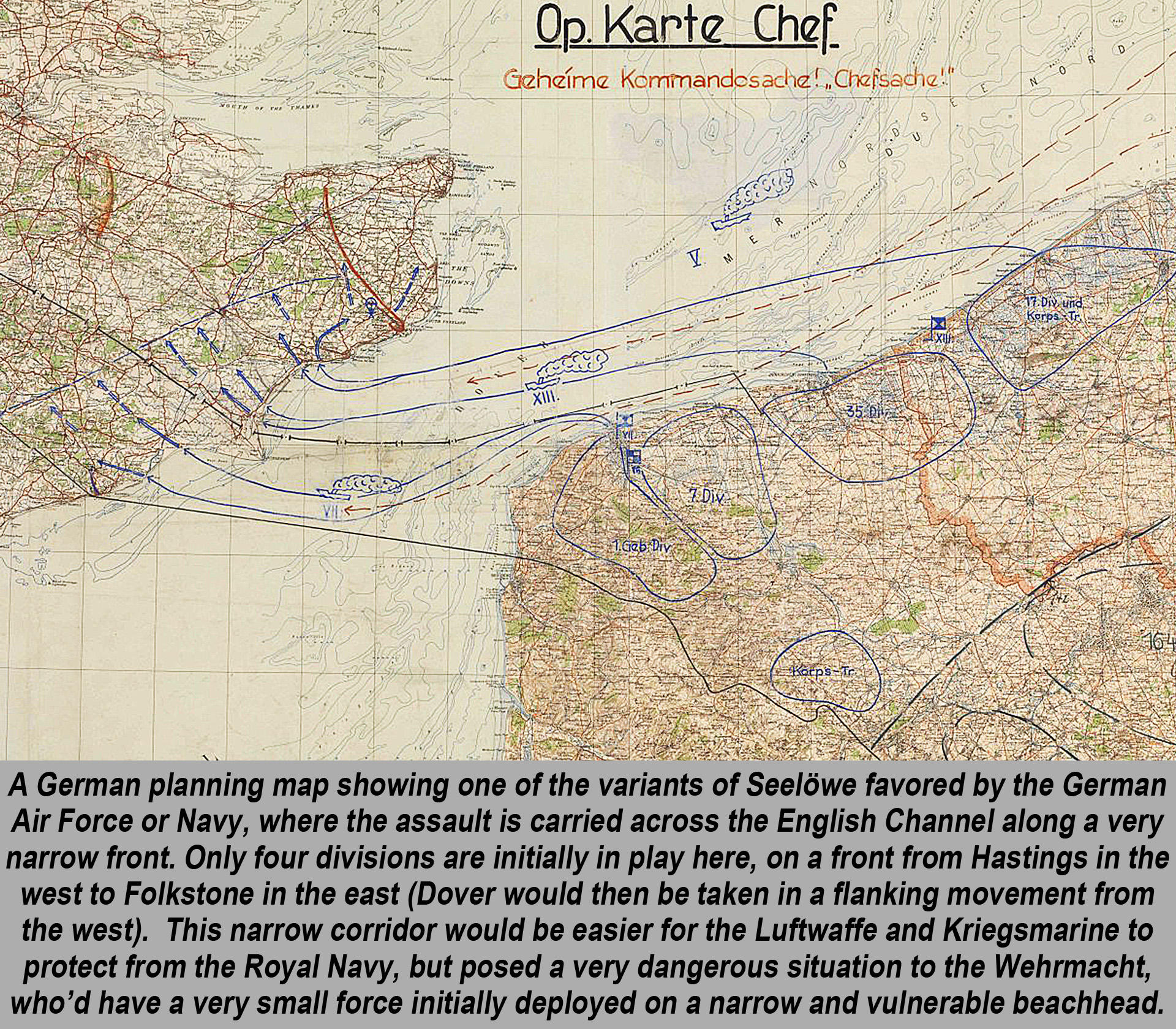
For purposes of brevity, these plans fall into two basic categories: those proposed and favoured by the Kriegsmarine and Luftwaffe, and those proposed and favoured by the Wehrmacht.
In summary, the Navy / Air Force plan called for a very narrow invasion corridor, with one assault zone extending from Hastings to Rye in the west, and a second from New Romney to Folkestone in the east. A lead proponent of this plan (drawn up as early as November, 1939) was Grand Admiral Raeder, commander of the Kriegsmarine.
Clearly, the Kriegsmarine and Luftwaffe wanted a narrow invasion corridor because this would be much easier for them to establish over the English Channel, protect against RAF and Royal Navy interference, and maintain a reasonable flow of supplies once a beachhead was established.
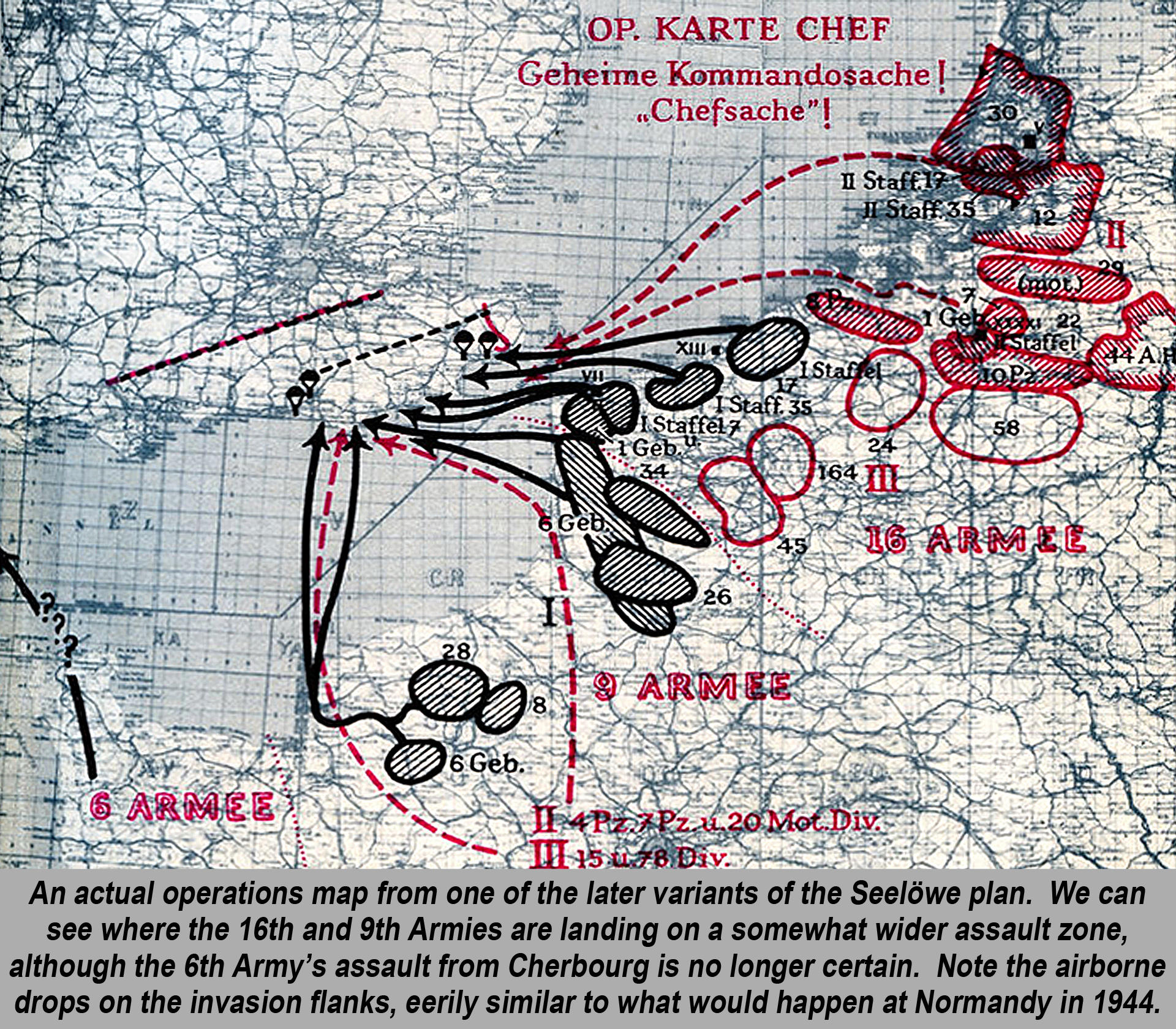
The Wehrmacht, however, hated this idea. To launch an invasion on such a narrow, vulnerable front (with only four initial divisions in two corps) seemed in their eyes nigh-suicidal. They wanted a much wider invasion corridor, with some plans calling for landings as far west as Portsmouth, Southampton or even Weymouth.
Of course, both plans were unrealistic. The Kriegsmarine and Luftwaffe could never hold open the Army’s overly-ambitious proposed invasion corridor, nor could the Army spearhead an invasion of England with just four initial divisions on such a narrow front.
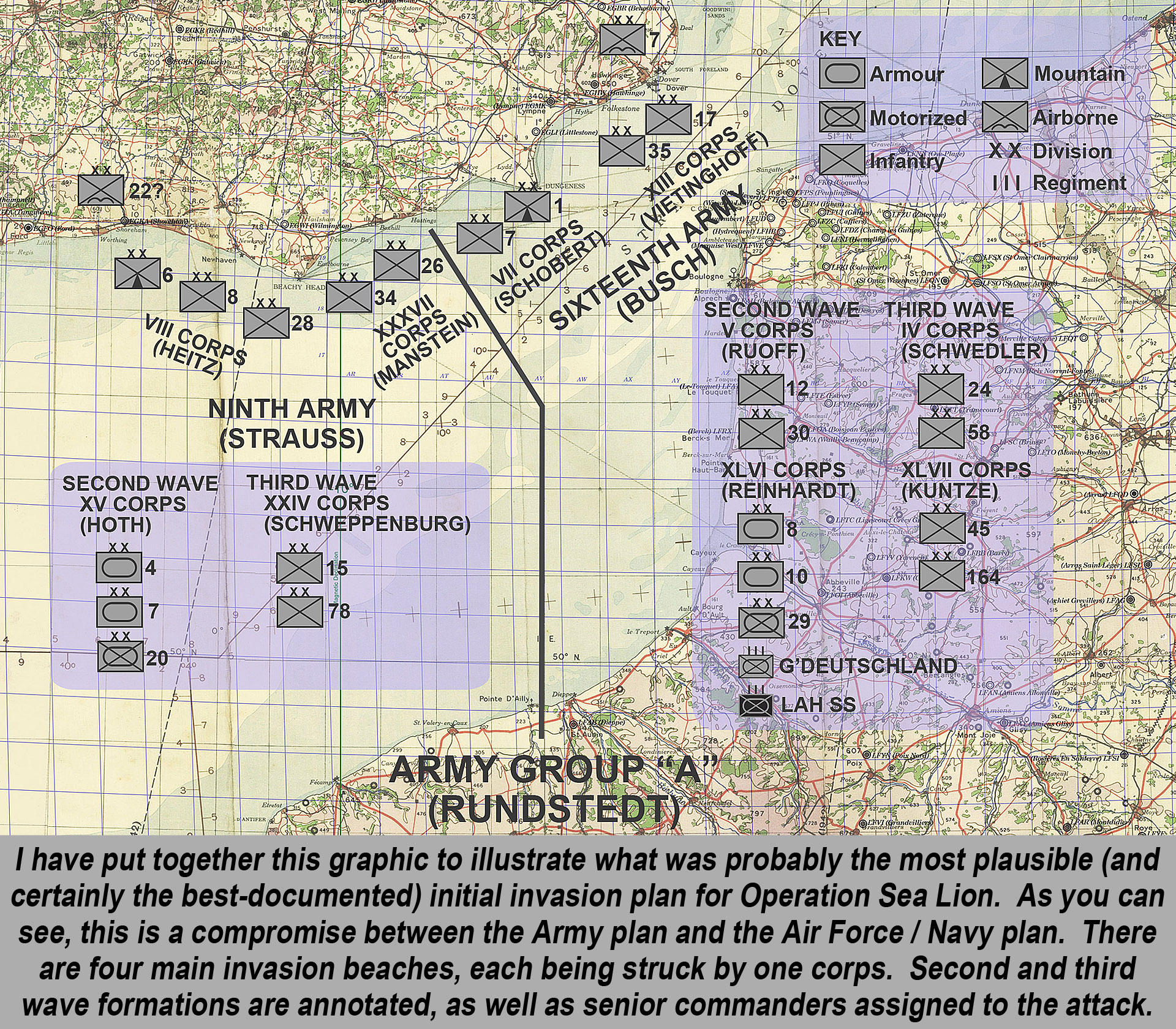
On July 16th, 1940, Hitler issued Direction No. 16, his order to begin preparations for invasion. The German Army, Navy, and Air Force now had to come up with a workable compromise plan, finalized on or about August 30. Since these are the most plausible and well-documented, we’ll use these plans as a basis for our exploratory campaign.
Sea Lion: Prerequisites
The most immediate and incontrovertible prerequisite for any realistic contemplation of Sea Lion is of course that the British have to decisively lose the Battle of Britain, the gigantic, months-long air battle to control the skies over England. Starting in July, 1940, the British historically won the battle, Germany’s first real defeat of World War II.
For the Germans to have any chance at all, we have to imagine they win this battle, and win it badly. Such a result is possible, looking at German operations starting on “Adlertag” (Eagle Day - August 13th), a concerted effort to destroy RAF airfields and other vital infrastructure and force RAF fighters into combat against superior numbers.
This endeavour started very well, and within weeks the RAF was almost dead on its feet. Only when Hitler and Göring make the spectacular mistake of switching emphasis to attacks on British cities does the RAF get the reprieve it so desperately needed to recover.

So if we imagine the RAF largely crippled by early September, 1940, we now face other conditions the Germans have to meet. The first is a shipping fleet to get their troops across the Channel. In this, they were surprisingly successful, largely by appropriating thousands of small craft from the many ports of Holland, Belgium, and northern France.
The Germans also had specialized equipment ready to go, including four full battalions of “tauchpanzer” submersible tanks, based on the PzKpfw III. The Germans also had their ace in the hole, the best airborne assault force in the world, including gliders, an airmobile division, and of course the dreaded “Fallschirmjäger” parachute troops.
These specialists are the real key to initial success for Sea Lion. The German vision for Sea Lion was much less a “Saving Private Reinhardt” scenario with troops hitting a fortified, defended beach. Rather, airborne troops would take airfields, ports, and even beaches, on which heavier German seaborne formations could land in relative peace.
The other critical condition facing the Germans was time. Fragile as it was, any prospect for Sea Lion would have to be carried off before the middle of October at the latest. The weather over the English Channel tends to get borderline apocalyptic at that time, especially for any army trying to mount an assault across it.
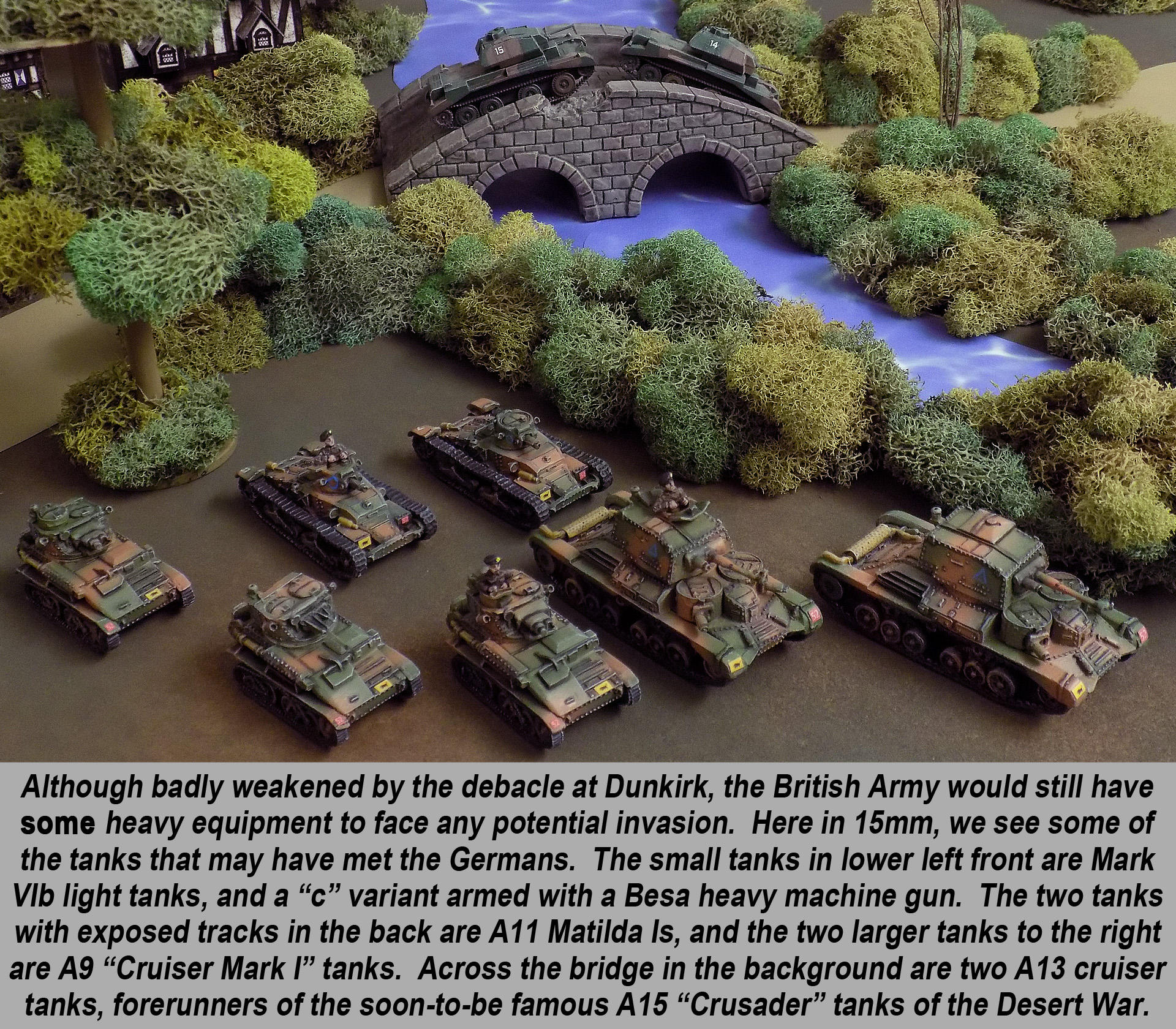
The Germans also had to hurry before the British were able to recover too much from their defeat in France. While many men had escaped at Dunkirk, there was practically nothing in the way of heavy artillery, tanks, or other equipment. But the British were recovering fast (with the help of the Americans), so time was short.
Sea Lion: Getting Started
Of course, this is only the start of what I’m sure is a fascinating, controversial, and provocative topic. While certainly full of charged opinion, simply asking “would Sea Lion have worked” is a blatantly oversimplified question. We’re just exploring what might have happened if the Germans tried it, the prognosis will be presented in Part Five.
Also, the plan will be covered in more detail as we game through the opening battles. Again, we’re using the “compromise” plan widely published, others will certainly have opinions, ideas, and quotable sources on other plans. Please remember there were many plans and we’re just using the most plausible and well-documented one.
For now, let’s just sit back and imagine that just maybe, somehow . . . the Luftwaffe has managed a victory in the Battle of Britain. There was never a “Blitz” against British cities, the Germans just kept hitting the RAF where it could really be hurt, at its bases on the ground. Now, the RAF is all but gone, and the Germans own the air.
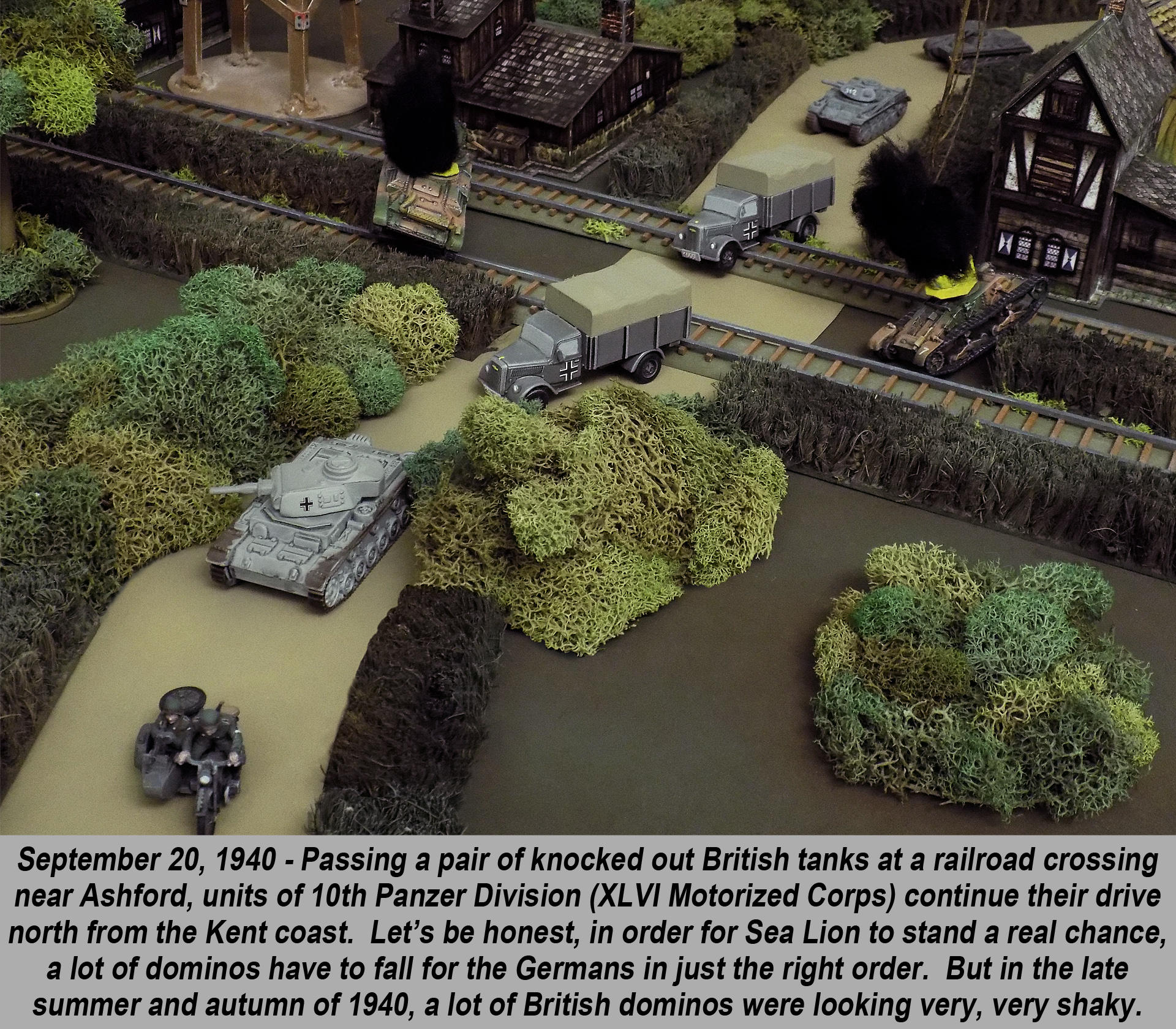
Now, the skies over Sussex and Kent are dark with German Heinkels, Dorniers, and Stukas. Huge 15-inch guns are installed at coastal batteries at Calais and Boulogne, ready to hurl 1800-pound shells across the Channel at targets from Folkestone to Hastings. The U-boats pull back from the Atlantic and now nest thick in the English Channel.
The date is September 15th, 1940. Across a darkened, blacked-out England, the roar of German bombers is replaced by the drone of hundreds of Ju-52 transport planes, some loaded with paratroopers, others towing DFS-230 gliders.
The die is cast. Operation Sea Lion is about to begin.
If you would like to write for Beasts of War then please contact us at [email protected] for more information!
"Win, lose, or draw, we are GOING to invade England, and see what happens on the tabletop..."
Supported by (Turn Off)

Supported by (Turn Off)
"The most immediate and incontrovertible prerequisite for any realistic contemplation of Sea Lion is of course that the British have to decisively lose the Battle of Britain..."
Supported by (Turn Off)





Excellent lunch time reading – and I see normal service is resumed with a recent historical article! 🙂
Living in Sussex, I can vouch that there are a lot of wide, open beaches, both sand and shingle, across the south coast. Defences at the time, as you point out, were poor and what did exist were built in the 19th century (Martello Towers and the later Palmerston Towers). Newhaven Fort is a Palmerston Tower and was the largest defensive structure to be built in Sussex.
The only real challenge along the area of the south coast Sealion targeted are the sand banks around Rye and Hastings (and the world’s largest Cuspate Foreland!). This presented William with some issues in 1066.
Once ashore, the countryside is rolling farmland all the way to the North Downs just south of London, where you would imagine a reasonable defence could be mounted.
I’m currently playing as Germany in the excellent PC game Hearts of Iron 3 and I’m faced with the same issue. I’ve just defeated France and it is summer 1940. How to launch an attack on England while avoiding the British Navy? I’m taking a similar approach in trying to bomb the air bases flat to gain control of the skies in Southern England. But it’s not going to be a pretty invasion….
Oh no, @redvers ! You live in Sussex? Apologies in advance if we blow up your house (or more accurately, your grandparents’ house).
According to the plans I have, Hastings is a landing point, but not one of the larger ones. I have a feeling the Germans may have been trying to avoid the natural obstacles you mention.
Some of my Panzer Leader maps are being custom-drawn from a combination of satellite images (Google Earth) and 1940 aerial photographs. I use the 1940 data for towns and roads where I can, but Google Earth has better topographical data. Anyway, I’m definitely seeing the rolling farmland you’re talking about. Some of the beaches like Folkestone have almost Omaha-style bluffs behind them, but that’s about it.
Re: 19th Century fortifications: As you can see on our map, we are putting the German 8th Division / VIII Corps / Ninth Army at Newhaven, and I did see Newhaven Fort and hell yes … I avoided it. 😀 Yes, it’s 19th Century, but we can take as an example the Germans assaulting across the River Bug against the 19th Century fortress at Brest at the opening of Barbarossa in 1941. They did take it – eventually – but had a hell of a time.
Also, @warzan ‘s 8th Guards Soviets had to assault German troops in a Prussian 19th Century fort at Poznań, Poland in 1945. Again, they did clear it, but fighting raged for over a month and casualties were very high.
Yes, these fortifications are old … but they’re really big piles of brick, concrete, and earth that you can’t bomb, shell, or strafe into submission. It’s time for SMGs and flamethrowers, which is always a grim business.
Sounds like you’ve got your work cut out for you in your Sea Lion game if you’re still trying to beat the RAF down in southern England. Just don’t switch to the cities. 😀
My house wasn’t built until well after the war, so no issues there!
Newhaven is reasonably large and I could understand that it would be hard to take, particularly given the other historical battles you mention. But there wasn’t a lot else defending the coast of Sussex beyond a few small, squat Martello towers. Good for a single gun and maybe a couple of MG’s but little else. So Newhaven would have been tough but the likes of Brighton, Seaford and others would have been less well defended. There would be plenty of beach for the Germans to aim for!
This is kind of what we’re aiming at in Parts 2 and 3 regarding the state of British beach defenses. Very, very thin in the summer and early fall of 1940. Which is a “good” thing, because the quality of the German invasion (*ahem*) fleet is also very bad. They certainly rounded up a lot of ships, and made some great modifications (my favorite is the propeller-driven “air boat” in the photo above), but this is no “Overlord” invasion fleet.
Overlord shows what this kind of amphibious assault looks like when both sides have 2-3 years to prepare. Sea Lion is 2-3 months, but again, for BOTH sides.
I think what some people do, almost subconsciously, is put a 1940 German invasion fleet up against an imagined British 1944 “Atlantic Wall,” because the conditions of Normandy are so thoroughly branded into our collective hindsight. In such a scenario, the Germans naturally have no chance.
As I expected a well written article. You even covered the near german win of the Battle of Brittain. I often have the feeling that the point that most of the RAF was destroyed in mid. 1940 is missing.
@redvers don’t underestimate the natural obstacles. Sand banks, weather condition and so on were often the end of a well planned invasion. Foreigners don’t know such specific condition which every inhabitant knows to well. So a sand bank could be a very good defence line 😉
Thanks very much, @setesch – hopefully I got all my German right. 😀
Other people were also asking / commenting on the Battle of Britain in the Weekender thread, and how the Germans might have won that, or how close they did or didn’t come. One of these days I may have to come up with an article series just on the Battle of Britain, it would need its own article series to do it justice.
So for this series, we just have to start with a presumption that yes, the Germans have scored a crushing win here. Otherwise, discussions on Seelöwe are dead on arrival.
Even assuming a complete German victory in the Battle of Britain, though, we can’t discount the RAF completely.
This is because British airfields in the RAF areas covered by 12 Group and 13 Group . . . hell, even 10 Group out in the west by Exeter, are largely out of range for German Bf-109 fighters based out of northern France.
Which means you can’t send bombers out there by daylight.
They tried escorting bombers with the larger, twin engined Bf 110C “Zerstörer” heavy fighters, but these were a disaster against single-engined fighter like the Hurricane and the Spitfire IA.
They tried sending a surprise bomber strike with no escorts at all, with Luftflotte V out of Norway, and were absolutely slaughtered.
Night-bombing could be done against these northern and western targets, as German bombers hit cities all over the place during the Blitz, but I don’t think you can bomb precision targets like airfields / radar stations / sector control stations by night with the technology at hand.
So even with a German “win” in the Battle of Britain, there will still be RAF squadrons lurking in the wings in Wales, the Borderlands, Scotland, etc. These will certainly come into play as (a) the German advance crawls toward them, and (b) as German fighter squadrons start extending their reach by basing in airfields in southern England.
another fantastic looking article series @oriskany !! look forward to the next part.
Thanks very much, @bigdave. Yes, in the next part, we have the intros out of the way and some of the analysis, so it’s time to hit the beaches!
Fabulous article @oriskany! 🙂 Once again a great mix of exposition and eye candy. I’m guessing the BG games were a lot of fun! Not to mention the Panzerblitz ones! 🙂
I always thought one of the greatest factors in the invasion would have been fighting British troops on their own soil. Yikes. Not a happy prospect.
Thanks, @cpauls1 – indeed PanzerBlitz / Leader and Battlegroup are my go-to systems. PanzerBlitz has been there for 32 years, I hope it shows how much I like Battlegroup, that PanzerBlitz now has an equal partner on my “shelf of glory.” 😀
Indeed, I’ve been adding a few small special rules to these Battlegroup games just to try and reflect some of the conditions you mention, especially the prospect of British troops fighting on their own soil.
One the one hand, I’ve been shaving down some of the lists and units presented for the B.E.F. in Battlegroup Blitzkrieg. The B.E.F. was one of the most mobile and best equipped parts of the British Army, and while most of those men managed to get home via Dunkirk, virtually all that heavy equipment, tanks, vehicles, and heavy weapons had to be left behind. So we’re looking at large infantry units, albeit with little in the way of heavy weaponry.
On the other hand, we’re also cranking up the troop quality levels for British forces. Yes, many of these men were raw recruits in August – September 1940 (especially recently-mobilized Territorial Reservists or Home Guard), but we’re counting these “inexperienced” troops as Regular. Regulars as Veterans, etc.
i = inexperienced
r = regular
v = veteran
e = elite
We hope that by doing this, we can simulate the grim determination many expect would have been exhibited by British troops, at least at first.
That said, if the Germans managed a bridgehead and won the first few battles, this “bulldog fanaticism” may have started to erode. The Germans had won in Poland, Denmark, Norway, Holland, Belgium, France, and in our timeline, the Battle of Britain. If they managed a landing and won the opening battles in Sussex and Kent, their aura of invincibility would have been enhanced.
British troops are not immune to this. An example can be taken by the near-awe they held for Rommel in the desert (as unjustified as that may have been). They;d literally started to resign themselves into the belief that he was invincible. There’s the famous story of either Auchinleck or Montgomery passing a formal order to the 8th Army against even saying his name among the rank and file.
Operation Sea Lion would certainly fail with men like Captain Mannwaring and the Walmington-On-Sea Home Guard ready to repel them. The Germans “don’t like it up them!”
Have no fears, @rfernandz2001 – we’re not selling the Home Guard short. There have been some scenarios I’ve run in “Para Leader” (airborne supplement to Panzer Leader) where the Home Guard actually performs pretty well. German fallschirmjäger platoons get badly scattered by winds and before they get a chance to consolidate, the Home Guard gets lucky with a kill now and again.
There’s also the famous story of elite British commandos getting ready for the raid on St. Nazaire in 1942. They have a “dress rehearsal” exercise at a British port (I can’t remember where), with Home Guard playing the part of the German defenders.
The Home Guard totally kicked the commandos’ asses (granted, I don’t think this was a live fire exercise), but I think they had to change some elements of the St. Nazaire plan.
I saw a programmer on the Home Guard and some were given special commando training to fight behind enemy lines…Each groups/cell first task was to kill the person who gave them their operational orders in case he was captured and gave the location of each cell to the enemy
I may have seen the same documentary, @torros . I’ve also seen another one on YouTube recently that described these guerrillas getting the standard order: “Take two or three with you.” These men knew they were going to die.
There’s also a show I found that captures more of the mood of the people awaiting invasion (more than any actual data or facts), but still provided some interesting insight. Part of the show details the writings of a novelist Margery Allingham, who lived with her husband along the Romney coast. They had a old 1800s revolver with just three or four bullets. Their promise again . . . “take two or three with you.”
https://www.youtube.com/watch?v=7NnsRCt8TGM
Excellent article once again looking forward to parts II-V. Nice to see Historical gaming getting top billing at BoW
Cheers,
Joe90
Thanks very much @joeninety – Indeed, it’s been nice to get back in my historical (or at least alternate historical) comfort zone. 😀
I definitely want to take a moment to thank the editor @brennon for putting up the article, making it look so great, and giving it a good “time slot” for publication. Thanks very much!
Lovely article @oriskany, very much looking forward to the next instalment.
Thanks very much @felixpike – Is that a WW2 fighter / bomber insignia on your icon? Or just a coincidence?
I’d like to give another shout-out to thank the @lancorz for helping with the banner graphics, side-bar graphics, and front-page images for this series. I love the compass and the coffee-cup stain. Just goes to show how rushed the Germans were in planning this operation, they couldn’t even keep their coffee sorted! 😀
Gee gawsh :3
It seem it is 😉 I had this insignia on the War in the Pacific game forum. 😉 @oriskany
I certainly mean it, @lancorz . 😀
Sure enough, @yavasa – a US Navy fighter squadron:
https://en.wikipedia.org/wiki/VFA-31
Confirmed for heavy fighting in the Pacific! 😀
@oriskany, it’s taken from the patch of Fighting 31 (VF-31) of the US Navy. My nickname has been Felix for many years (for completely unconnected reasons) so I’ve sort of adopted Felix the Cat as my avatar!
Yep, @felixpike – I could’ve sworn I’d seen it before as aircraft squadron insignia . . . did a Google Image search on it and there it was. https://en.wikipedia.org/wiki/VFA-31 😀 😀
Many people assume that “Oriskany” comes from the American Revolutionary War battle of August 1777. While I’ll confess I’ve read / gamed / written a lot on that battle (probably the bloodiest in American history “per capita”) the source of the name is a little sillier than that. Others have guessed it’s from the American Essex-class aircraft carrier USS Oriskany, CV-34, recently sunk to start a new coral reef off the coast of the my home state.
Actually’s its from a silly sci-fi starship game my friends and I used to play quite religiously. In the far-off future when the US Navy sails the stars, one of the best destroyers in the fleet is USS Oriskany. Picked more or less at random until she just became one of those characters / units that ALWAYS gets lucky, always wins, always survives. This was a few years ago when I signed up for BoW, and used that as a name more or less on a whim And the rest is history. 😀
I don’t believe it for once I have arrived at the party on time. That must be one for the books. Great first article for this series in what is now a very matured style. This one is going to be a very interesting series as many people I have spoken to have very strong opinions on this topic.
Oddly Yarrack asked me a week ago to consider an Operation Sea lion campaign for March or April next year. Even stranger it will be done in 20mm and we will be using the Battlegroup rules as we want to focus on the lower tactical end of the spectrum. We will be taking a good look at the Home Guard, references to Dad’s Army have already been banned. A good part of this focus will be the hidden in plain sight fortifications and their somewhat questionable doctrine. They will be backed by the army on occasion. I mentioned you will be doing this series soon and so we will be using these articles as one of our primary resources. So I cannot think of giving you a higher accolade than that.
I have looked at several German invasion plans for England and realistically they came back to 2 things. Who is going to get ALL the glory if it works and who will get all the BLAME if it fails. All 3 forces worked beautifully together for the invasion of Norway and this was used as a foundation template for Normandy.
Goering seemed to win the glory stakes with a Luftwaffe first Battle of Britain that would lead to the demise of Operation Sea Lion. Yet we believe it should have been a combined effort focused on gaining only local air superiority, with just enough naval assets to keep the RAF and RN out of the channel.
For us the go, no go rests on that shambles of a mostly towed or pushed invasion fleet. The English Channel has a reputation of swallowing this kind of fleet. While the floating Pz IIs were just about there, the Pz IIIs were half baked and still had issues that were not resolved in 1940. I will save commenting further for later in the series.
Truly great job @oriskany and I am going to be locked in for the rest of the series. 😀 😀
Awesome, @jamesevans140 – I was hoping you’d turn up. 😀
Thanks for the kind words. I just hope the style doesn’t become “too matured,” i.e., formulaic.
Indeed, people have some strong opinions on this topic. Glad to hear your group will be tackling this topic next year, and using Battlegroup no less. Please let me know if you need any of the research I’ve been putting together. I have pretty detailed records on Great Britain’s order of battle and dispositions (dated 11 September 1940), German plans, use of “Brandenburger 800” commando units, etc.
I can’t disagree outright with just about any of the preliminary points I your posts, i.e., the poor condition of the landing fleet, the Luftwaffe and U-boats’ ability to shut the Royal Navy out of the Channel, etc. A critical factor remains German cooperation between the three major branches (or lack thereof). There was certainly no “SHAEF”-like combined staff with ONE overall commander (i.e., and Eisenhower) role. OKW COULD have been that unifying force, but again, without that single unquestioned commander to which all air, land, and sea commanders report . . . I don’t know how effective they would have been. Of course there’s Hitler himself, but if he’s the actual field commander of your invasion . . . eh . . . the less said the better.
Essentially, I think Sea Lion would have depended on the three branches of the OKW “playing nice.” They got away with it in Norway. I guess we’ll never know for sure how it would have worked in Sea Lion.
I’ve seen your new posts on PinInterest, I will get to looking at hem soon. Still at work here, and of course keeping up with this thread. 😀
As always you light up the way wargaming can and perhaps should go by looking sideways at what might have been, a little out of the box thinking and land up another great potential for game,s a plenty, another great set of articles in the offing here mate. I wonder when that wargaming book is going to come from your keyboard, you can only put it off so many times mate LOL!
Hey, who knows re: the wargaming book, @chrisg . 😀 BoW isn’t the only place I write or publish, and sooner or later I’ll be able to combine all these articles into a coffee table book of sorts. 😀 (after some editing to clean up the embarrassing typos, of course). I really hate it when I make misteaks.
There are place down in the London area which have been found, built to place weapon and troops in bunkers for this invasion. (Time Team) even did an episode about or defence.
Indeed, @nosbigdamus – even if we can imagine German spearheads getting as far as London, I can easily see this turning into a “Stalingrad West” kind of situation, with horrific fighting in bunkers, buildings, houses, factories, subways, and even sewers.
This article is perfect timing. I have been looking to run a solo campaign based on Sealion for a while now. I will use Bolt Action (I am looking at the skirmish level rather than bigger scenarios) and see how to include some partisan type engagements as well.
Looking forward to the next episode
Awesome, @applemak – please let us know how those games / engagements turn out when you get the chance to run them. Our Battlegroup games get a little small in scale, but nothing quite as “skirmish-intimate” as Bolt Action.
Bolt Action is a great infantry game, I feel. It’s when people start bringing a lot of tanks and artillery into it (on both sides, that is) that it starts to get a little strange for me. But it sounds like it would be a perfect fit for your project.
Hope you keep us in the loop! 😀
Really nice write up. Looking forward to the next article
Thanks, @bruce9651 . We’re aiming at one article each Monday until December 5 – so we can wrap up before the DropFleet Commander boot camp. 😀
Great article, Sir!
I still think they should have invaded via the lovely Suffolk coast. All nice and flat here and sparsely populated and apart from the odd Martello tower only weakly defended. Great place to get a bridgehead. 😉
Can’t wait for the next instalment!!
Have no fear, @suetoniuspaullinus – in Part 3 we lay out our vacation plans along the lovely Sussex coast (Part 2 is mostly in Kent).
The invasion of the Netherlands while fast did cause quite a bit of losses in transports.
As such the Germans would have had to succeed at their stated goal (capture the Dutch government + Queen).
I’m sure it had an effect on Sea Lion as well.
source : https://en.wikipedia.org/wiki/Battle_for_The_Hague
Considering that they failed against the unprepared and under equipped Dutch troops one has to wonder how they’d do against the British who at least had some experience after Dunkirk.
There is going to be a movie about Dunkirk : http://www.imdb.com/title/tt5013056/
It will be interesting to see how accurate that one is.
@limburger – The ragged state of the German Army and Air Force (as you probably know, in the German military, airborne forces belonged to the Luftwaffe, not the Wehrmacht) in the aftermath of Case Yellow and Case Red is certainly a valid observation, one we’ll be staying with through the course of this series.
I’m looking forward to that Dunkirk movie as well. 😀 Her’es hoping for the best.
“dusty labyrinth of historical wargaming.” 🙂
Unlike most of the site, I had never heard of this invasion until now. Yes I’m an ignorant American :(. I have to say I love the realistic look at a “what might have been” scenario.” To often alternative history is way off the mark…machine guns at Gettysburg or steam powered mechs in WWI (No Battletech hate mail please, I have my own Mechs and they are even inner sphere). I love that this article approaches the possibilities in way that clearly describes what would have had to happen for this to even start. Can’t wait to read the rest.
Dusty indeed, @gladesrunner . I missed it. And not all Americans are ignorant. Just those voting for Donald Trump.
I think you hit on a good point though, distinguishing between alternate history, and “pulp” alternate history (WWX, Konflict 47, Dust, All Quiet on Martian Front). Not that there is anything wrong with either. But they’re definitely different.
I guess you could make the case that even the most diligent, faithful, precise historical wargame becomes “alternate history” the second the dice first hit the table. 😀
A great article, really looking forward to the rest, just a couple thoughts on the German
Navy and the RAF. Following the invasion of Norway the Germans sustained heavy losses
Especially their destroyer fleet would this deficit be factored in when they conduct the seaborne
Element of the operation. With regards to the RAF what role would their bomber command
Elements have in targeting the beachheads and infrastructure like roads and bridges to
Slow the German advance. I can recall a couple of incidents in the 1980’s during my
Service where a cache of ‘Mills’ bombs and Phosphorus bombs were dug up by members
Of the public having been buried for nearly fifty years!
Thanks for the great input, @ozzie . To reply point by point:
German destroyers lost at Norway: While the Kriegsmarine indeed sustained heavy losses (almost 50% of their surface fleet) in Operation Weserubung, I don’t forsee the lack of German destroyers (primarily the Z-class, I believe) being a major obstacle for Sea Lion’s initial landings.
This may sound crazy, I know. But the fact is the Germans never had any hope of matching the Royal Navy on the surface, before or after Norway. So do the losses at Norway really matter? Accordingly, plans to make the assault across the Channel were built around neutralizing the Home Fleet without a major German surface contingent. Whether or not these plans would have worked is an open question (personally I think some elements would have and some would not have), but either way the losses at Norway wouldn’t have been a factor.
The best way destroyers really protect an invasion fleet is from enemy submarines. So with fewer destroyers, one might make the case that the Sea Lion invasion fleet is vulnerable to British submarines. But the British submarine fleet in 1940 was very small despite German successes in WW1. Furthermore, those few Royal Navy officers that were fans of the submarine at the time were making the same generalized mistake the Japanese were making at the time, envisioning submarines as “the cavalry of the fleet” – screening the main body and attacking enemy capital ships … rather than as an economic weapon against trawlers, tankers, freighters, and yes … troop transports.
As we’ll see in Part 2 and especially in Part 5, I honestly don’t feel the Home Fleet was nearly as big a factor as most people tend to think it was. I have what I feel in a fairly compelling case that greatly mitigates (note I don’t say completely eliminates) the threat posed by the Home Fleet against at least the initial phases of Sea Lion.
With regards to the RAF what role would their bomber command Elements have in targeting the beachheads and infrastructure like roads and bridges to Slow the German advance.
None at all. Seriously. The RAF had nothing like a real bomber command this early in the war, certainly nothing like the fleets of Lancasters that would level Hamburg, Berlin, and Dresden later in the war. The raids the British tried against German targets in 1940 showed that the took horrendous damage when attempted by day, and could barely find a German city when attempted by night.
In any event, I think you’re talking about tactical targets, not strategic ones. By and large, you couldn’t hit tactical targets by night in this day and age. So in an invasion where the British have already lost the Battle of Britain and Messerschmitt Bf-109Es rule the sky, I can’t see “Battle” bombers and similar woefully deficient aircraft standing any chance at all over German invasion beaches. In fact, these squadrons had just finished being massacred in the Low Countries and France. The infamous raid mounted by the RAF against a German river crossing in Belgium (I think) not only failed to knock out the bridge, but sustained the one of the highest rates of loss ever recorded in the history of aerial operations.
Please understand (and I’ll keep repeating this) 🙂 . . . I’m not trying to “shut anyone down” or discount anyone’s input or opinions. The “full prognosis” for Sea Lion is being published in Part 5, and is a lot more complicated that a “yes or no.” I just feel that a lot of what people think about Sea Lion has been handed down and handed down and handed down . . . and I’m trying to take a detached, objective, look at ALL the moving parts (or at least a lot more than are usually considered).
I can recall a couple of incidents in the 1980′s during my Service where a cache of ‘Mills’ bombs and Phosphorus bombs were dug up by members
Scary stuff. Hopefully none of this stuff was still live after 40 years. Were members of your unit trying to actively clean / comb beaches, or were they found by accident?
The caches were found by accident one in an urban redevelopment site and another was a bunch of very rusty mills bombs that looked like they had been inside a crate that had rotted away completely thankfully the finders were sensible to leave the items in situ and the authorities informed.
Yeah, @ozzie , as fascinating as such a find would have been, that’s not the kind of thing you want to play with. 😀
A great start to the series @oriskany as you say the u-boats would be moved to France to harass all shipping going to the UK slowing the build up of the defences at the cost. One thing you never mentioned/I missed most of the German fleet was towed barges not the designed landing craft used on DDay slowing everything so could they supply the army with this fleet?
Great input, @zorg – I will try to answer.
In VERRRRRY basic terms, the Kriegsmarine’s overall plan was to seal off the western and eastern ends of the channel long enough for the invasion to get across. This would have been accomplished by mines and especially U-boats, in conjunction with heavy activity by the Luftwaffe.
How wide a stretch of the Channel are they sealing off? That depends on which version of the plan you’re using. The Navy and Air Force wanted a very narrow channel, the Army wanted a ridiculously wide channel. Records strongly suggest they had settled on a compromise, which is the best-documented plans we’re using for this series.
The German surface fleet, such as it was (even weaker than most people realize because most of the “ahem” capital ships the Germans even had were under repair), I don’t think was even being used in a big way. It would have been suicide. The best information I can find is that they would be sent to other parts of the Atlantic to try and “draw off” elements of the Home Fleet.
This part of the plan I think absolutely would NOT have worked. We must always remember that the British were getting very good intelligence out of Germany thanks to the ULTRA section and the Enigma transcripts. No German “bait and switch” plan I think would have worked, and no matter what we think of Sea Lion, it would NOT have been a surprise.
As far as the nature of the German landing craft, yes, many were being towed. Records show whole “Tow Task Forces.” The fleet is very poor, which is the primary reason the Germans have such an brutally narrow window. As said in the article, once the October weather hits, the game is up (maybe even before that).
As far as how this effects the landings, more on that will come in Parts 2 and 3. (I can’t give EVERYTHING away).
Would it have worke
received and understood.
loose lips sinks ships.
Not at all, @zorg – I’m not trying to discourage anyone’s participation and feedback. I just don’t want to get too far ahead.
I’ll say this much for sure. The very poor nature of the German “landing fleet” was factored into the landing scenarios we’ll show in Parts 2 and 3. Stay tuned! 😀
Lol no spoilers.
role on next Monday.
http://www.johndclare.net/wwii6_sealion.htm#part7
I do not say they cannot come, only that they cannot come by Sealion
Operation Sea Lion order of battle
Heeresgruppe A
Generalfeldmarschall Gerd von Rundstedt
16.Armee — Generaloberst Ernst Busch
First Wave
XIII.Armee-Korps — General Heinrich-Gottfried von Vietinghoff genannt Scheel.
17.Infanterie-Division
35.Infanterie-Division
Luftwaffe II./Flak-Regiment 14
VII.Armee-Korps — Generaloberst Eugen Ritter von Schobert
1.Gebirgs-Division
7.Infanterie-Division
Luftwaffe I./Flak-Regiment 26
Second Wave
V.Armee-Korps — General Richard Ruoff
12.Infanterie-Division
30.Infanterie-Division
XXXI.Armee-Korps — General der Panzertruppen Georg-Hans Reinhardt
8.Panzer-Division
10.Panzer-Division
29.Infanterie-Division (mot.)
Infanterie-Regiment (mot.) Großdeutschland
Infanterie-Regiment Leibstandarte SS Adolf Hitler (mot)
Third Wave
IV. Armee-Korps — General Viktor von Schwedler
24.Infanterie-Division
58.Infanterie-Division
XXXII.Armee-Korps — General Walter Kuntze
45.Infanterie-Division
164.Infanterie-Division
9.Armee — Generaloberst Adolf Strauss
First Wave
XXXVIII.Armee-Korps — General Erich von Manstein
26.Infanterie-Division
34.Infanterie-Division
VIII.Armee-Korps — General Walter Heitz
6.Gebirgs-Division
8.Infanterie-Division
28.Infanterie-Division
Second Wave
XV.Armee-Korps — Generaloberst Hermann Hoth
4.Panzer-Division
7.Panzer-Division
20.Infanterie-Division (mot.)
Third Wave
XXIV.Armee-Korps General Leo Freiherr Geyr von Schweppenburg
15.Infanterie-Division
78.Infanterie-Division
Heeresgruppe C[edit]
Generalfeldmarschall Wilhelm Ritter von Leeb
6.Armee — Generalfeldmarschall Walther von Reichenau
II.Armee-Korps — General Walter Graf von Brockdorff-Ahlefeldt
6.Infanterie-Division
256.Infanterie-Division
Airborne Formations General Kurt Student
7.Flieger-Division
22.Infanterie-Division (Luftlande)
Bau-Lehr-Regiment z.b.V. 800 Brandenburg
British forces
Home Forces
General Alan Brooke
Chief of Staff: Lieutenant-General Bernard Paget
38th (Welsh) Infantry Division
21st Army Tank Brigade
IV Corps — Lieutenant General Francis Nosworthy
2nd Armoured Division
42nd (East Lancashire) Infantry Division
31st Independent Infantry Brigade Group
VII Corps — Lieutenant General Andrew McNaughton of Canada
1st Armoured Division
1st Canadian Infantry Division
1st Army Tank Brigade
Northern Command — Lieutenant General Ronald Forbes Adam
I Corps — Lieutenant General Harold Alexander
1st Infantry Division
2nd Infantry Division
45th Infantry Division
X Corps — Lieutenant General William Holmes
54th (East Anglian) Infantry Division
59th (Staffordshire) Infantry Division
London District — Lieutenant General Bertram Sergison-Brooke
20th Independent Infantry Brigade (Guards)
24th Guards Brigade Group
3rd London Infantry Brigade
Eastern Command — Lieutenant General Laurence Carr
II Corps — Lieutenant General Edmund Osborne
18th Infantry Division
52nd (Lowland) Infantry Division
37th Independent Infantry Brigade
XI Corps — Lieutenant General Hugh Massy
15th (Scottish) Infantry Division
55th (West Lancashire) Infantry Division
XII Corps — Lieutenant General Andrew Thorne
1st London Infantry Division
43rd (Wessex) Infantry Division
New Zealand Division
1st Motor Machine Gun Brigade
29th Independent Infantry Brigade
Southern Command — Lieutenant General Claude Auchinleck
V Corps — Lieutenant General Bernard Montgomery
3rd Infantry Division
4th Infantry Division
50th (Northumbrian) Infantry Division
VIII Corps — Lieutenant General Harold Franklyn
48th (South Midland) Infantry Division
70th Independent Infantry Brigade
Western Command — General Robert Gordon-Finlayson
2nd London Infantry Division
III Corps — Lieutenant General James Marshall-Cornwall
5th Infantry Division
3rd Motor Machine Gun Brigade
36th Independent Infantry Brigade
Scottish Command — Lieutenant General Harold Carrington
46th Infantry Division
51st (Highland) Infantry Division
As always great read – Sealion is an interesting operation to dig into
@rickoshea – Great input, sir.
I gotta admit, though, that I’ve seen the webpage in your link and straight off the bat, I don’t agree with very much on it.
“I do not say they cannot come, only that they cannot come by Sealion”
Is this a quote attributed to someone?
“When France collapsed, in mid-June 1940, the German staff had not even considered, never mind studied, the possibility of an invasion of Britain.”
Not true. Grand Admiral Erich Raeder had detailed plans on paper as early as November 1939.
“Thus, any Sealion which takes as its Point of Departure the premise that German forces attempted to cross in the immediate aftermath of Dunkirk.”
No it doesn’t. We’re talking September 15-22, not the end of May-June 1940.
“The Germans planned to lift 9 divisions (D-Day had 5).” – while they’re correct about the German plan on nine divisions (proving that they’re at least using the correct “compromise plan” of 30Aug40), D-Day in fact had nine divisions as well.
US 4th Infantry – Utah
US 29 Infantry – Omaha
US 1st Infantry – Omaha
UK 50th Northumbrian – Gold
Canadian 3rd Infantry – Juno
UK 3rd Infantry – Sword
UK 6th Airborne – behind Sword
US 82nd Airborne – behind Utah
US 101st Airborne – behind Utah
Then of course there are additional divisions landed later in the day.
“Overall, the plan to capture Dover was far less well thought out than the Dieppe fiasco.”
Except the Germans weren’t planning to land at Dover.
Even when these people get something right: “The main surface fleet of the Kriegsmarine was to ‘Break out into the Atlantic and draw the Home Fleet into following it . . . wishful thinking'” – they honestly get it right for the wrong reasons. They immediately start quoting British shipping figures, completely bypassing the far more relevant fact that the ULTRA / Enigma intelligence being collected at Bletchley Park would clearly warn the British of any deception plans attempted by the Germans.
I’m not going to keep going, I’ll just say that I found this page in my research, and after the first 5 or 6 factual mistakes I kind of gave up on it. The presumptuous tone of the text (“Getting it to a workable state requires so many changes that an author’s artistic license would be revoked” . . . “if we could wave a magic wand”, etc) clearly shows that the writer already had his mind made up before looking at any data, exactly the kind of thing I tried to avoid while writing this series.
ON TO BETTER NEWS:
I like your Order of Battle. I’ve noticed this is the Army’s plan, since it includes the 6th Army / Army Group C. The Order of Battle used in this article series is similar, but looking at my first and seventh images, you’ll find minor differences.
Not to say that the Army’s plan is “invalid” (they ALL are, this invasion never happened 🙂 ). It’s just that launching the 6th Army out of Cherbourg toward Portsmouth / the Isle of Wight / Southampton would exponentially increase the amount of water the Kriegsmarine and Luftwaffe would have to control against the Royal Navy, a dubious prospect even with a much narrower slice of water.
For this reason, I chose not to use the Wehrmacht’s version of the Sea Lion plan, any more than I chose to use the Luftwaffe / Kriegsmarine plan.
I have a 15-page British OOB dated 11Sept40 I will try to include in a forum post once we get the supporting forum thread going (source: Stacey, C.P., The Canadian Army 1939-1945, An Official History, Ottawa, King’s Printer, 1948 and Lt. Col H. F. Joslen, Orders of Battle, Second World War, 1939-1945, Her Majesty’s Stationary Office, 1960).
At first glance, I think we’re working with generally the same information. 😀 I especially like how your OOB includes Brooke as the overall commander, clearly after Ironside had been replaced 19July1940.
More information on the British OOB / dispositions will be rolled out as the article series progresses (especially parts 2 and 3, when the Sussex / Kent invasion really gets started).
Thanks very much, @rasmus ! 😀
great read oriskany.
Thanks very much, @radegast6 . 😀
I always greatly enjoy your articles @oriskany, historical or otherwise. Please keep it up!
Thanks very much, @ghostbear !
Thanks very much, @ghostbear ! I’ll keep it up as long as people keep reading (and posting) on my ramblings. 🙂
Thanks @oriskany I will take you up on your offer of your research material as there is no point for us to do the same work to end up in the same place.
Norway worked because it was not the jewel in the crown that England would have been. So the people involved were very minor political players while Sea Lion has the egos of the main political hitters involved.
Sea Lion would never had a central controlling body or person other than Hitler himself. He avoided this kind of structure, preferring several commands with competing authority and allowing for survival of the fittest to give him the eventual best command structure. Know for the man himself. I believe we would see just as much or more mind changes from him than at Kursk or the D-Day landing sight. This opinion is fueled by his own statement of “I am a hero by land, but a coward by sea” or words to the same effect. At the end of the day it does not leave me with much confidence, not that I had much to begin with.
I will not elaborate more about about the invasion fleet in this article. Most of my opinions here comes from our mutual experience in logistics.
What amazes me is that if you average the best of all the German invasion plans you end up with a mirror of Normandy. Roughly 4 divisions hitting the beaches with airborne units on the flanks with an aim for taking Dover rather than Cherbourg.
For invasion by sea the only references they had for modern warfare was mainly Gallipoli with inputs from Norway. Given the this I am not surprised by the number of plans they came up with as they were groping for a blitzkrieg solution that got around one major issue, the lack of battleships and cruisers to bombard and isolate the invasion area.
There are 2 minor issues that could of had major impact that are easily overlooked. First are the notorious mud flats of the British coastline. Yes the Kriegsmarine may have had accurate maps of them, but there is no guarantee this information would have been shared. An example of this is the bocage of Normandy.
The second are the large and old coastal fortifications, especially the ones modernised after 1900. Modern thinking off the time was that these sort of fortifications played no part in modern warfare. This seemed to be backed up by how easily the large fortifications of Belgium and France were defeated. What was not observed was that none of them were taken on head on. Look at the bitch slapping Patton got at Metz.
One of the references we will be using is an episode of Time Team. If your not familiar with it, it is British program like those that renovate your home in 3 days but uses archaeology instead. In the episode they look at the layered defences, including fortifications, and tactics used by the home guard within the defences within a town that sat along the invasion path to London. It took a good look at the command, control and communication bunkers that were deep with amazingly well hidden entrances.
Often and I think it is because I mention FoW so much it is forgotten that I play so far early war using Battlegroup rules. I love using these rules to really zoom in on the tactical detail. Although I must admit I don’t have the deep understanding of the rules and experience that I have in FoW. For early war 20mm has the greatest range of models that can be purchased very cheaply when you include scale models as I don’t mind gluing 50+ parts to assemble a model.
We will be taking a very close look at your Battlegroup games and any comments that @piers brings to the table as we have not campaigned with these rules yet, just one off battles looking at different situations.
So I may be even more chatty than I am usually, so I apologise in advance, especially on your usual follow up gaming articles..
I enjoy the format that you have evolved, while it has reached maturity it is by no means clinical as you place putting your heart and soul into your articles. You are far from simply milling out volumes of articles for the purpose of volume alone.
I know how busy you are at the moment so I was hardy expecting you to look at any updates to Pinterest for at least the next 4 weeks. When we do have time to talk I have finally worked out the true meaning of the U.S.expression of “a flawed concept” and I have a much deeper understanding of TD units now.
Looking forward to the articles to come for Operation Sea Lion as I have a personal vested interest in them. 😀
Awesome, @jamesevans140 . The research is mostly higher-echelon materials, although the British OOB drills down to battalions and sometimes companies. I’m afraid I’ve come up short on what the average company or platoon was actually equipped with. Of course I can find BEF ToEs with no issue. It’s just that these in many cases would no longer be accurate for a Sea Lion scenario after the equipment losses of the summer.
I think we agree that comparisons between Norway and Sea Lion can only be taken so far. I hope I didn’t present the idea that because the Germans pulled it off in Weserübung, they would have pulled it off in Sea Lion. There are SOME comparisons to be made here – The German branches could cooperate in the short term when they wanted to, the Germans could launch such operations very quickly (Falkenhorst wrote the first draft of the plan on the back of an envelope), etc . . . But in the case of Sea Lion, I thijnk it’s clear the Royal Navy would at least try to “intervene” much more strongly than they did in Norway, the Germans didn’t have a Vidkun Quisling in Great Britain, etc.
“Sea Lion would never had a central controlling body or person other than Hitler himself.”
Totally agree, in fact I think I said that somewhere in the thread up there. Yes, there was an OKW, but no “Eisenhower” figure to outright command the Navy, Air Force, Army and intelligence services all together.
Also agree on Hitler’s (or really any dictator) practice of dividing command structure in “deliberately inefficient ways” in order to reserve real power for himself, and of course his vacillation on the whole Sea Lion thing. Such as when he told the Wehrmacht that the Luftwaffe would be charged with winning total air supremacy, while he told the Luftwaffe they onlyhad to win reasonable and temporary air parity. (may be paraphrashing there)
Did know that much about the mudflats. These are geographical formations inland? Or right on the beaches? Others have mentioned the sandbars.
200% agree on the fortifications. Other readers have mentioned them above ( @redvers ), he actually lives in one of the invasion zones and knows the area well, mentioning Newhaven. I agreed with examples of Brest in 1941 and Poznan in 1945.
A couple of people how now mentioned Time Team. I’ll definitely have to check that out. 😀 I admit I haven’t done so yet.
AS FAR AS A PROGNOSIS of Sea Lion and its chances in general . . . and I say this to anyone posting on this thread:
1) I realize it sounds like I’m “defending” German prospects for success. That’s only because so far many people are judging out of hand that the Germans would fail, and I’m trying to reserve a final opinion for the end of the series when everything’s been presented. If people were proclaiming that Germany would win Sea Lion out of hand, I’d be defending the British prospects. 😀
2) A lot of what people are saying on this thread has a great amount of merit. Some of it I don’t agree with at all. I just can’t agree or disagree openly without spoiling the series.
3) The only time I am “agreeing” or “disagreeing” openly is when I’m trying to keep the question open. This is more for the sake of the article series than any actual historical opinion.
4) There are very important factors (at least I feel) that people haven’t brought up yet, or honestly even come close. So while I certainly hope people keep posting observations, conjecture, and best guesses, let’s please not make up our minds fully just yet. If nothing else, let’s tell a great wargaming story! 😀
Ah yes, let’s imagine the Brits got knocked down and it was actually Vichy France that produced Alo! Alo! a couple of decades later 😉
Ok, as far as I know @oriskany and his attitude towards this articles I can say it will surely be based on solid foundation and research that will shed a lot of light on the quasi-historical campaign that will unfold in the next episodes. Looking forward to it.
On the one hand there is not much to comment on this one with the plans sorted out and the subtle but really important problems on both sides highlighted. I think there is not much of a need to delve into details like the facts about the RAF that it had a lot of foreign pilots including American volunteers, Czech, Polish and even Barbados etc. thanks to which it had people to fly the plains and fight. Nor it is important to point out the technical problems German fighters had to combat during the fight i.e. short range which got particularly pesky during the later parts of the Battle. Yet, they need to be pointed out to some degree. 😉
I am of an opinion that Germans could have pulled it of with a bit of sheer luck, weather and what you have stated form the very beginning @oriskany air superiority. They had the biggest at that time experience when it comes to usage of airborne units, which I assume would capture key points when it comes to securing the beaches if dropped in the right places. We are all smart now and know how the scattered drop in Normandy influenced combat efficiency. Without any amphibious experience (not counting Norway – different type on invasion when you simply sail into a port ;-)) with gathered-all ship different-invasion fleet it would actually be a problem to sail through the Canal without technical problems and with a good pace. I wonder how the supply lines would look without something like the Mulberry harbour. Would the German rather week airborne transport be sufficient enough in the first days if no port would have been captured in the first days? Questions, questions, questions… and let’s not forget Dad’s Army 😉
That’s why I am really interested in the next installment @oriskany
I totally agree @yavasa , that in any discussion of the Battle of Britian, (the aerial “prequel” this series), the inclusion of Americans, Poles, Czechs, Australians and New Zealanders, I think one Israeli (or in those days, a Palestinian “Zionist?”), etc is vital.
I think you’re now the fourth person who’s brought up interest in the Battle of Britain in detail. That may well have to be a future article series. Believe it or not, I do listen, I do read all these posts, and I really do take people’s interests into account re: what series I try to do in the future.
I’ve wargamed through the Battle of Britain several times, both at the operational “sector command” level and the “cockpit” tactical level. These games, however, were my own dining room table Frankensteins, I’d have to come up with an actual “real” published system to play it. But the good news is, all the historical and technical research is already done and recorded. 😀
Back to Sea Lion – no, the Germans hadn’t even imagined anything like Mulberry or the Pluto pipelines for cross-Channel oil supply. In very broad strokes, their airborne forces were to take a couple of airfields (Lympe and Hawkinge come to mind), with which they would fly in additional units like 22nd Air Landing Division and additional supplies and reinforcements.
Also, their seaborne invasion forces would land NEAR ports like Newhaven, Dover, and Folkestone, then pivot around and take these ports via inland approaches (as opposed to assaulting the ports directly by the sea). Once at least one or two of these ports would be taken by first and second wave forces, third and fourth wave formations can “soft land” in the ports.
Again, such was the plan. Would it have worked? Certainly not perfectly. Even the Allies lost one of their Mulberry harbors immediately to a storm.
@oriskany September 1939 we can pair up 😉
Ok, back to the topic. I saw the maps and plans. Read a lot about the Sea Lion and Battle of Britain a few years back. Problem is what you have said during the Weekender. The one-sided perspective.
The maps that you have provided show exactly where the Germans were planning to drop their airborne units and land from the sea. The places were well chosen, but… correct me if I am wrong but the Luftwaffe had a rather weak transport fleet. So, what to do? Send in the 22nd first or supplies for the units already on the ground. And yet, assuming the RAF is no more we have to remember the airfields are bombed and heavy transport planes have difficulties with landing so the paras and glider wave would have to not only fight in encirclement but also prepare the airfields (easier to do with the rather grass covered fields, but still…) Well, the whole Goering’s flying circus was rather prepared for th Blitz rather than an attrition fight.
What if within the captured ports we have some sunken ships just to block the entrance? We might assume that they could do something more or less as the Americans later in the Pacific but would be slow and ineffective with what they had at hand.
So, maybe not to talk everything over before the second article comes out I will shut up 😀
There’s only one thing in your post I 100% do not agree with. “… I will shut up.” Please do not! 😀
Your points about the transport capacity of the Ju-52s is a valid one and has been brought up by some others. Now, the Germans really did have a lot of success with supplying armies competely by air. Norway (in some places), the Demyansk Pocket in the winter of 41-42. Yes, the do fail miserably in the winter of 42-43 when the 6th Army at Stalingrad is surrounded. But that was 26 divisions, I think. We’re talking about 1/3 that number, the weather is not against the Germans, and the Germans (in this scenario) control they (they did not at Stalingrad).
Now, where I would agree is that many parts of the Sea Lion pan seem to be asking an awfully lot of the Luftwaffe. As we’ll explore in Part 2, they have to:
1) Sink the Home Fleet (at least if it tries to interfere with the landings, which it almost certainly would).
2) Provide tactical support to the landings (Stukas bombing bunkers and bridges and so on).
3) Deliver and protect the airborne landings (even if the Luftwaffe has totally won the Battle of Britain, there would still be RAF squadrons at bases further to the north and west where the Luftwaffe can’t reach from northern France).
Now we’re adding a fourth mission? Start flying in supplies?
Again, these were the plans. Would they have worked? Certainly not to perfection.
The issue I’m coming across is that
Well as promised a very interesting read. The big mistake Germany made with the Battle of Britain was to switch from Bombing the airfields and military targets to the the bombing of london. Had they continuedthey would have taken control of the skies.
The big thorn obviously was the British Navy, but whilst they may have managed to get past the home fleet initially the channel would have remained. I think that the ultimate issue for the Germans would would not have been from the initial invasion, and the creation of a bridgehead, but the sustainability. I think the British government and military command would have fallen back to a secure location away from london and would have started by calling back the rest of the fleets from around the world cut off the German supply lines and launched a counter attack against the German forces using every able bodied person in the country.
Seriously awesome post, @commodorerob . The Home Fleet is indeed a major factor, but in our assumed timeline of the Germans winning the Battle of Britain, its prospects for stopping an INITIAL assault across the Channel really start to fade. Examples and supporting arguments to come in Part 2. 😀 So a short-term prospect for Sea Lion is really (I think) a lot better than many believe, it’s intermediate and longer-term operational-scale chances start to erode thanks to longer-term supply problems you mention, and the grass-roots resistance of just about every person in southern England.
Thanks @oriskany. At first I would be looking at Regiment and then down to battalion to pin point interesting battles. This way I will know who is fighting and what kind of reinforcements surrounds them. Only then would I drill down to platoon and section TO&E for the time period. If you have drilled down to that for your games and I can piggyback on your research on that.
I totally agree with your last 4 points and support them. Notice I talk of problems and issues, not victories and defeats. While we talk of Germany’s 3 forces at the highest level it can’t be forgotten the at grass roots level we are talking about some of the most professional and experienced servicemen in the world at this time. Often it is these guys that get the job done while the high end brass is still muddling through.
The mud flats are tidal of nature with some stretching a mile or more out to sea. They can also extend inland as well, but what ever they do they are an expansive area. They are a bit like tidal Everglades in the US without the grasses and rushes, just mud with the water level being at surface level.
The Time Team show on the Home Guard was a good look at them as teams and the defensive web they worked within. The impression of the Home Guard that a lot of people have comes from a long running British comedy called Dad´s Army that has a lot of slap stick and buffoonery in it. Similar US shows would be F Troop or Hogan ‘s Heroes.
I think it is great that so many people have added their 2 cents worth in, and at length, as it shows it is going to be a very interesting article series indeed. I can’t wait. 😀
Interesting points on the Time Team, the bunkers people have mentioned, the semi-fanatical resistance many would offer, etc. For this reason I’m very skeptical about German chances when (and if . . . a big freakin’ if) they ever reached London. Paris was largely given up to spare the city’s inhabitants and architecture. I don’t think London would be so lucky. Like I said . . . somewhere in these threads ( 🙂 ) London could turn into “Stalingrad West.” If it did, I think that marks the limit of Sea Lion, no matter how optimistic a view you take for the Germans.
The question is, would that be enough?
This is a pleasant surprise and a series I’m looking forward to seeing more of this. Commenters and @oriskany have already made the early points I would have gone with. I’d just add that there’s a podcast called Binge Thinking History which, last year, ran daily bulletins reporting each days progress of the Battle of Britain. Check it out here:
http://bingethinkinghistory.blogspot.co.uk/
Thanks for the kind words and the tip, @seldon9 – I’ll definitely check out that podcast! 😀
An interesting side fight and probably quite important in regards to German transports going across the channel could be some engagements between the British MTB’s and the German E boats
@torros – That actually would be pretty awesome. My limitation is space in the articles (but we can always put it in the supporting thread) . . . and also I don’t have the miniatures for it. 😀
Maybe I’ll do one of my hex-grid battles along these lines in the support thread. Unless you or @commodorerob want to take a swing at it? 😀
I don’t have anything for it either. It was always one of those’ must to that one day’ gaming things
I like the idea of the MTB’s versus E boats, I will have a word with herself on making a few in very small scale to sort out something with some of the older rules somewhere in the rules I have I think there was something I will be able to adapt, however I would ask if anyone out there has something they can let me know the title of I can look up.
My father was hospitalized somewhere where when he looked out of the windows he could see some MTB’s in the harbour below, he always said how very few there seemed to be by the time he left hospital. He also said that a short Sunderland flying boat had an accident and wrote of three or four in an accident as it made an emergency landing as it was shot up. I was wondering if Germany, or any of the countries they had taken control of had something very similar and if so would they have used them as a shock or even surgical attacks.
Great as I said before and I will be following this very closely and will be hopefully fighting this in some ruined city or town LOL.
CG
Very cool. I was just imagining putting together some simple .png “e-cutouts” on a hex grid like the Battle for Penobscot we ran for the American Revolution. Maybe three combat / attack values, one for guns (if any), one for small arms / AA, and one for a single torpedo spread attack.
Armour is basically nil, a new hit points maybe to allow a slight hit from cannon or small arms (don’t know much about these ships), but a torpedo hit would probably be universally fatal.
Then again, would these craft even want to USE their torpedoes on each other, evasion would have to be pretty easy, and would the torpedoes be better reserved for firing at larger craft?
Just a few preliminary ideas.
Ok, into this wave of heavy military historical debate I just wanted to add… Those gliders F***in rock!!! I can’t believe those are made out of paper. Then again, actual gliders aren’t made out of anything much more sturdy than that so I guess it fits 🙂 Your writing is always top notch and I think it sometimes overshadows the little touches you have on your boards, so I wanted to make sure they got a shout out.
Thanks very much, @gladesrunner – I can’t take all the credit, though. I found the downloadable pdf for these by a guy “named” RocketmanTan on DeviantArt:
http://rocketmantan.deviantart.com/art/DFS-230-SS-Special-Forces-Assault-Glider-438677703
Interesting reply @oriskany and a tough one. According to European traditions of war when your capital is under threat or has fallen you sue for peace and asked for terms. The terms usually lose boarder towns to the victor that will give him strategic advantages in the region and pay a lot in tribute over the next decade or so. On the other hand WW2 was not panning out that way. Governments were packing there bags and fleeing to other countries to rule in exile. If the UK did this most would expect their government to flee to the U.S., however I believe they would setup in Canada. This makes better sense politically as the government in exile could still use a decapitated commonwealth when bargaining with the U.S.
bargaining with their hand out and living as a refugee out of a spare bedroom of the U.S. places them in a very subservient position.
Surrender or flee for the UK government is a hard one to call. If their holds they will flee, however their moral may collapse under the pressure of the world’s greatest military power is about to fall and have to except occupation. The British are well known for their stiff upper lip and business as usual. The Royal Family would have to escape or face being forced to abdicate and Hitler crowning himself as King just as William the conqueror did. 🙁
That really would be one for the books!
Once the Germans had secured a lodgement they would have captured several aerodromes which would be enough to begin airlifting operations similar to Crete in operation Mercury. They Germans had made a lot of effort for this heavy lift capacity well before the Battle of Britain accumulating in the development of the Me Goliath. So there maybe a tipping point to how long it is worth defending channel. By this time the Germans would own the coastal defences on both sides channel. This plus Uboats, Eboats, JU87s drive and packs of FW Condors and JU88s dropping torpedoes is going to made holding the channel untenable at some point. However there are a lot of big If’s attached to the above so I would not write the channel off just yet.
As far as London is concerned is another story. Given in your scenario that the RAF lost the Battle of Britain would imply that the Germans have air superiority. Given this you could get a surrender or London dies in a similar fashion this threat was given to Holland. I would imagine all pressures would be applied to get England to surrender not just purely military means. If this were the case and if surrender terms were not agreed to then I would expect to see much of London burning.
As I stated at the beginning these points are really hard ones to call as most of these if’s will be sorted based on the results of wargames.
The British Home Guard bunkers are tough and really cool. They could look just like a large spoon flood clearance drain, an icecream factory or even a news stand. The German soldiers could be playing a relaxing game of football on a patch of grass not knowing the is a sector communications centre beneath their feet. This is really cool stuff, so you can see the attraction for my wargaming group to want to focus on the Home Guard using Battlegroup. 😀 😀 😀
Definitely a lot of great questions. Some of these we address in subsequent parts of the series (mostly written already), others we’ll leave to the community and the upcoming support thread in the forums. 😀
One thing I can say, I’m definitely interested in your “Home Guard Resistance” Battlegroup campaign, as this is one aspect of the campaign I wasn’t able to cover very well in the series.
@oriskany
I agree with most of your points. Weather was on the German side and later during the war they really showed a few times that an air bridge can be maintained by the Luftwaffe.
Now, I do not know if I understood correctly the part where you point out things. I assume you meant the Luftwaffe had to sink Home Fleet and so on. It is a fair point.
They had to provide support to the units on the ground and here I assume the Germans had to try to get at least one airfield on the British soil operational as soon as possible in order to transfer some planes over there in order to maximize the range and “in the air time”. Yet a problem I find is that they would need to bring some fuel in for the machines which adds another brick to their logistics. We have to remember that they are invading an island so towing everything is not an option… at least not in the beginning.
When it comes to the northern parts of the UK and relocation of the surviving squadrons up there. Hmm there were some RAF forces there already and fought some bombers coming from Norway. Everyone is concentrating on the fighting over the Channel and later the cities in the South but let’s not forget about the people who fought up North.
Thanks, @yavasa –
“I assume you meant the Luftwaffe had to sink Home Fleet and so on. It is a fair point.” – I should have said “sink or ward off heavy units of the Home Fleet that try to interfere with the landings.” The distinction being, the Luftwaffe wouldn’t be able to bomb Royal Navy elements further north in places like Scapa Flow, at least not tactical targets (by daylight) with fighter protection (out of range of Bf-109 jagdgeschwader squadrons).
“Everyone is concentrating on the fighting over the Channel and later the cities in the South but let’s not forget about the people who fought up North”
I couldn’t agree more. As I hopefully said somewhere in the above comments or Weekender thread (I’m honestly starting to lose track 🙂 ), even if we assume a total Luftwaffe victory in the Battle of Britain, at least some RAF fighter squadrons will be still in action west to Exeter and Wales, and north to the Borderlands and Scotland.
These were airfields, radar stations, and sector control stations the Germans would not be able to bomb from northern France, at least not with fighter protection. As we saw when Luftflotte V tried to bomb Scotland / northern England out of Norway (without fighter protection), they were massacred by British fighters. Now NIGHT bombing ranged all over northern England during the Blitz (when British fighters would not be able to intercept yet – radar-guided night fighters hadn’t really been developed and deployed). But I don’t think you can bomb tactical, precision targets by night in those days.
So the Germans would have to bomb those targets by day. Which they can’t do without fighter protection without being slaughtered. Hence, RAF squadrons would still be recovering / rebuiling in the north and west. As the Germans push into lower England, these squadrons come back into play.
Then again, German fighters (and thus, escorted bombers) now based in southern English airfields would now be able to range further north, continuing the Battle of Britain into a second phase?
Great input! 😀
Basing German fighter squadrons and bombers in southern England would greatly increase any resupply issues the Germans may have encountered.
Great article so far @oriskany especially enjoying all the input from everyone. Regardless of where any of us think the planned invasion would fall down or succeed the journey is going to be fun.
Thanks very much, @huscarle , we’re just gettin’ started! A few more days until we “hit the beach” (so if today’s Thursday, that makes this “S-Day Minus 5?”)
Then again, I’m certainly not the first guy to be wargaming in “historical invasions of Britain” – am I? Saga players have been doing this for years! 😀
I will be meeting with Yarrick on Sunday to discuss the campaign further. I will be seeking goals and boundaries for the campaign, the only thing I know for sure is that we will be exploring the fighting style of the Home Guard and a number of guys wish to go down as far as individual level in small unit contacts that will build the big picture. This is why we are using Battlegroup rather than FoW, however if they wish to look at a larger scale look at British and German army encounter or two then it will be back to FoW for these.
Once I have had this meeting I will have a much clearer picture for what the guys want. Isolated battles that will paint the big picture, linked battles or narratives battles is one thing I need back from them so I at least know the kind of direction they want to take. Then the real work can begin. I am not lead on this project and it is driven from Yarrick’s side and my rule is the mule to make it happen. I will keep you posted on our Home Guard version of Operation Sea Lion.
Seriously sounds great, @jamesevans140 . I’ve been chatting with other players who are running similar-sounding games in Command Decision (very close-in tactical, small-scale action).
This is the kind of action I sort of WANTED To do in this series at least once . . . but like I was saying to Justin in the Saturday interview . . . these kinds of “guerrilla” actions tend to take place after an army has won (at least in a given sector) and is now entering an occupation phase.
If I give a definite answer whether I will or won’t feature it, it kind of gives away the ending. 😀
Don’t let them make you into too much of a mule. That’s a problem I seem to have a lot of times, I wind up doing 90% of the work helping others set up their gaming campaigns and goals.
Thanks @oriskany and I will take your advice and hand out tasks for others to do.
The Home Guard was there for more than just guerilla warfare as it was a hybrid warfare organisation. For example.
To the south of London much farmland was on recovered swamp land prone to flooding so most villages and towns were built on small rises.
An AT gun would be setup on the forward slope of a rise facing down an approach road. This gun would be flanked by hidden in plain sight HMG bunkers and similar entrenched mortars.as a German army unit approached the AT gun would take out a vehicle at a marked spot. The German unit would send forward its infantry that would get caught in the cross fires of the HMG bunkers and plunging fires of any mortars. The German infantry would call for the AFVs to deal with the bunkers. However by this time the AFVs are engaged by hidden guardsmen thus breaking up the attack and repelling the initial German advance.
In general it would depend on how advanced were the construction of the layered defences were. On strategic cross road towns it would be significant but a remote village would have none with any combination in between. Larger populations and importance of location played a big part with how advanced the layered defences were. It was not intended for the Home Guard to hold a town just to greatly delay the German advance. If the town had to be held then that was the job of the army. For the most part they would be dealing with armored cars, Pz-1’s and Pz-2s and they may choose not to engage units heavy in Pz-3/4’s. So much of their AT equipment would still work.
The German response to my above example would be in force and they would take the town. After this the remaining Home Guard would switch to guerilla warfare tactics. This is an advanced example but it reflects the hybrid warfare nature of the Home Guards.
In full combat the Home Guard was of limited endurance just like an airborne unit behind enemy lines. Much of its equipment were superseded or obsolete. Their combat training was not as good as the army but they also had a lot of ambush and guerilla warfare tactics but their are local knowledge was second to none. They were made up of the young (school cadets), middle aged and old with in their prime army advisors. The true makeup was really set by what was at hand. Their tactics were a bit WW1’ish with modern twists and at the same time as light infantry and guerilla tactics. All variances of quality and training to be found.
So the Home Guard are extremely eclectic in nature, far more than my Finns. There are many examples in exercise were the Home Guard beat their army and commando brothers in arms. While you can site many exercises were they were swept aside by the army or proven to be a liability that were consuming depleting resources. Today they tend to be remembered in the incompetent clown ilk created by the comedy TV series called Dad’s Army.
So as you can see there is much scope for wargaming these guys at the individual tactical scale. So they are worth a few games after your articles if you don’t include them.
Yarrick will also be taking me to a scale modelling and model train exhibition that is in town. There are a huge amount of reseller there. He always takes me to these events as I am very good at haggling. So we will see the latest products, stock up on supplies and make our first purchases for the Home Guard. By the way they are talking it seems I have already been slated for the German role. It should be fun.
On a side note have you considered rebuilt French units. British equipment and French doctrine could be interesting. 😉
Sorry I should really learn to control my swyping.
Great reply, @jamesevans140 –
Agreed 100% about the multiple roles on the Home Guard. I probably should have been more clear in my post, what I should have said is I wasn’t sure if this series was going to get in to the guerilla side of the Home Guard. On the more “front line tactical” side, actually helping the regular and territorial army (where they could – they admittedly limited in training and equipment), we actually WILL be having that. Those units are built, those games were run, and those articles are written.
I know what you mean about Dad’s Army. However fun a popular show may be, that same popularity can create in unfortunate and unintended distortive lens through which the subject will be viewed by future generations.
I think it was on the Weekender thread where I mentioned the story where a Home Guard unit was used to “play” the Germans in a dress-rehearsal exercise for the elite Commandos getting ready for the St. Nazaire raid in 1942. From what I’ve heard (no deep research on this), the Home Guard soundly trounced the Commandos and forced some changes to the St. Nazaire plan.
That’s actually a great idea about the French units. I also liked @yavasa ‘s idea about the British blowing up ships to block certain harbors. Hmm … keep an eye out in Parts 4 and 5. If anything in these parts “looks familiar” I’ll promise to give credit. 😀
I think it’s great to see a Sea Lion article that takes a new slant on it and views it openly.
One thing that is a problem for the German invasion fleet is the weather and the nature of the channel at the time. But that’s kinda not the Germans fault!
I think you have to consider the Battle of Britain as going Germanys way as the basis for the operation to go ahead. I also think it’s not an impossibility for the Germans to maintain local air superiority over the channel for a period and possibly extend this for a time to mainland UK, but a more difficult proposition if there are some remaining RAF units to contest it.
For an example of this in practise we have Crete,where the Luftwaffe with total air superiority was able to operate easily from far afield air bases and provide direct ground support.
My major concern would be around having an Airborne and an air landing divisions at readiness in September 1940 after losses earlier in the year. It’s not beyond the realms of possibility though losses in transport aircraft in Holland adds a difficulty, plus the loss of well trained pilots for parachute drops is also an issue after Holland. These can be got around by diverting the Bomber training pilots, as done for Holland, to fly in the transport fleet again, but this impinges on Luftwaffe bomber abilities. That may, or may not, be an issue depending on how things will proceed. For the Fallschirmjäger the lack of Ju52 is an issue. Air Landing troops can be sourced via Gebirgsjager divisions, as at Crete, but suitable aircraft for parachute drops will be at a premium. There is also a lack of glider pilots trained for offensive drops, though plenty more could be found if time is available for training. However landings would be more akin to those at Crete, targeting landing zones, than precision strikes such as Eben Emael which require an extended period of planning. I’m unsure how much of an issue it is with Student being hospitalised but it may have an effect.
I think the other bugbear is the Royal Navy and their actions but again with no RAF they operate with new risks. We can see how the Repulse and Prince of Wales fared against Japanese aircraft and really the British would need to go all out, with all remaining RN and RAF reserves to penetrate and destroy a significant protected German invasion fleet if it had close air cover from bases on the French coast. It’s not a foregone conclusion for either side at that point and strategically, failure for the British could be the nail in the coffin before the Germans even land if the Home Fleet was badly mauled.
But perhaps the greatest threat to German plans is the channel. It has the potential to seriously scupper things especially for shallow draft boats and towed barges.
Resupply of an invasion force is another matter… I’ve been convinced by German logistics and an air supply corridor is not able to sustain the quantities of supplies needed for multiple divisions in a Combat stance. It’s another option for the British. Let them land and then use the RN and remaining RAF assets to strangle them and cut off their supply while containing the enemy bridgehead on dwindling g supplies.
So many options and variables. It’s what makes counter factual study so interesting.
Will be interested to see next week’s article.
Epic input as always, @piers . 😀
I would fully agree that the weather and “cooperation” of the Channel can be a potential killer for any invasion, in either direction. We’ve all read on the horrendous headache this was giving the Allies in 44, and of course their fleet was infinitely better prepared.
This is one reason I tried to keep this little version of Sea Lion in September. I’ve read other games / alternate histories that put it as late as mid-October, but from what I’ve read the weather over the Channel that late puts such an operation out of the question, especially given the tenuous nature of the Germans *cough, ahem* . . . “invasion fleet.” 😀
Totally agree on Germany having to win the Battle of Britain, but even a decisive win here wouldn’t knock out the RAF completely (as you point out). Like Yavasa and I have been discussing, at least some RAF units will have survived / been drawn back to airfields further north and east, out of range of Bf-109s based out of northern France. As I’m sure we all know, you don’t knock out an air force by shooting down all its fighters, but by smashing up its bases and infrastructure. But as the Germans painfully learned with Luftflotte V out of Norway, you can’t send precision (i.e., daylight) bombers past the range of your escorting fighters.
So I believe that even if the Luftwaffe would’ve won the battle of Britain, enough RAF squadrons would survive to pose a threat to vulnerable operations like gliders and their tugs, paratrooper transports (7th FJD), air-landing transports (22nd ALD), and of course resupply transports.
The more I read / write about this the more I’m coming around to what you’re saying about the state of German airborne forces. And I didn’t even start in a “confident” place to begin with – as I still can’t find any source that even tries to identify who would have landed on the western shoulder (in Sussex). Almost any plans I find show airborne landings on both wings (almost Normandy-style), but while the planned eastern landings of 7th FJD and 22nd ALD are pretty well documented in Kent, the only thing I can find on the western flanks in Sussex is from what I believe is an OKW transcription dated 30Aug40 . . . “additional airborne forces will be provided.”
I did not know that about the Gebirgjager divisions possibly being used to “fluff out” understrength airborne formations. The plans I’ve found (Peter Schenk) show two of these GbJ divisions going via sea in with the ground troops – 1st GbJD with VII Corps / 16th Army and 6th GbJD with VIII Corps / Ninth Army. I’d have to check to see how many of these divisions the Germans had available at the time.
I also see what you mean about a lack of skilled pilots for parachute drops being taken from much-needed bomber crews, especially considering how many other simultaneous tasks the Luftwaffe would have to be carrying out. Like I was saying with other readers, the more I looked into this, and objectively tried to think through how the Germans could manage an initial invasion, again and again and again the answers kept coming up: “Oh, the Luftwaffe can do that. The Air Force would have to handle that. Well, the Germans could use air power for that . . .”
But how many things could they do at once, especially considering the losses they certainly would have sustained in our presumed victory in the Battle of Britain?
I do promise we look at the Royal Navy’s strengths, vulnerabilities, options, other commitments, and impact on the invasion fleet in Parts 2 and especially 3. Great points on Repulse and Prince of Wales, I mention these specifically in Part 3, adding names like HMS Courageous, Royal Oak, and Barham to show vulnerability to U-boats.
In the Royal Navy’s defense, I absolutely do NOT think they would have fallen in the least for the planned German ruse of sending their few surface units out into the open Atlantic to “draw” the RN away. As I’m, sure we all know, the ULTRA / Bletchley Park / Enigma situation would have given plenty of warning on any planned German deception efforts. I don’t think any part of Sea Lion would have been a “surprise.”
“Resupply of an invasion force is another matter…” As a former logistics / supply member of the US military, I couldn’t agree more. I believe like just about all German efforts in WW2, the critical factor is time. The Germans have to win FAST. Any time the Allies could run out the clock, the Germans rapidly found themselves in real trouble. Sea Lion would have seen this dynamic in spades. On the other hand, at this point in the war the Germans were pretty good at winning FAST victories.
I’ll admit the odds are against them, but given the fragile state of the British military at the time … just maybe?
I have a few things on the state of 7th Fleiger that may be of interest, my MA was on them.
I think you are right on September… after that the channel is a scary place for a barge. It’s an odd stretch of water. Small but volatile!
I shall check at see what’s training at Stendal with regards FJ replacements but not many I suspect. An Airborne component in September would be a bit of hodge podge, but I suspect it could be done. I shall check what they were preparing at the time.
As for the state of the British defence, I’m not as confident as some on it. My Grandfather was a Dunkirk evacuee and many regular troops had suffered a big blown to their morale. I’d also be concerned about the lack of heavy equipment and ammunition. I know some coastal batteries were reporting two rounds of ammunition per gun… in total. It’s another mixed bag.
I will have a look tonight and see if my old research will let me put together a German Airborne drop for September. Most likely will need to make its main efforts at securing a couple of airfields near the coast.
Thanks again, @piers – indeed, that’s one thing I semi-regret in my graphics (Image 7) for this article, I have the 22nd ALD on the Sussex landing with a question mark by it. I should have put the 22nd by the 7th FD in Kent, and just left the western airborne drop as a ?? with no number.
I am very happy and (somewhat relieved) that you’ve brought up the somewhat shaky state of British morale in some places. Knowing that a great portion of the readership resides in the UK I’ve been trying to respectfully skirt around that a little. 😀
Between May 10 (when Winston Churchill took office), May 13 (his first address to the nation, I think), and the first victories of the Battle of Britain three months later, I don’t think his position as PM was quite a secure as many people remember. He was a compromise choice as Chamberlain’s replacement and knew his country had shaken confidence. Hence the “We shall fight them on the beaches . . .” etc.
I’ll have to look up my source, but I’ve read somewhere that despite these speeches, quite a few members of Parliament thought this confidence and defiance of Hitler to be “suicidally obstinate.” God knows America was NOT on his side yet, even in spirit. FDR didn’t trust him (wartime allies or not, politically opposite ends of the spectrum), the American people were staunchly isolationist, he faced a Republican Congress two months from an election to an unprecedented third term as US President (back when that was still legal). The point is, no American aid could be sent even if the FDR wanted to (leaving aside individual volunteers, etc).
Now, in our timeline, the British have lost the Battle of Britain. Where does Churchill stand now in Parliament? The British Army’s morale, or the public confidence? American support to a “losing cause?”
I realize this all sounds pretty far afield. But I think the state of “the British mind” could have a big impact on German victory conditions. I don’t think anyone reasonably images the Germans establishing a huge “panzerkiel” and shoving all the way up to Edinburgh. 🙂 To a large extent, it’s about when (or if) the British crack.
This is one of several reasons I feel Sea Lion, as tricky and dangerous as it would have been in 1940, becomes an outright impossibility in 41. By then the British have WON the Battle of Britain, the people are confident, Churchill has become this icon of cigar-chewing defiance, and FDR has pushed through the Lend-Lease Act. No one would be cracking then.
Hi @piers, welcome to the party, I was hoping that you would turn up.
“I was hoping that @piers would turn up.”
Couldn’t agree more. 😀
@oriskany
Just looking over what is available in terms of Airborne troops in Autumn 1940.
The main problem is there is only 3 FJ regiments. Each is however three battalions. The Sturmregiment was organised into four battalions and Meindl transferred to it in August.
The MG Battalion was ordered to form 1st July 1940 but it was not combat ready till spring 41.
The pioneer battalion formed in June 1940 and didn’t get its men till late 1940… due to the parent units not releasing them due to Sea Lion planning!
The Panzerjäger kompanie was in enhanced training by August and they sent a group to look at staging areas for Sea Lion in August too.
The artillery battalion was looking at reequipping and was engaging in trials to drop artillery over the summer.
The medical company enlarged to a battalion and was sent back to Sennelager for intensive infantry training.
The Luftlande Geschwader was enlarged at end of august 1940.
The problem though that summer was how to train the 3000 to 4000 new volunteers. The parachute school didn’t have enough training slots so Stendal was reopened and a third school set up at Breutzen. Which took time to arrange.
Other issues were a change in the parachute and standardisation of drop canisters. They also for Sea Lion worked on supply calculations for the division and 7. Fleiger calculated they required 60 tons of ammunition and 15 tons of food supplies daily. That means 750 containers per day. They simply didn’t have enough made.
The FJ also began looking at dropping more radios especially the larger 200 watt sets for reliable long distance communications and found that two glider were required per set.
With regards Sea Lion planning, the order from OKW on 16th August gave a drop at Brighton. On 12th September 7FD were assigned into 16. Armee sector with a drop north west of Folkestone.
The 7FD planning staff were not brought into Sea Lion planning till early September when General major Putzier was included.
On 18th September 7FD received the following missions for Sea Lion;
Open passage of the Royal Military Canal in Hythe for 17 ID.
Safeguard landings by blocking roads from Canterbury to Folkestone.
Support action to seize Dover.
The staff of 7FD planned two waves to be timed simultaneously with the landing of 17ID. The two waves were an hour apart and amounted the Sturmregiment and FJR 2 & 3 and KG Brauer with three battalions.
The rest of the division would come in five hours later when Lympne airfield had been captured by the first waves.
These operational orders were confirmed on 23 September by the OKW war diary in Greiffenbergs report.
However…
OKL were still odb the intention that 7FD would be used as a quick reaction force and at least part of it would be retained for such need!
Wow, great information and detail, @piers . I feel better now because this lines up with what I was able to find (except your information goes into much greater detail) 🙂
I have the three FJR and one Luftlande-Sturm-Regiment. I have the targets of Lympe, the Royal Military Canal, Postling, near Sandgate, Paddlesworth, etc.
Now I will confess I do change it a little in Part 2 (never mind spoilers, we’re almost to Part 2 anyway. 😀 ) Due to Paddlesworth’s proximity to Folkestone and the fact that the Panzer Leader game map easily encompassed both locations, I didn’t want to have an amphibious landing AN an airborne landing on the same table in the same game (only so many special rules can be crammed into one scenario!) 😀 I just bumped the Paddlesworth glider landing (II. Battalion, Air Landing Assault Regiment, “Kampfgruppe Stentzler”) I think one mile north to Hawkinge airfield. Rendered inoperable during the Battle of Britain historically, I’m just imagining that Hawkinge is still a worthwhile target for the Germans to take as part of their strategy of seizing airfields (to facilitate units like 22 ALD).
I did NOT know that about FJ artillery. Good God, can you imagine? I’m assuming we’d be talking about 7.5 or 5.0 cm infantry / mountain guns or the like? Or is this a glorified mortar unit? Anyway, I didn’t feature them, obviously.
My source does mention the PzJg battalion, but I didn’t use them in any of my games / reports. Nor did I use (thankfully) the pioneers, which my source lists as part of the operation – but yours (which I trust more) says they weren’t ready until later in the year if I read you correct. By source does list “Kampfgruppe Bräuer” having an “extra battalion” for its landing at Postling. I don’t know if this is the recently-enlarged machine gun company, but again, didn’t feature it so hopefully I dodged a bullet there as well. 😀
@oriskany I think that change actually makes some tactical sense to be honest!
I’m just looking into whether it’s actually possible for 7FD to carry out the operations after Holland. One issue is that all of 7FDs paperwork was destroyed in Berlin when the Luftwaffe offices were bombed, so none of the original planning documents survive. It’s a matter of piecing bits together.
I’ve just been looking at the casualties from Holland, and it’s not small, but it’s not crippling. Between killed and captured, they lost around 10% of their force. Another 15% are wounded and general attrition gives us an estimate of around 30% losses in Holland in terms of personnel.
Interestingly the losses to 22LL are slightly higher.
Some of these losses could be replaced, perhaps easier among 22LD though than 7FD.
Despite these losses, the main concern from reports is the high kill rate among their aircrews. With 70 air crews killed and another 120 men captured the permanent loss was very serious and high in officers and NCOs as they’d been drawn from training schools. This factor would be an issue in Sealion so perhaps a higher incident of misdrops may be a factor at the very least.
What the reports clearly note of concern ate the aircraft losses. 200 JU52 were lost in Holland and around another 100 were in long term repair. These meant that nearly three quarters of those used in Holland were destroyed or damaged seriously enough to be withdrawn for repair. This issue is noted and immediately after Holland, in June 1940, they are scrapping around for more aircraft in order to replace losses on the transport arm. I think what this means for Sealion would be that although the initial lifts would be ok, losses are unlikely to be replaced, and thus would have a serious knock on effect as losses to aircraft are very high in all German Airborne operations.
The FJ artillery were getting rid of their Skoda guns and replacing them with 75mm 36 L19 Mountain Guns. These had to be landed by JU52 or glider. At least they’d given up on the idea of ponies to pull them…
The Panzerjäger had 37mm PaK36 and we’re using motorcycle sidecars to move them and another to tow the ammunition trailer. I suspect these could have been available by mid September as they were training in Munsterlager during August.
Each FJR had its weapons companies too with MGs, mortars and the Sturmregiment had MGs, mortars and light flak and AT guns. They did have a Nebelwerfer Detachment using crated rockets, but although they were at Crete, I don’t think these were available till early 41.
@piers –
“I think that change actually makes some tactical sense to be honest!”
Cool deal! It’s already set for publication on Monday, as a Battlegroup scenario – albeit a small one and with only infantry, some small fortifications for the British (guard posts and machine gun nests around the airfield, that kind of thing).
“Some of these losses could be replaced, perhaps easier among 22LD though than 7FD.”
So . . . this is something I’ve always wondered. Were these “Air Landing Divisions” basically just light infantry? I mean the idea for them was to fly into airfields that actual paratroopers and glider assault troops had already secured? Of course I’m not sure about that. Sites like http://www.feldgrau.com (which I’m sure you’re familiar with) list them as part of the Wehrmacht, while actual paratroopers were Luftwaffe personnel.
“I think what this means for Sealion would be that although the initial lifts would be ok, losses are unlikely to be replaced, and thus would have a serious knock on effect as losses to aircraft are very high in all German Airborne operations.”
I would agree not only for the airborne operations, but also infantry, armour, artillery, practically everything the Germans would have managed to get across the water. Air replacement / resupply might hold up initially and for a brief period, but not for long. Sea transport might work for a while, the Germans had “appropriated” a lot of freighters, merchantmen, etc … and had a range of good ports in essentially perfect condition along the French Channel coast. But even if they managed to take two or three ports along the coast of Sussex or Kent (assuming the British didn’t hedgehog the f*** out of them in defense, sink ships to block entrances, or blow up facilities)?
I dunno. Second wave along brings German deployment to twenty divisions + independent regiments like 1st SS LAH and GD. That’s a lot of supplies to keep shutting back and forth while the Luftwaffe and U-boats try to keep the Royal Navy off your throat. And with the poor level of high-level German interservice cooperation . . .
Great info on the artillery and PaK guns for the airborne. Checking back through some of my go-to websites for quick information on OOBs and ToEs, I’m realizing that a lot of them are much more army-focused, and thus don’t have a helluva lot on Luftwaffe FJs. Even Feldgrau.com kinda let me down, until I figured out to lookup FJ units by regiment and not division (7th FJ on that site was founded in 1943 for some reason??? But when you look up FJR 1,2 ,3, you get the correct information).
Someone needs a new web administrator! 😀
7FJD was raised in 43.
7.Fleiger didn’t become 1. Fallschirmjäger Division till 43.
The Luftlande divisions were essentially a lightened infantry Division designed to be air portable. They bore some resemblance to a Gebirgsjager division in some respects and the idea was based on German Airborne doctrine which was largely, pinch an airfield and then get as much on it as fast as possible.
Interestingly they are not mentioned much in 7FD sources with regards Sealion, indeed hardly at all, so I’d wonder on any close cooperation between the two.
Okay, so 7.Fleiger evolved into 1.Fallschirmjäger, which makes it completely different from 7.Fallschirmjäger. Can’t see how I missed that, it’s not like German military organizations are confusing or anything. 😀
http://www.feldgrau.com/7FJD.htm
@oriskany
From what I can gather, and I’m using a little guesswork here, KG Meindl had two reinforced battalions from the Sturmregiment and KG Stentzler had the remainder of the regiment. Meindl was tasked with the canal in Hythe and Stentzler was to go for the high ground at Paddlesworth.
KG Brauer was to consist of a parachute infantry battalion, the parachute engineer battalion and the grouped anti tank companies from all three parachute regiments. It was to land north of Sandling Park and link with Stentzler to take Sandgate. A second battalion of parachute infantry was attached to Bräuer to be dropped south of Postling as the divisional reserve.
FJR2 was to seize the high ground north of Postling and FJR3 was to safeguard landing operations of 17ID and take Lympne airfield.
Cool deal, @piers – I think we might be looking at the same (or very similar) source data. The only difference is that my information (partly drawn from Peter Schenk, Invasion of England, 1940: Planning of Operation Sea Lion) – does seem to list the exact composition of the KG in all cases:
Copy/Paste:
“7th Flieger-Division – The division was assigned drop zones in the area of Lyminge—Sellinge—Hythe on the right wing of the 16th Army and tasked with the immediate capture of the high ground north and northwest of Folkestone. The division consisted of Fallschirmjäger Regiments 1, 2 and 3 commanded by Oberst Bruno Bräuer, Oberst Alfred Sturm and Oberst Richard Heidrich respectively, and the Air Landing Assault Regiment commanded by Oberst Eugen Meindl. All four regiments were to be employed in the operation.
1. Kampfgruppe “Meindl” was to land at Hythe, secure crossings over the Royal Military Canal at and west of Hythe and advance along the line from Hythe rail station to Saltwood to prevent any flanking moves by the British.
2. Kampfgruppe “Stentzler” led by Major Edgar Stentzler, the commander of the II. Battalion of the Air Landing Assault Regiment was to drop and seize the heights at Paddlesworth and hold off any counter-attacks (this is the part I moved to Hawkinge).
These two groups would be timed to drop as the landing craft carrying 17th Infantry Division hit the beach near Folkestone.
3. Kampfgruppe “Bräuer” was to drop an hour later south of Postling. This enlarged group would consist of a complete parachute battalion, a parachute engineer battalion, the antitank company of FJR1, all of FJR2 and FJR3, and an extra battalion as divisional
reserve.
Once landed, Kampfgruppe “Bräuer” was to take Stentzler’s group under its command and the combined force was to take Sandgate and the high ground west of Paddlesworth. FJR2 was to move north of Postling and guard against attack from the north while FJR3
was to secure the western flank with one battalion detached to capture and hold Lympe airfield for a later fly-in by 22nd Air Landing Division, possibly as late as S plus 5.”
@oriskany
One last thing I just found… The new directive issued on 18th September 1940 by Luftflotte 2 stated expressly that the landings north of Folkestone would be exclusively by parachute drop as it was feared that use of gliders was not possible due to enemy recognition of their use and the increased blocking of potential landing sites.
I’m not sure if that would have been feasible in practical terms with the need for heavier weapons but it’s an interesting view they took and most likely due to aerial reconnaissance photographs of the suitable landing sites. I imagine they would have still used gliders one Lympne was captured to bring in heavier equipment.
Uh oh . . . since Hawkinge is technically north of Folkestone (2.2 miles or so), this might be a misstep on my part. I “hit” Hawkinge with gliders.
Well just lose a few gliders to obstacle defences on the way in! 🙂
ToE for Fallschirmjäger for this period of the war don’t exist. All the KStN tables were lost to Allied bombing but we can work out the likely forms from equipment allocations issued to the battalions.
Okay, there were two gliders on the table for our game. We’ll just say a third glider “hit a tree” on the way in. 😀
The nafziger collection has a few bits and pieces and TOE’s on this
I found this but you probably already know about it but just in case
http://usacac.army.mil/cac2/CGSC/CARL/nafziger/940GHEB.pdf
And this. Again I am sure you know this info already
http://usacac.army.mil/cac2/CGSC/CARL/nafziger/940GIAA.pdf
Actually I DID have a lot of this already, just not on this level of detail. 😀 Holy crap, look at this drill-down into the smallest of support units! Great stuff!
For example:
223rd Bakery Company
223rd (mot) Butcher Company
223rd Administration Platoon
1/223rd Medical Company
223rd Field Hospital
1/,2/223rd Ambulance
223rd (mot) Veterinary Company
223rd (mot) Field Post Office
223rd (mot) Military Police Troop
Bakery Companies? Motorized Field Post Offices? 😀 😀 This isn’t nearly enough detail, friend. To run proper Sea Lion games and articles, I’m afraid we need individual ID tag numbers of all German soldiers slated for the invasion. 😀 😀
Sequentially, if you please. 😀
Totally kidding of course (hey, it’s inter internet. You never know). 😀
And finally
http://usacac.army.mil/cac2/CGSC/CARL/nafziger/940GHEA.pdf
By the way, I never knew your BoW Icon a photo of one of the characters / actors from Dad’s Army. 😀
https://en.wikipedia.org/wiki/James_Beck
😀
@oriskany I spoke with Yarrick yesterday and we will be going to the scale model and train convention today (Sat) rather than tomorrow as originally planned. We will be meeting with another of our group for lunch to discuss our Battlegroup Operation Sea Lion campaign. The venue places us perfectly to buy models for the game after lunch.
Yarrick has read your first installment and thought it was very impressive. 🙂
Awesome news, @jamesevans140 –
Glad to hear things are moving on your group’s Sea Lion explorations. The great thing about that model train buildings and terrain, of course, will be its versatility. You’ll be able to use it in Lorraine or anywhere else your future WW2 campaigns may take you (okay, maybe not Iwo Jima, but you know what I mean). 😀
Glad t hear Yarrick liked the article. And haven’t even “landed” yet! So does that mean Yarrick will be joining Beasts of War?
Backstager?
Just kidding.
But not really. 😀
@oriskany
this is the site for the collection
http://www.cgsc.edu/carl/nafziger.asp
You really have to use the pdf finder ( link neasr bottom of page)
Good Gawd Awlmaaaaahty! Look at this list of OOBs! over 11,000 in all?
Ground control to @torros , there are officially no more OOBs to find! We have to wait until Trump blows up the world, civilization is re-founded, and a new age of human warfare begins!
Seriously, thanks for the great reference. I’ll definitely be adding this to my reference list for ongoing projects.
In all honesty I thought everyone knew about them
@oriskany I am actually looking forward to expanding my 20mm scenery and there will be other battles in mid and late war for the group to explore with the Battlegroup rules. It will be a break from painting and building 15mm stuff.
I have emailed you some stuff you may find of interest.
As the say you can lead a horse to water… and I have tried to get Yarrick to drink. Maybe this time. 😉
I have the e-mail documentation, @jamesevans140 – thanks very much! 😀
I know what you mean about horses and water. There are actually several BoW members I’ve managed to sign up from local groups, but even though I still game with two of them, they don’t come on BoW that much.
No worries! Have a great weekend. 😀
Back from my outing @oriskany and greatly enjoyed getting out of the house for a change. I have had way too many non days since the beginning of July.
I picked up a few good deals including a Ju-88 that I can use in both FoW and BG. I could not resist picking up a Austin MK IV WW1 armored car. It has options for post war modernisation and will be great for the Home Guard. This kit is made by the Russian company Master Box and is beautifully detailed and at $23 very competitive price wise against a wargaming model in this scale (1/72) if someone actually made one. I will be looking for 18 pounder guns as the older WW1 models were available in limited numbers and for off board artillery the 8″ howitzers were available in limited numbers as both were used in camps for artillery training.
We also went through the BG rules this morning cherry picking rules so our Home Guard units could function as true hybrid units. We are now searching for the Time Team episode that covered the Home Guard.
Well we had a very long lunch and possibly had a hotdog or two too many but we managed to nail a few things down and a surprise as well.
Firstly the battles will be low key and a bit off the main lines of advanced and we well be playing against an interactive background story. So for the moment we are going to use your articles and wargaming threads to be that background story. Depending on the outcomes of your battles will effect and impact on what we will have available.
As predicted I am lead on the German forces. For the most part I will have two types of forces available to me. The first type will be advanced reconnaissance units probing an area and on occasion it will be backed by a standard Panzer platoon, 3 x Pz-1 and 2 x Pz-2. Pz-3 and 4s will be rare. On occasion for larger battles I will be able to beaf this up.
The second force available to me will be occupational security forces in the anti-partisan rule.
For larger battles and if your created storyline allows the Home Guard will be backed up with army units. These units could be rebuilt French units.
Now for the surprise, they want to do the Battle for the Channel using modified War at Sea rules this will be a separate investigation as it would be a little difficult if your storyline had the Germans dominating the Channel and our sea battles gives it to the RN.
Finally if they really get into Operation Sea Lion they want the option to switch over to FoW to get some large games in that will either investigate your storyline or goes off on a different tangent.
They would also like games that are independent to the main campaign if they uncover something interesting that they wish to explore further. Such as was Germany cable of holding the Channel and block war supplies from Canada. As the U.S. is neutral at this stage it represents a very different ballgame.
So the group is excited about this project. It’s goals are a bit vague and needs better definition, but on the whole we were able to get through a lot of details. For a first meeting I think it went very well. Because we well be using your storyline there will be a need to discuss somethings with you and who knows the horse may drink. 😉
@jamesevans140 –
Wow, there’s a lot to go through here, so let me get started.
1) Man, I’m honored you guys are using my humble little article series as your background timeline. Please feel free to step off the path or expand further than my “storyline” goes. This isn’t false modesty or me just being gracious, the truth is I’m very limited in the scope I can explore. Five articles, minus one for introduction and one for summation and a more detailed “prognosis.” That’s three 1,500-word articles, so less than 5,000 total. Not a lot of room.
Then again, we can probably push deeper in the supporting forum thread (I should probably start that pretty soon). 😀
2) Good call on the 18-pounders, you’ll see MANY of those in our Panzer Leader 1940 games. There are also the 18/25-pounder refits.
3) German reconnaissance detachments or battalion (Aufklärungs-Abteilung) at the time is a mixed bag. According to what I’ve been able to find, some of the mountain divisions that landed with the first wave used “light cavalry” and bicycles in their recon units. Others had motorcycles. This seems to be the case with most of the infantry divisions, with the composition of their recon battalions (or whether they have a recon battalion at all) dependent on the overall quality of the division’s equipment.
It’s not until you get into the Panzer Divisions that you start seeing SdKfz-222 armored cars, halftracks and the like, at least in 1940. Up until then the best you normally see is trucks, a small battery of towed 37mm ATGs, some pioneer engineers, and 7.5 infantry guns.
Actually I just checked, and SOME “1st wave” infantry divisions (“1st wave” in the German Army, not first wave of Sea Lion) had a single platoon of SdKfz 222 or Kfz 13. Even then you still see some cavalry.
3) For this timeline, we ARE having some cooperation between Home Guard and regular army units. I’m also appropriating and expanding on your idea of rebuilt Free French units. All equipment is left at Dunkirk, I’m imagining actual “Free French” units armed mostly with British small arms, etc.
4) Parts 3 and 4 will be highlighting some of the naval action. I won’t be running any games, but filling in some background color. I also have a complete list of the Home Fleet in September 1940 – not nearly as big as many people may think, but definitely a major force nonetheless.
5) For the Panzers you have two basic things to consider. First, the only tanks I can find that were landing with the first wave were the “tauchpanzers” of Special Tank Battalions A-D (about 40 tanks each). These were mostly PzKpfw-IIIDs, I believe, fitting with additional snorkels, seals, engine ventilation gear, etc. For game terms, I’m sure any early PzKpfw III would work.
Actual Panzer Divisions don’t land until the second wave. This includes (as shown in Graphic 7 above) 8th and 10th with Sixteenth Army in the east, and 7th Panzer with Ninth Army in the west.
Personally, I’m sticking with 10th Panzer only because 7th and especially 8th used PzKpfw-38(t)s in place of PzKpfw-III for their medium tank. I have a few 38t miniatures but not a lot.
The overall mix, however, is about right. maybe . . .
10% PzKpfw-I
50% PzKpfw-II
20% PzKpfw-III, mostly ausf. D (or PzKpfw-38(t))
20% PzKpfw-IV, mostly ausf. D
Also, most of the Panzer Divisions are still organized along pre-Barbarossa OOBs, i.e., built around a BRIGADE of two Panzer Regiments. For the rest of the war the Panzer Divisions would only have one Panzer Regiment, reporting directly to division. It was in this way the Germans were able to instantly “double” their paper strength of Panzer Divisions for Barbarossa when Hitler demanded 20 divisions instead of the initial 10. 🙁
An excellent reply there @oriskany. 🙂
The biggest historical for research and reference is that Operation Sea Lion never happened and many would put it in the realms of fiction. So as a group we decided quickly on basing our campaign on the storyline you create here. There are a number of fictional works we could have chosen. The major benefit of choosing your storyline are that we are familiar with your research and the dedication you out into your work and secondly we have access to the author. This is not a complement, it is a warning 😉
The advantage of using a storyline background is that we can skip chapters and delve into others. Our focus is on the Home Guard in Hybrid Warfare which includes how it might have been supported by the regular army in its operations. For this purpose it would best we work under the premise that the Germans have invaded, establish a bridge had and have consolidated. Now they are moving forward for occupation. If some of the guys wanted to play some hitting the beaches games I would have no issues with that and we would take a closer look at your starting games.
I am familiar with early German recon units and went with them as they are a good matching against Home Guard units and these are the types of units they would choose to stand up against. I also would imagine there would have been a couple of foot formations that obtained enough horses so they didn’t have to walk but I would not call them cavalry. The average farmer would have shot their horses than give them to the Germans. Given that more artillery units would have to rely on horse power there would have been an effort to move horses north. If a railway station trying to do this was captured then a foot unit would have its horses. There would not be enough vets and fodder handlers to go around so these horsed units would not be horsed for long. I am thinking about a battle that if the Home Guard did not win then the next battle that that German unit fights it will be horsed. I want to put a small string to each Home Guard loss to remind the players they are losing a country.
The early war Panzer Divisions were more like small corps when compared number wise to the latter Panzer divisions. While the breaking up of the Panzer divisions to double their numbers was a bit of a cheat this organisation was found to be more agile than the older organisation. The U.S.also found this out when they went from heavy to light armored divisions.
For our games i will not be considering the Pz-3 tauchpanzers as they had unresolved issues. Even the ones used in Russia were not operationally ready for Sea Lion. The reasons are a subject for another day. Once on the land they are just another Pz-3.
I will not be making any changes to the general TO&E from France as lessons learned and manufacturing have not have had a chance to make a difference. If the Germans did Operation Sea Lion in 1940 they would have to run with what they had. Once they had landed several Panzer Division the standard Panzer unit will be roughly the same basic 3x Pz-1s and 2x Pz-2s unit. Given repairs and the like the larger Panzer would be even more rare than they were in France. On the other hand units of Char Bs are not a far stretch either. More than likely a number Panzer divisions would have made good their numbers with French tanks and any new Panzer divisions at this time would be mostly French tanks. If we decide to try this out I will use the TO&E of all French tank units sent to Finland.
In very rough numbers there are around 150,000 French soldiers and another 40,000 soldiers from Poland. If the invasion came sooner than expected I believe these soldiers would be thrown into the army and simply labelled as free French or Polish units. In the latter stages there might be a few Canadian divisions that were quickly shipped over. The loss of several transports would have been excepted as this was for the mother country. Part of that stiff upper lip thing. Australia was too far out of the picture to offer any real help, if Operation Sea Lion was postponed to 41 then Australia would have released the 6th division to be used in Africa or the defence of England. We are going with 1940 as the date.
Once the bridge head and supply corridor was established and under German control then the second stage would begin with the Panzer divisions landing in strength minus any listed for the continued occupation of France. In this stage they may have opted for Pz-38Ts over the Pz-3s as they are roughly equal at this stage of the war and from memory the 38T was mechanically for reliable and more importantly they are smaller so you get slightly more of them per large barge. I would imagine Hitler would want blitzkrieg operations to start as soon as possible. Time is not on the German if they drag their feet as the Commonwealth would respond making up for British losses in infantry.
So at the end of the day I see both sides a little makeshift, rough around the edges and a bit rushed.
Yes we are waiting on the support games thread but I was not expecting one until after part 2 was released.
The next meeting for our campaign well be in 2 weeks. Yarrick and I will exchange a number of emails before then. I also imagine each of your postings will generate a number of emails as well. I would also like to tighten up the scope of this project a bit more in the next meeting such as the historic start date as this will impact on the unit types, numbers and strength. Get the group to except that Pz-3’s and Pz-4’s are treated at least number wise as Tigers later in the war. Being the German player I am not expecting much resistance on this point. This concession I hope will stop them over tooling up on 2 pounders and yield a battlefield were the AT rifles still have a place and battles can escalate. For us escalating battles are fought over three battles with victory points. You start well a small force for the first game, double it for the second and double it again for the third game. The side with the largest total of victory points wins. Units from previous battles must be part of your army list in the same condition as they finished the previous battle. These games are great for meeting engagement battles where both sides are feeding units into the line.When you play two or more linked sets of these three game battles they simulate battalion or regiment sized battles when you don’t have enough models or not enough space for battles of this size.
At this early stage of planning I can’t say that anything is locked down but this will start to happen at our next meeting. When it is a project that our whole group will play does require a lot of planning. Such as who is supplying models to which side, who is building what additional scenery and the like. I am not going to be the mule for this project so they are going to have to be hands on for this one. As you know my hands are already very busy.
Thanks, @jamesevans140 – although I’ve just noticed that 4th Panzer also landed with XV Motorised Corps / Ninth Army. So that’s one more Panzer Division we can draw from with “normal” PzKpfw IIIs instead of PzKpgw-38(t)s. 😀
An excellent reply there @oriskany. 🙂
“So as a group we decided quickly on basing our campaign on the storyline you create here.”
Thanks again! I feel like Sir John Hackett when Harold Coyle chose to “set” Team Yankee in the setting laid out in his “The Third World War – 1985.” And I never even had to become Commander of NATO Forces. 😀
“This is not a complement, it is a warning 😉 ”
Fair enough. I’m ready. 😀
“For this purpose it would best we work under the premise that the Germans have invaded, establish a bridge had and have consolidated.”
Cool deal. We do explore a little into what happens as the germans drive inland. So win, lose, or draw, the Germans will have at least some parts of Sussex and Kent under occupation long enough for these Home Guard battles to start to ignite.
The Germans would have (at least tried) to bring many horses with them. The “cavalry” in some of the infantry and mountain recon units are platoon-sized at the most, I’m certainly not saying the whole recon battalion is “cavalry” or horse-mounted.
The early war Panzer Divisions were more like small corps when compared number wise to the latter Panzer divisions.
I’d have to agree with that, as in many ways they’re almost like two panzer divisions (at least compared to the panzer divisions of 1941-onward. Of course, they don’t have double the strength in infantry and artillery, which are just as important (being mechanized to the point that they certainly were not in the rest of the Wehrmacht). Also, we have to take into account that many German “panzer corps” later in the war were only called that because they happened to have a StuG battalion attached to it somewhere. 🙁
For our games i will not be considering the Pz-3 tauchpanzers as they had unresolved issues. Even the ones used in Russia were not operationally ready for Sea Lion.
Eh … not too sure about that. Anyway, we’re using them in Parts 2 and 3. I would totally agree that they’re basically “just another Pz-3” once ashore.
I will not be making any changes to the general TO&E from France as lessons learned and manufacturing have not have had a chance to make a difference.
Absolutely agree. Given the extremely tight deadlines the Germans are up against, there’s no way any significant changes can be made. If anything, I’ve been thinning the Germans down a little to account for supply problems, losses in France, rushes reinforcements and replacements, etc.
I agree on the French units (as infantry only), and also the Poles (remnants of Polish units that had fought at Narvik and in France. 1st Canadian Division was fully deployed outside of London and ready in England as of 13Sept1940 according to my records (actually they just called it “The Canadian Division” since there wasn’t a second one yet). Same with the New Zealand Division, deployed near Ashford.
In this stage they may have opted for Pz-38Ts over the Pz-3s as they are roughly equal at this stage . . .
As we’ve both said earlier, I’m sticking with German OOBs dated 10May1940 as a starting point. Therefore, 7th, 8th Panzer Divisions are Pz-38t. 4th and 10th are built on the Pz 3. No other German panzer divisions are allocated to Sea Lion in the records I’ve been able to find.
So at the end of the day I see both sides a little makeshift, rough around the edges and a bit rushed.
That’s certainly been the overall outlook on this end. Yes, the Germans are in terrible shape, but are the British are even worse?
All I can say as a German Battlegroup player . . . don’t underestimate the 2-pounders. 😀 Especially against your early Mark IVs, they’re not as tough as you think! 😀
What a truly excellent reply there @oriskany! 😀
The system would not allow me more than one plus but I would if I could.
We have been commenting with each other long enough for me to know how much latitude to give to your statements by how you word them. Also I am not a lawyer do I would never press you on the exact dictionary meaning to every single word you use. Here too latitude is required as we speak slightly different versions of the language and culturally we place different emphasis on different words. I have noticed that you do try to find the middle ground of words and there common usage.
This is your storyline do don’t get too hung up on my view of the tauchpanzer 3s (TPZ-3). At the end of the day this is your story and you can use them as they were supposed to work. The main point at the end of my statement is by the time our Home Guard encounters them they will be just terrestrial tanks that can easily cross deep rivers without the need of bridging equipment. Working the same way as they did in Russia.
Many of the early war divisional organisation for most countries were at best a bit lumpy. The Italian binary divisions were a bit on the light side. The square armored division like the early Panzer Divisions, British and Canadian, and U.S. Heavy Tank divisions were all too tank top heavy. They lacked in infantry and artillery to separate into combat commands. By the time we get into the Lorraine the Panzer brigades were acting as two combat commands. One based around the Panther battalion and the other around the Pz-4 battalion. Officially they were called Column A and Column B, in the field they followed tradition and named each Column after the battalion commander. They were a bit too top heavy in infantry now and had no artillery. The triangular divisions turned out to be better balanced and operationally more agile as they could operate as 3 separate combat commands. As you have mentioned these early. German square Panzer Divisions lacked the infantry and artillery to separate into combat commands so they were used like sledgehammer in this time period lacking all the operational eloquence of the latter armored divisions.
Both sides will be heavily reliant on horse muscle power so I believe horse rustling becomes a valid military tactic and we may look at this. After all stealing horses from the British is closer and faster than collecting horses from all over Europe and transporting them across from France. It works the same for the British rather than trying to source horses from Canada and the U.S.
The Commonwealth divisions will be interesting as they will for the most part fully equipped unless they offered them up for British use. By this stage an amount of U.S. infantry weapons had started to arrive and most of these went to the Home Guard. I don’t think this would change the unit stats by much in game terms.
As I mentioned before there are a number in our group that live their assault from the sea scenarios. Recently they replayed Normandy in 40K using Imperial Guards vs Blood Axe Orks. They used this clan of Orks as they are prone to using human equipment and tactics, so they are more likely to stay behind their defences resisting the urge to rush forward and engage in their naturally preferred hand to hand combat. They had a lot of fun. So it is highly likely we will play at least one hit the beaches game but keeping it separate from the storyline but choosing a beach where the result of your storyline were closer to indecisive. There would be additional games if your storyline turns up something that would be interesting to investigate further. I could then unleash our ‘beach boys’ to investigate.
I believe there should also be a slight sting in the tail for the Germans as well as the British for losing a game. There can be games of Home Guard guerilla actions against German supply lines and units. If I lose this type of game then in my next frontline game it will be much harder for my units to reply. After all the games should be just as much fun as they are informative. 🙂
Ouch even in FoW the 2 pounders, 37mm and 45mm in this time period hit and bite like the 75mm and 88mm of late war. From my previous losses these small nasties command my respect. I have played games where both sides had these nasties and both sides were using T-26 tanks. Very bloody.
Looking forward to the next installment that is now only hours away. 😀
Good morning, @jamesevans140 – \
Okay, as far as the tauchpanzer III goes, I believe we’re in overall agreement. My sources simply say “four battalions were ready, equipped with Tauchpanzer.” Testing was complete and the tauchpanzers were ready (whatever that means). I certainly have no detailed data or results on that testing. I would say that (as you’ll see in Part 2 and especially Part 3), these tauchpanzers have to make a pretty serious roll to effect a successful landing, one which should statistically result in “gaming” losses of up to 30%.
I’m sure if a modern auto maker sent out a new line of cars that experienced a 30% failure rate the first time they were actually used, they would be labelled “not ready” and recalled (yes, even GM). 😀
Most of all, once a TchPz III gets out of the water, it quacks like a duck, as the saying goes. 😀
This is some of the more detailed information I’ve been able to find (although I’ll admit I’ve hardly spent hours on this):
The Panzerkampfwagen III als Tauchpanzer (diving tank), or Tauchpanzer III, was a version of the Panzer III modified to operate underwater for up to twenty minutes. This demonstrated a very different approach to the problem of supporting amphibious operations to that adopted by the Allies in 1944 – rather than produce submersible tanks, the British and Americans concentrated on making their tanks float.
The Tauchpanzer was produced by sealing all openings on the Panzer III using a waterproof compound. The gap between the turret and the hull was closed with an inflatable rubber ring, while rubber sheeting covered the commander’s cupola, the mantlet and the hull machine gun. The engine intakes were blocked with rubber seals, while the exhaust stacks were given non-return valves to prevent water reaching the engine that way. The rubber seals were fitted with explosive charges to allow them to be removed from inside the tank. In case the waterproofing failed the tanks were equipped with pumps.
Air was supplied by an 18m long flexible hose, attacked to a buoy floating on the surface, with a 1.50m air intake stack above the buoy. Maximum operating depth was 15m, and the tank was designed to stay underwater for no more than twenty minutes.
The idea was for the tanks to be taken close to the British coast on specially adapted ships, and then lowered into the sea. They would then drive along the seabed before emerging on the invasion beaches. The design was tested in August 1940, and again in the autumn of the same year, and proved to be a success, but it would never be used against its intended target.
A total of 168 Tauchpanzer IIIs were produced by converting a range of existing types. Early in 1941 they were modified again. This time the long hose was replaced by a shorter 3.5m snorkel, to adapt them for river crossings. In June 1941, operating with Panzerregiment 18, they were used to cross the River Bug at the start of Operation Barbarossa. After that they were used as normal tanks.
Both sides will be heavily reliant on horse muscle power so I believe horse rustling becomes a valid military tactic and we may look at this. After all stealing horses from the British is closer and faster than collecting horses from all over Europe and transporting them across from France.
I would certainly agree with this once losses started setting in, especially for the Germans. Photgraphs of German horses clopping out of wooden landing craft suggests they were at least planning on taking large numbers of horses with them. Once losses / casualties started to mount, given the extreme difficulty I think we can assume for the German resupply / reinforcement efforts, I suspect they’d be looking to appropriate from local sources wherever they could.
The Commonwealth divisions will be interesting as they will for the most part fully equipped unless they offered them up for British use.
This is the general approach I’ve been using. A few divisions did not go over with the BEF for the fighting in May and June, 1940. They would be 100% TOE/OOB. But when 250,000 BEF troops come back with ZERO equipment bigger than a Bren gun. I’m imagining (totally an educated guess here) that some of these 100% divisions would have some of their equipment re-distributed to help bring some of these formerly BEF divisions back up to some level of actual usefulness.
Also, I admit that in gaming / writing terms, it was a lot easier to simply “level off” ALL the divisions to a general “significantly below TOE” state rather than have some divisions at 100% and some at near zero.
I’m getting lazy in my old age. 😀
By this stage an amount of U.S. infantry weapons had started to arrive and most of these went to the Home Guard. I don’t think this would change the unit stats by much in game terms.
This is a tough one, I honestly don’t know. I’ve seen some sources that that the US was sending small arms and other aid to the British even before the Battle of Britain started. The famous “destroyers for bases” deal was signed on September 2, despite its flagrant illegality because of its circumnavigation of Congress and the United States’ official position of neutrality. I’ve seen photos of Home Guard type units with M1928 / M1A1 Thompsons, clearly American. But there’s rarely a date with these.
By and large, America was NOT sending aid to Britain this early. For Roosevelt to send aid to the UK in the summer of fall of 1940 was a tremendous political gamble. He faced a Republican congress, a staunchly-isolationist public, and yes … this was an election year (November 1940 was just two months away). This would be his third term, never done in the history of the Republic. America had just crawled from the Drepression, and no one fancied the idea of sending (what would be in today’s money) trillions of dollars to yet another war “those irresponsible Europeans” had let ignite. Sending aid publically would mean alienating the public, antagonizing his political allies, and agitating and energizing his political enemies.
Proof of all this can be taken from the fact that Lend-Lease wasn’t signed until March 1941, after the UK had proven to be a sound investment by winning the Battle of Britian, enduring the Blitz, crushing the Italians in North Africa, etc. Oh, and of course FDR winning that pesky election in November 1940.
All that said, however, we do see FDR “sneaking” aid to the UK wherever he could. Oversimplifying a little here, this comes down to whatever he could do “for free,” i.e., as commander-in-chief of the US military, but not without appropriating additional funding (the purse strings are controlled by Congress). He could order the US Army to send surplus small arms and fifty old WW1 destroyers (especially if we’re getting Caribbean Islands in return), but as far as actually spending ADDITIONAL money on longer-term (and more meaningful) aid, he has to wait until he can safely push Congress to pass Lend-Lease.
But all that is relatively academic. In gaming terms, both US and UK platoons have 2-I-1-6-1 values in Panzer Leader, and in Battlegroup you add +1 ROF for each rifle and +2 for each SMG (if in Close Combat), plus the ROF for LMGs. So absolutely agree, in gaming terms it makes no difference. 😀
Good morning to you @oriskany. A well stated and reasoned reply.
Prior to the lending your neighbor a hose of 41 there was the cash and carry period. I am not sure when it actually started but Finland used cash and carry in Dec 1939 and after Dunkirk Britain had cashed it to almost bankruptcy in just a few short weeks. Knowing full well of this point F.D.R had start climbing that sharp and slippery slope of the isolationist congress. So then for him it was old tubs for land leases, then hoses for neighbors, then it was arsenal for democracy. Obviously this is a simplified statement.
I truly admire the more than magnificent politic job F.D.R did in getting his country ready for war and protecting it. I don’t believe he gets enough credit for this, yes I am a F.D.R fan. He was faced with a population for the most part that did not want to get involved with another European war, a congress that was isolationist controlled, had a military that was rated the 28th most powerful in the world, just below Hungary and oh that’s right no money either. If Britain fell the Germans get the RN making them the most powerful navy in the world and they could easily transferred armies to Canada and do the same deal with Mexico that they did with Russia over Poland. Most men would crumble and run away from a problem like this. Yet F.D.R took brilliant small incremental steps in solving this problem and he protected his nation and started getting it ready for war. This includes conscription for home deployment of a half a million. He was one of the greatest national leaders of all time. Yes he had some faults, actually some big ones. Looking at him warts and all he still stands tall as a leader of a nation. OK I will put my stars and stripes banner away now and roll out the roo.
Once the German’s their blitzkrieg operations they need the follow-up of foot slogging infantry divisions. When these divisions moved operationally their equipment was moved by mostly by horsed limber or wagon. From memory only the recon and anti-tank battalions had vehicles and this was not universal. However once on the move there need for house power will only increase the German need for horses. Horses consume a lot of resources. They easily get sick, leg bones break, they lose horse shoes, they don’t handle the child very well and they pull muscles. So you need a numbers of fully qualified vets to look after then. You need to carry a huge amount of folder in your supply columns and soldiers to look after this and feed the horses as well. Given all these issues you would not use them but both sides here have no other choice. Look at the huge number of horse losses in both summer and winter in Russia. In WW1 the British needed a huge amount of horses from the U.S.and that supply hardly kept up with losses. All these issues would have more impact in this campaign than most others. I don’t see this as something that would make both sides fall over but it would come into play with military decisions. Not being able to advance as far as planned, etc. More of one of those friction of war things.
If you intend to run at 30% or more casualties on the TPZ-3s just to deployment then I believe this amount of casualties would cover their operational issues as well. Many of these casualties could be recovered and sent into the line at later date as replacement Pz-3s.
One of the many attractions for wargaming Operation See Lion for me are the operational issues that would make this campaign quite different yet similar to other campaigns. It’s very rare German all arms commitment for one thing.
Well I bit you a good night @oriskany and I am so much looking forward to reading and taking notes on part 2 over breakfast in the morning. 🙂
Generally – the Tauchpanzers will need to roll a 3+ on a d6 to successfully make their landing. So I’m expecting / hoping these and the German landing graft will hit about 1/3 (results of 1 or 2) just getting out of the water.