



































![O-12 Infinity Fast Response! Firebat Attack Wing Unboxing & Review [7 Days Early Access]](https://images.beastsofwar.com/2026/01/unboxing-corvus-belli-infinity-firebat-attack-wing-coverimage-225-127.jpg)


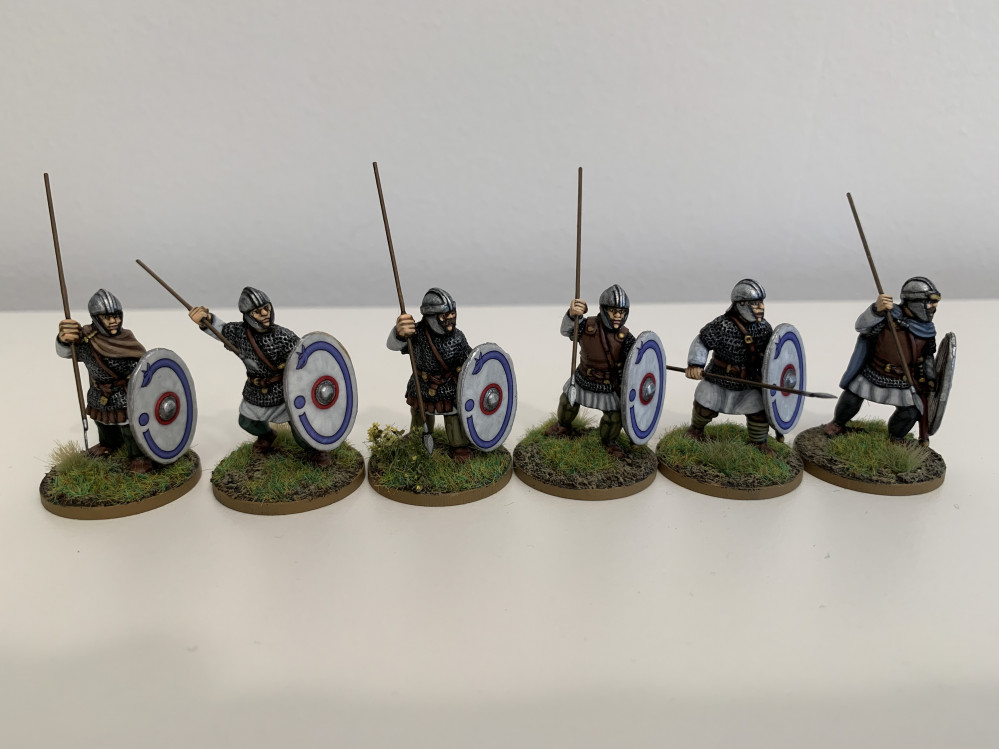
Romano-British for Dux Britanniarum




Recommendations: 1546
About the Project
This was a project started during lockdown to build a Romano-British war band for Dux Britanniarum by Too Fat Lardies. It's stalled of late, so my hope is that by documenting progress on this project I'll be incentivised to finish it.
Related Company: Too Fat Lardies
Related Genre: Historical
This Project is Active
Orchard
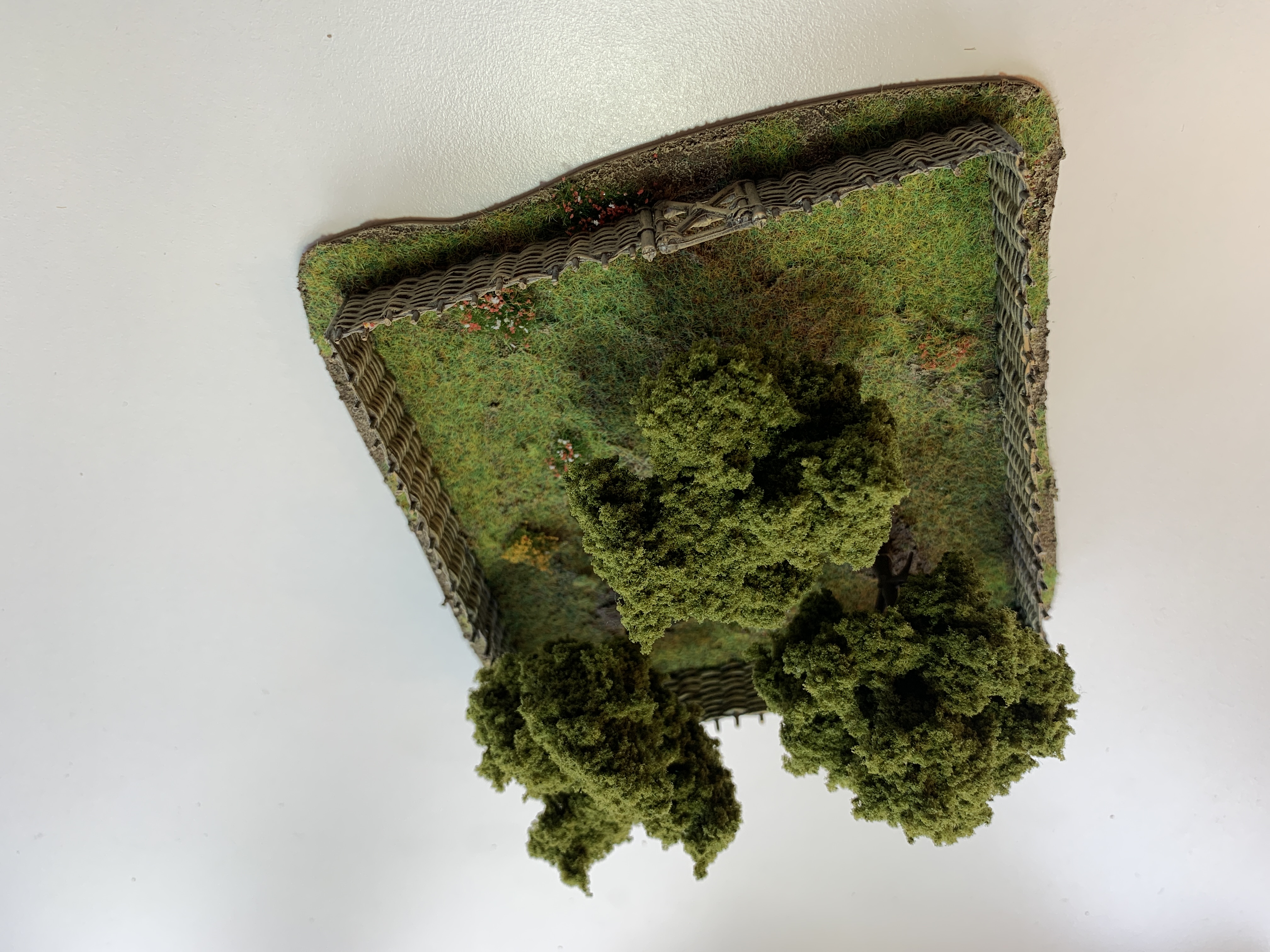
This is a small enclosed orchard. Nothing very fancy here. The wattle fencing was painted in exactly the same way as that used in the pig sty in the preceding entry. The trees are from Woodland Scenics and can be detached to make room for figures within the enclosure. They were originally purchased for a 15mm scale project, but serve equally well as 28mm fruit trees.
Terrain
I’ve been working on some terrain recently. In the terrain generation rules for Dux Britanniarum you frequently need some farm buildings, so building those has been my first objective. I decided to go for a collection consisting of a farmhouse, storage barn, orchard and pig sty.
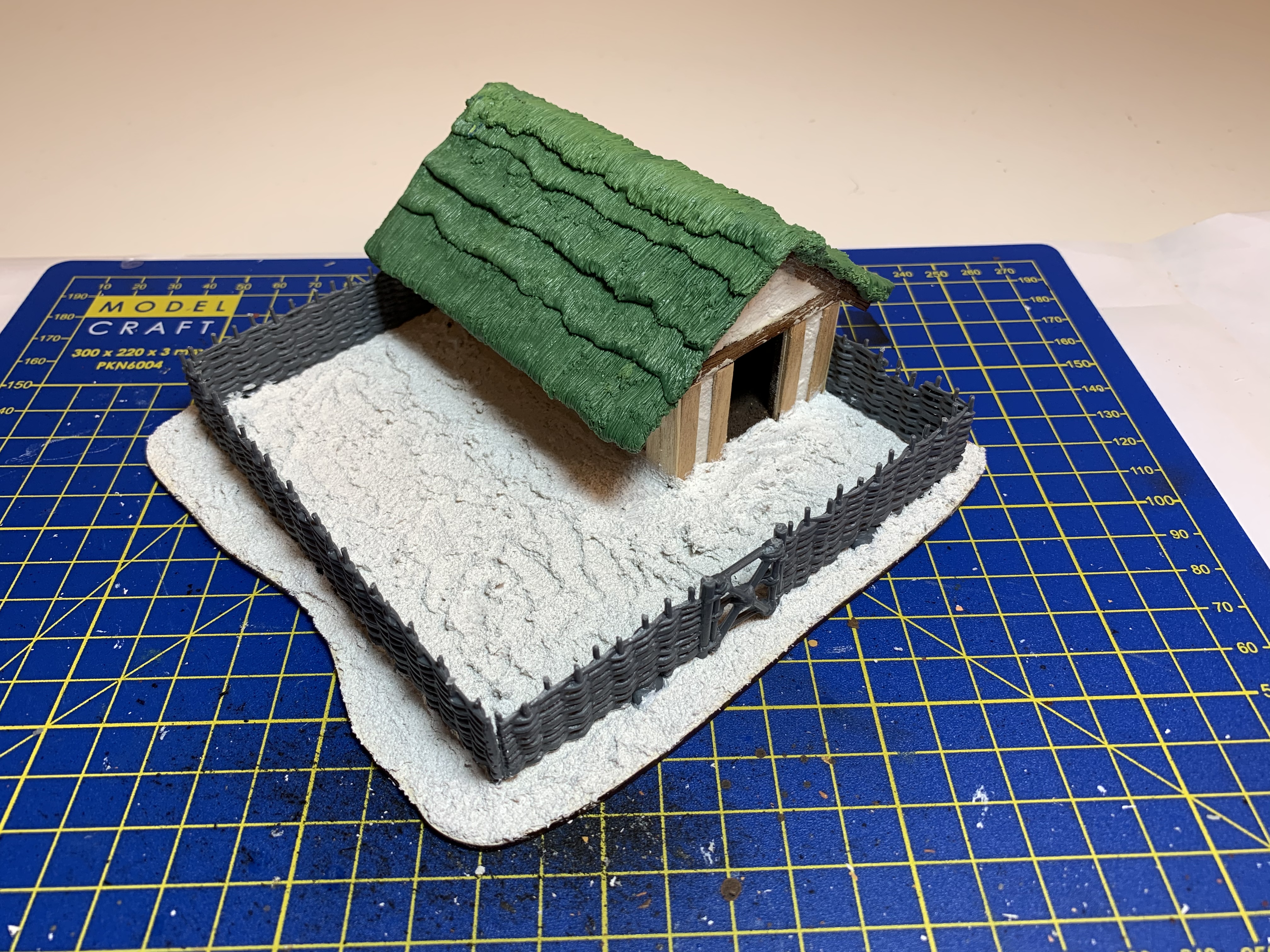
The pig sty was tackled first. I’ve posted this image before and there are more details in that earlier entry, but briefly, this is the Warbases Dark Age barn enhanced with polyfilla covered walls, coffee stirrer wooden planking and thatch made from green stuff.

The daub walls were painted with a base coat of VMC Light Grey, followed by a second coat of 50% Light Grey mixed with 50% Off White. Finally, I did a dry brushed highlight of pure Off White.
The thatch was give a base coat of 80% Beige Brown with 20% Cavalry Brown. It was then given a dry brushed highlight of 70% Tan Yellow mixed with 30% of the base coat mix. This was then washed all over with Army Painter Strong Tone ink.
After the ink had dried, l repeated the drybrushed first highlight. I then drybrushed a second highlight made up of 70% Tan Yellow mixed with 30% of the first highlight. The third highlight was 100% Tan Yellow, but this wasn’t quite light enough, so I gave a fourth highlight of 100% Buff. The overall effect is one of fairly recently laid thatch. If you wanted older thatch that’s been on for some years, then you would need to go for a much greyer look.
The wattle fence was painted Light Grey and then washed with Army Painter Strong Tone Ink. It was then give a first highlight of drybrushed Tan Yellow followed by a second highlight of drybrushed Buff.
The wooden planking was base coated in Neutral Grey and then washed with Army Painter Strong Tone ink before being drybrushed with Tan Yellow.
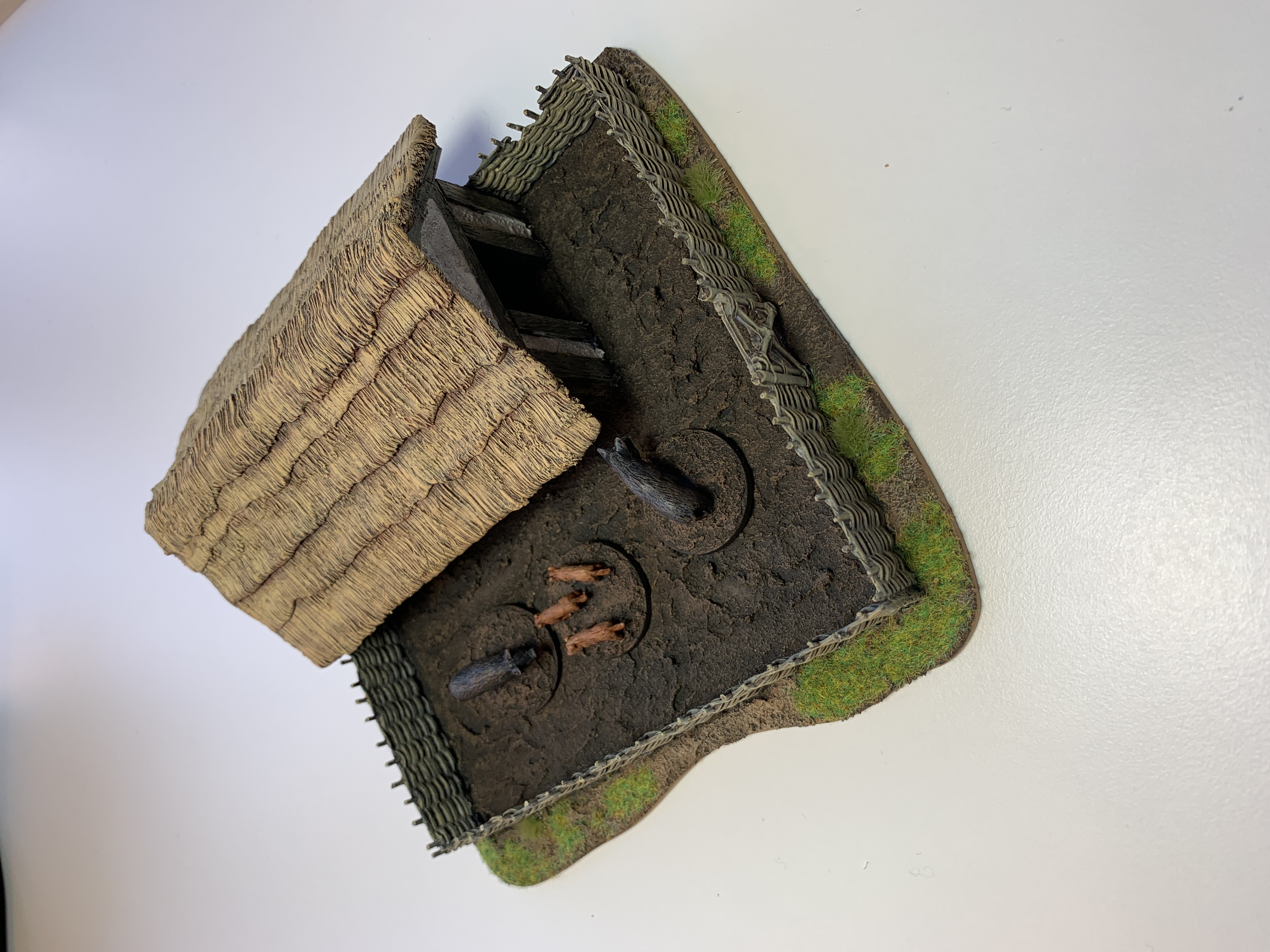
As this is a pig sty, I wanted the ground inside the enclosure to look muddier than my usual base colouring. I painted the base with a mix of 80% Chocolate Brown and 20% Black. I the. Added pure Chocolate Brown in selected areas to add some interest. The whole interior was then washed with a mix of 90% Chocolate Brown and 10% Black. I then added a drybrushed highlight of Beige Brown.
Finally, any pig sty needs pigs. I purchased some Iron Age pigs from Warbases. A bit of internet research revealed that the Iron Age pig has been recreated by breeding a Wild Boar with a Tamworth sow. This produces piglets with their mother’s ginger-orange colouring that goes much darker as the mature.
So the piglets were base coated with Orange Brown before getting a wash of Army Painter Soft Tone ink. They were then drybrushed with Light Brown before getting a final drybrushed highlight of 50%Light Brown and 50% Tan Yellow.
The adults were base coated in German Grey. This was drybrushed in London Grey for a first highlight, followed by a second highlight of Neutral Grey. This made them look a little bit blue, which wasn’t what I wanted, so a final drybrush of Beige Brown toned them down to where they needed to be and also gave a hint of their piglet colouring which you can often see in reference pictures.
The Completed Warband
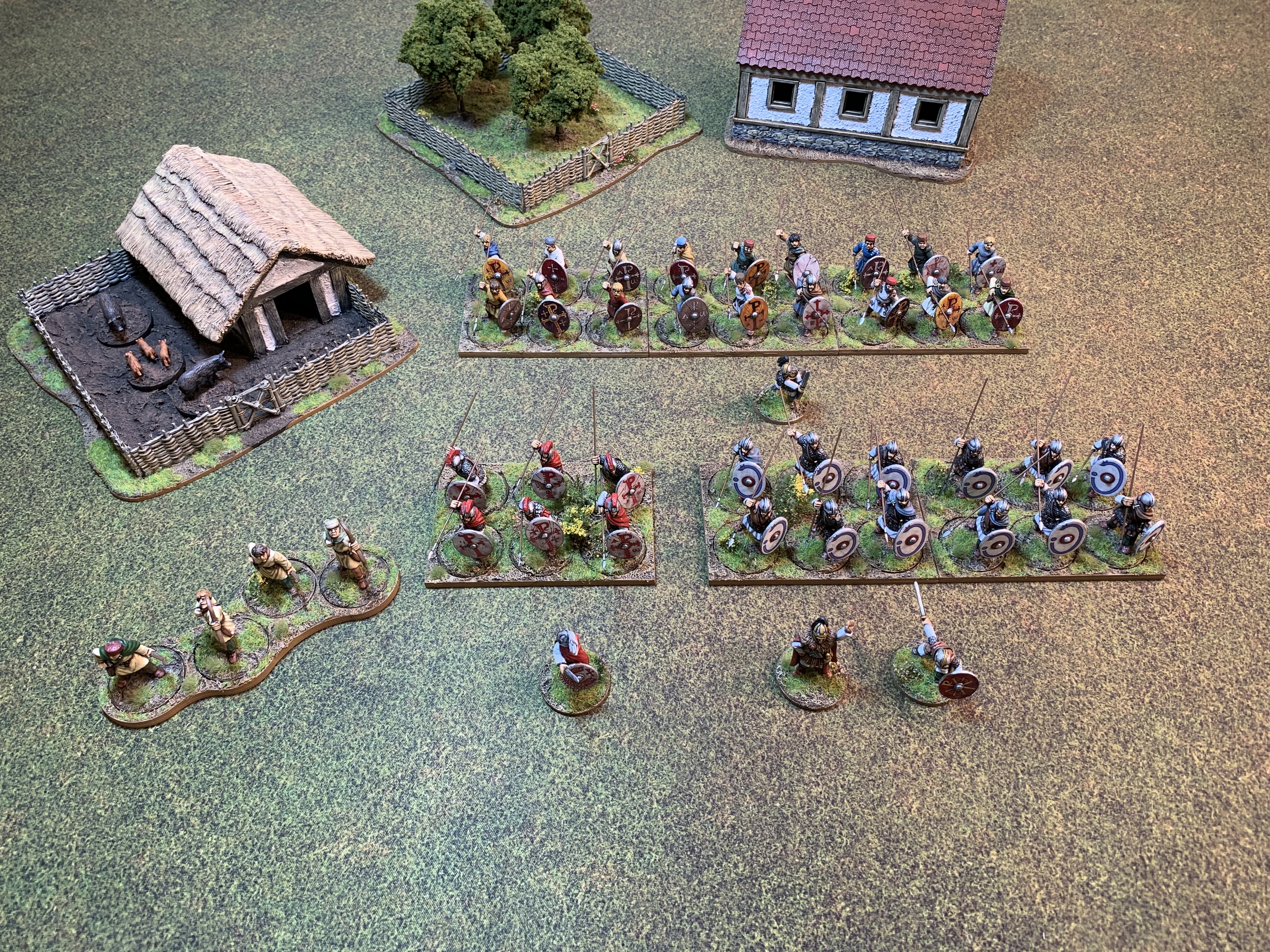
So this is the completed starter force for a Romano-British warband in Dux Britanniarum.
In the second rank you have three groups of Numeri, being led forward by one of the Nobles, Urien Cadwalladr. In the first rank to the right as you look at them are two groups of Milites and to the left are the elite Comanipulares. The Noble, Peredur Constantine stands in front of them. To the far left of the picture is the group of four Archers.
The Lord, Garcianus the Victorious stands at the front with his Champion, Gwallawc.
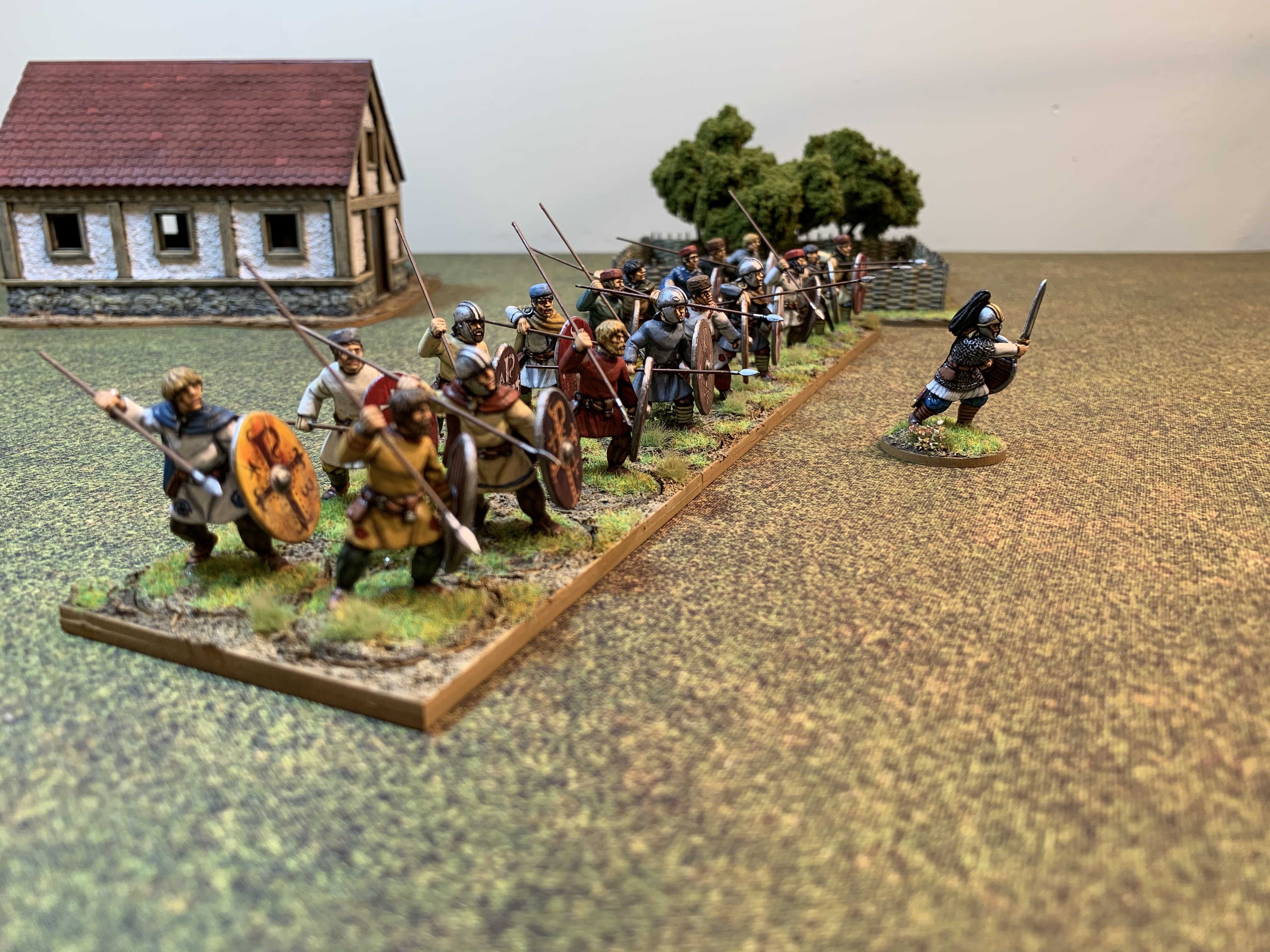 Urien Cadwalladr leads the Numeri forward
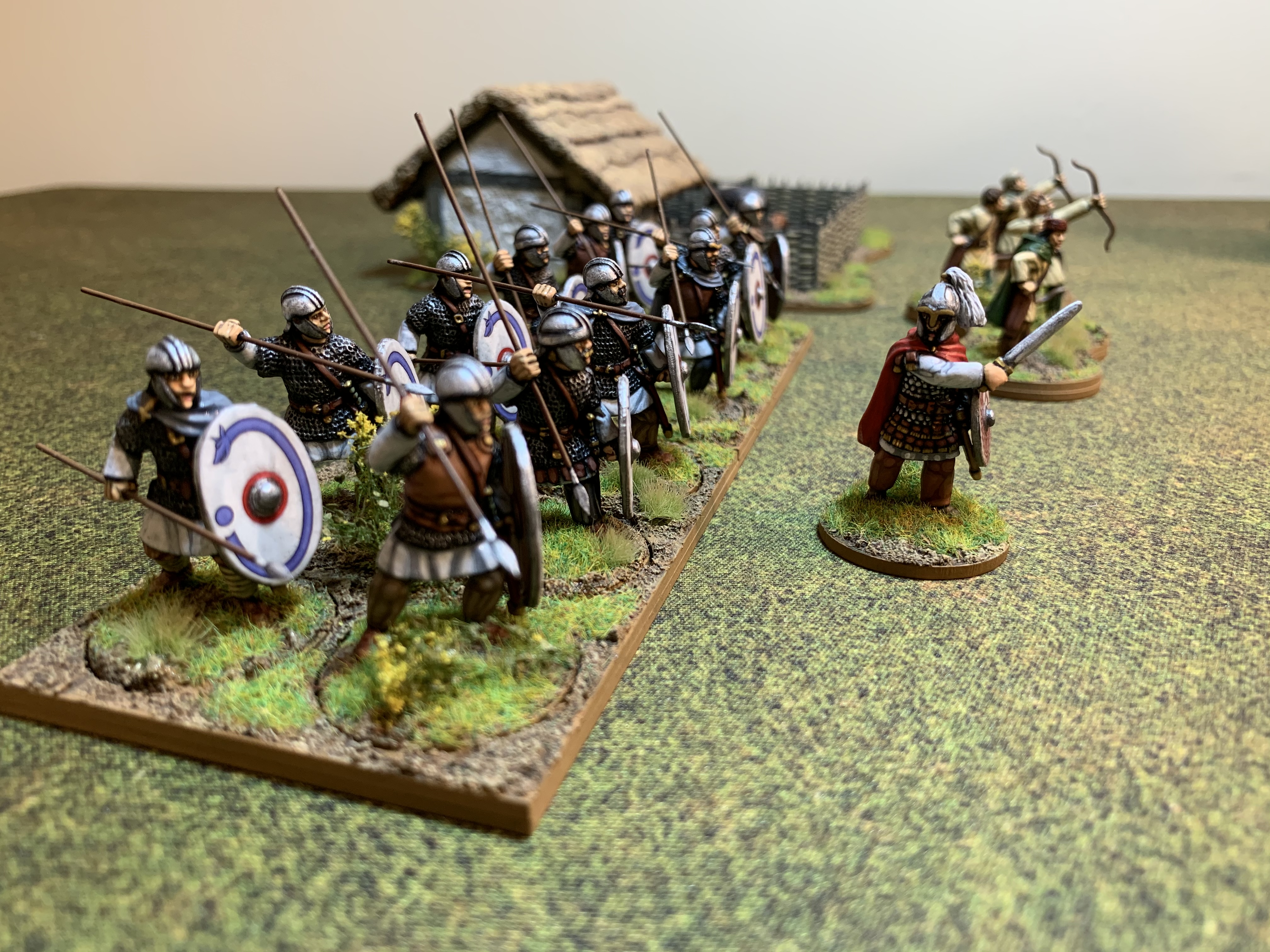 Peredur Constantine advances with the Milites and Archers
 Garcianus with his Champion and Comanipulares
 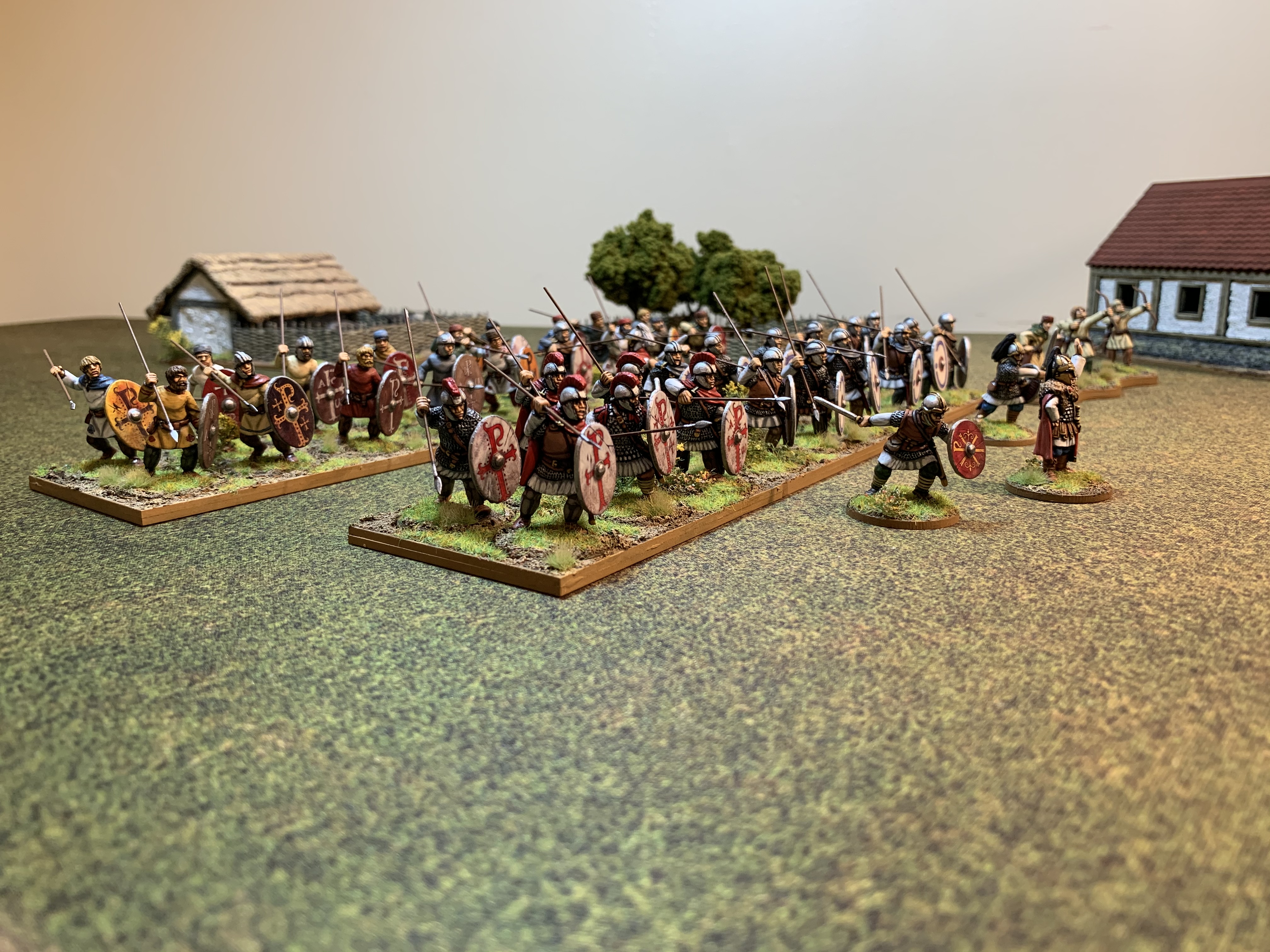 The Warband advances
I now need to consider what I do next. I’ve achieved my initial goal of producing a Romano-British warband. I should say that using the project system to update on progress has been very useful in keeping me on track and not getting distracted. It was also extremely inspiring to be given a golden button back in August which encouraged me to keep going. Thinking back to that particular XLBS show I remember Been and Gerry saying that they wouldn’t mind seeing reinforcements and maybe a battle report or two. Well to do that you need a campaign and that means that Garcianus and his men need some opposition and that means the Saxons…!
The Lord
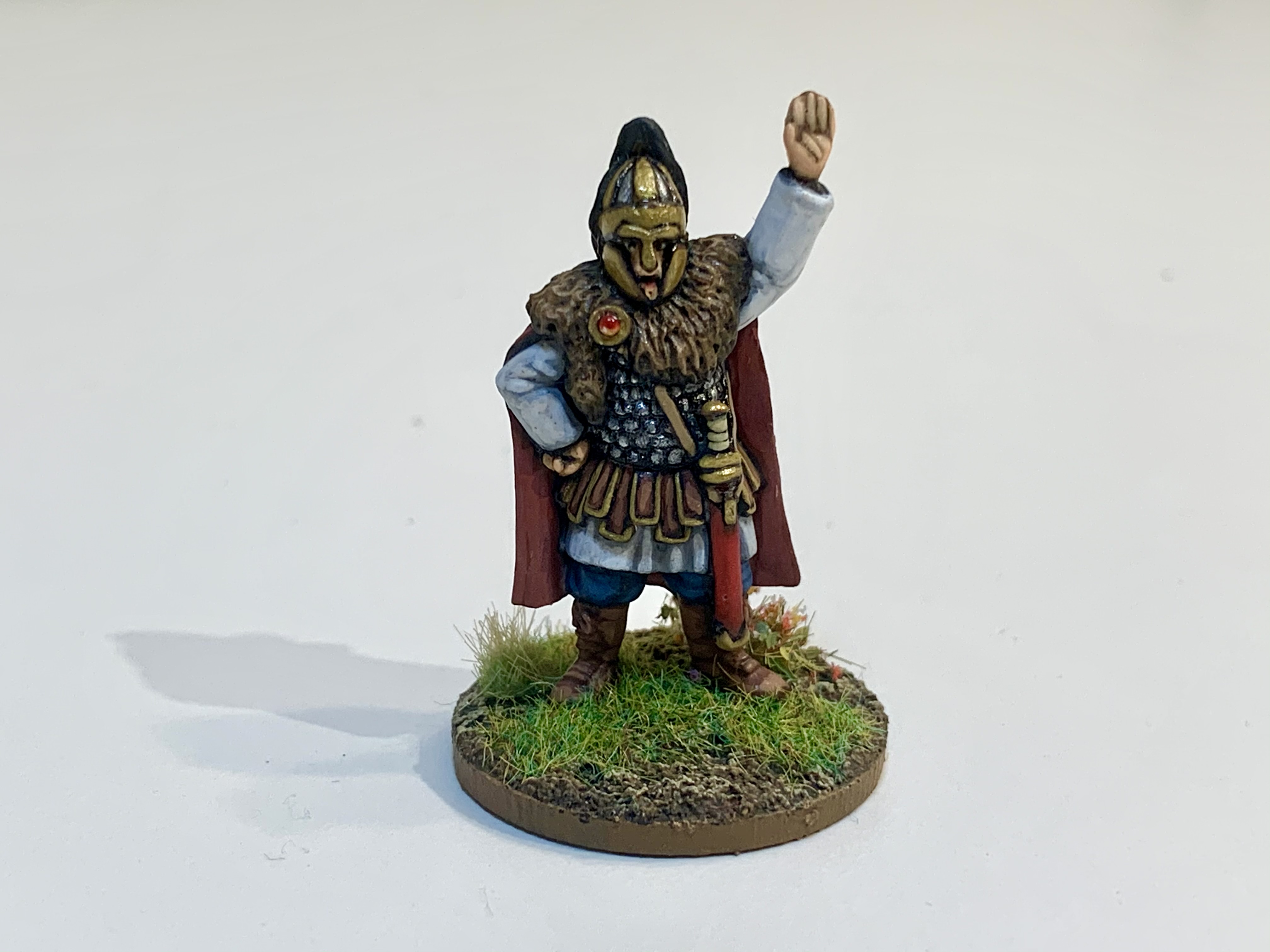
So we come to the final figure in this starter warband for Dux Britanniarum, the Lord, Garcianus.
Although he is only 24, he has already gained a name for himself and a roll on the relevant table shows that he is known as Garcianus the Victorious. This has no immediate effect, other than to make me hope that his performance on the tabletop will live up to his reputation!
He has a physique of average build and the Dutiful characteristic. This means he has the welfare of the people at heart and must follow the King career path in the game rather than pursue the life of a Warlord. The king he serves is 61 years old. This is relevant to the campaign, as the death of a king gives an opportunity for your Lord to take his place if he has gained enough support.
Garcianus is an exile, the son of a high-ranking father in a kingdom no longer in existence. This reduces his starting level of wealth and indeed, he only has a Beggar’s Bowl in funds.
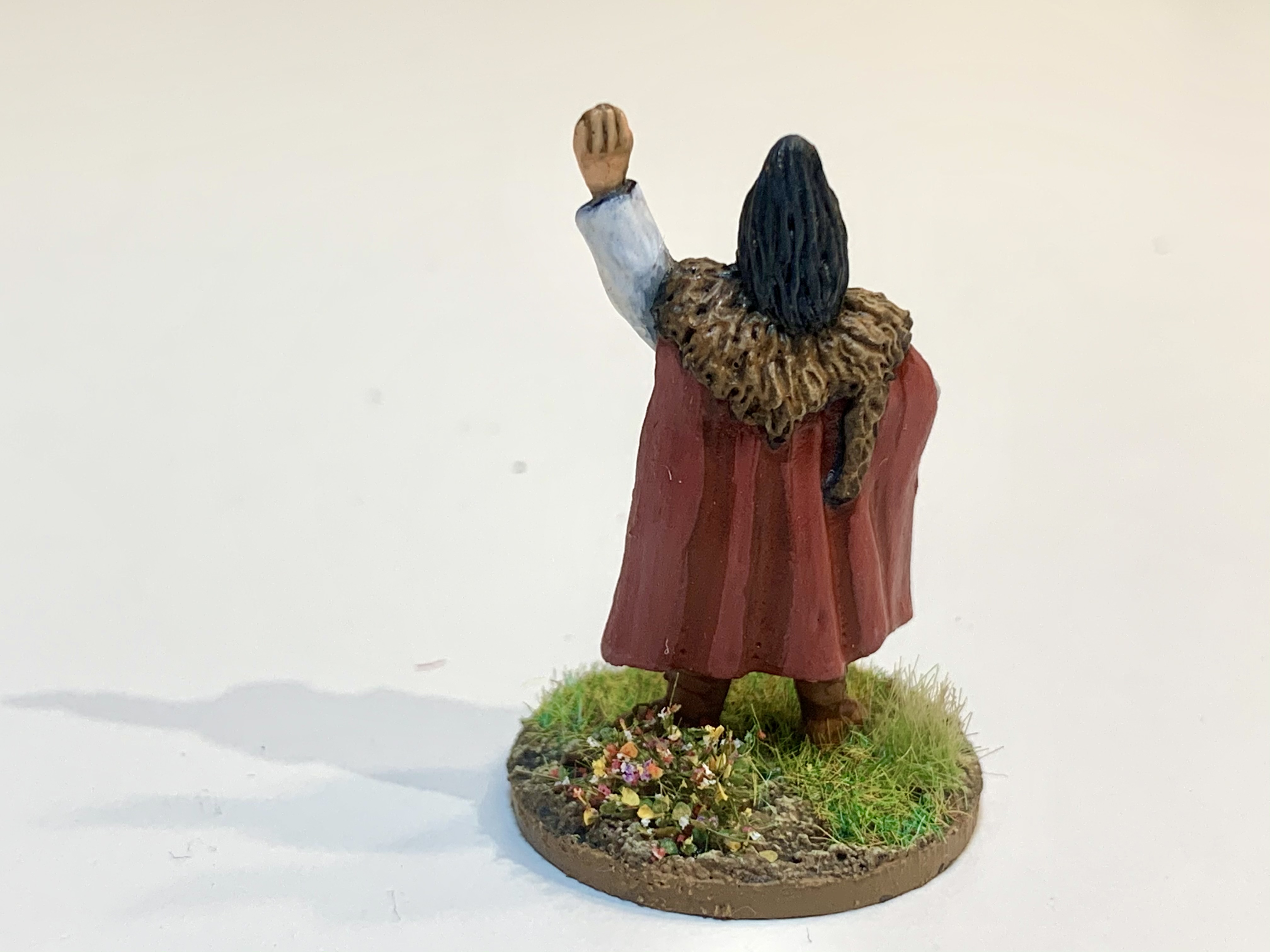
Garcianus is Footsore’s Romano-British Warlord figure and was great fun to paint. The fur collar on his cloak was probably something on which I went a bit too far. I followed a tutorial in the Dark Ages edition of the Painting War series of occasional magazines. The end result was an eleven step process and although I think it looks good, I do wonder if that was excessive. Nevertheless, I shall list out each step so you can have a go yourself should you be so inclined. These aren’t the precise colours used in Painting War, but the ones I had available that most closely matched their instructions. The colours I used were:
German Camo Black Brown (VMC 70.882)
Orange Brown (VMC 70.981)
Light Brown (VMC 79.929)
Dark Flesh (VMC 70.927)
Pale Grey Blue (VMC 70.907)
Army Painter Soft Tone ink
Note that all highlights are applied by drybrushing. The steps were as follows:
Base: German Camo Black Brown
1st highlight: German Camo Black Brown 50% plus Orange Brown 50%
2nd highlight: German Camo Black Brown 25% plus Orange Brown 75%
3rd highlight: German Camo Black Brown 10% plus Orange Brown 90%
1st Wash: Army Painter Soft Tone Ink
2nd Wash: German Camo Black Brown 10% plus Orange Brown 90%
4th highlight: Orange Brown 100%
5th highlight: Light Brown 20% plus Orange Brown 80%
6th highlight: Light Brown 40% plus 40% Orange Brown plus 20% Dark Flesh (note that this mix looks suspiciously similar to Tan Yellow, so that might make a suitable single colour alternative)
7th highlight: Light Brown 20% plus Orange Brown 20% plus Dark Flesh 10% plus Pale Grey Blue 50%
3rd Wash: Light Brown 50% plus Orange Brown 50%
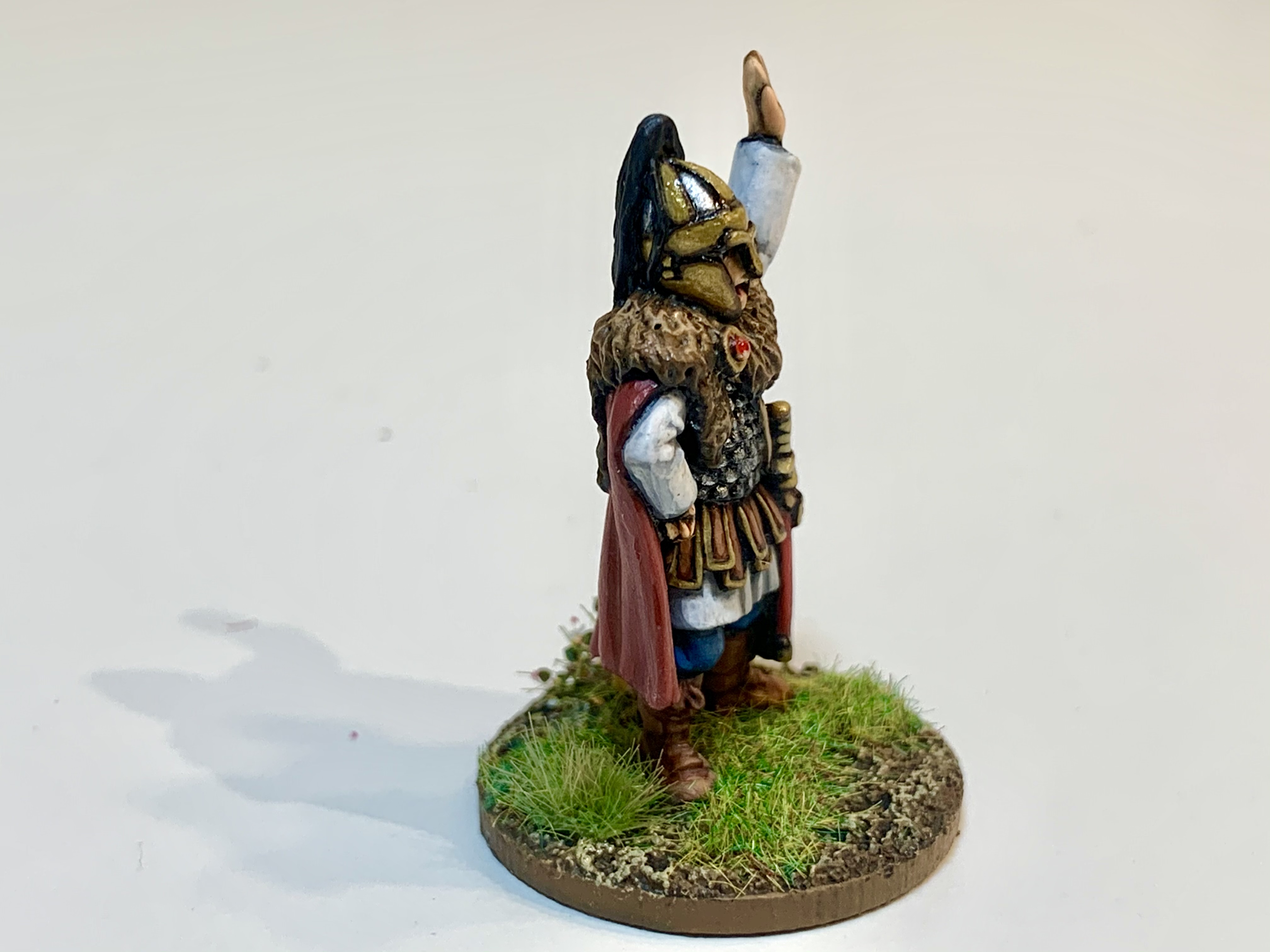
The other prominent feature on Garcianus was the large jewel on his cloak clasp. I’ve always avoided jewels before now, but felt that I couldn’t do that with the model. I watched a YouTube video where a chap in Singapore was painting Eldar spirit stones and adapted the techniques he described. Essentially it was a base coat of VMC Dark Vermilion over Black. I then painted a line of Orange around the lower left quarter rim, followed by an even thinner line of Flat Yellow over the Orange. Finally I did a small stroke of White over the Flat Yellow as the light exit point. This was complemented with a dot of White in the upper left corner to simulate the light entry point. Lastly, a coat of gloss varnish gave the jewel a general sheen.

This completes my Romano-British starter force for Dux Britanniarum. I’ll try and post some pictures of the complete force over the weekend.
The Champion
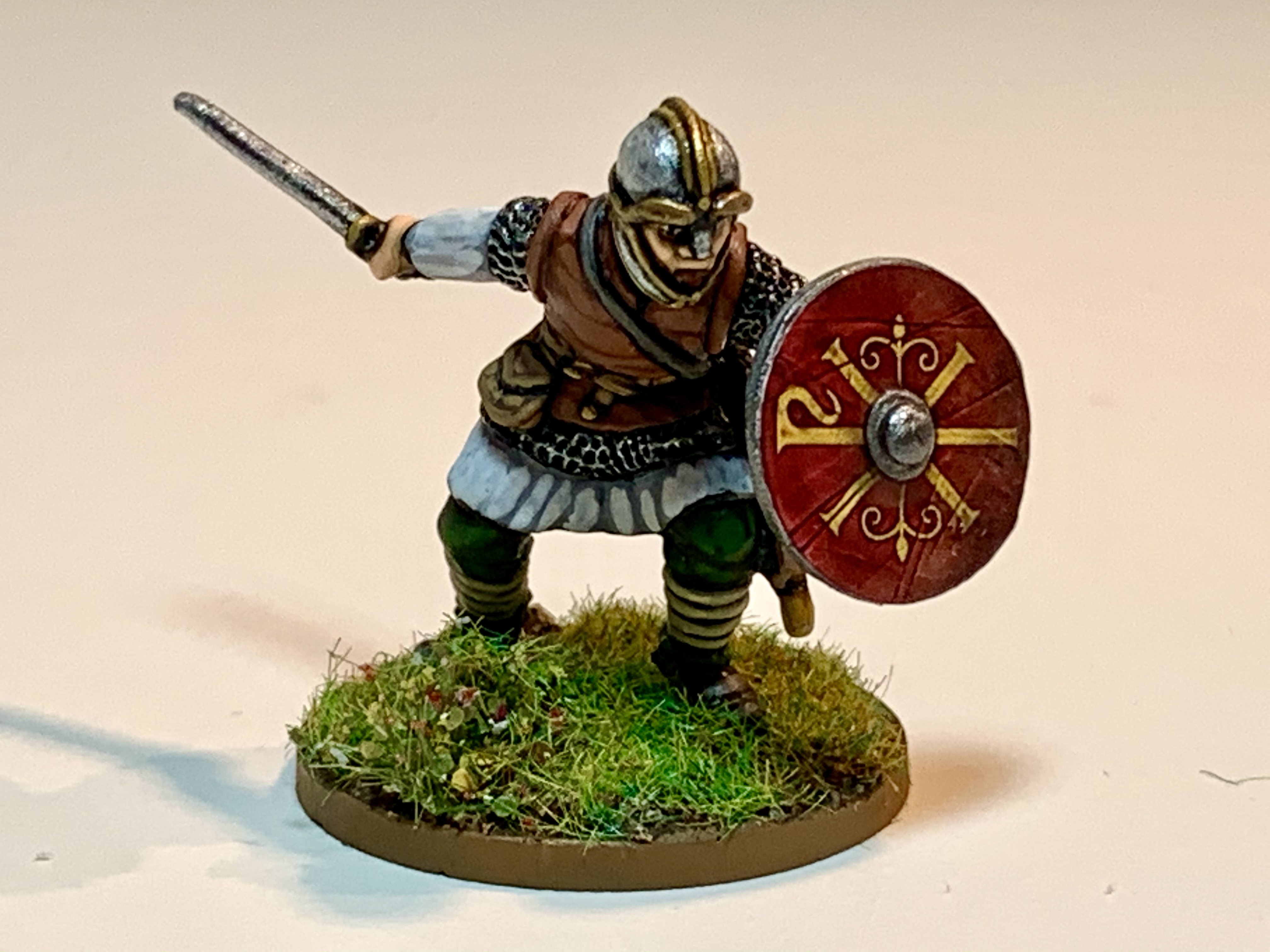
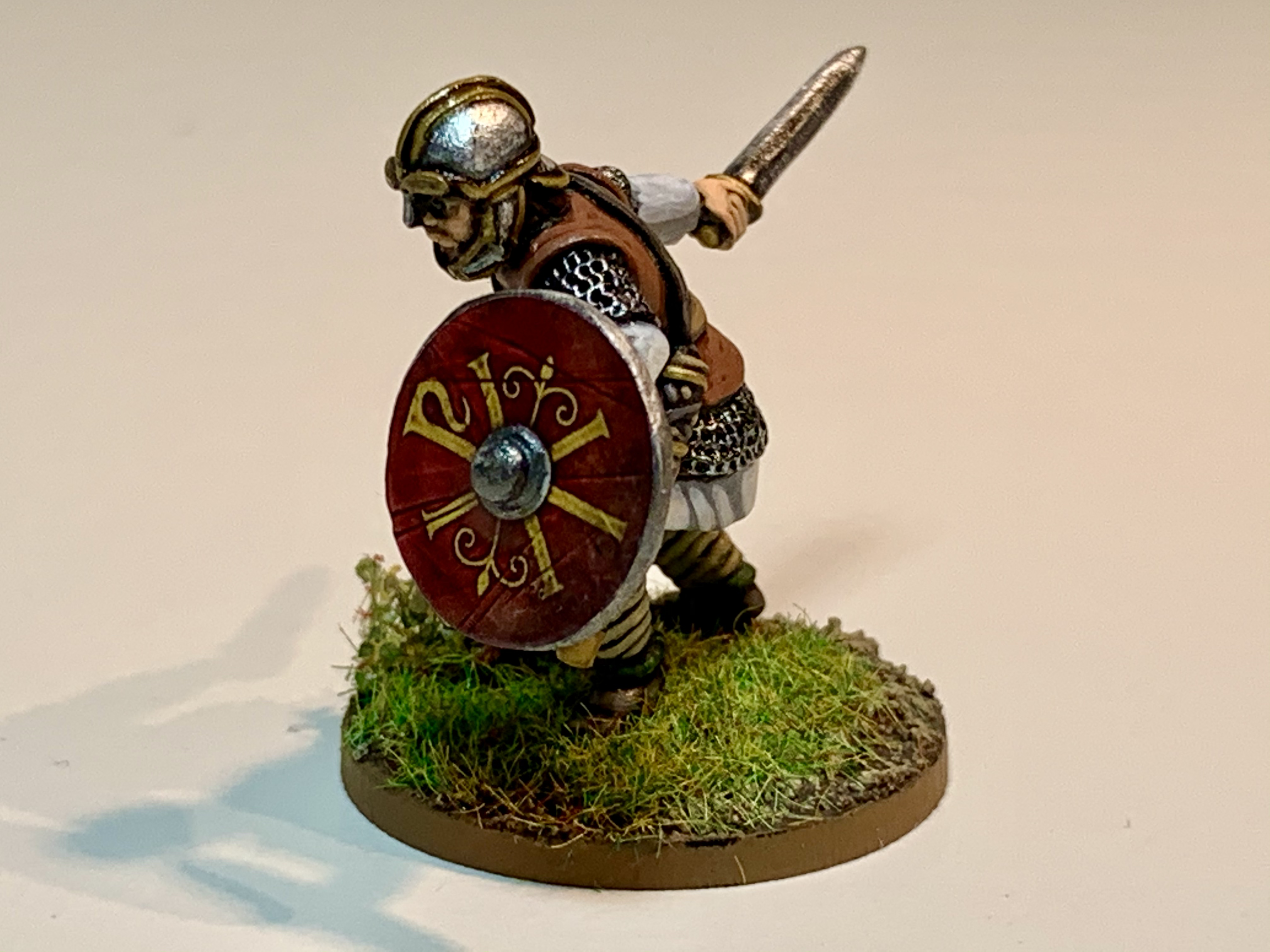
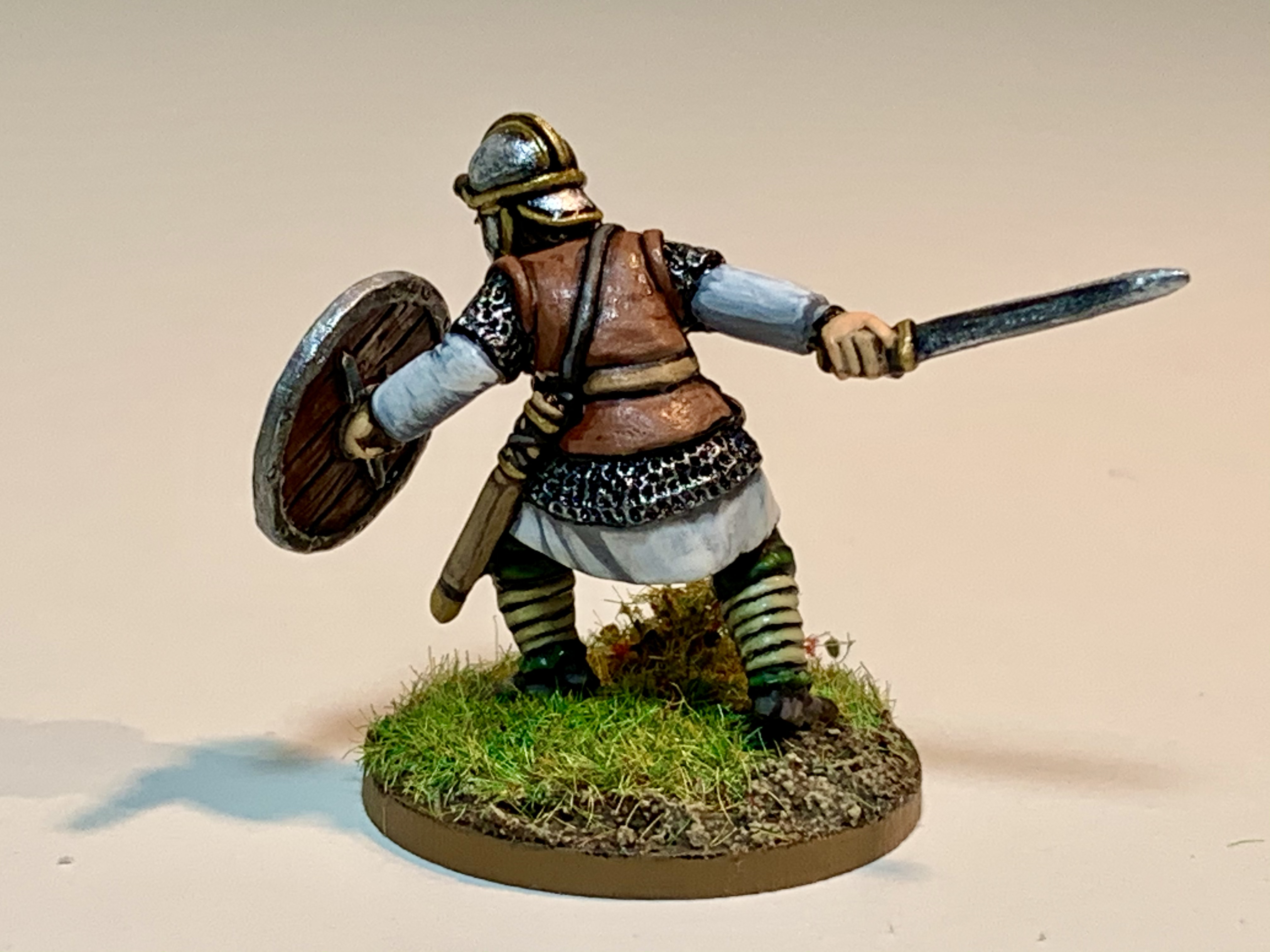

This is Gwallawc Gwerthefyr, my Warlord’s champion. Champions add some period flavour to the game, doing such things as taking part in single combat in the pre-battle phase as a way of boosting Force Morale, and protecting your Lord in combat by taking hits that would otherwise go on him.
Unlike Nobles, champions don’t have characteristics as they aren’t in the running to take over should your Lord fall in battle.
Gwallawc is the Gawain miniature from Footsore, coming in a pack with Galahad. I chose him as the champion as he looked more of a professional fighter with his leather cuirass over his mail. I kept the colours quite muted as a result, with only the white tunic to tie him into the rest of the army. One thing I did find was that I needed to make his belt, purse and baldric stand out from the leather cuirass, whilst still looking like leather of a different colour. I therefore gave them a buff colour as follows:
Base: Beige Brown (VMC 70.872)
1st highlight: Beige Brown 50% plus Iraqi Sand 50% (VMC 70.875)
2nd highlight: 1st highlight 50% plus Iraqi Sand 50%)
As he was looking quite dark at this stage, I deliberately chose a brightly coloured red and yellow shield transfer to offset that. The design is tilted 90 degrees as the position of his hand makes clear that he is twisting his shield and punching it forward towards his opponent.
Second Noble
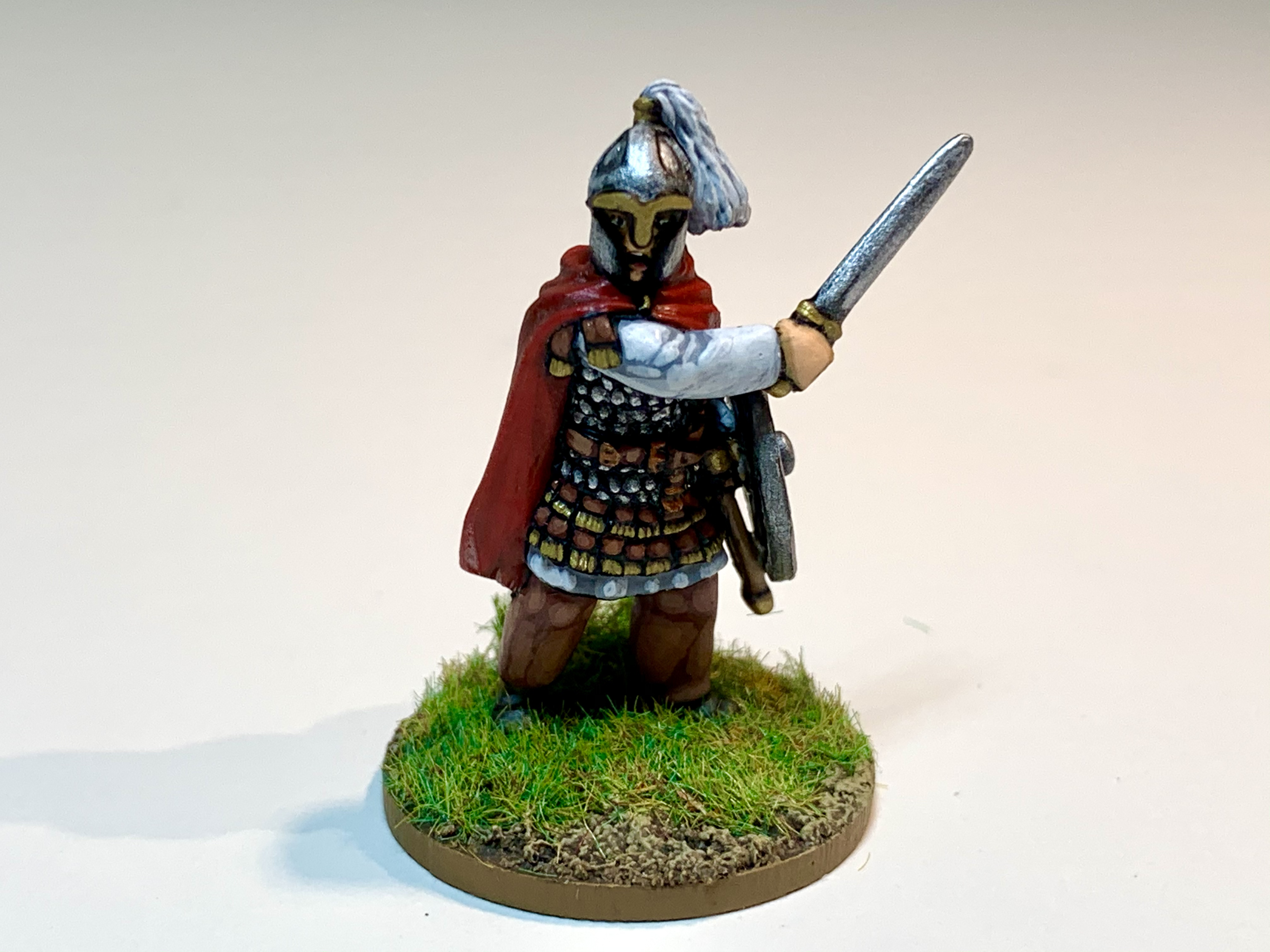
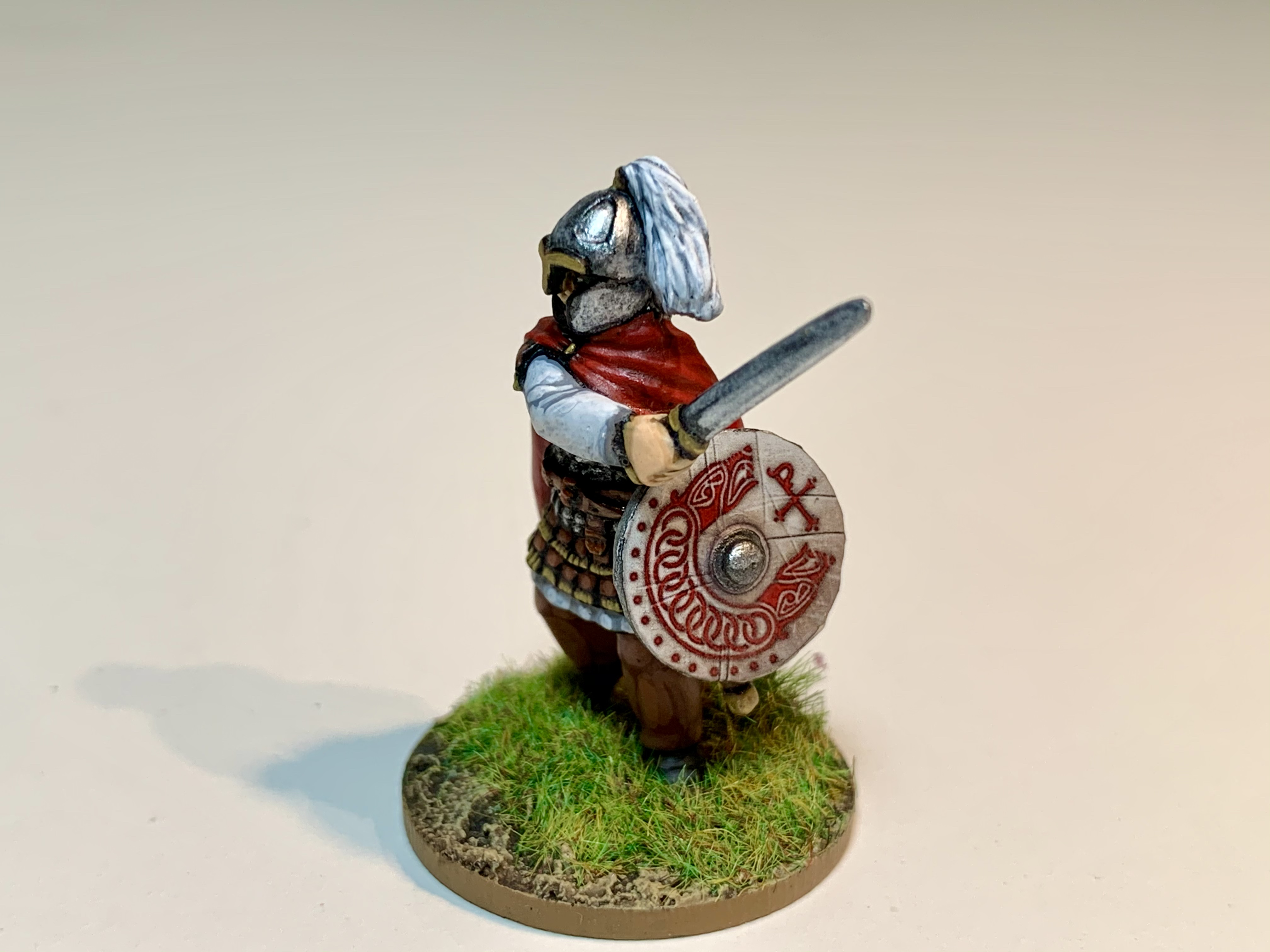
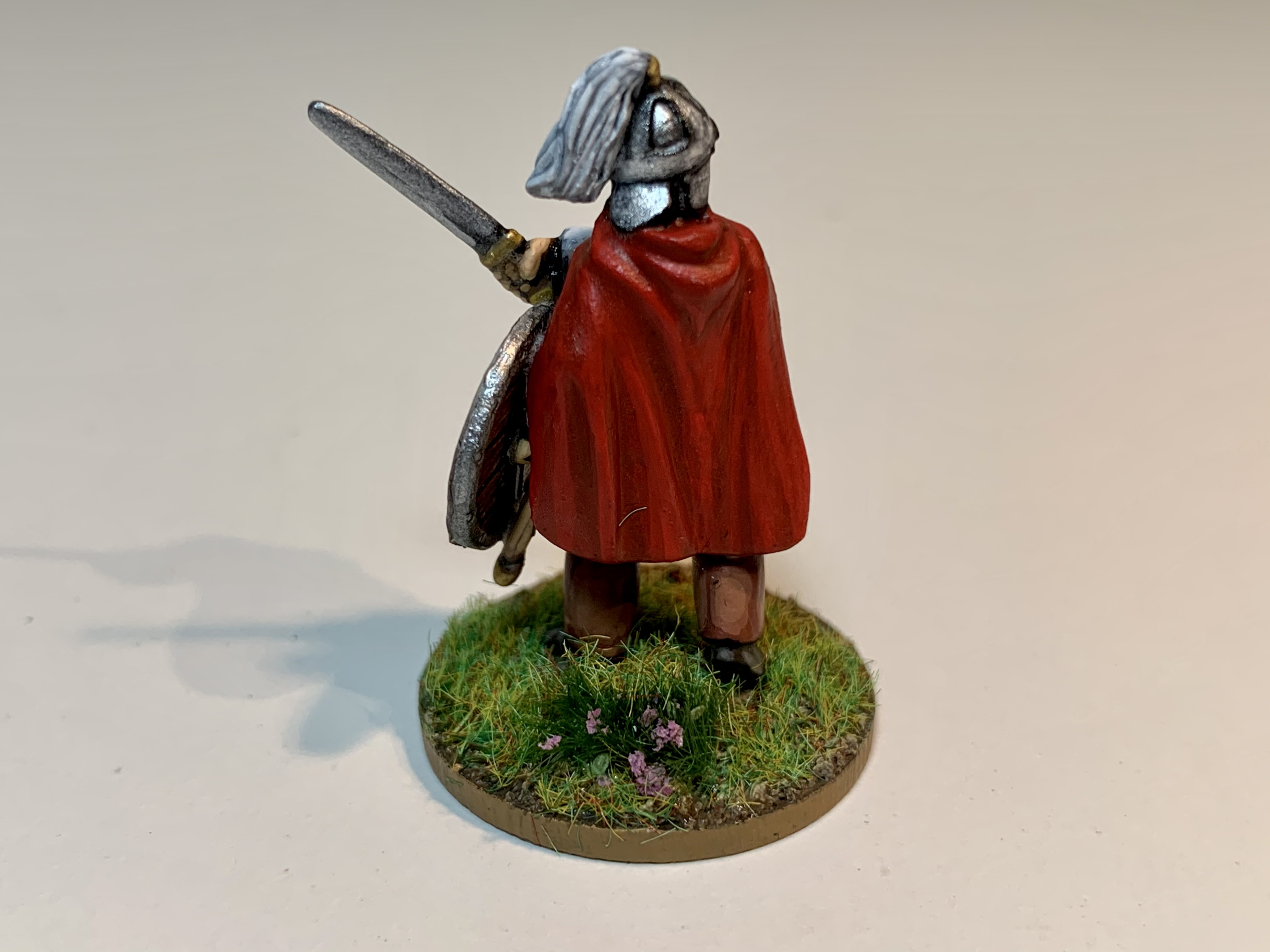
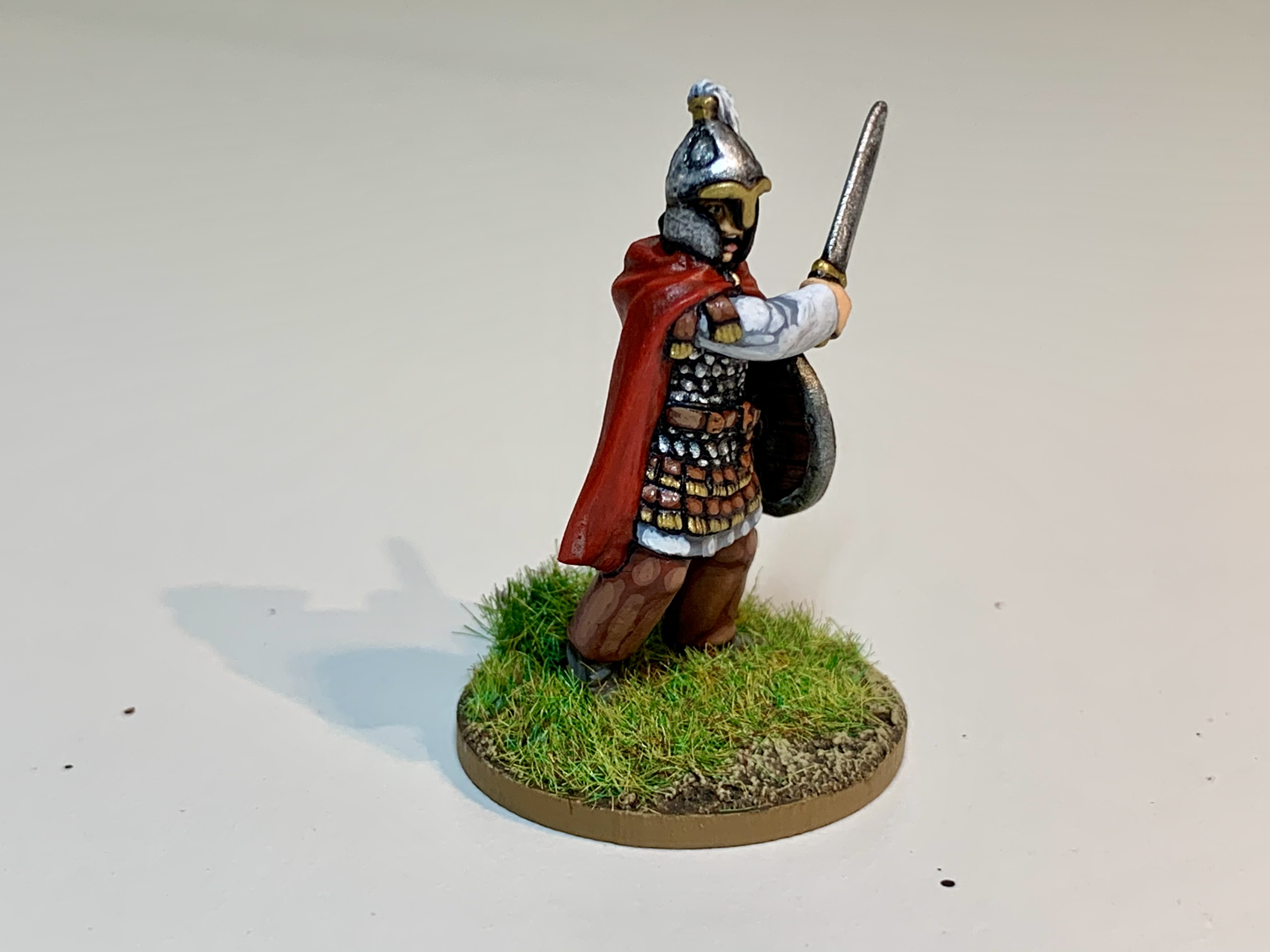
This is the second of my two nobles. A quick roll on the name generator dubs him Peredur Constantine, so clearly someone whose parents wanted to show that they were both Romano and British!
Peredur is 33, of average build, but has the constitution of an ox. This does make a difference in the game, allowing him a once per game re-roll if the prior roll would have resulted in a wound or death. Like his fellow noble, Urien, he is also the son of an honestiore.
He is from Footsore Miniatures Late Roman Infantry Command Pack. The sculpt is a bit messy on the interior of the sword hand, but a bit of filing and a half-decent paint job makes it unnoticeable. I’m not sure who would be pedantic enough to inspect the model on an area you can’t normally see anyway.
There wasn’t anything particularly special about the painting. It’s the same combinations of reds and browns that I’ve reported on earlier in this project. I did try to tie him into the red and white colour scheme for the Comanipulares. I imagined him as having a particular role as their commander. I used a Little Big Men Studios shield transfer that would complement that colour scheme as well.
My first Noble

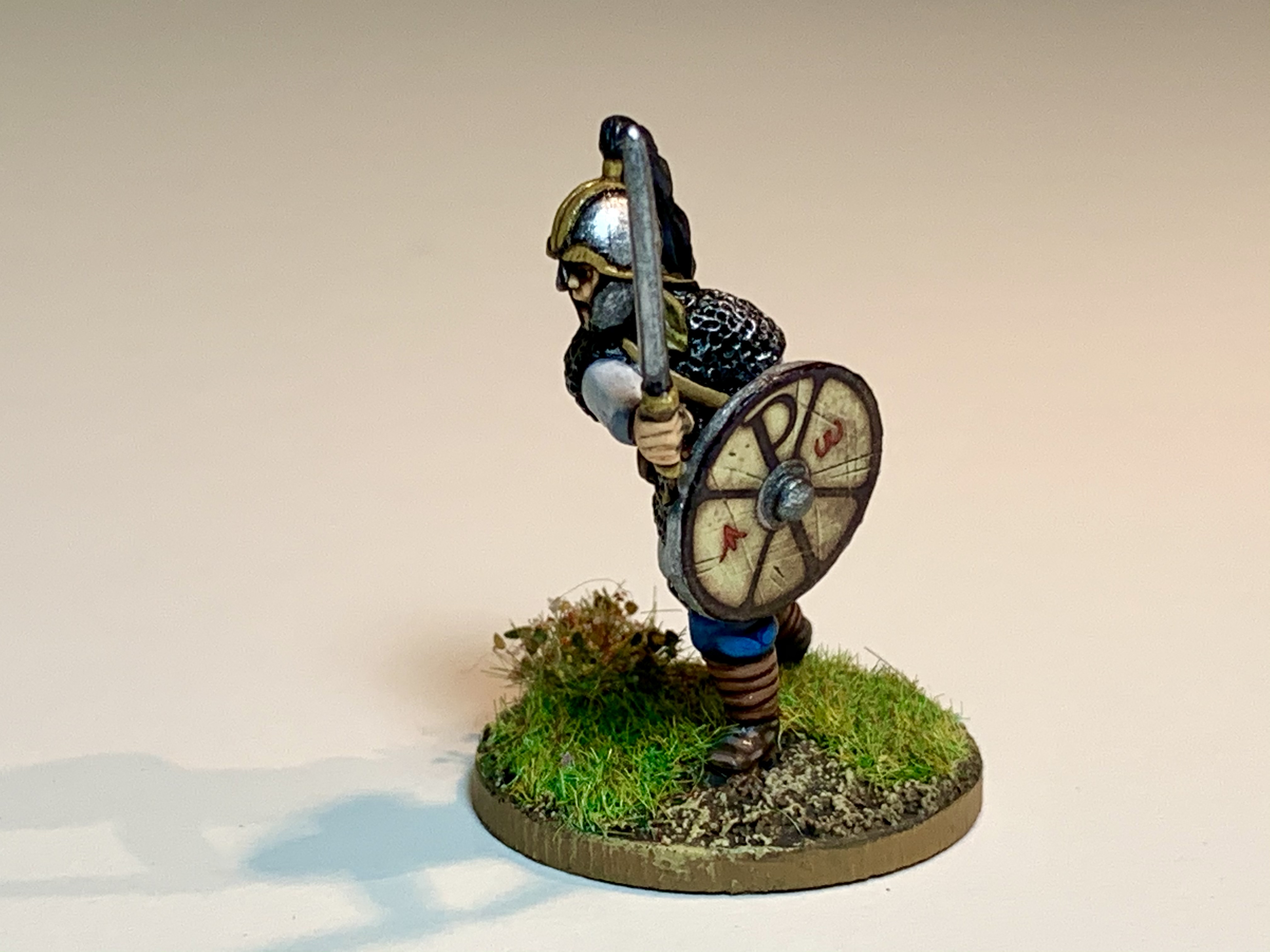
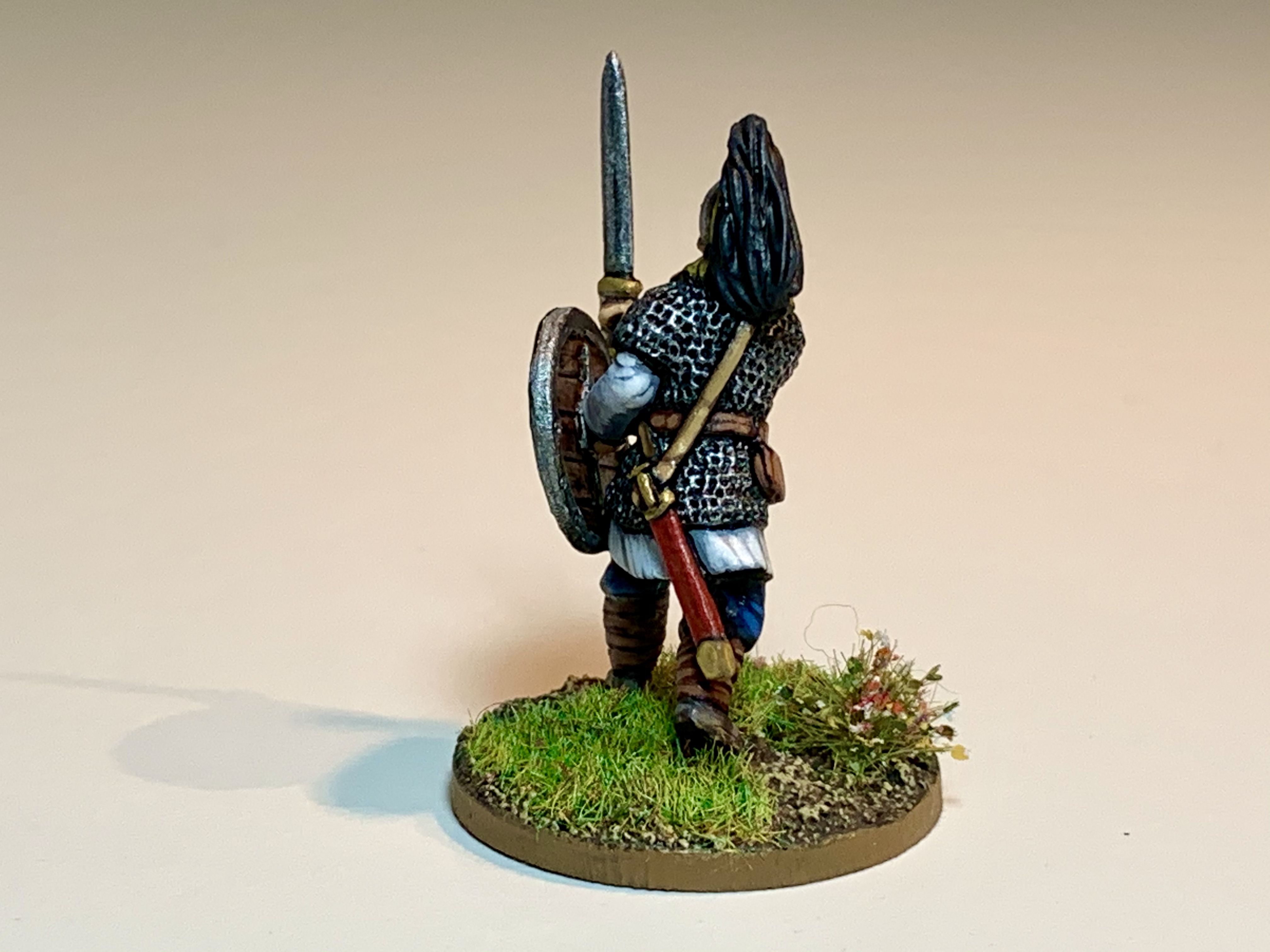

This is the first of my two Nobles, who are the subsidiary leaders of my Warband. In Dux Britanniarum you have to roll for various background characteristics for you Warlord and Nobles, most of which make little difference on the tabletop, but which can influence the course of the campaign.
So, after rolling on the tables in the rule book and the Romano-British name generator on the Too Fat Lardies blog, we can meet Urien Cadwalladr, who is 24 years of age, with a tall and strong physique. He has the Thrifty characteristic, which means that were he to be the leader of my Warband, he would always have to keep a certain amount of cash in hand and not go splashing it about. This doesn’t seem to be the best recipe for success in the gift-giving warrior culture of late antiquity, so perhaps it’s fortunate that he isn’t my Warlord. However, that could change if my Warlord were to meet an untimely end on the battlefield and Urien were to rise to take his place…
Urien is also the son of an Honestiore, a local leader of some influence, which might have been more useful had he been the Warlord, as he would have brought some extra cash to the party!
The miniature is the Lancelot figure from Footsore, which comes in a pack with Merlin. One point to be aware of is that the right hand and sword are cast on a separate piece of metal protruding from the edge of the base near the right foot. This needs to be carefully removed and cleaned up before being attached to the socket in the right wrist.
I also found that the join between the hilt of the sword and the hand was very weak and it seemed inevitable that it would snap off at some point. This was addressed by inserting a small piece of green stuff around the join as shown in the picture below.
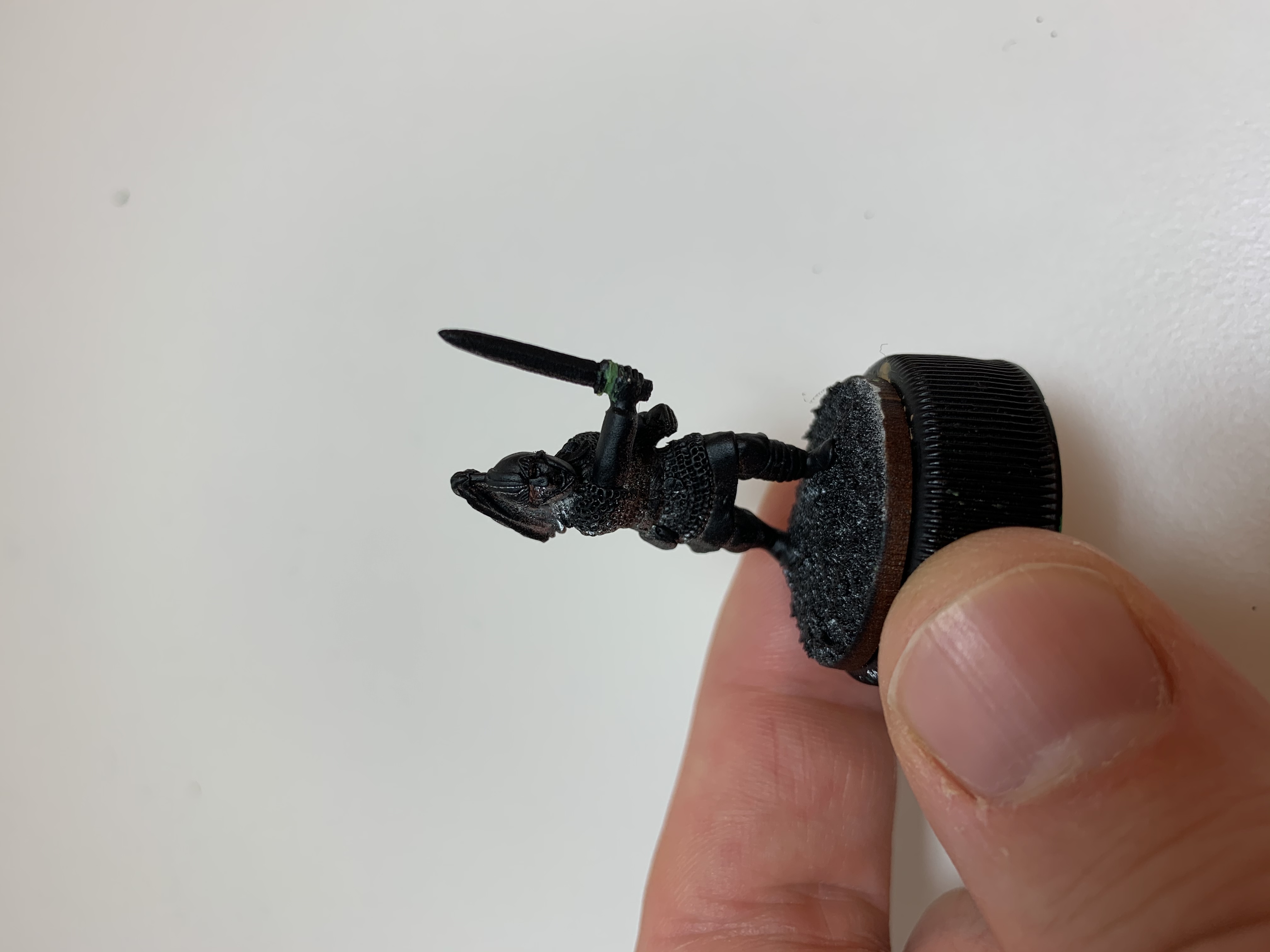 Don’t worry, I re-primed him afterwards!
In terms of painting, I wanted to tie all my characters into the general scheme of my Milites and Comanipulares, but allow them some individuality as well.
This meant that Urien received a white tunic and mail painted in exactly the same way as I described for the Milites in the earlier posts on this Project. The same applies for the Goldwork, Leather and scabbard. However, I gave him slightly fancier trousers, which seem to make quite a difference. These are a base coat of 80% Prussian Blue (VMC 90.965) and 20% Black (VMC 90.950), which was then highlighted with pure Prussian Blue, followed by a second highlight of 80% Prussian Blue and 20% White (VMC 70.951). Although the trousers are a very small part of the model, it seems this splash of colour is enough to provide interest to a model that would otherwise be a potentially rather boring mix of metal and brown, so much so, that a friend of mine viewing him over Zoom automatically referred to him as “the blue one”.
I selected another shield transfer from Little Big Man Studios, going for a design that was distinctive, but still in keeping with the Chi-Rho theme that appears on the shields of the Numeri and Comanipulares. Flowers on the base are from MiniNatur.
Comanipulares - complete
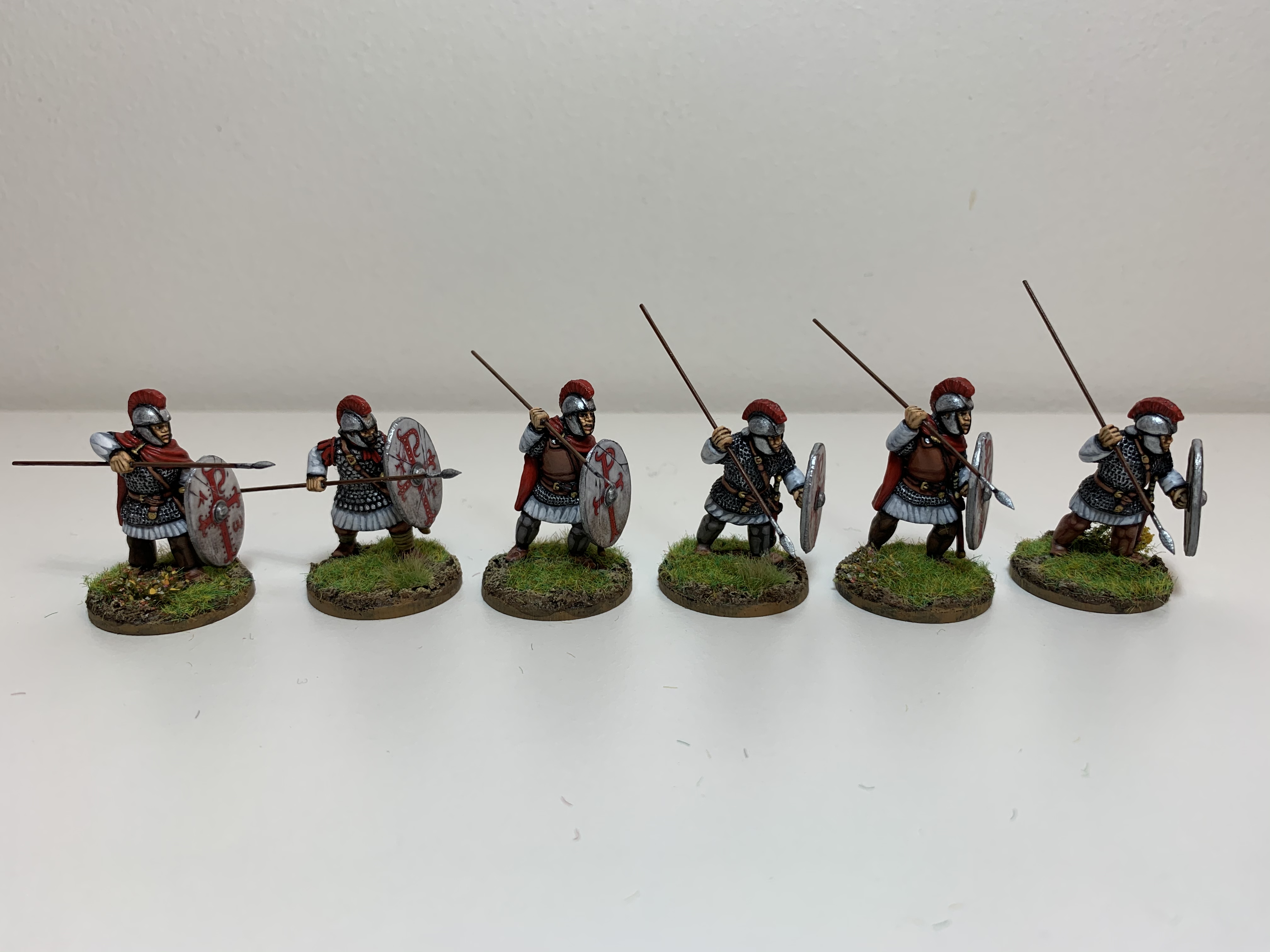 The elite companions of the Warlord
 I completed the Comanipulares this week, the single Group of elite grade troops allowed to a Romano-British warband at the start of a Dux Britanniarum campaign (in contrast Saxons get two Groups of elite Hearthguard but fewer troops overall).
I originally thought of doing an all red colour scheme for this Group, but on reflection decided that would be out of keeping with the look of the rest of my professional warriors. I therefore kept the white tunic colour scheme I used for my Milites and just used red on the plumes and cloaks. This also then pushed me down the route of choosing a red and white set of shield transfers from Little Big Men Studios. These come with a fetching Chi symbol and added battle damage!
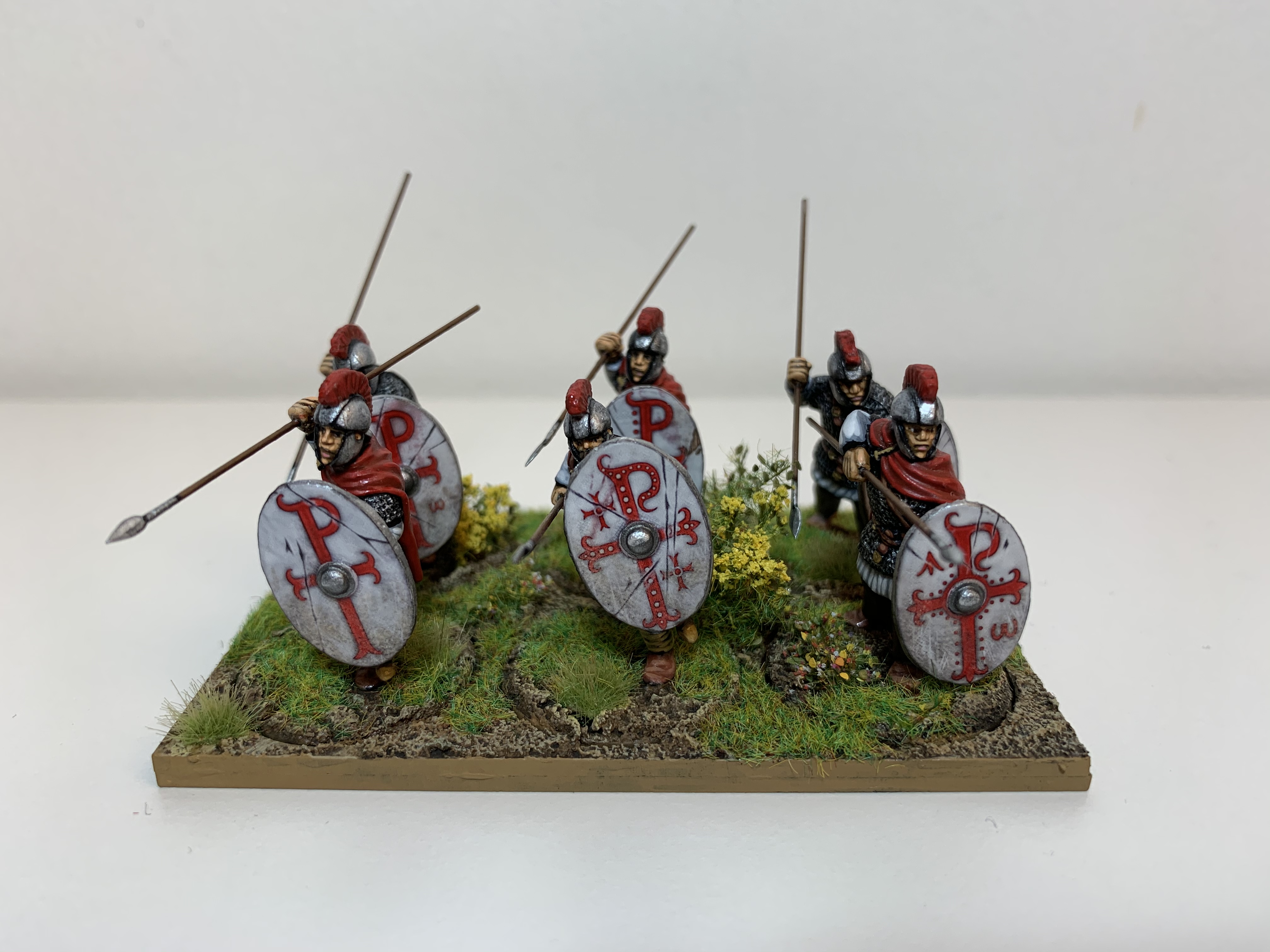 The completed Group on their sabot base
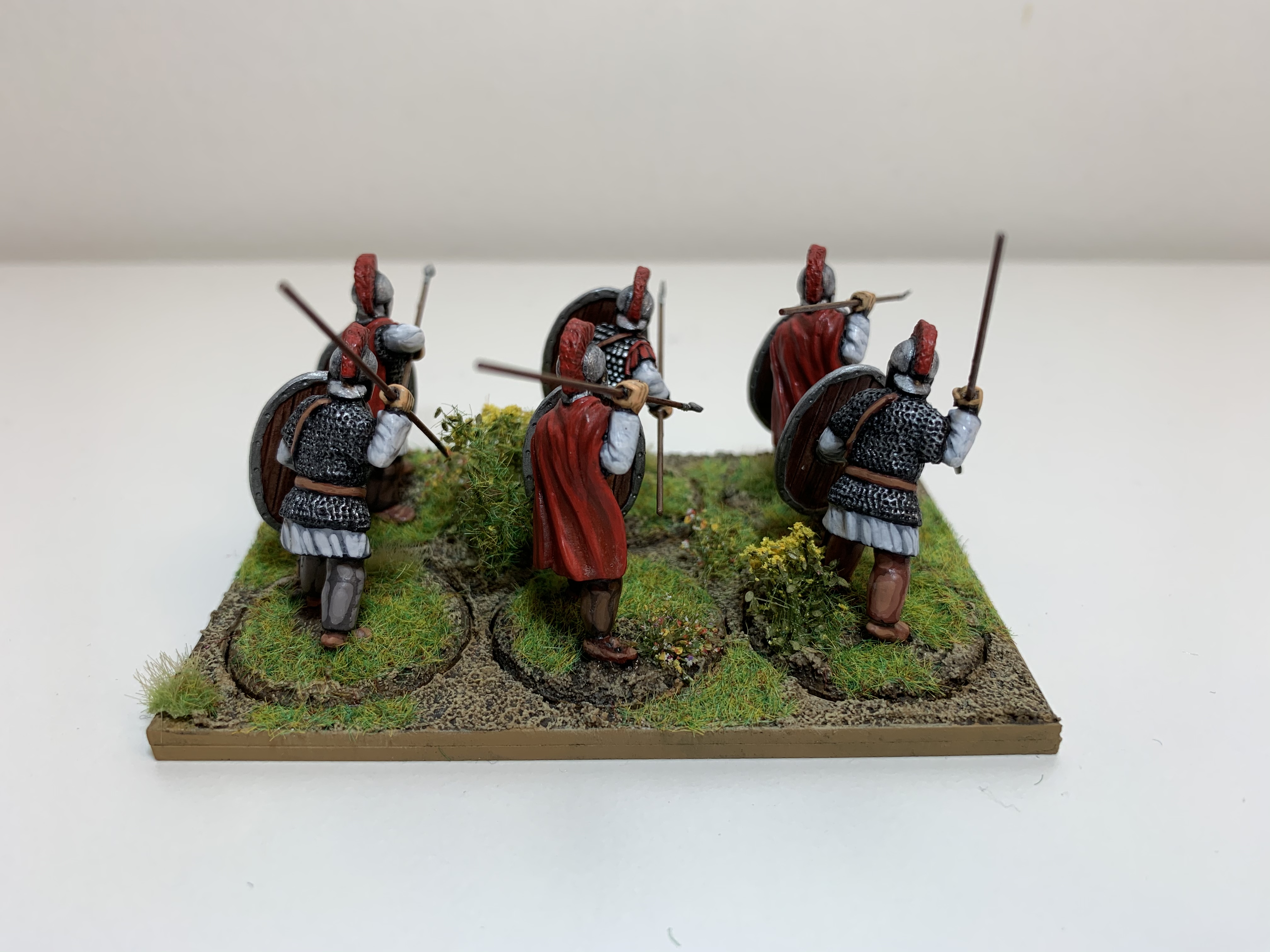 Lloyd shot
 Keeping the white tunics ties the unit in nicely with the Milites, whilst the red makes them distinctive. I also like the idea that when you are inducted into this elite unit from the ranks the Warlord gifts you with a plumed helmet, red cloak and new shield, but the rest of your equipment you have to find on your own.
The colour combinations were very much the same as for the Milites, with the exception of the red. This was as follows:
Base coat – Cavalry Brown (VMC 70.982)
First highlight – Cavalry Brown 50% + Dark Vermilion 50% (VMC 70.947)
Second highlight – Dark Vermilion
The flowers and tufts were from the MiniNatur range available from Warbases.
I particularly enjoyed painting these. They are from Footsore Miniatures Late Roman / Romano-British range. They don’t require much in the way of cleaning, but I would recommend paying attention to a particularly prominent mould line running up the left arm and head. A little patience is needed to make sure this has completely gone.
This completes the Groups of warriors. Just the four characters to go before the warband is ready.