





























![A Perfect Zombie Apocalypse Starter Set? Civilians & Survivors Review | Wargames Atlantic [7 Days Early Access]](https://images.beastsofwar.com/2026/01/unboxing-wargames-atlantic-civilians-_-survivors-1_2-coverimage-225-127.jpg)
![Wild Australia Wargaming? 28mm Ned Kelly Gang & Victorian Police Review [7 Days Early Access]](https://images.beastsofwar.com/2026/01/unboxing-traders-galaxy-australiana-ned-kelly-gang-_-victorian-police-coverimage-225-127.jpg)




Balanced, Deep, Easy to Play – You Can Only Pick Two!
February 1, 2012 by warzan

Balanced, Deep, Easy to Play - Pick Two!
In engineering there is a concept called the Project Triangle where between the three project attributes, Good, Cheap, Fast - you can only ever pick two.
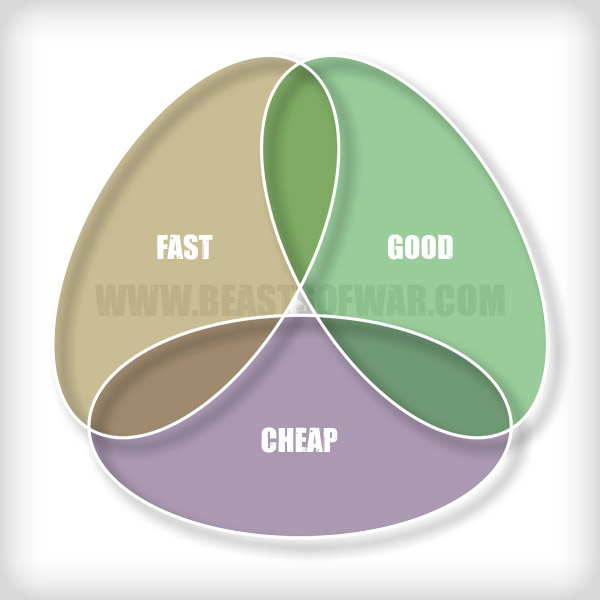
It seems to me that the same thing basically exists in game design the attributes are...
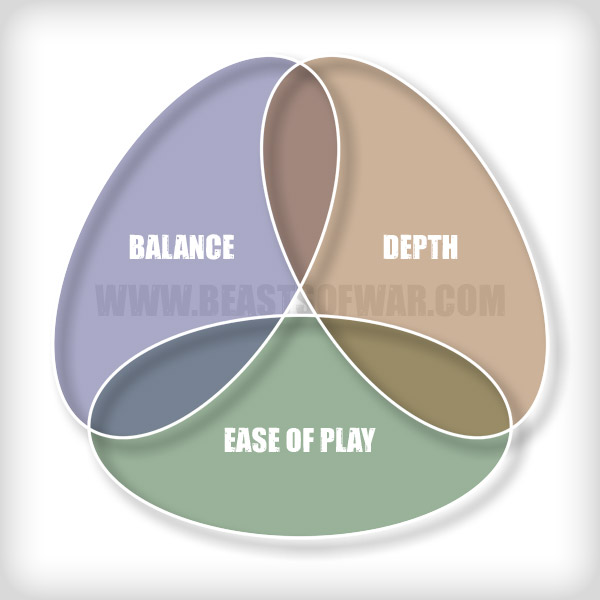
- Balance (How accurate are the rules do they cover the possible events)
- Depth (How customised can the game be and how many options are available, generally more options and customisation lead to more potential for narrative driven games)
- Ease of Play (Are the rules easy to pick up and play, are there more tables, charts or sub events or FAQ's that have to be considered)
... and I think its a case of pick two. The sweet spot in these cases is almost impossible to find because everyone has their own opinion on what is fun!
40K has for a long time veered towards Balance/Depth where it has so much depth that a lot of rules and FAQ's are required to allow it to function.
Warmachine has perhaps a little less depth which has allowed it to drift towards the Balance/Ease of Play side of the triangle.
Infinity has certainly moved for the Depth/Balance spot and although the basic rules are easy to play there is no doubt that there are a lot of rules/elements.
You could probably plot somewhere in the triangle any game you can think of, but the crux is you're not likely to find any that will exist dead centre.
Layers give Substance, Substance breeds complexity
All the wargames we know and love, have more often than not evolved from much simpler rules sets, some went on to become very complex and were then scaled back. However, all games will add layers of substance over time, like that new faction that must have a different play style, or the introduction of magic or aircraft. Some games will allow you to customise individual units and even models... as the more personal your experience is... the more likely you will stay hooked.
All of these layers will ultimately have an effect on the rules, which sooner or later will have to reflect the customisation or new addition to the game.
The difficulty is when you add rules, they have a knock-on effect on other rules.
Take a very crude example:
- You have 16 armies...
- Each army has on average 20 units...
- Each unit has on average 10 special options (weapons, magic, special rules etc.)...
- Now your core rules has (at least) 150 entries and you now have a whopping 480,000 possibilities!
Of course that is a very crude example, as some rules never interact... until they do!
On top of that there is no current software platform (that we know of) for tracking and mining rule sets for issues... yup... its all done in the minds of a handful of developers and play testers.
So, say you have access to a pool of 30 people to test your game. That leaves you with 16000 possibilities per person (and most will always overlap to find the same big obvious flaws to begin with).
Contrast that to when the book launches and is looked over by 1,000,000 eager gamers and you end up with each gamer representing 0.48 of a possibility (again this is just a thought exercise, so the numbers are rough approximations just for illustration).
It certainly makes a case for crowd sourcing, does it not?
Until that is you drop personality and interpretation into the mix...
The world is made of tribes and our wargaming community is no different, we congregate in places like this and forums and blogs, and digest the thoughts of others, many just take those thoughts at face value and it then becomes their belief, we become tribes.
This means that we cant actually consider the 1,000,000 to actually be a million independent gamers, because there are huge tribes in there, that may or may not have their own 'shared' opinions.
If it was just a case of spotting errors it might still work, but opinion always comes into play and opinions are very subjective... for every person that thinks A you will find one that thinks B and one that thinks Z.
So, you must then consider the final opinion... the only opinion that really matters perhaps? That of the game developer.
I feel that their opinion is the only one that matters, because we must rely on them to execute their vision. Some of us will like it others will not, but we hope at least, that the system will be coherent and not a hodge podge of conflicting ideas.
So the next time you think 'What are they doing this rule sucks its sooo stupid and so easy to fix', spare a thought for the 479,999 other little possibilities.
Many folk on the interwebs seem to think game flaws are easy to fix (most just focus in on a couple - but everyone's couple is different) any thoughts on how we actually get closer to the centre of the 'Balanced, Deep, Easy' Triangle?
Warren







Silly Warren…lovely post but you have forgotten the rule no 1- whatever I say it should be, is correct. Failure to comply with my logic is a terminal issue 😉
I’ll pick Balance and Depth. Sod simplicity if I want that I will play 9 men’s morri…. i mean C.O.C.K.
😀
we deal with this paradigm daily in the IT world.
The problem with your analogy is that GW is not a gaming company like TSR used to be. They are a model company that uses a game platform to sell more models. This is what they tell their share holders on a frequent basis. Game balance, and especially tournament balance is not a concern to the executive team that. Its simply, have we moved X amounts of units over Y amount of time and covered the cost of said units in order to make the share holders happy.
Good article though. I like it when you guys think outside the box.
Well while your view has obvious merit,
I do see a problem with your perspective concerning the analogy. TSR is at best today a name tag on a utility closet door where three guys armed with a lap top dwell inside. The closet however is located on the wizards of the coast wing or hall way. Deep Deep inside The Hasbro super slam structure…
It is correct to use all games as an example, in the listed article, they are all selling something which I don’t have issue with as long as what it is has value and is what I need to game.
Magic the gathering- is an example of a game which at the end of the matter is at the zero center of triangle’s
World of Warcraft- Has two parts of any given given triangle in perfect contrast of each other which makes the third part irrelevant
40k- if reading the above article correctly has tried to engulf the triangle as a whole
All of which are valid based on placement within the formula itself whether you sell models or not is needless logistics and does not really play into the article as a whole based upon my interpretation
A vision in the hands of a genius who has a lot of love to give, can go a long way, even if people originally dislike the initial direction. If he’s good enough, he can convince people to come over to his side.
*as a side not, I swear 40K was dumbed down and pushed into an “ease of play” area, with the last few editions. I swear it was more complex when I played it in my school days.
Yes I think it moved horizontally across the graph, kept and added to its depth, made it easier to play, but as a result left more room for ‘debate’ and cheese hunters.
Not a bad thing in of itself. Having read the article again i think the title could have been… You Can’t Please Everyone!
Or: ‘You can please some of the internets some of the time…’ 😉
The other side of the argument or debate would be how everything in the pc game world mmorpg plays like and looks like World of Warcraft.
They say that even D&D 4.0 plays like table top WOW with loss of originality or the ability to create something unique, due to the same process as brought out by article.
Which killed the online push or at least brought it down a bit along with the advent of console gaming.
Do we actually see the same ripple effect concerning 40k ???
This is a fantastic article I enjoyed it very much 🙂
What about Everquest?
I’m in the camp of Depth and Ease of Play myself. I love to have a story driven game, be it skirmish or on a grander scale and Depth means you can get the most from a game. If you have some form of progression, or indeed individuality within your armies then it can raise the bar in terms of just how long a game stays in your mind.
This is something that I think Warhammer has done so well in this latest edition. In terms of Depth it has a mass of options between armies and within the game rules itself you can do a hell of a lot with simply how the game plays from scenario to scenario. Just look at the varied terrain rules etc. On the flip side and looking at Ease of Play, Warhammer has got some of the best written rules in the business right now, and its incredibly easy to learn after one game.
Of course this goes for other companies and game systems too. Warpath/Kings of War is another game which does Ease of Play well – a simple system with massive armies? Bonus.
In terms of just play testing I think that there is merits to the public go at the Beta or Alpha. It means that you can see just how well your game is going down, AND means they can catch some of the massive errors or things that can be exploited. BUT it all ultimately comes down to the developers decision as you say. I have had the same thing in the past with a board game idea, and working on things within Warhammer. My initial flavour and feeling for the rules when shown to others changes because of their own opinions – but it took away from what exactly I was aiming for in the beginning.
Balance is important of course – but in the grand scheme of things I would prefer something fun to something balanced in its entirety. D&D is the ‘Balanced’ game, which is good – but World of Darkness it the other end of the spectrum, totally unbalanced in the favour of the foe, but so so much fun.
BoW Ben.
Malifaux has it all for me, it’s cheap, fast, fun and all the terrain and mission rules they give you give an almost endless supply of depth. The schemes and strategies are a great mechanic to Malifaux so they provide depth, it is character driven with an awseome story and it is really cheap and fun to play. Some people think neverborn are overpowered but they really aren’t since the Nekima double take list has been removed and Pandora cannot use incite/pacify on her own crew. I would like to point out though that with cheap, I think it should be Value as in, how much do you invest to how much you get out and I rate Malifaux 5 stars for value, a single model is as complex as a 40k army and all the combos mean that you are constantly learning tricks and coming up with new combos but it is easy to learn for begginers so it is easy to learn but difficult to master. So anyway, I think Malifaux does all the things you have listed.
Chess might be a game that comes close to the sweet spot. Its a simple game but hard to master.
Ah chess, the only game that I can remember what all the pieces are and do, yet am even more so terribly useless at playing lol
Maybe there could be a dice driven version based on more chance so I could actually have a chance of winning.
Scratch that, the Dice Gods hate me lol
Not that customisable though ….
Knightmare chess, Shuuro, Turanga, countless variants…
What do you mean, “not that customisable” ?
I totally agree, there are scores of variants. It would also be a cool observation to also add that I bet your best war gamers out here to date are also well versed in chess as well.
My dad passed down to me, a hand made chess set from Greece he picked up while serving in the navy. Many many years ago made from marble two types brass and silver. it appraised for 28000 dollars 10 yrs ago. May snap a photo some time and post it for you guys.
It’s one of these questions where there is no right answer. It’s like painting miniatures. Do you spray, dip, shake, done or do you lovingly personalise every one picking out the slightest deatils, base them well, etc. You’re trading off time/quality. Perhaps money too because with a fancy airgun you could probably do regiments to a reasonable standard fairly quickly or perhaps not so nice but faster is army painter sprays with dip but the cost of all those can’s mount up…
Anyway it all depends on what matters to the individual painter. I’ll never be a dipper but I’ll never get a new army painted quickly. To me taking my time over painting them is part of the package and the same could be said for wargames. You’ll have your beardies playing historic games that’ll have rules to simulate the fact that the sergeant twisted his foot on the cobbled street a few inches back and now has a slight hobble leading to his troops taking the mick and lowering his leadership all the way down to maybe Kings of War, or something like that, with a light/fast system. Which one is right? They’re both right. The beardies will love the expansive rules where as new players (or time constrained) might be more attracted to a light game and most of the rest of us will fall somewhere between.
The important thing is there remains the choice in the market
Its an interesting spin on the model Warren. It is possible to hold onto all three if you study anything in the area of Quality Project Management.
http://z15.invisionfree.com/joegamesaga/index.php?showtopic=196 I put a post on my forum only yesterday regarding The Cathedral and the Bazaar which I think is exactly what your describing.
The basic concept is that when you share your code, or in this case rule set publicly to the world, all the problems and exploits become shallow and fixed immediately as opposed to secret in-house creation of a rule set. Case and point to this model, KoW. Although KoW is not a true open rule set as rule/beta testers have no way to report issues and fixes that could be implemented up stream.
True, it should be like a wiki/repositories were you can commit your changes in different branches and as you say report issues.
The Best ones are indeed those that you can pick-up & play with lets say.. A free quick-start ruleset but have an actual core rulebook which focusses on balance/depth…
40k is one of those that have been created for ‘depth’, but looks like a lot of things are in essence to simple that it takes away the balance… Main example is off course cover, were the rulebook goes on and on about stuff, but in essence it’s just: 4+ cover when you’re in anything that’s not the table itself &r roll 2D6 to move through it…. Which isn’t balanced at all (Yes, I’m looking at you mr Basing-for-Advantage-Darrell). This is something you can fix easily, that isn’t a matter of opinions at all! This also goes of course for simple things like countless FAQ’s & the strange way the codexes are build-up…
A game however that is it all (depth, easy-to-play, balance) is lotr sbg… However, that’s what is WAS… Until gw decided they needed more money and started to make up some silly rules.
Well, that’s me 2 cents
Interesting article Warren.
Maybe it is worth remembering that different systems offer different variations in the mix so that there is a game for everyone. Trouble is that we do tend to want everything from every game?
In fact there is a lot of ways to calculate the correctness of a ruleset ( completitude no, it would probably be impossible because you never no what you could have, need or happens in the future. It could be done simulations to see if there is very common holes but the tricky ones that have a low probability of happens in a game are very difficult to get (driven simulations could improve it… but it won’t give any certainty that they are perfect rules). )
There are many ways to do it, one is using knowledge bases that represents the rulesets and the elements in that world with their characteristics, them you try to find “inconsistencies” when you add a new rule. The big problem is that rules are writed in natural language ( the ones that we normally speak ) we need formal language that are unambiguous and you can derive results from them ( you can even derive unbalance armies, not easy but it can be done ). Also you could find a minimal set of rules from a set of rules, reducing redundancy and making things a lot clearer.
I’m working for some similar stuff for my thesis right now, so if it doesn’t exist when i finish with it maybe I’ll adapt it for rulesets :P.
Sounds like someone has been studying production systems 😀 I have to say not a bad idea at all! Since reading this article I have found myself drawn to dice probability, which I think if done correctly would nullify most of the logic issues in the rule set as all models are structurally balanced. I think this video captures the conflict perfectly
http://www.youtube.com/watch?v=wex1Bn2Xodk
Although im left to wonder if the game is too elegant will it be as fun…
Warren are you mad? 40k in the balance camp?? warmachine outside of the depth camp??I do not agree at all with your views on the positions of the games.
I believe 40k is on the ease of play and depth camp forfeiting some balance to make each codex cool and unique. large FAQs represent a lack of balance more than depth in my eyes, especially when they tend to leave one or two questions unanswered.
warmachine feels to be in the balance/depth camp, using lower model counts to compensate for speed and ease of play. The FAQ/errata for the entire game system is just a few pages long while each unit may have several paragraphs of rules. to me that’s a sign they are more committed to balance right away.
Warpath is a great example of ease of play/balance. Anyone who participated in the playtest could feel those design paradigms oozing off every choice made.
for me personally depth/balance has it no contest. you can scale down the model count some to accommodate ease of play.
Warren are you mad? – Erm… Yup!
40k in the balance camp?? – 40K is in the Depth+Balance Camp Depth because there are probably close to 800 pages of rules throughout the system +faqs etc and customization right down to individual weapons on models.
warmachine outside of the depth camp?? – There is little to no customization of units in warmachine (i.e. wargear etc) so its built around a premise similar to paper scissors and rock.
Don’t take my words as an insult either as there is no right and wrong, but they are a reasonably accurate observation of the systems. 🙂
Lots of rules dose not mean they are balanced rules, just that there is a whole lot going on. I see more options, armies, and rules in general as a sign more of depth than balance. It is the quality of the rules (from a strictly analytical standpoint, which is more enjoyable is subjective) as a greater sign of balance.
It’s fine if you disagree, but I’m having a hard time seeing where your coming from my friend.
I would argue that if your core rulebook has over 50 pages of just rules then the game is probably solidly in the depth camp. ..or has very large print.
I think what this goes to show is qualities like “Depth” and “Balance” aren’t objective but subjective qualities in themselves. Even in the orginial if you think of “Good” and “Cheap”, to a multimillionaire a Bentley might be both good and cheap and to a, shall we say, ‘more challenged’ player snap might be an incredibly deep game. It all depends on your individual frame of reference. Similarly for Warren part of the depth might come from the richness of the fluff and how that translates to the rules where as to Darrell fluff be damned! The depth likely comes from the range of possible cheesy combos.
The triangle model is, of course, just a generalisation. On beta testing I think the wider you throw it open then the more different views you’ll have on what direction it should be pulled. You could get some wonderful community insight but at the same time have it pulled in all directions and end up in the impossible position of trying to be all things to all players.
The community is a fantastic melting pot of ideas but I think ultimately a potential designer needs to enforce a direction and cherry-pick what suits them from the community. What the triangle really shows is you can’t please everyone and you shouldn’t try!
I believe 40k is on the ease of play and depth camp forfeiting some balance,
I would say that most newcomers would disagree that 40K is easy to play. Also just because i have placed a game in the balanced part of the triangle, that doesn’t mean they have achieved balance, but that they have an expanding rule set that is trying to maintain a balance. 🙂
Out of curiosity, what would you say are some key factors in a ease of play/depth game? Are there any others out there in that camp that you could point out what you feel puts them in that part of the triad?
Also, on an unrelated note, do you feel good balance within a rule set leaves more room to introduce depth? It appears to me, the better your rules are balanced the more you can add before they are weighed down.
Remember the triad is about objectives not outcomes, its about where your resources are expended.
If you want a game that is universally easy to play, then you will have to sacrifice either balance (if you want a lot of options, customization or narrative opportunities) or depth (if you want the game to have clear outcomes without the need of a referee – or GM)
I’m pitching the idea that trying to set all three as objectives is unpractical as when all three are being worked towards, they start to cancel each other out.
I think we might just have reversed definitions of depth and balance 😛
any thoughts on how we actually get closer to the centre of the ‘Balanced, Deep, Easy’ Triangle?
I don’t think you can as everybodies happyzone on your diagram is in a different place. What I would call the middle is not where you would consider the middle.
You say 40K is veering towards balance & depth, I’d say it is firmly in the ease of play camp.
Go open-source but make sure you have an active leader who is prepared to make decisions and admit mistakes.
only 99979 zombies to go
I think where a lot of designers go wrong is in trying to be all things to all players. Balance and depth stem from genre. Ease of play, I think, stems from how loyal you remain to the genre. The more you mix it up, the more elements you try to add, the farther you get from your original vision.
What happens is, most designers keep grand plans in their mind, of a universal system that will enable multiple diverse factions with radically divergent styles. They hope to create a template that can be dropped into any genre, based on this universal system. But rules can be very genre-specific, because those rules tend to be married to the style and feel of the genre itself. Throwing them on top of another setting or literary type can fail miserably and end up generating endless rules clarifications, especially if the new genre is more trope-and-gadget-heavy than the old one.
I think that if you have a vision, and you build depth and balance around that vision, and you limit your scope to remain faithful to that original vision, you can come out with something that is also easy to play.
Agreed, but I think you can have general principles of a game (Warhammer and 40k share statistics and similar table mechanisms/rules for example) and then chop and change them for whichever genres you wish. Of course a mass-battle game will be different to a skirmish game, and a fantasy setting will differ to a modern or sci-fi one, but the underlying structure could be the same – like the paradigm’s used in story telling. This would allow ease of play, through familiarity (which is what the older editions of 40k/Warhammer did quite well), whilst building on the background by adding themes/depths for factions. Balance is, for me, the hardest thing to achieve – I think it’s impossible in fact, as the nature of dice can throw any goal of balance out the window. However balance can be tempered by the manipulation of chance. The only question is – how best to approach it? This is where combat systems and points/whatever you use for army selection come into play.
I fully agree building from the ground up is the best way to develop a system for all the ‘three rings’, which is why GW suffer as they constantly perform surgery on themselves instead of re-creating themselves 🙂
Saturday night I’m planning on having a couple of beers and maybe few glasses of Red as well. I strongly suspect I will come up with the definative answer to this teaser then.
If you’re like me that point is reached just after the ability to type/write/speak is lost 🙂
If your like me you will still believe you have these abilities only now they are so greatly enhanced you will have almost attained a Buddha like insight.
When I think of that middle area, I think of Classic BattleTech. Sweet game…you can learn how to calculate your shots in a few minutes. Tech levels can take you as far as you want to go in terms of realism..like wind affecting your shots…terrain catching fire/being destroyed. It’s well balanced, but a lucky shot can kill your pilot. Lots of room for narrative scenarios…and tournament play. The more I play BattleTech, the less I like other sci fi battle games, but that’s just me. Did i mention that the game scales well…and is much cheaper than GW and PP?
I think the sweet spot is very attainable by games, maybe not as easily for war games. Games that appear to easily achieve this are ones were you build or add to the board as you play. Like Go, which is a war game, Carcassonne, a tile based game that expands as you play, or Dominion, a build your deck as you play card game.
If the game is big enough you should be able to find an area that you and like minded people are happy to consider middle.
In gaming terms they don’t get much bigger than 40K which is probably why a lot of people play it even though they are unhappy with some aspects, you can always find enough fellow gamers who want to play and enjoy the game the way you do.
OK,
This just hit me and correct me if I am wrong…
I am reading responses most of which are caught in the part 2 of article that if it was mine would be titled “THE PLACEBO EFFECT” and would be a follow up.
Most people are falling short where the article clearly states that the pendulum swings based on personal preference as to where any one game may find itself.
However,
The formula presented must work or there would be no game or attraction that is note worthy to it. Therefore Warren clearly states in example that his travels are based upon what he can for the most part clearly see…
However it is very hard for any of us to nail this thing down because when we get our game on its all about what we like anyway.
Warren, (side note)
I know at times it feels like you are sitting on a bench at the zoo watching monkeys in a cage slinging their poop at people passing by…
But man its hard for me not to go at this as well without injecting likes and dislikes.
I hope I see more to ponder from this thread. I will say the one that rules that method listed if it can be done is a very rich man.
Disclaimer: There may be a nugget or two of truth within this post. I apologise in advance if you feel it has wasted your time (if you decide to read it that is). If you do I hope you enjoy at least a line or two
I’ve been tinkering with my own rules, on and off, most of my life (although this has never really culminated in a complete project – yet). I think a key issue is motivation – not just for games developers, but also for players (yes I think we should take responsibility for how we enjoy our games – more later). Why do we want to play these games? What games do we want to play? Why do I want to write/revise a game? To me these are fundamental questions, which may be obvious, but I think many of us stick to systems/aspects of systems we like and stubbornly refuse to adapt/move on and simply enjoy a game for its own sake – like we did when we first started playing. I know I, for one, have only begun reading non-GW systems in the past couple of years and the variety is almost too much – I’m like the proverbial dog chasing its own tail, sniffing butt for ideas to steal and adapt (so to speak) 🙂
I think new rules have a distinct advantage over older games (like Warhammer and 40k) in that both WFB and 40k (even GW to a certain extent) are like ancient cities, with their foundations and history stacked on top of previous incarnations, some districts have been burned down, temples to old gods lay forgotten beneath the streets, yet the old sewage system and foundations remain in place 😉
Basically there’s so much background and tradition that it would be impossible for them to radically change their gaming landscape (due to the bottom-line and release schedules etc) without obliterating the current city completely, or else dismantling it – regenerating it over time with an immense foresight as to how the whole system/models etc will develop. It would only be possible if GW adopted a totally different business policy – basically the share holders/salesmen and CEO would have to take life a lot less seriously and realise that they are in business to sell models, not books (that’s the Black Library’s job!). Why are they so obsessed with only providing their rules in hard-copy form when it would be more beneficial for people to spend money on models and not rules?
Likewise newer companies have had to, by way of necessity as much as any other reason, engage their potential customer base, be open with their development and business model and receive feedback from their customers. I think this is important as it can only help designers, as well as identify the market conditions for the idea/vision for their game. Mantic, Privateer Press, Relics etc have all benefited from this method to varying degrees. This, in theory, should result in a clearer, more balanced game – which can only become more balanced through being put through a tournament/more play-testing etc This process would have to be repeated with new armies/models in order to maintain it (so you’d have beta-tests for a new range etc before putting them into print).
I think there’s also a mental side to gamers (we are all a bit crazy after all). The Rules for any game are, at best, guidelines. As Warren demonstrated there are so many possibilities that it would be impossible for a game to have an answer for all of them. The remedy for this lies with us and with tournament organisers – limitation’s can be liberating. I don’t see why a WFB/40k tournament (for example) should have any Special Characters involved, with a reduction on pts to certain elements perhaps? If a tournament is about general-ship then you should take away all the more eccentric variables and provide missions that test it – even to the point of having unequal pts etc (for war is seldom fair). For me scenarios are crucial in aiding balance, as well as providing depth of play – such as altering battlefield conditions and environments etc.
The problem with cheese-hunters and the WAAC approach (which is just as correct as playing for lols – it’s fine/if not correct to play games to win) is that a great many games systems/designers don’t take them into account when writing rules (probably). Therefore cheese is always available and redundancy becomes almost like an instinct (why take x unit when y is clearly so much better? This may also affect sales of said units to some degree). I think Games Designers do things for fun and perhaps get carried away, without looking at the bigger picture, or else over-react to a problem in a previous edition by neutering it completely – not on purpose, but that’s the nature of creation – sometimes you hit and sometimes you miss?
This may explain why the emphasis on units changes from edition to edition? I think the sales people at GW (not sure on others) may interfere too much with the rules – not selling enough Zombies? Then make them better, reduce their points and make Ghouls (who were the previous internet darlings of 7th Ed IIRC) more expensive (although this may backfire as Mantic’s are better/cheaper than those ancient sculpts they’re shovelling – it’s hard not to be cynical with GW’s motives these days). Again, it’s motive – if a change happens for the right reason, then great. If it happens for the wrong reason then it’s bad for the game and us/the company, which affects balance/freedom of choice if you want to be competitive – like the poor old Carnifex demonstrates 🙁
What I’d like is a kind of ”Frankenstein” or “Mr.Potato Head” system – where I can shape, mould and customise a faction/whole game to my liking – like difficulty settings and mods on a computer game. I think gamers neglect there own instincts and instead rage at the creators to fix things (as it’s easier to be hatin’ than creatin’), when they could be doing these things themselves. Of course, if you pay for a product, there’s a view that it should be right (which is reasonable enough – but it won’t solve any problems you have with a system/army/unit). It’s like modifying your car or PC. You have the foundation and you want to pimp it up, so you go out and buy a shiny gear nob, blingy rims and a fat exhaust system. You don’t rant angrily at the manufacturer because they didn’t put the faux-diamond trim wheels and furry dice in it to begin with – unless you’re mental? 🙂
We all like elements of the games we play, be it background/depth, balance or ease of play – only few of us (it seems anyway) are willing to put our designer hats on to make it a better, more personal experience. I truly wish GW weren’t so anal about their IP (which many companies are exploiting anyway so you have to question the sense) and would be more open with their game systems themselves. I’d like an archive of all their past systems available for those that would like to have a go (with updates to field the new units in them). I’d like the unit’s army entry and rules to be included within the instructions – so players can scrap book their own codex as well as be able to print up-to-date army lists off the internet – this can only help ease/accessibility of play if nothing else. For a creative company they are being run as if they are a dictatorial country.
Ultimately it’s down to us to nurture our own preferences until a game is designed that fulfils everyone’s most geek-laden wet-dream – now there’s an image to leave you all with 🙂
This article would of been cool to hash out on turn 8 is that coming back any in the new year?
Good idea
Turn 8 returns in march, but perhaps we can run something simple before then, let me think about it and brainstorm an idea up with the team.
http://www.youtube.com/watch?v=-FucbvoFFy0
LOL ,awesome there are so many directions we can go with this I hope it transpires.
So warren where does DBA fit on your triangle?
Thats an interesting one, I don’t play DBA, but if I had to guess… right at the very top point of the Triangle 🙂
Hi Warren.
I can see what you were sugesting about different games targeting differnt type of gamers, with different styles of play.
However, I do not think the ‘catagories’ you use are the best to describe ‘game development dichotemies.’
Could I suggest an alternative view?
If we use ‘depth of game play’ as the variable .(To define the range of gamers the game is suitable for.)
EG.(Using commonly known games.)
Shallowest. =Snap or Snakes and Ladders.
Deepest , Bridge or Chess.
Writing a game for 5 year olds to play for 5 to 15 miniutes.
Does not required the depth of game play adults require for a meaningful tactical exchange over the course of an evening or two…
DEPTH.
Most important is HOW the depth of game play is increased.
This is what I call the tactical-strategic focus.
At one end we have the games where the players resources and deployment is set.(NO strategic input.)But the game is totaly focused on tactical depth of play.(In game decision making.)
Eg Chess.
At the other end we have the game where the available ‘resources and deployment’ make up the bulk of the game play(strategic) , and the level of tactical interaction is minimised.
Eg Top Trumps.
(Remeber all the stats off all the cards, to give you an advantage on the limited choice of picking a single stat comparison.)
Obvouisly most table top wargames fall between these 2 extreems.
The great thing about tactical depth is the game play grows in complexity with the players levels of experiance.(Increase in game complexity without increasing complication.)
Strategic depth needs to add on extra elements to expand the game play.(Increasing complication with complexity.)
EASE OF PLAY.(Independant of ‘depth’ and ‘balance’.)
This is then dependant on the level of definition of the rules writing.
Clearly defined rules make the game easier to play.Poorly defined rules make the game harder to play,
The other major factor is the level of complication.
Rule sets that use the most suitable game mechanics use fewer resolution methods.
And generaly arrive at the desired depth of game play using the minimum amount of written rules.
Rule sets that use ‘inherited’ game mechanics often end up with multiple resolution methods, and so suffer from pages and pages of unecissary rules writing.(Which has a negative effect on clarity and game balance .)
BALLANCE.
The one thing that inherantly works against game balance is over complication in the rule set.
If all units have the same characteristics experessed in the same way.And all interaction is resolved useing the same resolution methods.
Ballance is easier to achive than multiple resolutions using entirly different sets of charactrsistics.
THE ONLY WAY to achive game ballance is through extensive play testing .(To determine comparative values, and synergistic anomalies.)
If the game has the most apropriate game mechanics and resolution methods, it allows well defined and elegant rules that deliver fast playing intuitive and rewarding game play.
(Eg Blood Bowl.)
PS, if a game has well defined inclusive rules, ALL units/elements have thier detailed in game abilities covered in the rules.They do not need ‘extra’ bolt on special rules .
In summary, I belive ;-
Rules are written for a specific demoghaphic , with a specific type of game play in mind.
The clarity and complecation in the rule set, compared to the complexity and level of intuitivness of the game play , determine how ‘good’ the rule set is .
(Poorly defined, overcomplicated rules that delivers counterintuitive and shallow game play is bad.
Well defined straight forward rules that deliver intuitive, complex game play is good. )
There are ‘good’ rule sets and ‘bad’ rule sets.
But some gamers simply pick a rule set that is not suited to thier play style….which is an entirley different topic…
Warren
Reading lanrak’s reply just gave me yet another avenue of thought in reference to your article but will refrain in the hopes of you guys taking this article to the next level and going live cast with it. Which would give us a great smash up of ideas and other possibilities to explore.
However, even if it doesn’t happen it is rare to have a piece of journalism snatch you up and at the same time give you the keys to even drive for a spell. This article has done just that, as you can see by the quality found in the responses, I am not alone in this thought.
Great Job- and keep them coming 🙂
dawnpatrolchapter.
I totaly agree , its is an excelent topic and Warren has done an grand job ….
Just a thought occured to me when re-reading Warrens original post.
Do we need to have every single small amount of variation covered by thier own specific rules?(The road to over complication.)
Or would it be more desirable to nuture more ‘owner ship’ in the actual army creating process?
Eg Theming your army using your imagimation in modeling and back story,but use the existing rules ?
I can remember an awsome Night Goblin army featured in WD.’Ma the Grubs trading caravan.’
All the units were night goblin.BUT he used themed ‘counts as’ to fill in the gaps…EG herded Giant Scorpions= wolf chariots,etc .
To represent all the special units characters and themes from this single gamer developed army would need an army book on its own!
So where should you draw the line?
Same in game effect = NO rules change > every minor visual difference = new rules.
Now if you are trying to sell the latest minature releases , then writing new rules for the new minatures sort of makes sense.(Short term).
BUT if you focus on the game play , so ALL players get the maximum from all existing armies.Doesnt this mean you sell more of everything all the time , not just the new model range just after they are released?
Just some ideas for discussion.
(I am a bit of a techno dunce.So ill post up my ideas here if its ok?)
Hi.
Just a quick note .
To help the gamers understand the reasonong the game developer used.
Designers/developers notes are a VERY important part of a rule set.IMO.
This way gamers can decide if the rule set is suited to thier style of play.
Eg a gamer that likes accurate historical simulation ,may not be happy with the levels of abstraction found in fast play rules.
And similarly a casual gamer may find the level of detail in a acurate historical simulation over the top.
So the designers/developers comentary is often very helpful in finding the right game for you.
A game that tries to be everything to all gamers. often ends up just being a big mess.
A few of us tried to open source some rulesets a couple of years back but it all kinda died when other stuff came up (my fault) – I was the not so evil overseer. A lot of progress, but there wasn’t enough to make a publication – the blueprints still there, and I was thinking about re-birthing it or killing it – one or the other. Anyways, if anyone thinks they can design games or at least pull some stuff together – its over at http://herebedragons.darkbb.com – Post something if you think it’s worth keeping going cos it was me going mad for a while there… Always needed a lot more people than we had anyway – twenty-odd of people that only met on on internets was never gonna work. So yeah – a few ideas for nice backgrounds that you can use your miniatures in alternately, so making army lists for any systems/minis that you have already could be excused. Definitely going for the Grognard method meself – hunting for the glory days when everything was dodgy photocopies and monthly magazines.
Having done that stuff though – it is generally true that this venn diagram works. It’s hitting a sweet spot that people want to learn enough to play, but not so much that it’s inaccessible. The best thing GW did was the Starter sets that got you quick start rules. Kinda like a PC game – you should always have some tutorial scenarios that can get you rolling dice within ten minutes of reading the rules…